Jeremy Harris
-
Posts
26430 -
Joined
-
Last visited
-
Days Won
360
Everything posted by Jeremy Harris
-
We also want a glass cantilever canopy, about 2m wide, but so far I've had a struggle finding a fabricator that can make one. The problem we have is that I can only fit support brackets about 1.8m apart, and this seems to create problems. I did a rough design, that had a stainless steel beam running across the rear edge as a support for the glass, with the main support arms welded to that and projecting out either side, but the only fabricator I found that was initially OK with this idea, lost interest and stopped taking my calls.
-

MVHR boost
Jeremy Harris replied to Oz07's topic in Mechanical Ventilation with Heat Recovery (MVHR)
It's something I keep meaning to do, but haven't got around to it. Something really simple, that just detects a rise of a few percent RH over a few minutes, and then switches on boost until the RH comes back down to close to whatever the pre-boost RH was would probably work well. Doesn't need to be very complex, and just having a fixed boost timer triggered by the sudden increase might work well enough. -
MVHR boost
Jeremy Harris replied to Oz07's topic in Mechanical Ventilation with Heat Recovery (MVHR)
I have to change the threshold around twice a year, because of the seasonal change in RH. Right now ours is set to 52% RH, with a 2% hysteresis, and that seems to work OK. The house is currently sitting at 38% RH downstairs, but the extract plenum is at 48%, probably just because the air in the extract plenum is a couple of degrees or so warmer than the house. Ideally I'd like the humidity switch to just work on rate of change, rather than an absolute threshold, as that would, I think, make it adjustment free. If it just worked so that boost was triggered if the RH rose by a few percent over the space of a minute, then I think that should work a bit better. A sudden change in RH is likely to be a more reliable indicator of the need for boost ventilation than the RH hitting a set threshold. -
The wall end of the conduit comes up inside the service void, just inside the twin stud wall, and the cables then run vertically up to the isolator switches on the wall above.
-
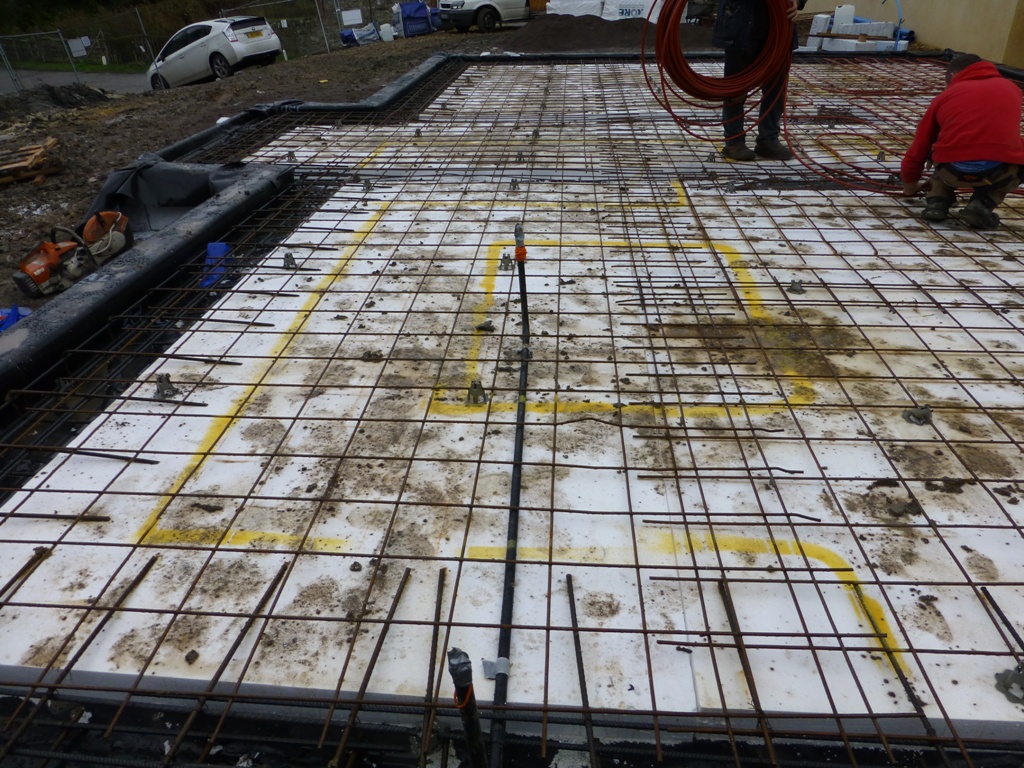
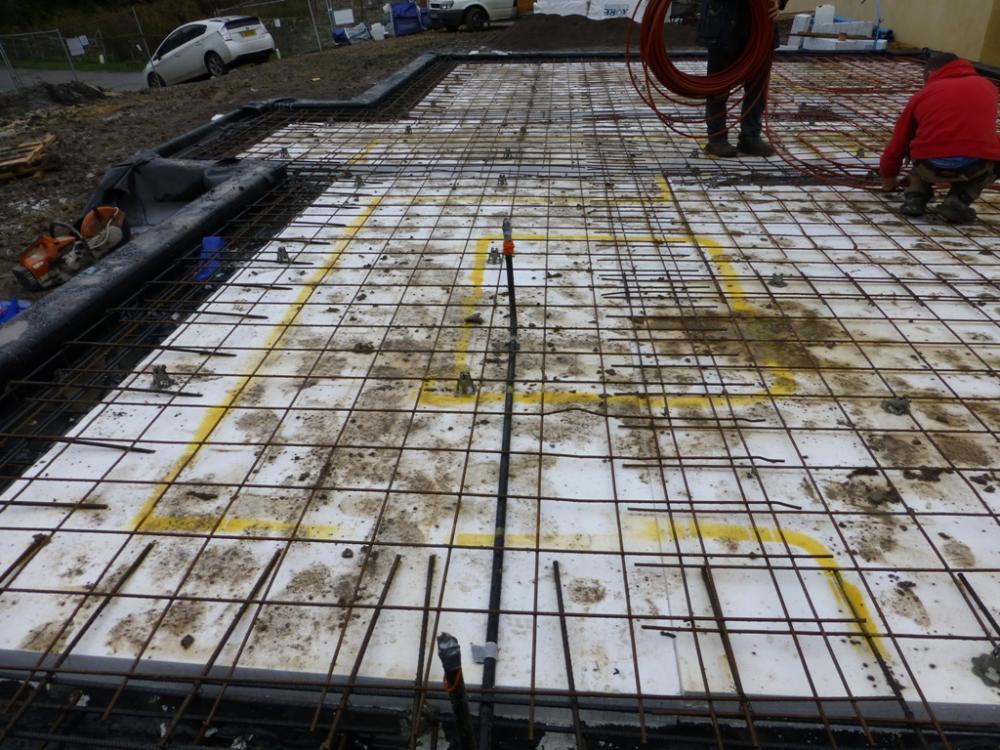
I just ran 25mm electrical conduit through the slab like this, with gentle bends on either end to make it easier to pull the cables through: Before the pour, the conduit was cable tied to the steel mesh to hold it in position.
-
You can work it out from the angle of repose ( https://en.wikipedia.org/wiki/Angle_of_repose ). For fine, dry, sand this is around 34°, for wet sand it's about 45°. I'd aim at about 30°, determine the volume (density of dry sand is about 1.6 tonnes/m³), work out the size of the cone from the angle of repose and the volume, then use that to determine the diameter of the base.
-
Decent thickness of EWI on that and the decrement delay is going to be measured in weeks, rather than hours...
-
If the pdf is protected, then a lot of the time it's easy enough to break that protection and allow the pdf to be edited. Not sure of the legal position, but in the past I've used one or two password crack tools on pdfs with a fair degree of success (I get the feeling that some forms of pdf protection just aren't very secure). Once unlocked, then something like Nitro Pro allows easy editing of any pdf file, although it's not free.
-
TBH, any competent surveyor should be OK, but might be worth hunting around for any that are known to have worked as expert witnesses, ideally in your area. RICS have an expert accreditation scheme, so may be worth asking them: https://www.rics.org/uk/surveying-profession/career-progression/accreditations/expert-witness-accreditation-service/ . Worth getting someone who has acted as an expert witness in court before, as if push comes to choice and it goes to court then it's a bit of a faff for the expert giving evidence to have to demonstrate their competence to the court. This has to be done for every case, but it's a lot easier if the expert can just state to the court that their opinion has been accepted on several previous occasions. Even better if that opinion has been accepted in one of the better-known courts - for example, the opinion of an expert that can say their evidence has been accepted at the Royal Courts of Justice is likely to be given more weight than someone that's only previously given evidence in relation to a small claim in a county court.
-
Temporary heat source for UFH: Willis heaters
Jeremy Harris commented on oranjeboom's blog entry in Kentish RenoExtension
I agree, but I didn't draft the WRAS rules, I'm only repeating them here! FWIW, I leave the fill loop pipe connected as well, as much to keep it tidy and the ends clean as anything else. -
Temporary heat source for UFH: Willis heaters
Jeremy Harris commented on oranjeboom's blog entry in Kentish RenoExtension
The 20 A DP isolator needs to be uprated, or two need to be fitted, as each Willis heater will draw around 13 A, so with both on the current will exceed the 20 A rating. -
Temporary heat source for UFH: Willis heaters
Jeremy Harris commented on oranjeboom's blog entry in Kentish RenoExtension
I think it's what many do, but to comply with the regs there needs to be an air break between the mains and the inhibited water in the system, I believe. This is the reason that the filling loop pipe has O ring seals and hand operated retaining nuts, so it can be removed when not in use (without tools) and so provide the required air break. -
Temporary heat source for UFH: Willis heaters
Jeremy Harris commented on oranjeboom's blog entry in Kentish RenoExtension
The filling loop should be a flexible pipe, with hand disconnects and shut off valves at both ends, and a non-return valve on the mains feed side as well. When not being used to fill the system the valves should be shut off and the pipe disconnected. In practice the pipes are often left connected, with just the valves shut off for isolation. You can buy a filling loop kit which has all the bits needed, like this one: https://www.screwfix.com/p/r24-filling-loop/83905#_=p -
Yes, building regs were revised a few years ago, so there's now no limit on the steepness of the fall, and no requirement to faff around using back drop chambers if the fall happens to be a bit steep.
-
Bends slow flow down a lot, especially on runs with a fairly shallow fall, and when the flow is slow, especially where toilet paper hasn't yet had time to break up properly, there's a fair chance of getting a soft blockage. The recurring problem we had with our first house was because the foul drain had been re-routed when it was connected to mains drainage. This meant that the toilet pipe discharged directly to a chamber about 1 1/2m away, just the other side of the (ground floor) bathroom wall, with a right angle bend in that chamber to a fairly shallow run across the back of the house to another chamber. It was that run across the back that always blocked, never the run down the side of the house out to the main sewer, even though the latter was also at a shallow angle. I think that part of the reason that sodium hydroxide works well to clear blockages like this is just that it dissolves everything, so making it all liquid. I'm convinced that it's mainly toilet paper that causes the problem, by sticking to the sides of the pipe when the flow speed is low.
-
Minimum Reasonable wall width for good U values?
Jeremy Harris replied to puntloos's topic in Heat Insulation
Why bother with the steel frame, though? SIPs are structural, at least up to two or three storeys, so there's no need for any steel. -
Little things put a massive smile on my face sometimes
Jeremy Harris replied to ToughButterCup's topic in Lighting
Main advantage for me is that CEF is about 2 miles closer to me than Screwfix, plus they rarely have a queue at the counter, plus pretty much everything they stock is pretty good quality. My experience with Screwfix recently has been that they tend to be a bit expensive now, plus the quality of some of their stuff can be a bit suspect. -
Minimum Reasonable wall width for good U values?
Jeremy Harris replied to puntloos's topic in Heat Insulation
If going for ICF, then it doesn't really make sense to also use timber frame as a structural element, as the ICF will do both. -
Minimum Reasonable wall width for good U values?
Jeremy Harris replied to puntloos's topic in Heat Insulation
Yes, probably the fastest way to cool/heat a house is to use some form of cooled/heated air system. With a low decrement delay the system needs to be able to respond fairly quickly, in order to keep the temperature reasonably stable. Clearly, using a fair bit of power to rapidly control temperature isn't really in keeping with the PassivHaus concept, but if the cooling power is being self-generated by a PV system than I can't see that it's really an issue. If going for layers, then something like ICF makes sense. That has a very short decrement delay insulation layer (often EPS) coupled with a moderately high heat capacity structural core. The combination of the two produces a structure with a decent U value as well as a reasonably long decrement delay. -
Minimum Reasonable wall width for good U values?
Jeremy Harris replied to puntloos's topic in Heat Insulation
There are two considerations, really, as U value is only part of it, decrement delay is at least, if not more, important than U value, as that's largely what determines how comfortable the house will be, in terms of not suffering from rapid temperature fluctuations. Decrement delay is described here pretty well: http://www.greenspec.co.uk/building-design/decrement-delay/ and, although related to insulation performance, it's equally closely related to the heat capacity of the fabric. One problem with making very thin walls, apart from decreasing the U value to a sensible level, is in increasing the decrement delay to a sensible level, too. In general, lightweight foam materials tend to have a pretty short decrement delay, as they have a very low heat capacity, whereas some other insulation materials, like some fibre materials, wood fibre or blown cellulose tend to have a reasonably long decrement delay. It's quite possible to combine material layers so as to achieve both a low U value and high decrement delay, as another option. Alternatively, you can accept having a short decrement delay and just fit a heating and cooling system with a very rapid response time, so it can cool the house as fast as it heats up, and vice versa. Location and orientation also play a big part in this decision. If the fabric of the house isn't exposed to bright sunshine for long periods during the day, then decrement delay becomes less of a concern. It's primarily an over-heating issue, as in bright sunshine it's pretty easy for an external surface to get to well over 40°C (I've seen outside surface temperatures of around 50°C at times here). That creates a pretty high temperature differential across any wall or roof, and will tend to drive heat more rapidly through the fabric of the house unless the heat capacity of that fabric can absorb some of that heat and so slow down the rate of heat transfer. If it can slow it down enough for the heat not to reach the inside face, before the sun has moved away, then generally that's good enough, as as soon as the outer temperature drops heat will start to flow back out. -
Little things put a massive smile on my face sometimes
Jeremy Harris replied to ToughButterCup's topic in Lighting
I've always bought 221s from CEF, fair bit cheaper than Screwfix and usually in stock. Not as user friendly as 222s IMHO, it's easy to break fingernails opening the 221s. Nice and compact, though, not really much bigger than the push fit Wagos. -
I think the re-heat time of these is reasonable, as the 80l internal tank has a fairly large surface area, and it's the surface area that tends to dominate the heating time, for a given temperature differential. One advantage the tank-in-tank systems have is a higher potential flow rate. The main disadvantage is that they tend to be physically larger than an equivalent size coil type thermal store.
-
Our frame went up in October 2013, and the roofing still wasn't on by Christmas. That winter was dreadful, with the worst flooding seen here in over 100 years. The frame got pretty wet, but all was fine when it dried out. The only thing I should have done was wait another month or so in the spring before getting the plasterboard fitted and skimmed, as the house was still drying out and we had some minor cracking in the plaster around the windows.
-
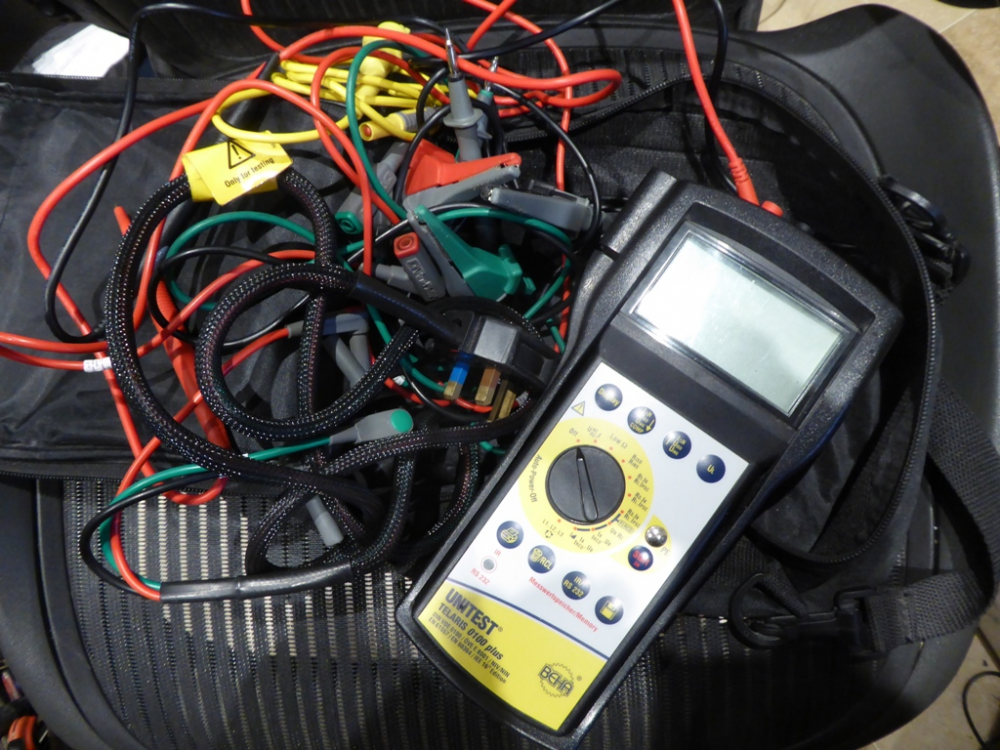
It seems that a fair few of the limited scope or reduced fee cartel membership options have now been removed. I suspect the reasoning has more to do with maximising income for the Part P cartels than anything associated with electrical safety. For example, NAPIT scrapped the "Just Eight" scheme, which was ideal for any competent person who wasn't doing a lot of Part P work a year. The membership fee was something like half that of full membership, but you were limited to only being able to notify 8 Part P jobs using the database access a year. Still had reduced price access to all the books etc. My old Telaris Unitest does pretty much everything, and stores all the results in order so they can be read out as a serial text for putting on the certificate, but it is an awkward thing to use. It also only does a 500V insulation resistance test, and there have been a couple of times when having the option to test at 1000 V would have been handy. It does do non-trip loop testing, though, so must have been quite a reasonable bit of kit back when it first came out.
-
Planning permission precedents.
Jeremy Harris replied to Christian Hillier's topic in Planning Permission
Welcome. The simple answer is that precedent counts for nothing at all, and is not a valid planning consideration. Planners will often refuse to accept any argument based on precedent, and will judge each application solely on its own merit. Having said that, fitting in with the local street scene, and making a development in keeping with its surroundings, are valid planning considerations, so it may be that some older developments in the area have changed the local street scene such that any new development might be viewed in a slightly different context. There's no law that requires that planners be consistent, really, and very often they aren't, as circumstances change from year to year. The local plans are very often out of date, I think. That doesn't mean a lot, as it could be argued that national planning policies should be applied, and they may or may not prove helpful. I'm afraid inconsistency between planning decisions made in the same area, but at different times, is entirely normal, and something that has to be lived with!