Jeremy Harris
-
Posts
26430 -
Joined
-
Last visited
-
Days Won
360
Everything posted by Jeremy Harris
-

MCS installer stoops to new low.
Jeremy Harris replied to ProDave's topic in Air Source Heat Pumps (ASHP)
A random web search quickly found that ASHP being sold retail for £3,156.30, inc. VAT: https://www.swatengineering.co.uk/shop/mitsubishi-electric-ecodan-air-source-heating/mitsubishi-electric-air-source-pump-puhz-w85vaa The chances are it could be found at a better price by hunting around a bit. A complete packaged system, including that heat pump and a 200 litre cylinder costs a bit over £2,000 more, so the total for all the parts needed, excluding the central heating system parts, looks to be around £5,200 at the most (I would guess the price I've just quickly found may not be the best). Worst case labour might be around 2 days. I fitted our ASHP in about half a day, and I'm not a plumber/heating engineer, and I'd never fitted one before. Labour rates vary, but around here a decent heating engineer might be as much as £250/day. -
Solar DHW with UniQ and PV Diversion
Jeremy Harris replied to DamonHD's topic in Boilers & Hot Water Tanks
I can have a go at giving those figures. December was pretty grim from a PV perspective this year, worst I think we've had since the system was installed, so may not be typical. Likewise the last few days have been higher than average for the time of year, as we've had several cold, very clear and bright, days (near-perfect PV weather). -
Cool Energy ASHPs'...............any good?
Jeremy Harris replied to selvbygg's topic in Air Source Heat Pumps (ASHP)
Why don't they give any COP data in their specification sheets? It's pretty clear that they look to be very much like are imported Chinese-made units, albeit fitted with a Mitsubishi compressor unit. Looking at the spec linked to above, for the inverter controlled unit, then it's possible to have a guess at some COP figures: Rated Capacity @35°C Water/ 20°C Ambient 17.0kw Rated Capacity @35°C Water/ 7°C Ambient 13.6kw Rated Capacity @45°C Water/ 20°C Ambient 14.9kw Rated Capacity @45°C Water/ 7°C Ambient 13.0kw Rated Capacity @7°C Water/ 25°C Ambient 9.9kw We can either assume that the above performance is using the rated power input, or that it's using the max power input: Rated Power Input 3.9kw/18.5A Max Power Input 4.7kw/21.3A Converting the performance figures to COP using the rated power input gives (I've highlighted the most meaningful ones, heating and hot water in cool conditions - they don't give any cold weather performance data): COP for A20/W35 = 4.36 COP for A7/W35 = 3.49 COP for A20/W45 = 3.82 COP for A7/W45 = 3.33 COP for A25/W7 (cooling mode) = 2.54 Converting the performance figures to COP using the max power input gives (same highlights as above): COP for A20/W35 = 3.62 COP for A7/W35 = 2.89 COP for A20/W45 = 3.17 COP for A7/W45 = 2.77 COP for A25/W7 (cooling mode) = 2.11 For comparison, the performance data for a Mitsubishi Ecodan 14 kW inverter controlled ASHP is (and Mitsubishi make it clear that their data is based on the maximum input power): COP for A7/W35 = 3.87 COP for A3/W35 = 2.91 COP for A7/W55 = 3.12 So, why does a Mitsubishi ASHP, that uses the same compressor as the Cool Energy unit, perform so much better than the Cool Energy unit? The difference is marked, bearing in mind that the max input power should be used for the comparison. Taking the A7/W35 condition, then the Mitsubishi Ecodan uses about 2.584 kW to deliver 10 kW of heat, whilst the Cool Energy unit uses 3.46 kW to deliver the same 10 kW of heat, so for that condition would cost ~ 34% more to run. The same sort of difference seems to apply for other conditions, although as Cool Energy don't actually give performance figures for either relatively cold air (the 3°C condition) or hot water at 55°C, it's hard to make an exact comparison. The question really comes down to two things. How well supported will the Cool Energy unit be when compared to any of the big name brands? And, will the reduced purchase price make sense in the light of the significantly higher running cost? For a house that needs the sort of heating power output for a heat pump of this size, then I suspect that the increased running cost is likely to exceed the difference in purchase price before too long. -
Solar DHW with UniQ and PV Diversion
Jeremy Harris replied to DamonHD's topic in Boilers & Hot Water Tanks
I can add a data point that may be useful. It's now exactly a year since I fitted two energy meters to our hot water system, one measuring the energy supplied to the Sunamp from the PV system, one measuring the energy supplied to the Sunamp from off-peak (E7) electricity, for a night time boost if needed. The total DHW energy used was 2,264 kWh. That's for two of us, but we don't really make much effort to reduce our hot water energy usage, other than trying to do some things when the sun is shining and the PV system is generating. Our daily usage works out as an average of about 3.1 kWh per person, which is close to the usual assumption that usage is around 3 kWh/person/day. The PV system provided 1,339 kWh of that, and off-peak electricity provided the additional 925 kWh. We currently pay 8.148p/kWh for off-peak electricity, so our total cost for all our hot water for the year was £75.37 Our off-peak boost is set to turn on at 01:00, which is around the time that the grid demand is at its lowest. Worst case boost would be about three hours, but in reality I doubt we ever boosted for longer than two hours, and the annual average boost time is about 51 minutes, so the boost will pretty much always be within the grid lowest demand period (which also tends to be the lowest emissions period). -
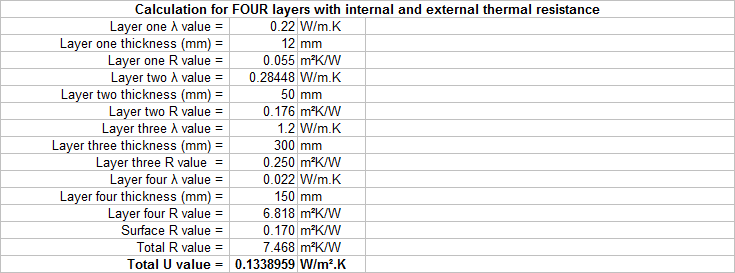
Use isocyanurate, as that's what PIR is. There's no option for entering a service void, but a quick run on that with three layers, plasterboard, 300mm concrete and 150mm of isocyanurate gives a total U value of 0.13 W/m².K, so same ballpark. The thermal resistance of concrete varies a fair bit with density (from about 0.6 W/m.K to about 1.8 W/m.K), and the value I chose (1.2 W/m.K) is around the middle of the range. Using another value from the typical range of concrete thermal resistance would change things slightly.
-
Just done a quick and dirty run for the following build up: 12mm plasterboard 50mm service void 300mm concrete block 150mm PIR EWI These are the results:
-
For just the concrete blocks on their own, as a single layer, with no insulation inside or out, then use the single layer option, enter the wall thickness (0.3m and the thermal conductivity (λ) for concrete (1.2 W/m.K), and this gives the basic U value for that layer, with normal internal/external surface thermal resistance values, of 2.38 W/m².K For a two layer wall, use the next option down, for two layers. If, say, the wall was 300mm of concrete, clad with 200mm of EPS as EWI, then the total U value would be 0.172 W/m².K If PIR was used as EWI, then the same wall structure, but with 200mm of PIR as EWI, would give a total U value of 0.105 W/m².K You could drop the EWI thickness down to 150mm with PIR as the EWI and still get a U value of 0.138 W/m².K, which is probably fine, especially as the U value will be improved slightly by having in internal service void, layer of plasterboard etc.
-
My Netgear router has a USB port for a shared access drive. Works OK, but will not run a USB HDD - it crashes the router after a few minutes, perhaps because the USB HDD needs too much current, and the router just can't handle it. With a normal USB stick plugged in, and the shared drive set up in the router settings, it seems to work OK, but also seems pretty slow for some reason.
-
Can you trust your smart building.
Jeremy Harris replied to MikeSharp01's topic in Networks, AV, Security & Automation
There's nothing I can see about rights to the data at all. The Tesla API is undocumented, and we only know about it, and the functionality it has, from a few people who have reverse engineered it. The official Tesla apps use it, and Tesla don't seem to be bothered by third parties using it. I had a play around to see how easy it is to use, and it seems pretty easy to control a fair few of the car's functions via a simple widget a bit like an Amazon Dash button. All it needs is a token, obtained by submitting a request with the appropriate owner authentication data for the car with the specified VIN, plus a code to renew the token when it expires after 45 days. That way the widget never needs to know the authentication details, as it can just renew the initial access token using the renewal code. It seems pretty easy to use something like a ESP8266 to do simple stuff, like act as a single button remote to turn on the heating/cooling in the car from anywhere in the world (as long as there's internet connectivity both ends). Just as easy to unlock the doors, open or close the windows, boot etc. Not sure it's really that secure, TBH. There's no easy way to remove the SIM card, as it's built in to the car somewhere, so things would need to be taken apart to get at it. Also, some of the car functionality would be lost without connectivity, as it relies on the LTE connection to do quite a bit of stuff, from basic housekeeping and software updates to things like voice controlled functions. -
I've just done this exact thing. The parts I used were these: 1 off Odroid HC1 ( https://www.odroid.co.uk/index.php?route=product/product&product_id=817 ) 1 off suitable 5V power supply (one can be bought from the link above) 1 off 8GB µSd card 1 off suitable 2.5" HDD, with a SATA interface (or you could choose the Odroid HC2 that takes a 3.5" SATA HDD https://www.odroid.co.uk/ODROID-HC2 ). An Ethernet connection to your home network I loaded this OpenMediaVault ( https://sourceforge.net/projects/openmediavault/files/OMV 4.x for Single Board Computers/ ) to the µSd card. OMV is pretty easy to use, and has a web interface that's used to set it up. Not the most intuitive web interface, as you need to, rather tediously, confirm everything twice, but there are tutorials around on the web and YouTube showing how to set this up. I'm using a 2Gb SSD, as I wanted the NAS to run silently, so that may well reduce the power consumption a bit, but I'm finding that my set up runs fine on a 5V 2A maximum supply (smaller than recommended) and when I measured the supply current it was usually around 700mA to 800mA, so well under 5 W. It seems pretty fast, and is dead easy to use. The open folders I have set up can be accessed by anyone, and I have other folders that are only shared with some users. For example, my car and I are the only users that can transfer data to two folders, one containing my car music collection, the other the video recorded by the car dash cam and sentry cam. My system, has been running for around a month now, and seems to perform faultlessly. It makes no noise at all, and hasn't noticeably altered the house energy consumption, plus it's saved a lot of faffing around transferring files, photos etc around using USB sticks etc. Very handy, as I can now power down my main PC all the time that I'm not using it, yet still have access to what used to reside in shared folders on it. You can try OpenMediaVault by installing it on your Zorin box and allocating it a drive to use (could be a USB drive). Should give you a feel for how it works.
-
Can you trust your smart building.
Jeremy Harris replied to MikeSharp01's topic in Networks, AV, Security & Automation
We had people at work who's job was finding clever ways to correlate data in order to increase its value, in that case primarily reconnaissance. Having seen several powerful demonstrations as to how data correlation can provide an in-depth insight into what's going on, then I think you're wise to highlight this with regard to building sensors. I've been playing around with the data that my car sends back to the Tesla Mothership all the time it's on. Easy to see that it could be incriminating. Only yesterday it logged me doing XX.XXmph on a section of the A46... -
Why not mount a window without a frame?
Jeremy Harris replied to Dreadnaught's topic in Windows & Glazing
Easy to do. I've seen a locally built timber conservatory built this way. The floor to ceiling glazing units were just bedded on soft sealant in a rebate in the timber frame, then capping bits of timber were fitted outside that hid the sealant and overlapped very slightly on to the glass. A suitable gap needs to be left around the edge for movement (hence the need to use a soft sealant) , but other than than I can't see any problems, other than coming up with a way to make the inside and outside look neat. -
From the phase relationship between voltage and current, the same way as most excess PV diverters work. They are always connected to the mains supply, so can measure the voltage easily enough, and the output of the current transformer will show the relative direction of the current flow.
-
The shower screen I fitted here is made from coated, self-cleaning glass, that doesn't need much, if any, cleaning at all. So far it's working perfectly, all it seems to need is a spray over with water to rinse off any soap/shampoo splashed. I've not yet had to use any cleaning stuff on it, or even go over it with a squeegee. I don't think that the coated glass screen was much more expensive than ordinary glass, either. It certainly wasn't mega expensive, as if it had been I'd probably not have bought it.
-
I've used Rain-X on house windows. Works well, and seems to last longer than when used on a car windscreens, maybe a couple of years or so. Only thing to watch is that the windows will still spot if just rinsed off with tap water (hard or soft), as the beads of water left behind by Rain-X will dry and leave behind rings of solids. Rinsing with deionised water gets around this, and doesn't need much water. A spray bottle filled with deionised water will rinse off several windows. Not hard to make your own deionised water, either, plus you can rejuvenate DI resin to save having to keep buying the stuff. Rejuvenating it just needs sodium hydroxide and hydrochloric acid (often sold as brick cleaner). I have a small deionised water filter that I made up for car washing ages ago, but am about to knock up a slightly bigger one, that will fit on a hose pipe. Should make rinsing off windows (and the car) easier.
-
Recommendations Underfloor Heating Engineers London
Jeremy Harris replied to tsmith's topic in Underfloor Heating
This thread is pretty close to being a duplicate of this thread, might be an idea to merge them: I've replied on the original thread with some info regarding floor temperatures, heat output and how to use a cheap IR thermometer to check the floor temperature. -
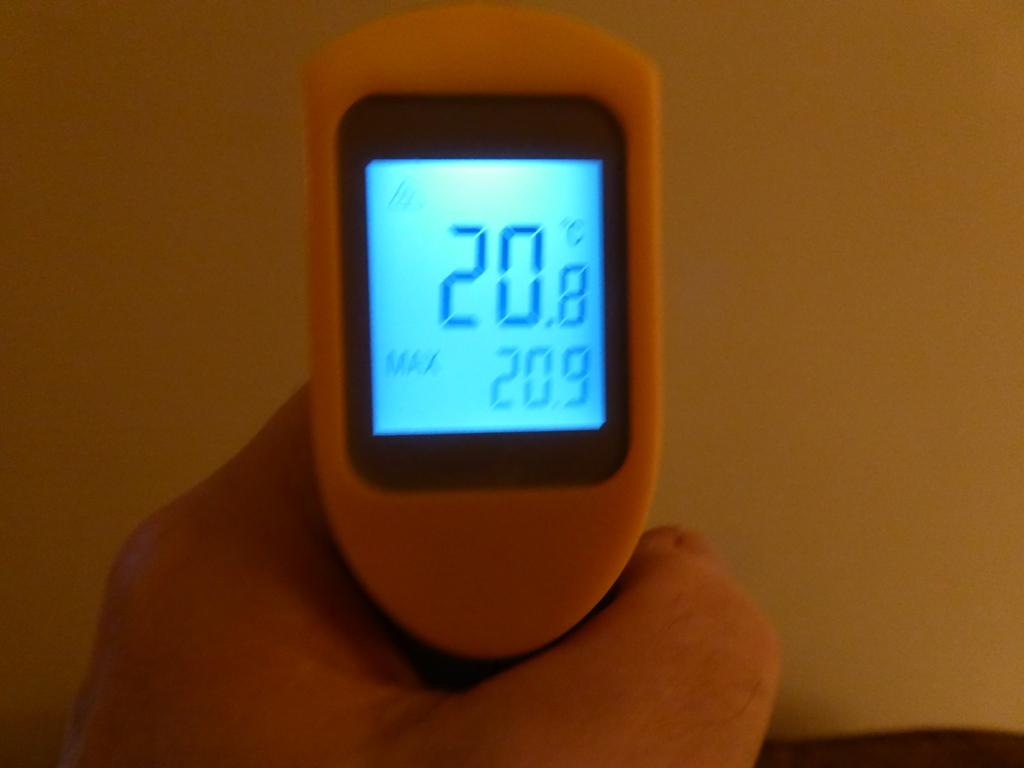
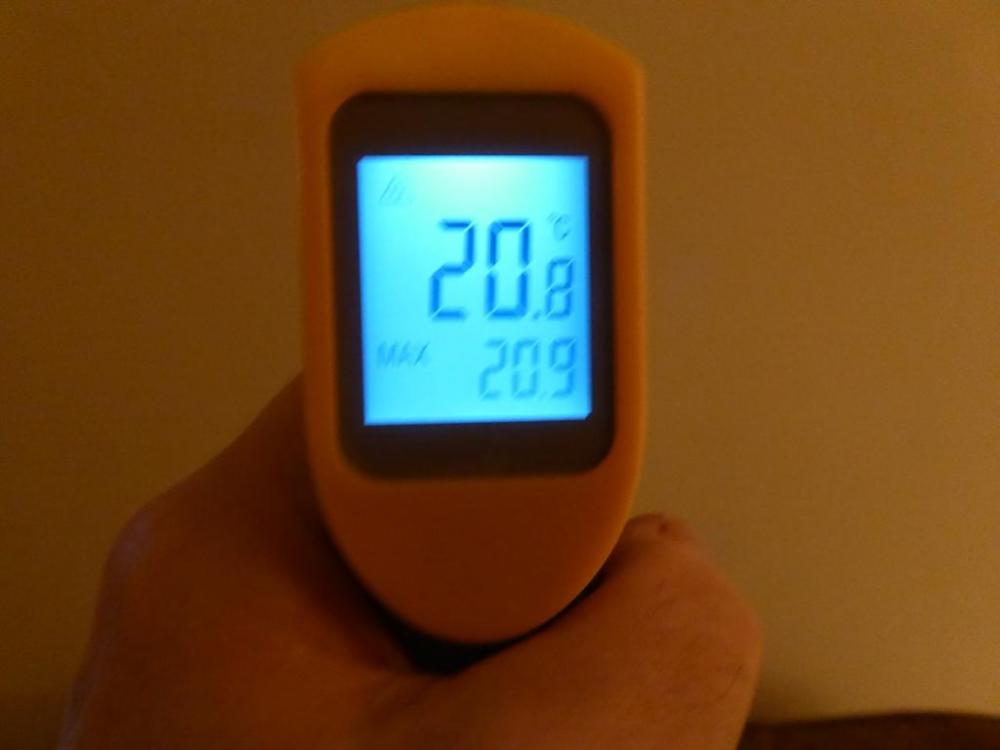
As above, the floor shouldn't really ever feel warm to the touch, as it should always be a lot cooler than body body temperature. How warm the floor needs to be depends on the heating requirement, and is normally expressed in terms of heat output per unit area for a given room temperature. A cheap IT thermometer will do the job of measuring the floor temperature OK, just needs to be pointed at the floor in various locations and the temperature noted. Loads of them on sale on ebay and the like. I bought this one (seen measuring the wall temperature) several years ago for around £10 and it's still going strong: You can estimate the heat output per square metre of floor by knowing the room temperature and the floor surface temperature. The figures below assume a room temperature of 21°C and give the floor surface temperature versus the heat output in W/m², and may help give an idea as to what to expect. It's rare for UFH to need to run at more than around 50 W to 60 W/m². Ours (albeit in a very well insulated house) rarely runs at more than about 20 W/m². Heat output = 20W/m² Floor temperature = 23.1°C Heat output = 30W/m² Floor temperature = 24.0°C Heat output = 40W/m² Floor temperature = 24.9°C Heat output = 50W/m² Floor temperature = 25.8°C Heat output = 60W/m² Floor temperature = 26.7°C Heat output = 70W/m² Floor temperature = 27.5°C
-
Some have a current transformer that clips on to the meter tails. Certainly the unit I've been looking at has this. It uses this, together with another current transformer clipped around the PV inverter output, to determine when to charge from excess PV generation, and to prevent the battery system exporting to the grid.
-
Most probably the case, as a lot of pallets end up getting contaminated with all sorts of stuff, that's been spilt on them, as well as some being painted. The pollution caused from burning rubbish wood like this is recognised as being even worse than that caused by burning properly seasoned timber, and burning properly seasoned timber is significantly more harmful than the emissions from the very dirtiest vehicle engine.
-
Trying to install linux on a VERY old laptop
Jeremy Harris replied to ProDave's topic in Boffin's Corner
I've been a long term user of Mint, but switched my Linux box over to Zorin Core a couple of weeks ago. I'm impressed with Zorin. Easy to install, seems to work reliably, pretty user friendly and it seems less resource hungry than Mint. I'm running it on a fanless mini PC, that has a 512GB M.2 SSD, 8 GB of RAM and a Core-i7 7500U processor. The same machine previously had Windows 7 Ultimate installed, and one noticeable change is that it idles at a much lower power level running Zorin. When running Windows it used to idle at around 6 W and peak at around 15 W. Running Zorin it seems to idle at around 3 to 4 W, but will still peak at around 15 W when working hard. The case of the machine feels noticeably cooler now, and as these Mini PCs run from a 12 V DC supply I'm seriously thinking about building a dedicated 12 V battery supply for them, charged from excess PV generation. I don't use my old big PC at all now, just two similar fanless Mini PCs, the Linux box, plus a Core-i7 8550U box, that has a 1TB SSD plus 16GB of RAM. The Core-i7 8550U is supposed to be a fair bit faster than the Core-i7 7500U, yet there's no noticeable difference between the two. I suspect that Windows 7 Ultimate on the Core-i7 8550U just uses a lot more processing power to do the same stuff as Zorin does on the slower Core-i7 7500U. -
Washing machine on a raised platform?
Jeremy Harris replied to epsilonGreedy's topic in Kitchen & Household Appliances
It was one of those things that seemed like a really good idea at the time, as none of us could foresee the potential problem. The daft thing is that we all know that washing machines especially older ones - this was around 20 years ago) vibrate a lot when on the rinse/spin cycle. Being on a quarry tiled floor probably didn't help, as it may well have made it easier for the machine to vibrate forwards enough to fall off the plinth, face first. -
Washing machine on a raised platform?
Jeremy Harris replied to epsilonGreedy's topic in Kitchen & Household Appliances
A word of caution. We built a raised platform at the end of my mother's kitchen to take the washing machine, tumble drier and dishwasher, specifically to provide easier access, with less bending over when loading and unloading the machines. It worked very well, and was solid enough as we made the raised platform using blockwork laid on a concrete floor, and then quarry tiled over the whole floor and the raised platform. Unfortunately, around a couple of years after we did this, the washing machine developed a fault, in that one of the spring dampers that support the drum broke. My mother was around at the next door neighbours at the time, and when she returned home later that evening she found that the whole ground floor of the house was flooded to a depth of a few inches, with the carpets floating off the floor. She had to move out of the house for around 3 months, whilst everything was dried out, the electrics replaced, the walls replastered, furniture and carpets replaced, etc. The cause of the problem was the raised platform. When the drum support failed, the machine started vibrating, moved itself forward and fell face down on the floor. The glass door broke, but the machine carried on working, trying to fill with water to complete the rinse cycle. Being face down, with a broken door, the level sensor failed to shut the water off, as it was trying to fill the whole ground floor of the house to the set fill level. So, by all means look at doing this, but think about fitting constraints to prevent the machine falling off the plinth, plus, perhaps, some additional means of shutting the machine off if the worst does happen. -
The simple way is to use the λ value for the material plus the thickness, making allowance for the surface factors. You can use this simple U value calculator, but it doesn't account for thermal bridging, geometric thermal bridging, or edge losses: Simple U value calculator.xls
-
IVT Ecolane ASHP - any owners out there?
Jeremy Harris replied to readiescards's topic in Air Source Heat Pumps (ASHP)
Just looked at the linked Red Limited ASHP. Doesn't look to be inverter controlled to me, and the design looks very like a few others I've seen that come from the Far East. I would be inclined to do a bit more research before making any committent. -
Just a word of caution. It seems that the "glass" panel is only 4mm thick, so that means it won't be glass, but some type of plastic, as there's no way a 4mm thick glass panel would be OK in that configuration. It's a cleverly worded advert, as it seems to avoid using the word "glass", yet sort of implies it is.