Jeremy Harris
-
Posts
26430 -
Joined
-
Last visited
-
Days Won
360
Everything posted by Jeremy Harris
-
Just fixing some expanded mesh to the outside with big head Hilti nails would be a pretty quick and easy way to provide a secure attachment for EWI adhesive. Hilti nails will drive into pretty much anything, just a matter of selecting the right ones for the type of concrete. It would be easy enough to just use Hiltis to fix internal battens for an internal service void, too.
-
I've just fired up a laptop and it seems to download and open OK. If you're having problems downloading it, and would like to see it, I can probably find another way to get it to you.
-
Worth giving Hilliard Tanner a call, too. He's been designing passive slabs for a decade or so now, and probably knows more about them than a lot of SEs. He wrote this report for Kore, which is probably worth a read: Kore Insulated Foundations Report.pdf
-
That uses the Secoh pump I switched our older BioPure unit to. It's also a bit quieter than the original Secoh pump that was supplied with it: https://webuildit-ltd.co.uk/product/secoh-jdk-s-eco-air-pump-60/ If anyone has one of the older BioPure units, they can swap the pump over for one of the newer Secoh JDK-S Eco pumps and gain a worthwhile reduction in electricity usage. The swap is easy, as they are the same size and have the same pipe fittings.
-
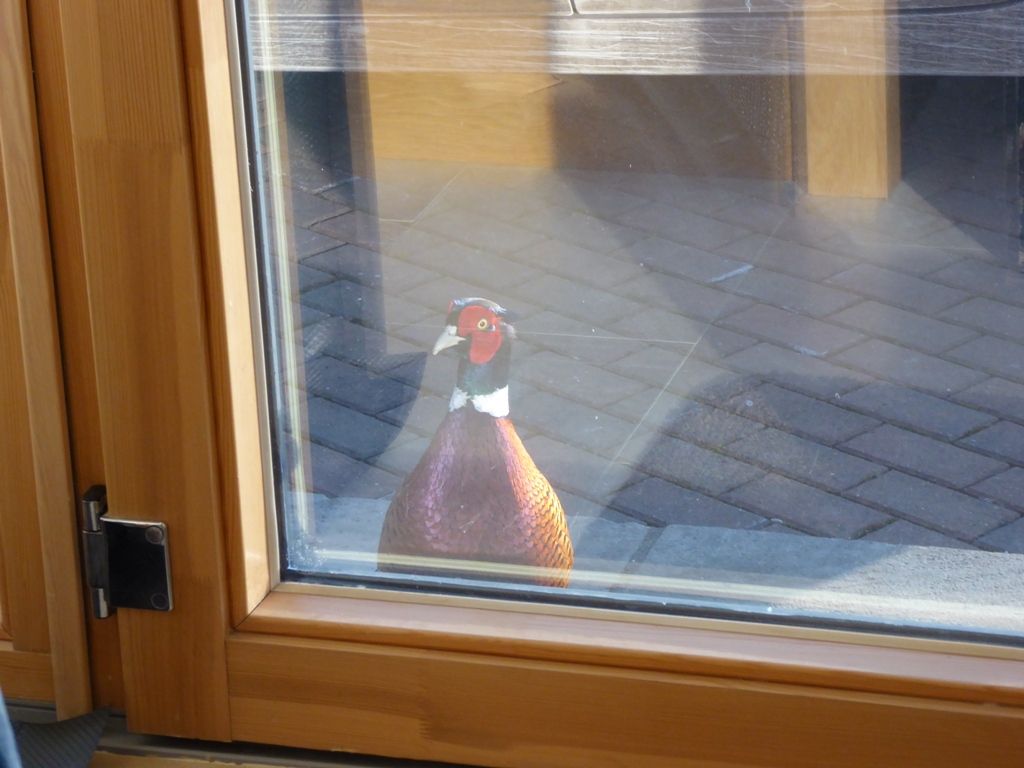
I'm currently thinking along the lines of having a remotely controlled GPMG mounted so that it fires across the doorstep at pheasant height... The main problem seems to be that anything inside the glass can't been easily seen from outside, because the external film works a bit like a mirror. I can put my face right next to the inside of the door and the pheasant takes no notice at all, but just carries on banging his head against the glass. I'd have to fit something to the outside of the glass, on top of the film, for it to be seen. It's a seasonal issue, or seems to be, as for most of the year pheasants will just sit (and crap) on our front doorstep, presumably as it's a relatively sheltered spot. For a few months we have to endure the damned things attacking their own reflections, though. If it was anywhere but the front door I'd be able to put something outside to stop them getting so close.
-
Yes, there are a few around that use some form of pulsed pump operation, although whether they are better than some of the newer, lower power pumps, I don't know. One of the issues that the pulsed pump systems have to deal with is sludge settling time - if the sludge settles around the aeration outlet holes during the pump off time, then there is a risk that the pump won't develop enough pressure to blow it away and restart the sludge circulation pattern. Pumps have failed because of sludge build up like this. At least one of the pulsed systems uses solenoid valves to direct air selectively around the unit, and this may be to enable the sludge circulation bit to keep working OK, as well as the aeration bit. I was planning on trying pulsed power to our unit, but in the end just swapped the pump for the much lower power version of the same output Secoh pump. IIRC, the original pump was around 50 W, the newer version is a bit under 30 W for the same pressure and flow rate, so more of a power saving than pulsing the pump would have achieved, with none of the risks associated with possible sludge settlement.
-
Yes, that's right, our whole house averages around 300 W to 350 W, but would need to be lower than this to be off grid, I think. The fixed loads that are on 24/7, and that I can't do much about are the ~30W for the treatment plant pump, and ~50 W for the MVHR. Getting the other background loads down was really just a bit of detective work going around finding things that used more power than they should and finding a solution that reduced the load. For example, I had a plethora of power adapters running things like the VDSL modem, router, a couple of Ethernet switches etc, and these were all replaced with a single battery-backed supply that feeds power via PoE to all the connected devices. The vampire load from a single supply is significantly lower than that from four or five separate supplies. Installing all LED lighting helped a fair bit (mainly in winter), but one of the other big savings was getting rid of the large PC and replacing it with a small fanless unit. The performance of the small fanless box is slightly better, and it saves a lot of energy. The old PC would idle at around 60 W and peak at around 150 W, the small fanless box idles at about 6 W and peaks at 15 W.
-
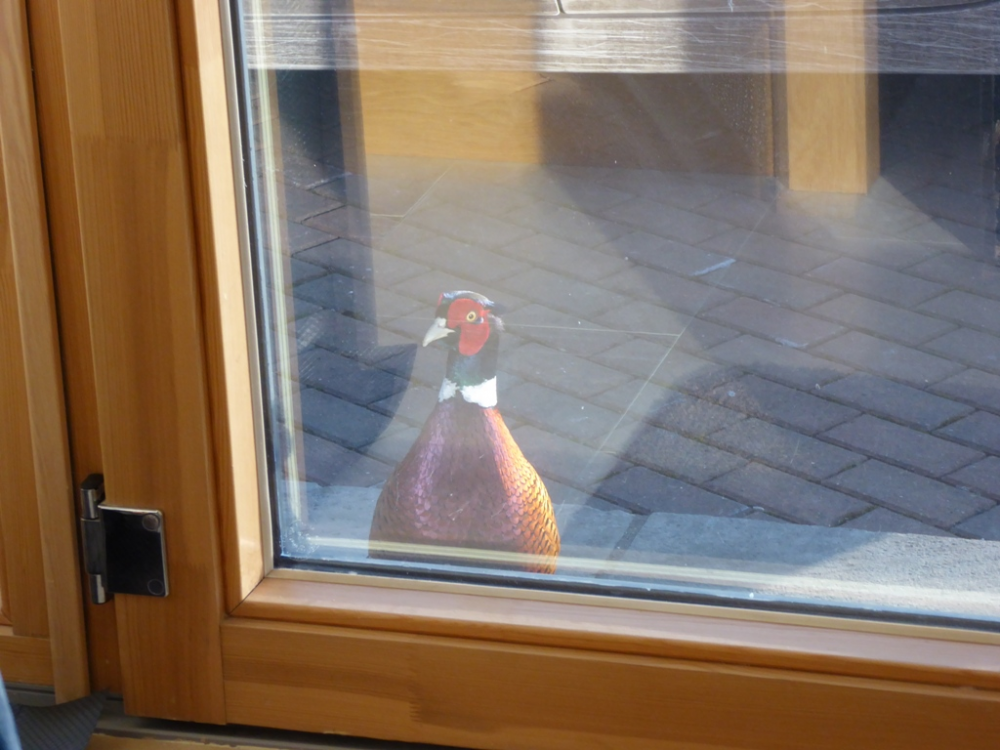
That's similar to the sort of thing we're after, but without the centre support, as we have no where to fix one to. My thoughts are that, as well as provide a bit of added shelter from the rain whilst unlocking the door, it may well also provide a degree of protection from over-heating, especially if we go for a slightly tinted glass panel. At the moment we have solar reflective film on the front glazing, which works well, but is now beginning to suffer from being constantly attacked by this chap (he, or his mates, have been banging away at it every hour or so for days now, same happened last year, and the year before):
-

MVHR in large volume New Build
Jeremy Harris replied to Triassic's topic in Mechanical Ventilation with Heat Recovery (MVHR)
Yes, I did add a fresh air feed (not extract) in the hall, right above the kitchen door. It was a last minute addition, and not originally planned, but it is very effective. It provides a sort of "air curtain" of fresh air right outside the kitchen, and because the kitchen is a relatively high extract rate room, this means that air is always flowing into it and out the extract. We do still get some cooking smells in the kitchen, but these never get out of the kitchen door, and tend to dissipate within an hour or so, less if I switch the MVHR to boost. -
Probably for a few reasons. The building industry in general is pretty conservative, and would rather stick to doing things the way they've always been done - probably one reason why we stick with labour intensive stuff like laying thousands of brisk and blocks to build houses. Another reason may well be the cost of transporting and erecting large blocks like this, that are too big and heavy to be lifted by hand.
-
How would you deal with the big thermal bridge at the base of the blocks. though? You could probably design a passive slab, with a reinforced ring beam around the edge, that would take the loading from the blocks. That would then give you insulation under the floor slab, under the blocks and up around the edge ready to be continued with EWI up the walls, so no thermal bridging at all. If you fitted UFH inside the concrete slab then you would effectively be warming/cooling the slab and the walls, like a giant storage heater/cooler.
-
Soft close toilet seat hinges
Jeremy Harris replied to Temp's topic in Bathrooms, Ensuites & Wetrooms
Bit different from when my school decided to introduce sex education (run by the deputy headmistress, who was also the RE teacher). The reason for introducing it was because the pregnancy rate, particularly in the fourth year, was relatively high. They didn't dare introduce sex education to children as young as the fourth years, though, so they decided it would only be for the sixth year pupils. I was one at the time, and, at a guess, every single sixth form pupil's parents turned up for the meeting, that was, by all accounts pretty heated. The decision was that there would be a trial introduction of sex education to the lower sixth, and it was hilarious. The deputy headmistress was a 50-something spinster, and I'll always remember her acute embarrassment, and the fact that she ended the "lesson" by saying "this seems like a lot of fuss over 30 seconds of unpleasantness", which was followed by a few of my class making comments like "sounds like you're doing it wrong, miss". At which point she lost control, and left the class, with a bright crimson face. We didn't have any more proper sex education classes, it was decided to teach the subject in biology instead. -
Little things put a massive smile on my face sometimes
Jeremy Harris replied to ToughButterCup's topic in Lighting
I've mislaid loads of stuff after our house move, and the one thing I keep finding when looking for something else is yet another box of wagos. I have no idea how I have come to have so many part used boxes of the things around, but the bugger is that they are all ones that I never use very much (like 224s and 773s). -
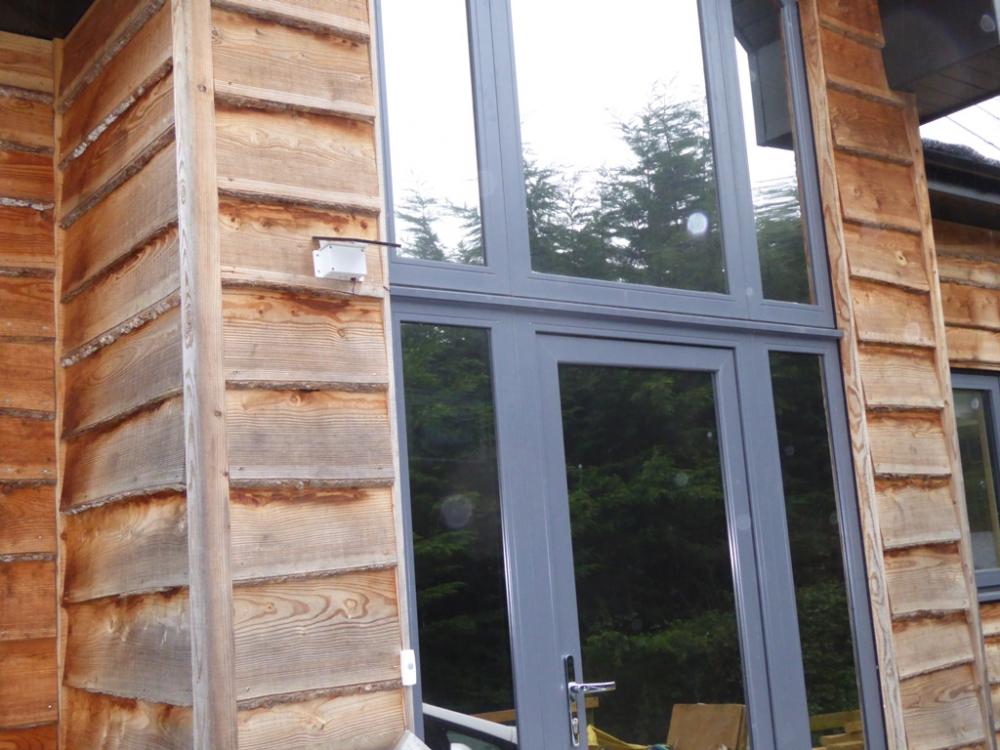
That looks very neat indeed. Has me wondering whether or not I could completely hide the vertical part of the brackets. If they were fabricated from 25mm deep stainless box (not sure if that would be stiff enough?) then I could strip part of the cladding off, remove the 50mm x 25mm vertical battens that run either side of the glazing, bolt the frames directly to the underlying timber posts and then fit new 50 x 25 battens alongside and refit the cladding over the top of the brackets. I have a few lengths of spare cladding, so if I messed some up it wouldn't be the end of the world.
-
Soft close toilet seat hinges
Jeremy Harris replied to Temp's topic in Bathrooms, Ensuites & Wetrooms
That, is absolutely hilarious. I get the point being made, and it's a very good one, but they could have cut about 50% of the content out and got the message across more effectively. There's only so far you can push the rather tenuous analogy between tea and sex, and this video pushed it just that bit too far, IMHO. The great conundrum when I was a teenager wasn't really about consent, as such, as 99.99% of the time it always seemed to be the girls that were totally in charge. The real problem was trying to work out when no really meant yes, which a fair bit of the time it did. There was some sort of mysterious pantomime that had to be gone through, because the social norm was that no one should openly admit to wanting something (and not just sex) when initially asked. Confusing as hell, as I recall. Not sure I've ever really worked out what it was all about, even now. I suspect that things have at least now become more open, so having conversations about this stuff may be a bit easier for kids today than it was years ago. I remember meeting up with a girl I'd known at school, around 20 years or so after we'd both left and gone our own ways. I'd fancied her at school, but she seemed completely uninterested. It was only when we met up years later that she asked me why I'd never asked her out, as she'd apparently fancied me like mad back then, although there was absolutely no outward sign of this that I ever saw. -
Soft close toilet seat hinges
Jeremy Harris replied to Temp's topic in Bathrooms, Ensuites & Wetrooms
Had to chuckle, @AnonymousBosch, as much the same happened to me when I was a small boy, staying at my granny's old Victorian house. The downstairs toilet had a massive polished mahogany seat, that was probably as old as the house. Unfortunately it had split, right at the front edge, and nipped my tackle in the gap as I went to get up. No lasting damage was done, but I still clearly remember the embarrassment of having to yell for my granny to come and rescue me, as I was securely held by the crack in the seat. I must have been about 9 or 10 at the time, and still remember it clearly, nearly 60 years later. Funny thing memory, we always seem able to recall the really embarrassing things in life with crystal clarity, but some of the more enjoyable things seem to fade a bit with time. I also very clearly remember being slapped around the face by a girl I was going out with when I was about 15. All I'd done was try and feel her tits... -
ashp ASHP - how much ???!!???
Jeremy Harris replied to Robert Clark's topic in Air Source Heat Pumps (ASHP)
The Mitsubishi Ecodan 11.2kW ASHP itself, with all the parts needed for installation of the ASHP unit, is around £4.5k or so, plus VAT. A straightforward installation shouldn't take longer than maybe a day, perhaps two if the job's a bit more complex. For example, we had our old gas system boiler changed, including removing the old hot tank, re-plumbing the house to accept a gas combi boiler and it took two chaps 1 1/2 days, with half a day spent flushing out the old radiators before connecting up the new boiler. To get to £10k to £12k sounds like there must a fair bit of additional work involved. Fitting a new hot water tank might be included, and could add maybe another £1k or so to the price. Changing the radiators for larger ones to better suit the lower flow temperature from the ASHP might be included, and could potentially add another couple of thousand. In terms of labour, plumbers/heating engineers seem to be up near the higher end of the daily rates, so maybe £250 to £300 per day each for your neck of the woods, perhaps? Around here I can get a decent heating engineer for around £220/day, but I dare say that's relatively cheap compared to the South East. Best get a detailed breakdown to see what is and is not included. -
Yes, could do. Might be a better way to do it, too. It would be easy enough to just add some additional battens around the brackets and then cut the cladding to fit tightly to the brackets. It would probably look neater, too, having the brackets inset into the cladding.
-
Being a canopy I'd guess it has to be toughened and laminated, just for safety. The area I need is OK, the glass needs to be around 2600mm wide by maybe 800mm deep, so a bit over 2m². The problem is finding out the maximum allowable span between supports for thicker glass. I'm guessing I'll need either 10mm or 12mm thick glass, and it needs to be able to span a distance of a bit under 2000mm between supports. Ideally I just want a couple of stainless gallows brackets, one either side, fixed to the timber structure, and spanning the gap across the front glazing. I want to fit it across this glazing, just above the front door, pretty much along the line of the lower edge of the stacking cill. I can rout out flat sections in the cladding either side to give the brackets a flat area to bolt down to easily enough, just need to remove a few nails first.:
-
Thanks. What I need to do is find out the spec of the glass, so I can work out how far apart the supports can be and still have it well within limits. Never done structural calcs for glass before, though. It'll probably need pretty thick plate laminated glass. maybe 12mm thick at a guess, just to take the bending load. OK
-
Wood fibre is pretty good stuff, IMHO. Essentially similar to cellulose (both come from the same source). Nicer to handle than a lot of other fibrous products, too, and it is reasonably good as acoustic insulation.
- 26 replies
-
- 1
-

-
- hemp
- insulation
- (and 1 more)
-
Temporary heat source for UFH: Willis heaters
Jeremy Harris commented on oranjeboom's blog entry in Kentish RenoExtension
Sat in my hand at the moment I have a brand new 1.5 bar PRV, but it's a 3/4" one, sent to me in error after I'd ordered a 1/2" one. Yours for the cost of postage if it's any use (been sat on the shelf above my desk as I haven't had the heart to throw it away...). -
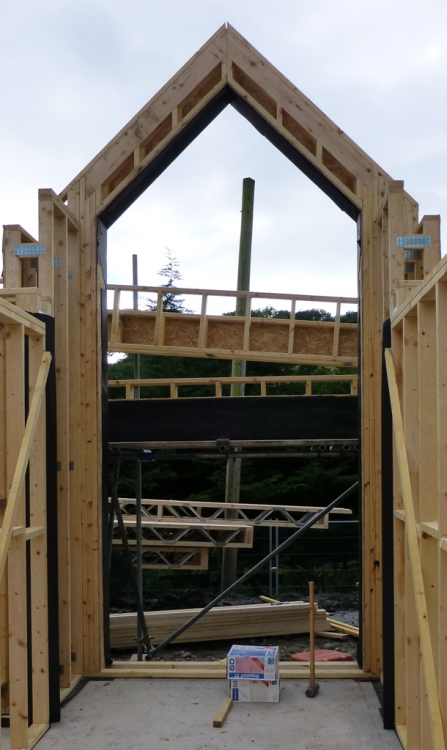
The substrate should be fine, as either side of our front glazing there are pretty hefty timber posts, made up from multiple studs (this is the inside view, but the structure is the same outside): I can easily fit hefty coach screws back into the frame either side, all I need to do is rout out rebates in the cladding either side, to get a flat area for the brackets to bear against (the outer wall is clad with waney edge larch). There's a batten right next to the glazing on either side, so in total there would be around 130mm depth of timber where the brackets go, with that being stiffened up by being the outer part of the twin stud wall frame. so the timber in the photo above is only spaced around 120mm back from the outer posts, and connected to them both by the OSB lining around the opening as well as the short timber spacers that keep the twin stud frames apart. The problem is finding a fabricator that can make a neat looking canopy, ideally without a cross bar at the front edge. The distance between the inside faces of the timber frame opening is 1900mm, so the gallows brackets needs to be on roughly 2000mm centres (might be slightly less than this, I need to go back out and find the exact edges of the battens either side of the glazing).
-
I'm not sure, TBH, but we would prefer flat glass, just so that it is in line with the glazing bar/stacking cill above the front door. I think a curved canopy might look a bit out of place with the straight line of the frame behind it. The fabricator we were talking to suggested putting a stainless steel bar across the rear of the canopy (underneath) welded to the brackets at either end, so that there could be an additional support in the centre at the back. I think this would have looked OK, but suspect he must have encountered a problem with the glass supplier, perhaps, as it just stopped answering our calls. I must have tried at least half a dozen or more canopy suppliers last year, trying to find someone that could supply a wide enough one, so really need to sit down and try again, as I lost interest when the other chap disappeared. Sometimes it's really hard trying to find suppliers for specific products like this.
-
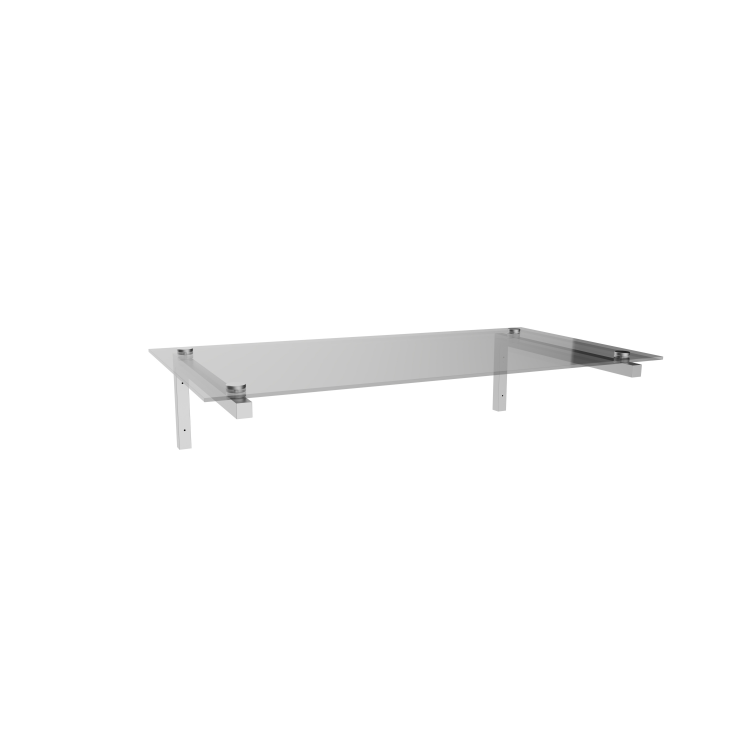
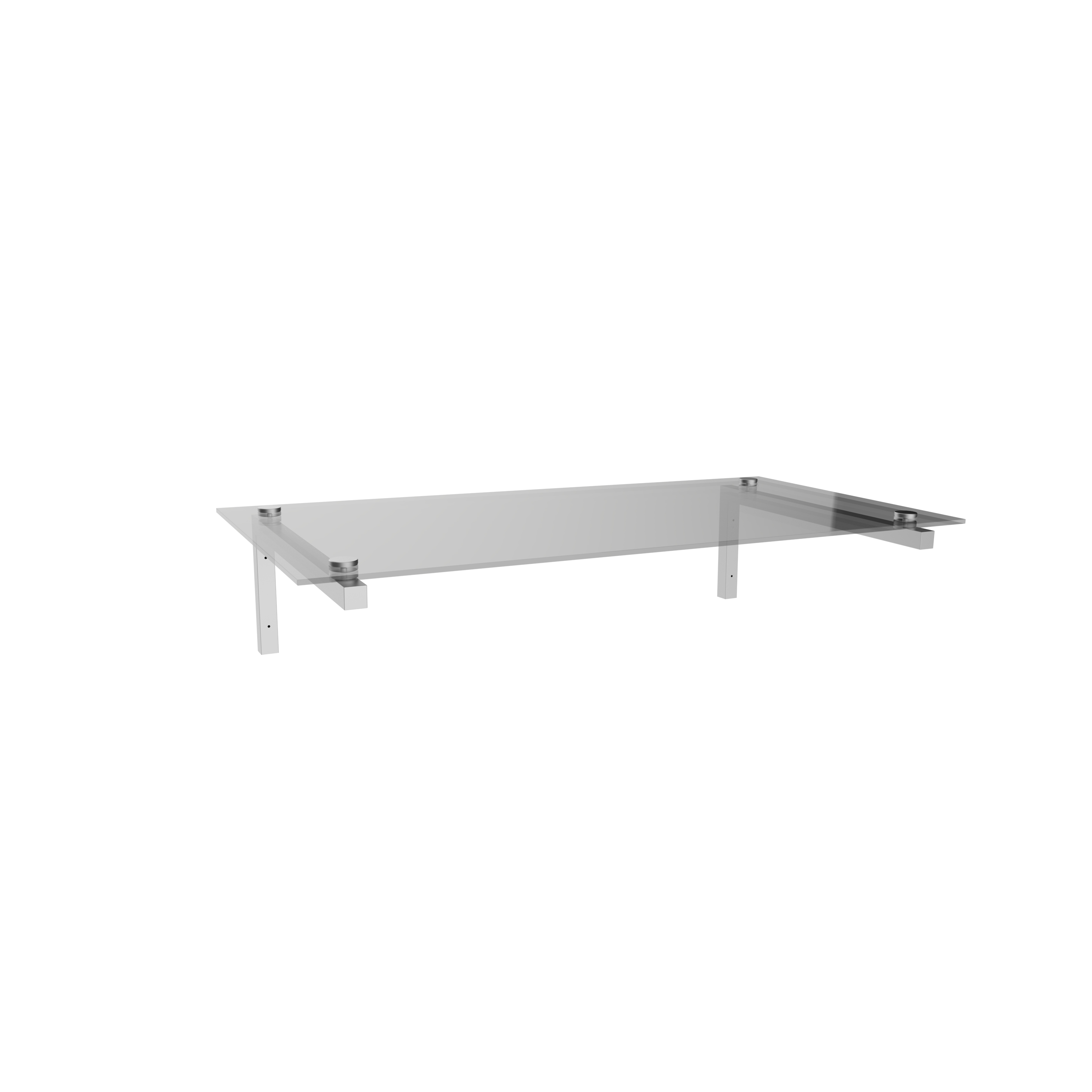
The design we wanted was a bit like this: The snag was that we found a fabricator who said he could make one up with the supports wide enough apart to clear our front glazing (so they could be bolted to the solid part of the house frame), but he then disappeared without trace, after having sent me some preliminary drawings. I believe that the span between the brackets is the main issue; we cannot fit a centre support as there's nothing to attach it to, only glazing.