


Jeremy Harris
-
Posts
26430 -
Joined
-
Last visited
-
Days Won
360
Everything posted by Jeremy Harris
-

MVHR is Largely Bogus
Jeremy Harris replied to DavidHughes's topic in Mechanical Ventilation with Heat Recovery (MVHR)
Just downloaded it and it opened in Excel for me OK. -
MVHR is Largely Bogus
Jeremy Harris replied to DavidHughes's topic in Mechanical Ventilation with Heat Recovery (MVHR)
@DamonHD (used to be on here for a time, but haven't seen him for ages) looked into this in depth some years ago, in the context of the school environment and the impact of CO2 concentration on the learning performance of children. IIRC, his findings (supported by some reasonably good science) were that learning performance started to fall off at concentrations above about 800ppm. That's not surprising, as we evolved to live in an environment with a CO2 concentration of less than 300ppm. From what I can recall of the aeromedicine stuff that was drummed into me at regular aeromedical and safety training school refreshers, the lower the partial pressure of CO2 in the air we breathe, the better our lungs are at expelling the stuff as a waste product. The rate at which CO2 diffuses from our blood stream to the air in our lungs is pretty much wholly dependent on the partial pressure of CO2 in the air, and that partial pressure is in turn proportional to the CO2 concentration. Arguably there is no optimum level of CO2 as far as our bodies are concerned, it needs to be as low as possible, and the closer we can get the internal CO2 level to that outside the better, as that global CO2 concentration is already a lot higher than it was just 50 or 60 years ago (in 1960 it was less than 320ppm, now it's around 420ppm). -
MVHR is Largely Bogus
Jeremy Harris replied to DavidHughes's topic in Mechanical Ventilation with Heat Recovery (MVHR)
There's a reasonably good argument for defining goals at the start of any project, and then gathering data to see how best those goals might be met, and finally doing a lot of "what if?" comparisons to try and narrow down all available options to get the best compromise. Sadly, this isn't often how some approach major works, as it seems to be human nature to want to choose things, not because they make best sense, but just because your want them, for reasons that may not be wholly rational. Many people buy houses, cars, choose holidays etc largely on this basis. With a renovation job I think that a bit of money spent up front on seeing just what you've got to start with, and just what you might reasonably be able to do, would be a wise investment. Even a rough and ready model of the best and worst elements of the fabric would give a useful indication as to where best to commit limited resources. It may well be that MVHR just doesn't make sense, in terms of the energy saving it might offer for a particular project, in which case a PIV system might be a lot cheaper and easier to install and offer much the same air quality benefit. It's far too easy to get suckered in by the advertising hype for products and systems, and assume that they are "must have" bits of kit. Sometimes they may be, but often they may not. Exactly the same arguments apply to other technologies that get discussed here, like heat pumps, or phase change thermal storage. They can work very well for some use cases, but not for others. It all comes down to understanding what you're dealing with initially, and what you might reasonably be able to achieve, both practically and in terms of affordability. -
MVHR is Largely Bogus
Jeremy Harris replied to DavidHughes's topic in Mechanical Ventilation with Heat Recovery (MVHR)
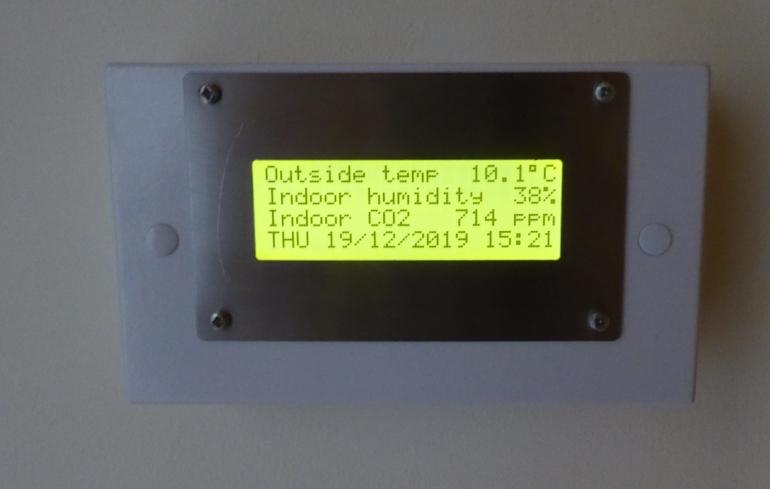
It's a nasty, wet, day here, and we've been shut indoors all day, not even gone outside once, so all doors and windows have been shut tight since yesterday. Just taken this 'photo of the hall display from the house monitoring/data logging system: That CO2 level is around 100ppm higher than we normally see, most probably because the MVHR hasn't been on boost since around 08:00 this morning, and because neither of us has been out of the house. If I started seeing levels as high as 900ppm then I'd be looking to find out why they had risen so high. We find that the CO2 level tends to fluctuate between about 450ppm up to about 800ppm, but never much higher than that. The outside CO2 level here seems to be about the global normal concentration ~420ppm. By way of contrast, this plot was from a logger placed in the bedroom of our old house, with a small window left permanently open for ventilation: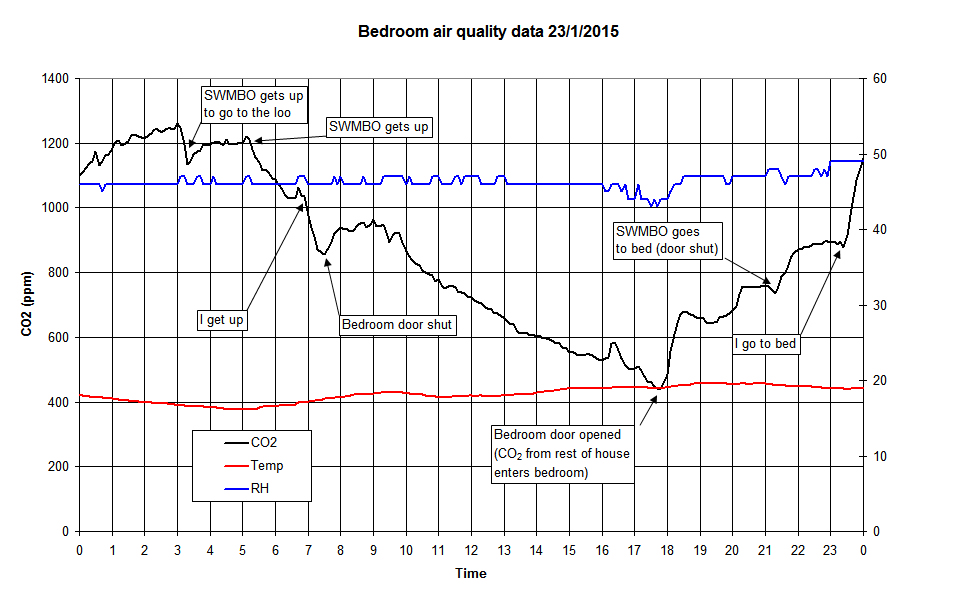
-
MVHR is Largely Bogus
Jeremy Harris replied to DavidHughes's topic in Mechanical Ventilation with Heat Recovery (MVHR)
It's not hard to look at all the various elements that make up the total heat loss rate and then see what the impact of MVHR is. The simple heat loss spreadsheet I wrote years ago does this (it's what I used to generate those two plots earlier in this thread) and will quickly show where the major heat loss elements are. The spreadsheet is this one: Heat loss calculator - Master.xls -
MVHR is Largely Bogus
Jeremy Harris replied to DavidHughes's topic in Mechanical Ventilation with Heat Recovery (MVHR)
I agree with your definition, it makes far more sense, however it seems that the abbreviation that has been almost universally chosen is MVHR. May be we should start a thread to try and stem the use of MVHR, and get it changed to MHRV, a bit like my attempt to try and stop the use of "thermal mass" (although in that case it's because thermal mass appears to not have any defined units, so can't be measured). Much the same here. The UFH seems to only come on infrequently in the relatively mild weather we've been having over the past few days. I have tweaked things a bit to allow the MVHR post-heating (from the integral air-to-air heat pump) to operate over a narrow temperature range now, as a way to improve temperature control if we get a sudden drop in temperature. The UFH takes a fair time to warm up, and although we find the post-heated air from the MVHR a bit too dry, it does have the advantage of being able to respond relatively quickly, so seems to work well to just keep the temperature up by maybe half a degree or so until the UFH has had time to take over. TBH, it's really minor, though, as the house is massively more stable in temperature than any house we've ever lived in. It's just that, having got use to the temperature being pretty constant, we now tend to notice a half a degree variation. In our old house it wasn't uncommon to get 3 or 4 degree variation throughout the day in winter, sometimes more than this, so perhaps we're just being too fussy. -
MVHR is Largely Bogus
Jeremy Harris replied to DavidHughes's topic in Mechanical Ventilation with Heat Recovery (MVHR)
No, if all you want is mechanical ventilation, then just fit PIV. Simpler, cheaper, provides just the mechanical ventilation function and can filter the incoming air to get good air quality. If you also want to improve thermal efficiency then fit mechanical ventilation with heat recovery. -
MVHR is Largely Bogus
Jeremy Harris replied to DavidHughes's topic in Mechanical Ventilation with Heat Recovery (MVHR)
I'm just viewing it from the title of the bit of kit, Mechanical Ventilation with Heat Recovery. It's primary function is heat recovery, that's why it was developed and it's why it has been fitted to passive houses, in fact it has become a key element in making a passive house possible. The air quality improvements are a side effect. A nice side effect, for sure, but still just a side effect. It so happens that to stop the heat exchanger getting clogged up with dirt and dust a MVHR unit needs a filter on the intake, and that has the side effect of delivering dust and pollen/spore free air to the house, which is very definitely nice to have. However, that filtration wouldn't be there if it wasn't needed to stop the heat exchanger getting clogged up. You could have exactly the same clean air ventilation benefit from just fitting a whole house positive input ventilation (PIV) unit. Cheaper, just as good at delivering clean air and good ventilation, but with no heat recovery. -
MVHR is Largely Bogus
Jeremy Harris replied to DavidHughes's topic in Mechanical Ventilation with Heat Recovery (MVHR)
The bottom line with regard to whether or not MVHR recovers as much waste heat as it could has to be related to airtightness, even if there is anecdotal evidence that sometimes this doesn't seem to be the case. If the house leaks air, such that the MVHR is effectively bypassed, then the house must lose heat from that bypass ventilation. Whether that heat loss is significant depends entirely on how much air leaks into/out of the house without passing through the MVHR., relative to the proportion that does pass through the MVHR system. Not only is airtightness a factor, though, location and environmental conditions are too. Taking our location as an example, we get few days in the year when there's much of a breeze flowing past the house, because we're in a relatively sheltered location. As such, our airtightness could probably be a bit worse than it is and the MVHR would still work OK. The other factor relates to how much heat is lost through the fabric of the house relative to the heat lost through ventilation. If the fabric heat loss is massively greater than the ventilation heat loss, then fitting MVHR may not make a big difference overall, as it can only ever reduce the ventilation part of the heat loss. Again, in our case the house fabric heat loss is pretty low, so ventilation loss would dominate the total, if it were not for the MVHR. -
MVHR is Largely Bogus
Jeremy Harris replied to DavidHughes's topic in Mechanical Ventilation with Heat Recovery (MVHR)
The critical thing is really the level of airtightness. What was your air test result? Unless it was significantly lower than current building regulations requirements (something mass house builders still really struggle to achieve) then I doubt it would be really worth bothering to fit MVHR. The ventilation level is modest, as the MVHR fans don't provide much pressure (as anyone who has tried to set up and balance an MVHR with any sort of a breeze outside will testify) so unless the house is pretty airtight it is very easy for natural ventilation from the leakage through the fabric of the house to dominate, and make the MVHR pretty ineffective in practice. After all the time I spent trying to improve the airtightness of our old 1980s brick and block bungalow, which had the really big airtightness advantage of having been wet plastered throughout, I came to the conclusion that it would be impossible to get the airtightness to the level needed to allow MVHR to work, without taking the roof and all ceilings off, removing all the skirting boards, removing all the kitchen units , ripping out all the wiring and essentially rebuilding the house from a bare shell. I managed to get the easy stuff sealed, like the doors, windows and loft hatch, but had major air leaks through every electrical fitting, as all had fairly open channels running up the walls to the loft space. I also had massive air leaks around the wall to ceiling junctions everywhere in the house. The gaps weren't visible, but there was nothing sealing the plasterboard ceilings to the walls anywhere - the plasterboard was, at best, just resting on the walls. The same went for all the light fittings, all had large holes directly to the loft space. There were pipes going out though the cavity walls (which were ventilated) in the kitchen, WC and bathroom, most of which were inaccessible, and none of which were properly sealed. I tried sealing them outside, as that was really the only place I could get to them, but this made little difference, as they were still open to the cavity. After tens of hours spent trying to get a decent level of airtightness, I couldn't get it anywhere near good enough to think about fitting MVHR, and concluded that retrofitting MVHR to an older house would probably not give a worthwhile reduction in the heating requirement. -
The invasion of privacy comes from audio data being constantly sent back to the servers of the companies selling these units, for almost all the processing of it into meaningful instructions. Some believe that the cheap box they have is actually doing all the voice recognition, when the reality is that all that cheap box can do is recognise a single key word, and then transmit all the audio from just before that keyword to some time after it, back to servers that are outside of your house, probably on a different continent, with different privacy laws, in order to be analysed. The same transmitted audio data is also recorded by those same servers, and may be listened to by people for any reason that the companies providing these services wish, as has recently been made public. Having one of these things in your home is exactly like having an open microphone connected directly to systems that maybe anywhere in the world. 24/7. If people trust that these units will only send audio data when they correctly interpret their keyword, then they need their bumps felt, as there is plenty of evidence that they can and do get key word recognition wrong. There's a good reason that, for example, the voice recognition capabilities of dirt cheap units like Alexa, etc, are so much better than the voice recognition system in my bit of fairly expensive tech on four wheels, and that's because, despite a fair bit of powerful processing power (enough to run some pretty capable AI), the systems in my car are nowhere near as powerful as the big servers operated by Amazon, et al, and the car has to rely on on-board processing for voice recognition. Because of this, its voice recognition is pretty primitive. It's a bit better than it was in my old Prius, but orders of magnitude less capable than the cheap boxes sold by Google, Amazon etc.
-
MVHR is Largely Bogus
Jeremy Harris replied to DavidHughes's topic in Mechanical Ventilation with Heat Recovery (MVHR)
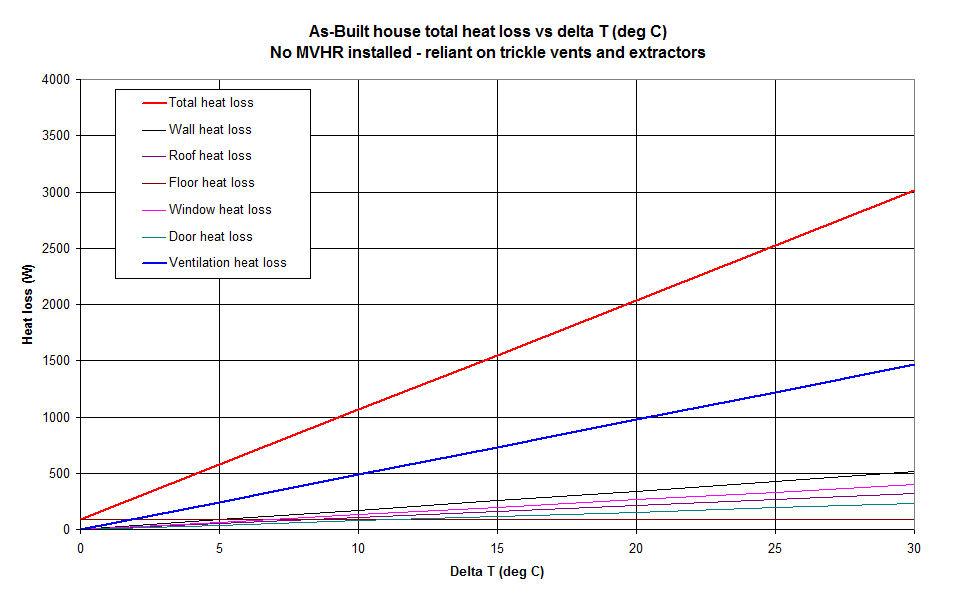
I spent a lot of time modelling the design of our house, and then measuring its performance, both when setting systems up, and through life with embedded sensors that are logged every 6 minutes and the data stored for later analysis. In terms of energy saving alone, our MVHR reduces our heating requirement by a significant amount, enough on its own to justify the expenditure. First, a look at the house heat loss, versus the difference between the inside and outside temperature, when not fitted with MVHR, but with the level of trickle ventilation/extraction required by building regulations: Note the blue line, which is the proportion of total heat loss attributable to the required level of ventilation to ensure that the house remains comfortable and damp free. Next, plotted to the same scale, the house as built with the MVHR system we installed. All other parameters are exactly as in the plot above, the only difference is the use of MVHR, rather than trickle vents, extraction fans, etc: Note that the ventilation heat loss is very significantly reduced, as is the total heat loss. In simple terms, at a differential temperature of 15 deg C between indoors and outdoors, the house needs about 45% less heating than if it did not have MVHR. That is, in my view, a massively significant benefit, nearly halving the heating requirement, just from fitting MVHR, and is, alone, enough to justify fitting it. Perhaps the most important benefit, though, is the one that everyone who visits our house notices almost immediately they walk in the door, and one that @NSS has made a very powerful argument for, the improvement in air quality. Having a house that is always fresh, has no residual odours from cooking etc, is free from pollen (that alone is a godsend for anyone who suffers from hay fever) and which results in bathrooms staying condensation free, with damp towels etc drying very quickly is probably as great a benefit as the saving in heating cost, and in my view probably worth fitting MVHR for on its own. However, there are many, many, examples of poor MVHR systems, either by poor design, poor installation, or a combination of both. There's also the fact that some people are persuaded to fit MVHR to houses that simply will not benefit from it, because they have an inadequate level of airtightness to allow MVHR to work effectively. Very few houses in the UK are built to an airtightness standard that will allow MVHR to work well, as even the current building regulations level of airtightness is inadequate for MVHR, and mass housebuilders struggle to even get houses to meet that requirement. There's little hope that a house built ten or twenty years ago could be made adequately airtight to allow MVHR to work efficiently, without a great deal of major improvement work to the core fabric of the house. I tried to improve the airtightness of our old 1980's built bungalow, and spent weeks air testing and going around sealing up every gap I found. Despite my best endeavours it still ended up at least 20 times more leaky than our current house. The main problem was that houses need to be designed to be airtight, it is pretty damned hard to try and bodge them to some level of airtightness when their basic structure was never intended to be free from many thousands of small air leaks.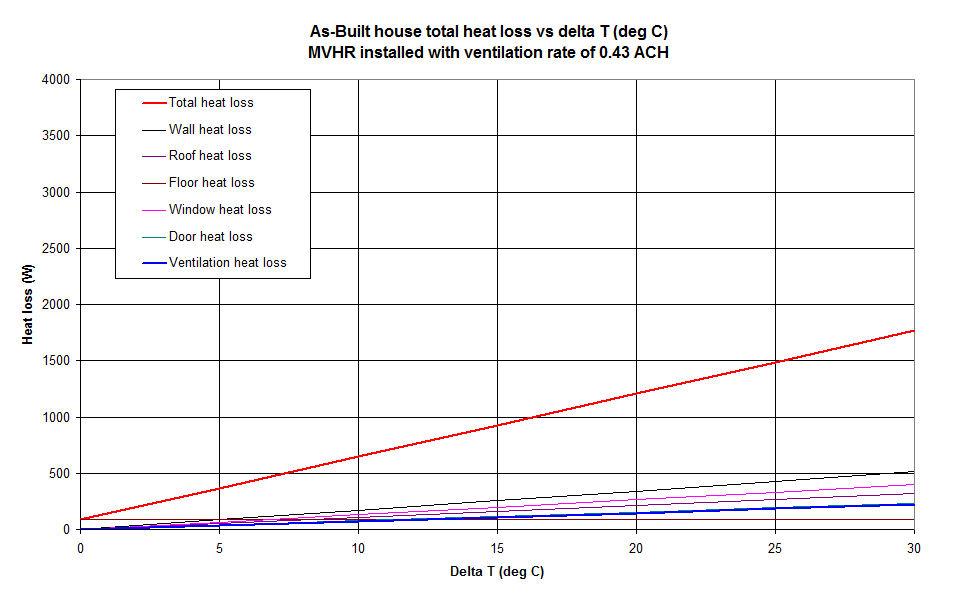
-
And Ben gets content from contributors (like me) for free, too. (just to be clear, I freely gave up a couple of hours or so to provide him with that content, as I thought it might be useful to someone).
-
Luckily all my battery packs (some genuine Makita, some Chinese knock-offs) should fit this impact driver (assuming it arrives). I bought it from a "UK" eBay seller, advertised as being in "London", but whose address is: SHANGHAI QINREN DIAN NAO KE JI YOU XIAN GONG SI 磊 高 抚远路1288弄59号501室 201908 上海, 上海 中國 Must be in Chinatown, I guess... On a more serious point, why does eBay allow so many sellers to fake their location? There are literally hundreds of sellers listed as being in the UK somewhere in listings, but when you scroll down to where they really are you find they are in China somewhere. I first thought that they were just drop shippers, but it seems clear that some are shipping directly from China, and not using a UK warehouse at all.
-
Good tip. Interesting to see if the impact driver arrives. I ordered the same one that AvE has in that YouTube video, cost around £26 delivered (as a bare tool, no battery pack). The eBay link, for those that want to live dangerously, is: https://www.ebay.co.uk/itm/372853575848?_sp=p2488212.m41214.l9765
-
volume of water required m3 per hour
Jeremy Harris replied to scottishjohn's topic in General Plumbing
TBH, I think the real risk of not disinfecting the water is probably very low, but we live in litigious times, and if thinking of having rented-out accommodation, then there is a legal requirement (at least here in England and Wales) to ensure the water is potable, with mandatory (annual, I think) water testing/analysis for any supply that is not directly connected (i.e. without an air gap) to the mains. I grew up in houses that had cold water tanks in the loft, and I'm pretty sure the bathroom cold supplies came from those tanks (just so the hot and cold were at the same pressure at the bathroom taps). I remember my mother telling me to never swallow the water when cleaning my teeth from the bathroom basin tap, though, so there was an awareness even in the 1950's and 60's that tank-fed cold water wasn't potable. I'd have no problem in using our borehole water without disinfection, as I'm pretty confident it's fine, but I did run a tap to my neighbour's vegetable patch (she had to unreel a hose around 50m or so to get to it, so I felt she might find it easier having free water to hand), taken off from before the UV unit, and felt the need to both tell her that it wasn't drinking water and fit a label to it stating this. The reason I did this is because she's in her 80's, and although she's in very good health I didn't want to take the risk of her believing that the water from that tap was safe to drink. Much the same goes in our house. I'd be happy to use the water without the UV unit running, but I wouldn't feel happy for my nearly 90 year old MiL to do the same when she comes to stay. The risk may be very small, but imagine how you'd feel if someone became seriously ill from drinking your water, let alone the financial impact if someone chose to sue. -
If it was installed with an OLEV grant, then it's mandatory that the smart connectivity be fitted and working. If it was fitted without an OLEV grant, then no need for the smart connectivity, and arguably it will be a LOT better without it. On one of the Tesla forums there are many reports of flaky smart charge points, badly designed apps, unreliability, etc. Having read many of these I started a thread asking whether Tesla owners (who, as a subset of people, probably lean towards anything with a bit of tech in it) and the results were overwhelmingly in favour of dumb charge points: https://teslamotorsclub.com/tmc/threads/are-smart-charge-points-worth-having.177611/
-
Bought one of these "fakitas", having seen this review (caution, AvE's language is definitely NSFW...):
-
volume of water required m3 per hour
Jeremy Harris replied to scottishjohn's topic in General Plumbing
The way mains water treatment usually works is that it relies on what they call residual disinfection. The water is treated at the supply end and usually a tiny amount of residual chlorine is left in the water, enough to stop any bugs from multiplying in any static parts of the distribution system (and there will always be some static pipes, somewhere). as long as there's no exposure to air, the chlorine remains in the water, but as soon as there is an open, ventilated, surface it comes out of solution (it's why you may sometimes smell it near an open running tap). As a consequence of this, the water in the break tank will very quickly lose any residual disinfection, and because of air movement into the open air space above the tank, bacteria, spores etc will get into the water. With no residual disinfection, the water has no means to prevent these bugs from multiplying. Add in that there will then be some static legs within the house, and with no residual disinfection there is nothing to stop bugs from multiplying. Any mains water supply that has a break tank has to be considered to be similar, as far as disinfection requirements are concerned, to water from a borehole or spring supply. The simplest way to disinfect such water is with a UV disinfection unit, fairly cheap to buy, and reasonably cheap to run. The only real limitation is that such a system does not provide any residual disinfection, so the unit needs to be placed as close to the point of use as practical (ours sits upstairs, in the services room, just before the water distribution system for the house). As @SteamyTea rightly says, there was a very good reason why water coming from vented cold water tanks in houses was classified as non-potable, and not to be used as drinking water. With cold tank systems, at least one tap in the house (usually the one in the kitchen) would be mains fed, to provide a safe drinking water supply, whilst the other taps were for washing, flushing toilets etc, and were not drinking water. -
volume of water required m3 per hour
Jeremy Harris replied to scottishjohn's topic in General Plumbing
We have two 300 litre accumulators, connected in parallel. They hold about 300 litres of water under pressure (the capacity of an accumulator is slightly less than half its rated volume). Far, far better, and cheaper, to just fit a bigger accumulator than to try and size the pipe and pump to deliver the peak flow. The calculations are really pretty easy, all the data is available in this thread, and it should take no more than half an hour to work through a range of options and come up with the one that best fits. Also worth remembering that to deliver the peak flow at that head may need a three phase pump, as well as a bigger break tank (to ensure it can keep up with the pump peak flow) and a bigger pipe up the hill. Smaller pumps are also a lot easier to handle and replace quickly than larger ones. It makes sense to have accumulators close to the points of use, as they are excellent at damping out pressure variations, so adding one for each additional holiday place makes sense. If you wanted to future proof things a bit, then you could use a larger than needed pipe up the hill, as that then gives the option later to change things without needing to do major works. Finally, bear in mind that some form of water treatment is going to be needed at the point of use, as there will be no residual disinfection in the supplied water, plus there will be a contamination risk because of the ventilated break tank. 5µ filtration plus UV disinfection should be all that's needed (the 5µ filter is essential to allow the UV disinfection process to work effectively - bugs "hide" behind very small particles). -
That's exactly the scenario that the three protective options in Section 722 are intended to address. The unit I linked to has a contactor that disconnects L, N and PE when it detects a voltage change on the incoming L and N, making the assumption that a broken PEN will change the voltage between L & N. The reason for breaking all three conductors is to prevent the touch voltage on the car body (which will be at the potential of the PE connection) from rising above a safe limit relative to the local earth next to the car, where someone may be standing. The difficult case is where there is another bit of earthed metal within touching distance, like an electric door, or maybe a freezer inside a garage where a car is charged. You then have a problem where a PEN fault could result in there being a dangerous PD between the car body and another bit of metal connected to a different earth. The whole thing is made more complicated because the signalling system used by the charge point comms system puts up to ~ 6 mA of DC down the car CPC, and that's enough to blind a Type AC or Type A RCD/RCBO, preventing it from tripping in the event of an AC leakage. The fix I've used is to use a Type A RCBO (OK for AC and pulsed DC) plus a DC sensing leakage detector (one of these: http://www.stegen.com/en/ev-products/126-residual-current-sensor.html ) to disable the charge point. Not 100% compliant, though, as it will reset if the power goes off and on again. The expensive way to do it is to use a Type B RCD/RCBO and earth electrode, but that may need changing the earth arrangements for other nearby parts of the installation to TT, through the same RCD/RCBO, in order to get around any problem with being able to touch two differently earthed bits of metal.
-
Buying from Tesla is painful, whether it's new or used. The cars are incredible, but service from Tesla, especially communications, is simply appallingly bad. You have to really want one of their cars to put up with the atrocious way they behave as a company. The box you have is almost certainly one of these units: https://matt-e.co.uk/wp-content/uploads/2019/10/SP-EVCP-Installation-Manual-v1.2-Oct-2019-A5-QCode.pdf or something similar. Questionable as to whether it really complies with Section 722 of BS7671:2018, but they do seem to be selling them as a compliant solution (hard to see how just monitoring L and N can comply, but no doubt they've managed to persuade someone within the IET). The charge point does have an internal SIM card and LTE connection, to allow the mandatory control required by OLEV, to allow grid balancing etc.
-
The snag I've found with the enclosed ones is that they end up full of water and crud anyway. At our old house, it was in the pavement outside the house and when I needed to shut the water off to replace the stopcock inside the house, I had to spend half an hour or so digging debris out of the small hole, and then struggling to get the very rusty valve to close (needed to make up a beefy key with a crowbar through the top to get the thing to shift).
-
volume of water required m3 per hour
Jeremy Harris replied to scottishjohn's topic in General Plumbing
Breaking this down into basics: You need a pump at the bottom of the hill that can pump from the break tank to the top of the hill, with enough reserve pressure to ensure a working head of ~3.5 bar at the top (you need this, as the normal setting will be turn off at 3.5 bar, turn on at 2.5 bar, or at least that's what we've found works well). That means that you need a pump that's able to pump the required mean flow rate to the accumulator(s) at the top at a pressure of roughly 13.5 bar (less if the break tank is positioned part way up the hill). You can probably get away with a pump that can supply around 15 litres/minute at the maximum pressure, as long as you have around a ten minute or so reserve in the accumulator(s). Look carefully at the pump curves, as the critical region is the area between the lowest head (the pump cut-in pressure) and the highest head (the pump cut-out pressure). For example, our little Grundfos SQ1-65 can deliver ~5 litres/minute at 8.8 bar, ~10 litres/minute at 8.4 bar, so a relatively small head difference can have a significant impact of flow rate (bear in mind this is a small, ~650 watt, pump). With 32mm pipe, and allowing for the fact that losses up the run to the accumulator really aren't a big deal (they have near-zero impact within the house, if the accumulator is sized properly), then frankly I'd not worry about the pipe loss, as you're never likely to be pumping high flow rates up it. Probably a lot cheaper and easier to just increase the size of the accumulator(s) at the top end than to spend a fortune on a bigger pipe and pump. For example, our borehole supply pipe is 25mm MDPE, but it would work just as well with 10mm (if 10mm was available), as it only needs a low flow rate to keep the accumulator charged. This Grundfos booklet has some useful information on pipe sizing, pipe flow loss, head, configurations for tank to tank pumping etc: GrundfosSQ pumps.pdf I would argue that just fitting a larger than needed accumulator at the top, and ensuring that the pump has enough head capacity to deliver, say, 10 to 15 litres/minute at the maximum required head (so your ~10 bar for the 100m height, plus another 3.5 bar for max cut-off pressure, giving ~13.5 bar (assuming the break tank is at the bottom of the hill). Large accumulators give advantages over a larger pump, by being able to even out any pressure changes when multiple taps are opened, so all around are a generally good thing. -
volume of water required m3 per hour
Jeremy Harris replied to scottishjohn's topic in General Plumbing
Something doesn't add up with these units. 2m³/hour is 48,000 litres per day, which is an astronomically large amount of water for domestic use. A 480 litre tank would be drained by a pump running at 2m³/h in a bit under 15 minutes, and it's debatable whether the mains supply could keep the tank topped up, I suspect. As mentioned earlier, the guidance is 150 litre/person/day, but I'd be inclined to use 200 litres/person/day. For six people that means supplying around 1,200 litres/day, so an average of around 0.05m³/hour, nothing like 2m³/hour. To meet the short duration demand (showers and baths) just fit a big enough accumulator to meet that requirement. The pump can run at a great deal lower rate, as it can refill the accumulator over a much longer period of time. You are going to have to have an accumulator at the top, anyway, just as a part of the pressure regulation and pump control system. To give an idea of what's needed, we use around 400 litres per day at a guess, have a pump that is rated at a bit over 22 litres/hour at a 3 bar working head at the house and we have about 300 litres of storage in two accumulators. (far more storage than we need, we just needed a very high initial backflow to flush our filtration system). The head from the water level in the borehole to the top of the house where the showers are is between 15 to 20m.

