Jeremy Harris
-
Posts
26430 -
Joined
-
Last visited
-
Days Won
360
Everything posted by Jeremy Harris
-
What's the official classification of that pipe at the top? I'll bet the water co have classified it as a communication pipe, feeding several properties. They do this semi-deliberately, in my view, as they are not allowed to connect a new supply to an existing communication pipe, it has to be connected to a main. We had a long debate with our water co over this, but they have the law on their side (something in the Water Act, IIRC). We have a pipe running down the front of our house, in the middle of a narrow lane and 2m from our boundary, that feeds one house. It has plenty of capacity, as when we dug across the lane to put a drain in we found it, and it's a 1 1/2" cast iron pipe, running down hill, from the main around 30m higher up. The house it feeds has a massive water pressure, so much so that they've had to fit a pressure reducing valve. Still, the water co wanted us to dig up 140m of lane, parallel to that pipe, and install a new pipe from the main to our house....................
-
 Isn't one of the main problems the fact that the VoA are very slow to respond to this sort of request? They are pretty slow when trying to make an addition to the lost, we found, so I have a feeling that any request to have a property taken off the list is going to go to the bottom of the pile.
 -
Had we known at first fix where the opening slot was in the back of the oven unit, then that's what we would have done. The problem then was that we hadn't yet finally decided on the kitchen supplier and when we did the drawings of the oven unit didn't include the dimensions of the rear opening slot anyway. Remember I had metal back boxes fitted in the service void, that was 50mm deep, and I have a personal dislike of plastic back boxes, perhaps irrational, but there you go. Great in hindsight, but when you're working with only limited information initially you're a bit constrained as to the options you have! The spur/radial thing is my age. Spurs were any cable run from the fuse box (as it was then) to a specific single outlet. Radial was a term generally used to describe the wiring scheme with multiple outlets on a single radial cable, to distinguish it from a ring scheme. With rings, spurs refer to single runs from a ring. I agree, I was wrong, the terminology has moved on, everything does. We even have more houses being wired with all radial circuits, a better solution in many ways than rings. We're all human...........................
-
Yes, it was the first option, but I just didn't like the aesthetics of it. If I'm 100% honest I didn't really like the original plan much either, with two visible 13A leads coming out the side of that tall unit, but at the time neither of us could think of a way around it without adding switches to the right and it was the best plan we could come up with and still be compliant with the regs. I didn't really want the hob switch on the right, either, but that was pretty much the only place we could put it. The change in the oven spec by the manufacturer forced us to change things, and by then the kitchen units, worktops etc were all fitted so we knew exactly what options were available. We were limited by the fact that the right most 13A box was up against a 50mm x 50mm service void batten, so drilling across into the service void behind the oven unit was not going to be easy without cutting out a fair sized bit of plasterboard and making good, although I did think of it as a way of hiding the wide, flat, cable. That cable's interesting, as it looks and feels identical to the blue, flat, three core cable that's fitted to the Grundfos borehole pump; maybe its a German thing. Having spare capacity on the cable to the hob switch, plus being able to hide the outlets to the two ovens, made the solution we opted for seem the best compromise, but I'm sure there are half a dozen alternative ways we could have solved the problem. With hindsight, perhaps we should have ordered the kitchen units and appliances before first fix, and found someone to store them for us, as that way we could have taken measurements for the access at the rear of the oven unit and come up with a neater solution from the start. The problem was that the units were all pre-assembled and would have taken up a lot of space somewhere. We couldn't have had them in the house when it was being plasterboarded out and plastered, or when the floors were being laid, either. Edited to add: Sorry, missed the point about radials. Yes, three radials from the CU, two 20A, one 40A. We gained two free slots in the CU, which is handy as the water heater was added later and would have taken the only free slot left, and it's useful to have one or two spare slots, I think.
-
We fitted a water softener, as the water was pretty hard, and as I have high blood pressure I plumbed in a bypass so that non-softened water went to the kitchen tap (where pretty much all drinking water should come from). Because I did this as an afterthought (again..............) the manifold plumbing was already in, so I tee'd off the kitchen cold feed after the manifold and plumbed in the bypass there, closing the manifold valve to stop soft water getting through. One consequence of this is that I can switch the cold supply to the kitchen from softened to non-softened simply by turning two valves in the service area. I can say with confidence that there is absolutely no difference in taste either way - the water seems to taste exactly the same whether softened or not. Because of the sodium issue, I looked at the concentration of sodium versus calcium in both supplies. The amount of sodium in our softened water was was tiny, far lower than the concentration in milk and many other drinks. I'm a fairly heavy tea drinker (although I've cut down a bit since having advice on this forums predecessor) so worked out how much additional sodium I'd end up ingesting because of the softened water. The result was a bit under 1% of my normal daily intake, and I never add salt to anything, don't eat foods with added salt and generally have a much lower than average sodium intake than most people (comes from being diagnosed with high blood pressure when I was 34 years old, and treated for it ever since!). So, my conclusion was that, for me, softened water added virtually no additional health risk. It also makes a far, far better cup of tea!
-
Part of the problem is the depth of the heat exchange coil as well, I think. Most are pretty big to give the required heat output and so take up a fair bit of space in the tank. A UVC just has a top outlet, so gains pretty much all that coil depth as useful hot water.
-
Thanks, those look similar to the ones I drew up some time ago, when trying to compare the performance of our old thermal store against that of the Sunamp PV.
-
The problem here is that there is case law that determines some aspects of a "rateable hereditament" but not others. I can see nothing from a quick look through the cases previously linked to on here that suggests that taking the windows out stops a house being a rateable hereditament, although removing the potable water supply does, for sure. The problem is that individual officers make the decision, as Mike mentions, and they are rarely legally trained or aware of the complexity of case law that has modified and better defined the definitions in the Rating Act.
-
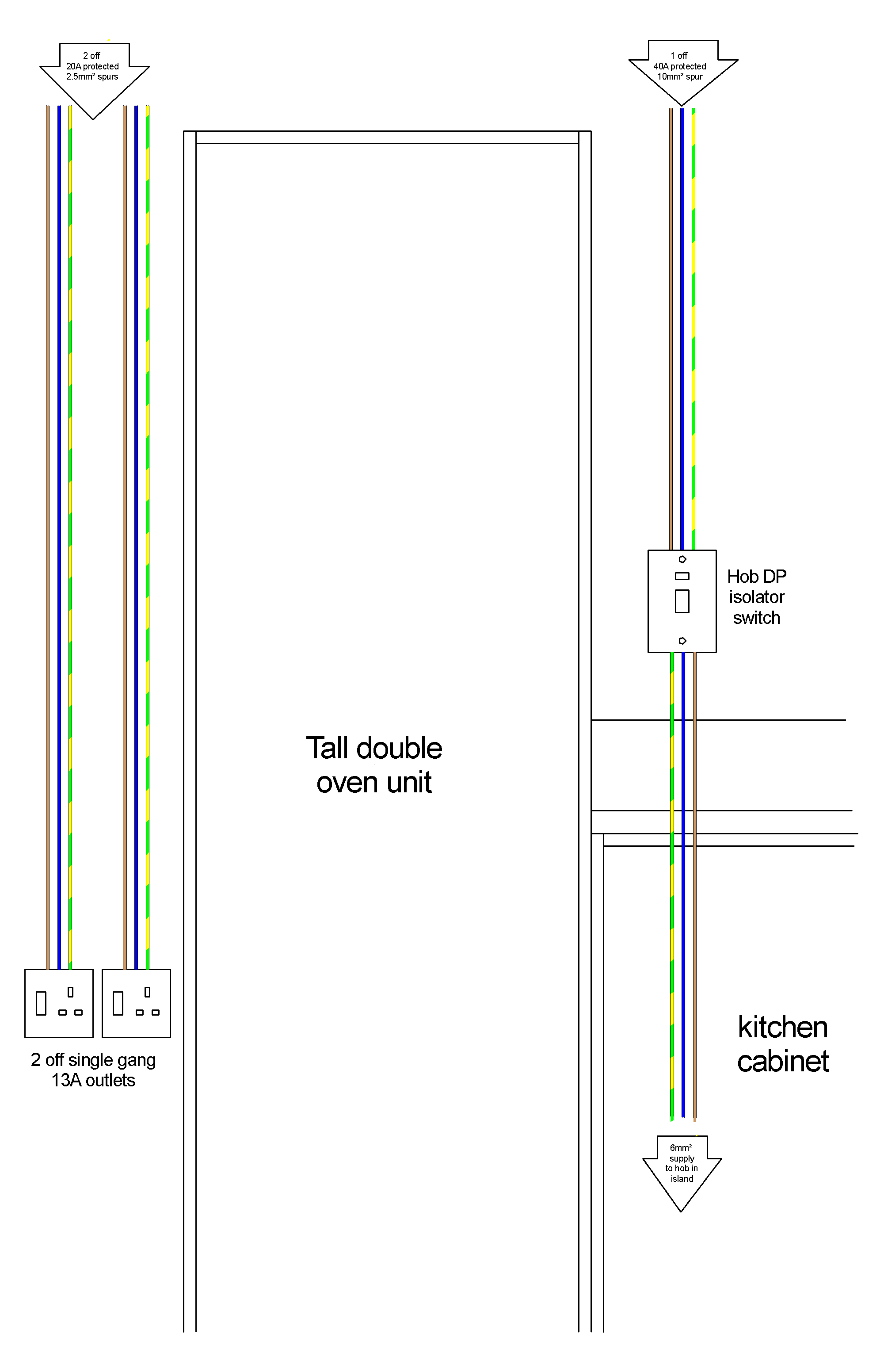
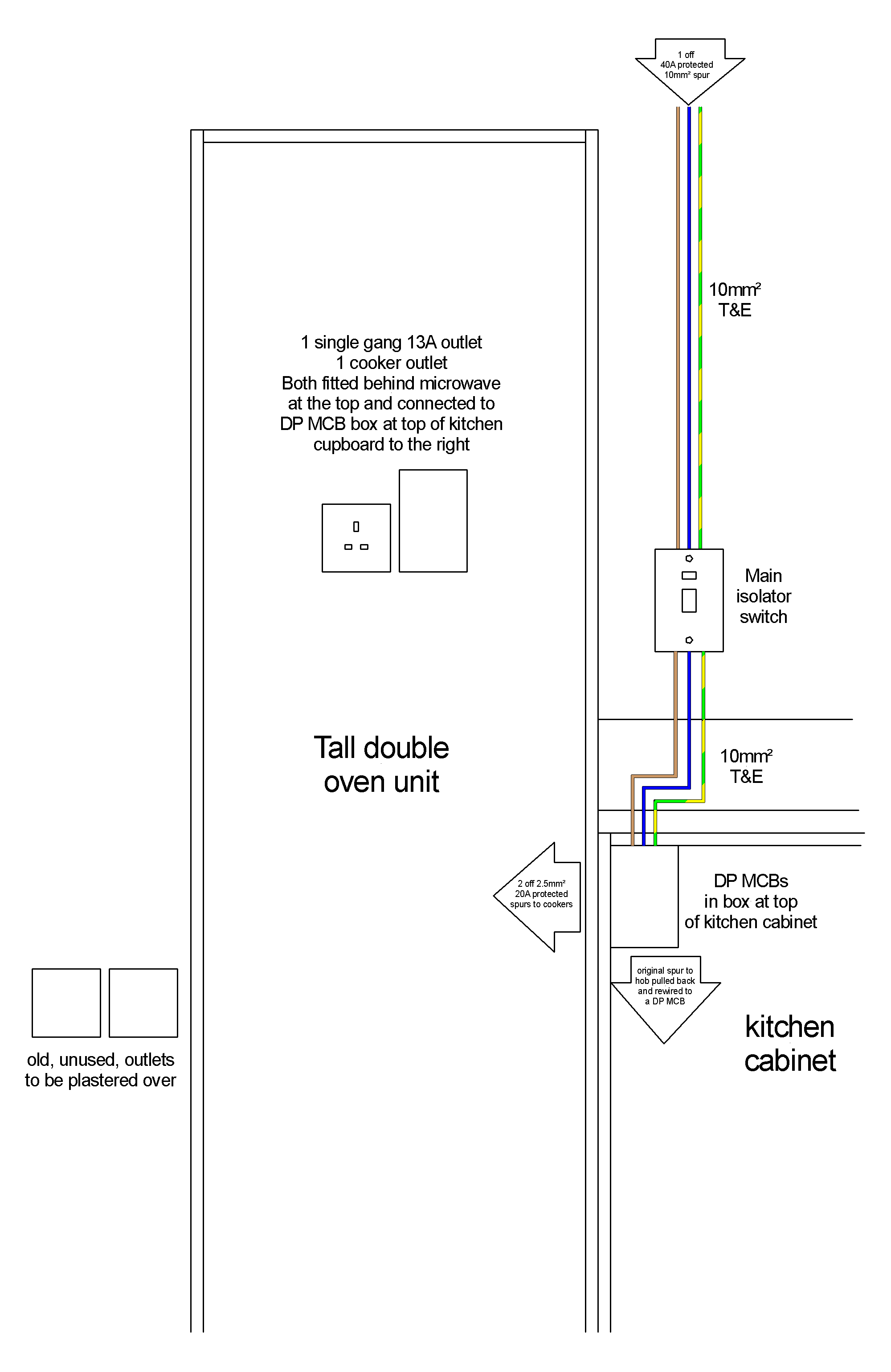
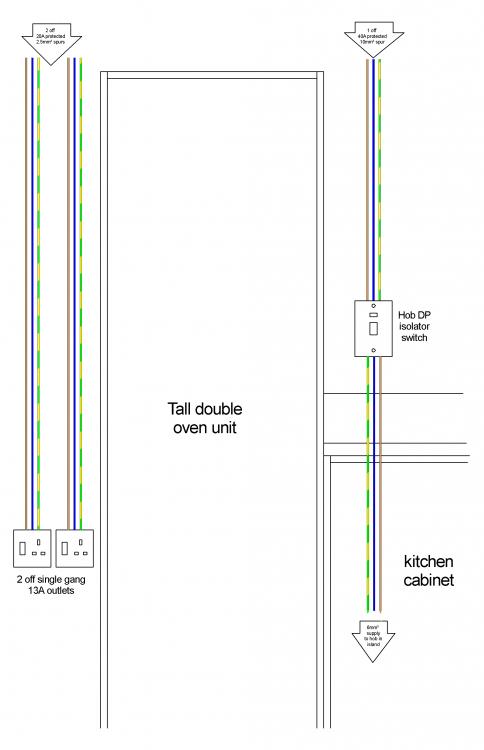
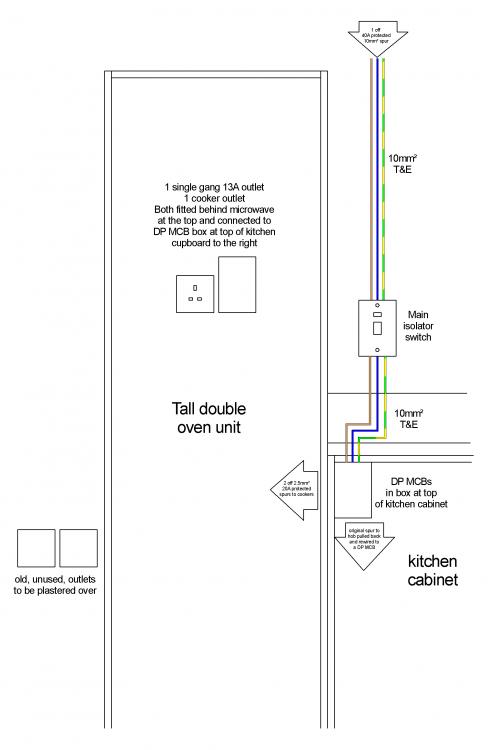
What our electrician installed and how the design changed because of the late change in oven supply requirement (something outside our control at the design stage, before first fix) seems unclear, so I thought a couple of very rough sketches might help make things clearer. First off, the plan was to minimise the clutter above the worksurfaces, and in particular we didn't want or need stuff on the short length of wall to the right of the tall oven unit, which is on the end of a "C" shaped run of cabinets. However, we needed to be able to isolate the supply to the hob, on the island, so had to fit a cooker isolating switch on that wall. Because the ovens we had ordered both came with fitted 13A plugs, we decided to run the two spurs for these down the wall to the left of the tall oven unit, so that they were accessible but not behind the cooking area. This is how the original installation looked, very roughly (please accept there is some artistic licence with these rough sketches): The hob cable is massively over-sized for the simple reason that I had half a roll of 10mm² left over from something else, and didn't have a roll of more suitable cable to hand. All three of these spurs were protected at the CU in the upstairs service room. The new oven was supplied with a flat, black, three core cable, with eyelet terminations that were fitted via Torx head screws to the connection panel at the rear. This cable was around 2m long, and the MIs said to connect it to a suitably rated and protected outlet. Had we just replaced one of the 13A outlets to the left with a 20A DP switched outlet, then we'd have had to enlarge the cable entry to take the flat three core cable, and the cable grip would not have worked well, I think. It would also have looked pretty dire, in my opinion. So, after a long chat with our electrician, we (rather reluctantly) decided to rip out the two spurs to the left, make use of the capacity we had in the cable to the right (allowing for diversity) and relocate the connections to the oven and microwave to the space above and behind the microwave unit (there was very little free space behind the oven - probably why it was supplied with the odd, flat, heat resistant, three core cable). We then had a problem in that we needed to be able to have accessible switches to isolate both the oven and the microwave, plus we needed protection on those two circuits. We couldn't easily run cables across to the left from the old spurs, as it would have meant ripping a big hole in the wall for access. We (rather our electrician) suggested that we use the hob isolator switch as the isolator for the whole lot (within it's rating, so OK), and add protection for the new spurs by DP MCBs in a small box in the adjacent cupboard, at the top and mounted on the side. This worked out well, as it just meant cutting a slot in the wall under the existing hob switch (to fit the new cable) and cutting a hole through the wall behind the cabinet and behind the oven unit to hook the cables through (luckily both were in the same bit of service void). This is what the final installation looks like: It's OK in terms of neatness, although we've lost a bit of cupboard space where we fitted the new box. At the moment the old outlet boxes just have blanking plates on, but the plan is to cut some bits of plasterboard to fit, fill the surface and redecorate (when I get around to it). So, the bottom line here is that we had a good initial plan, that would have worked fine if the manufacturer hadn't decided to change their product range between the time we ordered and the time we took delivery. I think it's just one of those things with any self-build, you have a schedule and often can't accept delivery of some things too early, because you don't want to have to store them somewhere whilst other work is completed. In our case, the order of work was first fix, then plasterboard, plastering and painting, then flooring, fitting the kitchen and then second fix, and even at the time of second fix we still thought we were getting both ovens with 13A plugs and leads. It wasn't until a couple of weeks after the electrical installation had been signed off that we discovered the change in oven spec. Could we have predicted it, or pre-empted it with better planning? I really don't think we could. We could have cancelled the oven order and looked for another pair that would fit the space and the power outlets we'd already fitted, but frankly that was not something my other half wanted to think about, having made her choice originally. We could have originally arranged the spurs for the ovens to be adjacent to the main switch, but we didn't like the idea of that area of wall being cluttered up. We could have fitted outlets on the wall behind the microwave slot, with separate isolator switches on the wall, but when we did first fix we didn't know where the access gap was in the back of the tall oven unit, as it hadn't been delivered and none of the cabinet drawings had that level of detail. The odd thing is that the spec of the new oven is near-identical to that of the old one, and it's rated at 2.2kW, which was the rating of the original one, too (which is slightly over the 2kW power for a 13A socket powered one, but the original would have been supplied with a moulded on plug and lead, so it would have been a case of the MIs superseding this, in this particular case). It is slightly deeper, front to back, and has a different looking front panel, but it seems to have all the features the original one had. I can only think that a regulatory change caused them to change it to a 16A rating. Maybe it's supplied in Germany, and the rest of the EU that use Schuko 16A plugs, with a 16A cable and moulded plug.
-
Somewhere I've got some graphs showing the comparison of two identical capacity tanks, one a thermal store, the other a UVC. Ther thermal store has a heck of a lot less capacity to deliver hot water than a UVC of the same capacity and at the same temperature, because of the way it cools down. A decent UVC should be able to deliver most of its capacity as hot water at the right temperature, which is its big advantage.
-
If the pipes are at least, say, 100mm clear of anything, then it's not that likely that you'd make an error big enough to go through one. I think we allowed around 400mm clear zones where the stud walls were going, for example, so there was a fair bit of leeway for small errors.
-
Building the Dream s6e4 - Are they exaggerating the profits?
Jeremy Harris replied to AliG's topic in Property TV Programmes
Me too, the utility companies were a complete PITA to deal with, with Openreach being the worst by far, and SSE as our DNO coming a very close second. I think the problem is that if you buy a building plot, your solicitor won't do any of these checks, and neither will the planners when granting PP, so it's entirely down to the buyer to do some research before making an offer to see how much it's likely to cost to get services in. Our case is a reasonable, if, perhaps, extreme, example of how things can be taken for granted and come back and bite you as the plot purchaser. Our plot had been granted planning permission in around 2004, following a prolonged battle with the planners and a few applications. The buyer was a gentleman who wanted to build a house for him and his wife as their retirement house (just like us). The seller was a chap well-known in the village for being a bit on the sharp side when it came to development (he'd bought an old orchard, subdivided it and built some apparently less than well-built bungalows on the top section of it). The chap that bought our plot originally trusted the seller (his first mistake), trusted the plans were accurate (his second mistake) and assumed that because the planning application (on which the permission had been granted) said that mains water and sewerage were available he trusted that too. When the buyer of the plot had completed the purchase, he discovered there was an unmarked big three phase power cable running diagonally across the plot, and only about a foot below the surface. He then discovered that the nearest water main was 140 metres away, and would cost a lot to connect to, and that the nearest main sewer was about 80m away up a steep hill and would also cost a lot to connect to. The combined cost of moving the three phase cable, taking down a power pole, connecting to the water main and connecting to the sewer came to more than he paid for the plot. He simply didn't have the funds to continue, so the plot sat as an untidy and very overgrown mess for the next 7 years, and all he did was renew the planning permission every three years. He put the plot on the market when the planners told him that they would not renew the planning permission in future, and that he would have to re-submit a new application. That's when we came along. We looked at the plot, liked it and I went off to read the planning files online. We didn't want to build the bungalow that had PP, so knew we'd need a new application. I had loads of really good advice on the old Ebuild forum, and that encouraged me to do research on services, very much like this thread. That's when I found out about the cable, the high cost of getting mains water and sewerage and, a bit later, a big boundary error. All told the plot was unsaleable at that stage, so I called the estate agent and said that although we were interested, the plot development cost was way too high and it was misrepresented on his particulars, He asked for copies of the quotes I'd had, plus the topo survey evidence that showed the Land Registry Title Plan was in error and told the seller he couldn't market it as it was. We made a very much lower offer, to take account of the high costs, and eventually (a year after first seeing the plot!) completed the purchase. From what I've read here and on the old Ebuild forum, this sort of thing is far from uncommon, and it's one reason that I'll always try and highlight the issue of doing full and poper checks before you agree to buy a plot. -
Just to add to the above, although we had hassle from the EA on a few things, when I applied for a Permit to Discharge to the stream alongside the plot they emailed me back with the permit within 4 hours! Not a single question was asked, they just granted it.
-
If you have plans and choose a good reference that isn't going to move, then you can just use measurements to find the safe zones. That's all I did. The guys laying the UFH had the same plans that I had, so it was easy to just chalk on the floor where the pipes were. Having loads of photos helped a lot too.
-
You're absolutely right, Dave. Keyless entry is a convenience, for sure, but has added a massive vulnerability into the vehicle security system and one that the scrotes have found a work around for pretty easily. If the car was just a receiver and the fob a transmitter, as push-button fobs generally are, then the amplifier (more accurately transponder/repeater) trick couldn't work. The problem is the car manufacturers seem to often place sales gimmicks intended to add convenience without thinking through all the consequences. I've been told by the Toyota dealer that Toyota have fixed the problem - they did do a firmware upgrade on mine recently that addressed "minor security issues". The main problem seems to be with VAG vehicles, as they seem to have a hard-wired system that isn't as easy to update, and it seems that it's certain VAG vehicles that are targeted by the scrotes using this trick. I could be wrong, it's a few months since I last researched it, but I believe that's the case. There's a video on this site showing an Audi RS4 being stolen in this way: https://www.driving.co.uk/car-clinic/how-thieves-hack-into-and-steal-keyless-entry-cars/
-
We had the best external key safe I could find at the time, bolted securely to a fence on the site that would have been noisy and difficult to demolish, as our meter box is in it. It was only there so that contractors could get in and out whilst we were building. One of the guys managed to defeat the combination lock one morning, as he'd forgotten the combination for that week (I changed it each week, as we had different people coming in and out). It's still on the fence, just because it's difficult to get off (I bolted it on with those shear-head security bolts), but now contains an old key that doesn't fit any doors on the house. My thoughts were that leaving an old key in it would probably waste a fair bit of time for any potential burglar, as I'm guessing these scrotes like to get in and out as quickly as they can.
-
Ecological method statement
Jeremy Harris replied to Russell griffiths's topic in Planning Permission
That's exactly what it sounds like to me. We had something similar with the EA, it turned out that a one-line letter to them for their records was all they needed, then someone could tick a box somewhere and say they'd done their work for that day..................... -
If you submit a new planning application then it will be decided on the basis of the policy that applies at the date that you submit it (officially the date the application is accepted as being submitted). This means that if any policies have changed between the date of the current PP and your new application you will be subject to those changes. If nothing has changed in terms of policy, then there's no need for concern, but it's worth checking, especially if the current PP was submitted some time ago.
-
We're much the same, these Part M, low threshold doors, make it awkward to fit a normal doormat. We're hoping that I can just cut out the travertine flooring neatly, and that the 12mm to 15mm depth gained will be enough to fit a doormat. The problem is one of having the courage to start cutting the flooring......................
-
Two 13A single gang sockets were fitted next to the oven unit (wired as spurs of 2.5mm T&E), on the wall, to take the 13A plugs from the two ovens. When the 16A oven arrived, the MIs said that it should not be wired with flex, and the terminals were clearly designed not to easily take flex. That meant we couldn't just replace one of the 13A outlets with a 20A DP switch easily (sorry, I don't have a photo, but it would have looked pretty dire). Had the new oven been OK with flex, then I'd have suggested just fitting a 20A DP switched outlet, but as above, it wouldn't have looked good. What we have now looks a lot neater, and will be neater still when I've put some plasterboard into the holes where the old outlets were and made good. It also means no holes in the side of the tall oven unit to run the two cables, which was the original plan. The original idea was to fit the side trim panel to the tall oven unit after feeding the oven plugs through holes in the inner cabinet, so there would be just two slots for the cables at the wall side. The spur wiring to those two outlets was removed when we cut the hole in the wall to run the new cable in - luckily it was only short and we could pull them out of the clips (with a fair bit of effort because of the awkward corner I was working in). All told it was a lot of faffing about, at least a day of my time trying to do the minimum amount of damage whilst pulling out old cables and putting in new, then making good the slot in the plasterboard, and half a day of electricians time in wiring it all up and testing it again. I felt like a gynaecologist at times, trying to get cables through spaces where I couldn't see where they were going, where the only access was via a hole right at the rear top corner of a kitchen cabinet......................
-
I don't know for sure, but I read the notice as if it were giving me warning that I had a duty to do everything reasonable to secure the key fob, and suspected that they would be awkward about paying out the full amount if they could show negligence on my part. I may be wrong; there has been a lot of publicity about scrotes breaking into houses to steal car keys, so maybe they were just giving a free public service notice. What makes me suspicious is that, as a sideline, I've worked as an expert witness for insurance companies (aviation related) or several years now, usually when they've been contesting personal injury claims following an accident. I have a bit of inside knowledge as to what they will try to do to get out of paying a big claim, and it's not nice.
-
The electricity connection was my only lucky break. By relocating the big 3 phase cable right under the meter cabinet, and leaving the trench open over the top of it, I only paid £300 for the connection, which I think is their minimum charge. It took to chaps two hours to do, but part of that was having a break whilst the potting cured around the underground joint.............
-
I'm not 100% sure on this. When I renewed my insurance last September I got a note with the renewal notice about key security. It highlighted some obvious things, like keeping car keys in a hidden location, out of view through the windows of the house etc. My guess is that the insurers were covering their backsides in case of a claim for theft resulting from someone breaking into your house and taking the keys.
-
Classic! Did anyone tip the IT people off to check the logs and see what he was looking at on the web as well?
-
FWIW, as assumptions are being made here that may well be well off the mark, and not for the first time, we fitted the kitchen wiring, plastered the house out, painted the walls, fitted the floors and kitchen and THEN ordered the appliances. There was a proper and fully worked through design for the kitchen appliance wiring, signed off by our electrician post installation of the wiring points for all the appliances that we had PLANNED to install. In the delay between selecting the kitchen appliances and ordering them, the manufacturer discontinued the line of ovens we (well, SWMBO), had originally selected. The supplier tried their best to get the versions we had originally wanted, but there were none available. We selected the recommended replacement from the manufacturer, same size, same sort of style, same functions, and the supplier agreed to sell them at the same price as the previous models, out of goodwill, BUT, the main oven spec had changed and it had been increased in power and so was now supplied without a lead and moulded 13A plug, as the rating had increased to 16A. Worth bearing in mind, as an aside, that the maximum continuous rating of a properly manufactured BS1363 plug is not 13A, it's 10A, which is why plug in car chargers that come with electric cars are only rated to charge at 10A. The consequence for us was that the electrician was called back to advise and change the installation, and the best compromise was reached, one that didn't require the walls to be ripped apart to get at the original wiring (well, not strictly true, a section of plasterboard had to be cut out to run the new cables, but luckily just a slot that could be patched and redecorated). Just one of those things that happen with a self build. Sometimes you can't plan for a manufacturer changing the design of a product in the time between planning first fix and fitting the kitchen. Not bad planning, not a human failing, not an error, just bad luck that had to be worked around. Between us, the electrician and I came up with a compliant solution, using what was already available, whilst causing the least disruption to the newly fitted and decorated kitchen.