


Jeremy Harris
-
Posts
26430 -
Joined
-
Last visited
-
Days Won
360
Everything posted by Jeremy Harris
-
 Indeed it was............... The household waste energy thing was an indication of how the gullible can be taken in and then sell a product on to a customer who believes them and loses thousands. I've spoken to the said customer - he is not a happy bunny. Come to that, neither am I, over the way my photo copyright has been abused. Let's not forget the cause of ebuild going down, either...................
 -
Electric shower vs. instant water heater
Jeremy Harris replied to Crofter's topic in Bathrooms, Ensuites & Wetrooms
I'm guessing that they get around that by discharging via the cold feed, so the tiny drips of expansion water that comes out of the PRV will usually not be boiling, but just a bit warm. In the event of a fault, then it's no different to me running the boiling water tap into the sink above, is it? I do that all the time, to run off the bit of less than boiling water before making a cup of tea, and to rinse out the small re-usable milk bottle I take over to the new house to disinfect it. -
Electric shower vs. instant water heater
Jeremy Harris replied to Crofter's topic in Bathrooms, Ensuites & Wetrooms
Our Itho boiling water tap came complete with the tundish and trap, plus an adapter to fit it to a 1 1/2" waste pipe. There are details on this blog entry, towards the bottom, with a photo of the installation inside the cupboard under the sink: http://www.mayfly.eu/2014/04/part-twenty-nine-some-details-that-may-be-of-interest/ Here's the photo from there that shows the PRV and tundish: The PRV is right next to a needle valve flow rate adjuster, hidden partly behind the grey waste pipe in the centre. The tundish, with integral water trap, is the black thing in the centre. What looks like a normal compression tee is actually a special, that allows the waste pipe to go right through it. The MI's say to cut a vee into the top of the waste pipe, then slide the tee fitting on so that the vertical bit is over the cut out, then fit the tundish reducer/adapter to the top. Cold water feeds into the flow rate adjustment valve from the 15mm copper on the left, and the cold water feed to the under-plinth tank is the flexible pipe to the right of that. This pipe also acts as the pressure relief pipe, as the PRV is in the top centre of the tundish.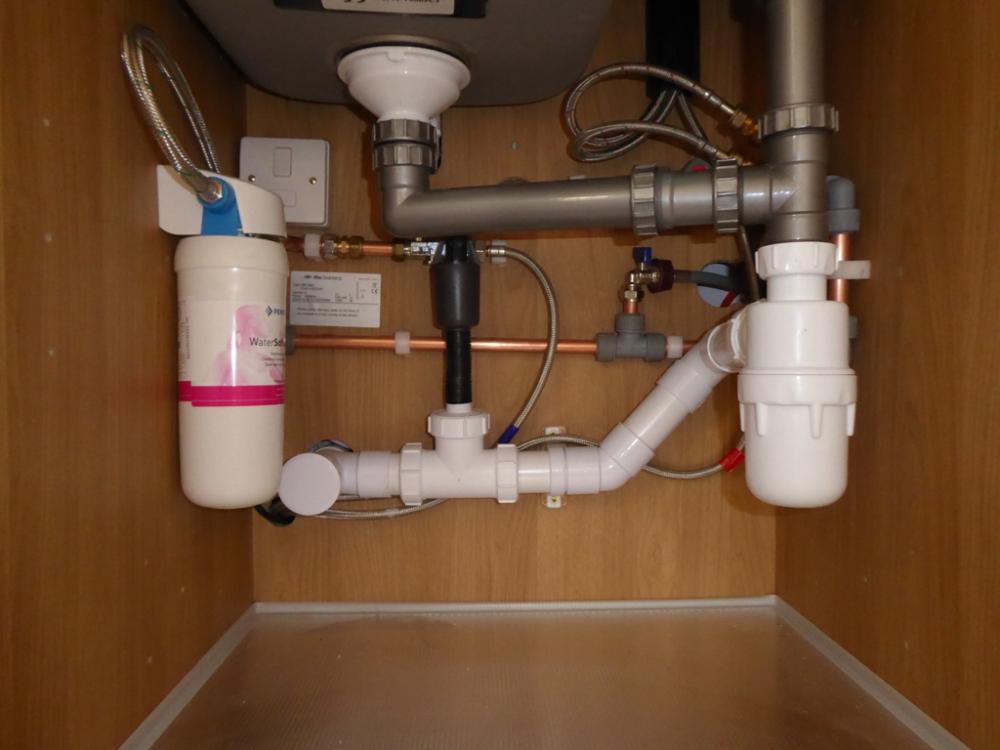
-
Thanks for posting this. You could almost take away the product name and most AutoCad users of my vintage would immediately recognise the screen and toolbars as being AutoCad. I'll give it a go later, as it looks like a zero learning curve for those already familiar with the AutoCad interface. I find I rarely need 3D anyway, as I've always stuck with the view that a CAD package is just a replacement for a drawing board, so tend to make drawings as I would on paper, anyway. Most house drawings are still done the same way, at least for planning and building regs, so a 2D package should meet most self-builders needs.
-
I agree, and got into an unpleasant argument with an idiot somewhere else (and it's rare for me to use such a term about anyone, but believe me it was well-deserved in this case!) about just this point. I did a few quick sums comparing our energy requirements, the energy yield from biocrops and our available land area, including woodlands. The inescapable conclusions were: a) We don't have anywhere near enough land area, if even if we stopped growing crops, keeping livestock or having woodlands and open spaces. b) Growing any form of plants for energy is a very poor use of land, as solar panels are two to three times more efficient at converting sunlight into energy than even the very best biocrop. c) When you add the processing and transport energy to the biocrop side the land use efficiency drops to perhaps 1/4 of the same land covered in current technology solar panels. The argument developed because the person in question argued that growing vertically stacked crops was more efficient, and refused to accept that the limiting factor was solar irradiation - vertically stacking doesn't suddenly increase this, it would break the laws of physics.............
-
Electric shower vs. instant water heater
Jeremy Harris replied to Crofter's topic in Bathrooms, Ensuites & Wetrooms
Curious............. We have a boiling water tap with a heated reservoir under the plinth, and that has to have a PRV and tundish, in fact it's supplied with one. The PRV is of the type that can operate regularly, every time the tank heats up and the water expands, as it needs to in order to keep water in the trap under the tundish (all part of the same moulding). Similarly, when we had these under-unit hot water heater at a place I worked, they had a separate tap and outlet, and the outlet was the expansion opening, as it was connected to the tank, the tap just turned on cold water to displace hot water and drive it out the outlet. The over-sink units are the same, I believe. I also remember an over-sink very hot water dispenser (for making tea and coffee etc) that had an overflow pipe led into the sink, that I always assumed was connected to a PRV. Be interesting to find out how the 20 litre unit mentioned deals with expansion and pressure relief. -
Electric UFH recommendations ( under tile UTH )
Jeremy Harris replied to a topic in Underfloor Heating
That looks good, wish they'd had it when we bought our flooring from them, as all they offered then was Sikabond 95 (and I've checked, the Sika stuff I used was called Sikabond, sorry for the error earlier with the name) -
I should add that the feed to the kitchen wall isolator switch spur is from a 40A RCBO in the CU, so is adequately protected.
-
First off, CUs do not need to be metal to meet Amendment 3, the new regs just say that they have to be made of fire resistant material. The manufacturers have decided to switch back to metal because it's the easy way out, so everyone is using metal CUs to meet the Amendment 3 requirement, but there are reinforced composites that meet the fire resistance requirements too, so I wouldn't be surprised to see compliant "plastic" boxes available before long. If a CU box is not being used as a CU, and just has a protected feed coming into it with the box just housing control gear, then that is fine, as far as I can see. I double checked this (admittedly under the last issue of BS7671, not the current one) when I did something similar and there was no problem at all doing this. Not only did our electrician sign it off, but the building inspector also had a good look at it, as he was interested in what I'd done. The problem only arises if you include primary circuit protection in the same box and rail as other control gear.
-
More or less what I did. I have one quickly accessible DP master switch on the wall, but all the individual circuits for the appliances are fed from a small bank of MCBs near the back on a side panel of a cupboard, mounted near the top to meet the accessibility requirements. My preference was to be able to isolate the lot quickly with the master switch, if need be, whilst putting the individual circuit protection in an accessible area (as required by the regs) but normally out of sight. In my case I have a 10mm² T&E feed to the isolator and then to the bank of MCBs, then appropriately rated cables to each appliance (IIRC all are on 2.5mm² T&E except the induction hob, which is on 4mm²)
-
Electric UFH recommendations ( under tile UTH )
Jeremy Harris replied to a topic in Underfloor Heating
I'm guessing you'll need to allow for the 3mm mat thickness, so yes a bit more Sikaflex, I'm afraid............ This stuff isn't like the PU based boat stuff, it's a modified silicone polymer, similar to CT1. I don't think you need worry about any more insulation, if it were me then I'd just bond the mat and bamboo down to the chipboard. It's a tiny bit easier to work with than the boat stuff, too, as it comes in big drums (around 10kg IIRC). I have a feeling I paid around £80 per drum, and used around 10 drums of the stuff.............................. -
I've just counted up and I have four CU housing that aren't used as CUs! There's the heating/cooling controls one you've probably seen, plus another in the water treatment building that has the borehole pump and filter controls, timer etc, plus two IP68 CUs that I converted into home made EVSEs (Electric Vehicle Supply Equipment). The two EVSEs have the DIY electronics that does all the control signalling between the car and the charge point, plus houses the DP contactor that isolates the charge lead if the car commands it or if the car charge plug latch is operated (makes sure the lead to the car is never live unless it's latched into the car and the car has sent the "power on" signal to the EVSE).
-
You do have to wonder at the intelligence of the government department that came up with that, don't you? I mean, it doesn't take a genius to see the flaws, and all I can think is that a complete f'wit in the government department just agreed to an industry proposal without reading it
-
Electric UFH recommendations ( under tile UTH )
Jeremy Harris replied to a topic in Underfloor Heating
I bonded our bamboo down to OSB upstairs and concrete with UFH downstairs with Sikaflex 95, a modified silicone polymer. It's very, very good indeed, and really makse for a solid feeling floor upstairs, and seems to deaden the sound transmission a bit too. One snag - you'll need to be sitting down when you ask the price..................................- 33 replies
-
- 1
-

-
- under floor heating
- under tile heating
- (and 5 more)
-
Mass builders here self-certify around 90% of the houses they build, as only one house on any type on a development is usually inspected, and then it'll be inspected by the mass builders tame building inspector, paid by the mass builder. How many inspectors in this situation are going to tell the company paying them that they have to redo some work?
-
Yes, roughly 10m head of water to 1 bar is a good enough approximation for this sort of calc.
-
I can answer the first, but not the second, question. Those DIN rail timers have no circuit protection capability at all, so need to have an upstream MCB as the very minimum, with an RCD before that if it's a standard split CU. I've used mine in CU housings that aren't being used as CUs, because they are often the cheapest way of getting a DIN rail wiring box. For example, my ASHP, UFH and DHW control box uses a small CU, fed from a fused spur, that contains four DIN rail mount relays, a DIN rail mount 12V power supply and some DIN rail mount cable junction boxes. Not only was it a cheap way to get a DIN rail box, but having a see-through lid allows me to see the relay LEDs.
-
Yes, it is. I'm no fan of the system we have, where the inspectors are employed by the builders, in effect.
-
If the bioethanol is just ethanol, then the products of combustion are just CO2 and water vapour, both of which people exhale is reasonable quantities. The problem is if the bioethanol contains impurities, or the burner bed contains materials that degrade with heat. The primary issue is that the law requires that bioethanol be contaminated with some form of bittering agent and/or colouring. How safe the bittering agent is depends on what it is, and whether or not it's been properly assessed for that purpose. The bittering agent is required simply to dissuade people from drinking the stuff, nothing more! The oxygen requirement is a bit of a red herring in a house with MVHR, as that will easily cope with the small additional ventilation demand - it's no worse than having a few friends around.
-
Therein lies the rub - years ago you'd have just called the building inspector, who'd have been all over it like a rash. Nowadays, with inspections mainly privatised, the inspector will most probably be the building companies tame one, and you have know way of finding who they are, easily. It's beyond being just poor quality, though, it's probably in the category where it's putting the future stability of the building at risk, as at the very least the shoddy construction has eaten away a big hunk of the structural safety factor, and over time those bits of packing will compress and cause settlement, for sure..
-
Who won? Bet it was the plumber.....................
-
That's an interesting, and demonstrably false, statement from the UFH people! I particularly like this, rather definitive, statement: Well, I can say that our "impression" (accurately measured to +/-0.1 deg C and logged) is that when it's around zero or below outside, our first floor (that has no heating at all) never drops below 1 degree lower than the ground floor (that has UFH). Basically, what the UFH people are saying is untrue, particularly their reference to a "very well insulated house". I'm pretty sure others here (like Tony) will confirm that the first floor will be heated quite adequately in a well-insulated house by just the heat rising from the ground floor. Our concern is that the bedrooms may actually be a little too warm, even with no heating, as, like a fair few people, we prefer the bedroom temperature to be no higher than about 18 deg C, and currently we've never seen ours drop below about 19.5 deg C, even in the coldest weather. That's without the towel rails in the adjacent bathrooms being turned on and in an unoccupied house, hence our concern about the bedrooms getting a bit too warm for us. There is a case to be made for floor comfort heating with stone or tile flooring in bathrooms, for sure, but that's really about making the floor comfortable to walk on with bare feet when you've just stepped out of the shower or bath. If they'd left out the reference to a "very well insulated house" then I would have said they may well have a case for some upper floor heating, but their statement as it stands smacks of being a sales pitch to sell more UFH to me!
-
Generally not, or at least, all the ones I looked at when I fitted electric UFH to our old bathroom weren't. It may well be that there are sealed, or SELV, versions around now, though. I just took the easier root of fitting the controller/programmer on the wall in the hall, right outside the bathroom door, to avoid any doubt, but having said that, the rules have relaxed slightly on bathroom zones since I fitted ours and technology has undoubtedly moved on. Edited to add: Just had a quick look. Technology has moved on and there are now wireless controls available, so you can indeed fit a battery powered wireless controller in the bathroom, with the LV switching done by a receiver outside the zones.
-
If he's admitted sending the sample, with the wrong label, then I agree, it's his problem. Depends how difficult he wants to be, but I would think that he would find it difficult to show that this wasn't caused by his error.
-
Probably worth noting that, although some (me included) bang on about how poor our building reg standards are, if a house is built to actually meet all of Part L, then it won't need a great deal of heating. The problem is that the majority of mass-market new builds aren't built to comply with the regs! A new house that's a bit better than Part L requires, won't need a great deal of heat input, and something like a wood burner may well be just too much heat for a room, anyway.
