Jeremy Harris
-
Posts
26430 -
Joined
-
Last visited
-
Days Won
360
Everything posted by Jeremy Harris
-
The board in the back of my approved and newly purchased meter box looks just like a bit of chipboard to me, and nothing like the old, darker coloured boards from years ago, the ones that looked like they may have been treated with something.
-
I can confirm that the pipe MBC uses fits the Wunda 16mm UFH manifold fittings just fine.
-

Opinions on induction hobs
Jeremy Harris replied to vivienz's topic in Kitchen & Household Appliances
Our boiling water tap (an Itho, rather than a Qooker) is brilliant. The snag is I ended up drinking loads more tea that was healthy, just because it was so easy to stop and make a mug! -
I'm with Dave on this. I bought a standard in-line axial fan kit, fitted it to around 3m of flexible duct in total, and it was useless. Swapped it out for a centrifugal fan (easy to tell the difference, the centrifugal ones are a much larger diameter in the middle) and it worked like a dream. Axial fans don't like working with any sort of restriction to flow, whereas centrifugal fans will run without blade stall at pretty high pressures. Central (as distinct from in wall, single room) MVHR units all use centrifugal fans for this reason, as they are usually moving air through a fair bit of ducting.
-
I ran the overflow to the same waste as the drain. Both pipes are just poked into a vertical waste pipe that comes out of the floor, at floor level, as you would with an older type of dishwasher or washing machine drain pipe. This vertical waste is swept tee'd to the vertical waste that runs down inside the airing cupboard downstairs and I already knew (from hearing the drips in the main waste pipe from the MVHR) that any water running down that pipe is audible when in the utility room, or going out the back door. I can hear the unit regenerating from just the trickle of water down that pipe too. I took the view that being able to hear dripping water was a good enough indication that there might be a problem. In fact, when the thing overflowed (because of the valve sequence thing above) I only discovered it a couple of hours later from the noise of water trickling down the waste pipe, then went upstairs to investigate and found the brine level had risen to the overflow. The pipes inside the thing that supply servo water and fill the brine tank are tiny, around 5 or 6mm OD, so the flow rate if there is a problem like this isn't that high. If I was concerned enough about it, then it would be very easy to just fit a small float reed switch, connected to a battery and buzzer, to indicate there's a problem.
-
SunAmp - our alternative to a UVC or TS
Jeremy Harris commented on TerryE's blog entry in The House at the Bottom of the Garden
I can confirm that with the electricity to the house off the Sunamp PV still delivers hot water as usual, until it runs out of stored heat. In our case the amount of hot water delivered is less, because we lose the preheat facility with the power out (the preheat uses a pump to circulate water from an ASHP heated low temperature buffer tank). Still enough for a shower plus a fair bit left over, though, if you start with the Sunamp PV fully charged at the start of the power cut. At our old house we have a gas combi, and one of the slight annoyances with that is that it stops working during a power cut, so we have no hot water. That's not the case with the Sunamp PV, but in most other respects it works just like a combi, in that it's an instant water heater with a high power output that only heats water when there is a demand (i.e. a hot tap or similar is opened). -
Wheelchair Access to new downstairs toilet
Jeremy Harris replied to 8ball's topic in Building Regulations
Have a chat with BC and see what they say. If you don't have Part M compliant doors en-route to the downstairs WC you're creating, or if the entrance door(s) to the house aren't Part M compliant, then frankly there seems little merit in going for full Part M compliance with the new downstairs WC/shower. Often BC seem to accept "best endeavours" with areas like this, where the design doesn't meet the specific dimensions in Part M, but is close enough that they will deem that Part M has been complied with. An example is our downstairs WC in the new house. It's about 50mm out in terms of the space there should be on one side, according to the drawing in Part M. I pointed out that I'd deliberately placed the WC slightly closer to one wall as we have a wheelchair-using friend, and he came around and suggested that he'd find it easier if there was slightly more room the other side than Part M requires! I felt his opinion carried more weight than Part M, spoke to the building inspector and he agreed. -
Wheelchair Access to new downstairs toilet
Jeremy Harris replied to 8ball's topic in Building Regulations
Not sure that you have to comply with the wheelchair access regs for just internal work - is the work notifiable to building control? Common sense is usually applied anyway with renovation work, as there are lots of cases where it's just not practical to make an existing house compliant with Part M access regs. The key bit of Part M that could apply (but only if you're doing major works I think) is that there should be a wheelchair access route from the parking or external entrance area into the house to the entrance floor WC. Making the WC Part M compliant when the entrance to the house may well not be Part M compliant seems daft, and I think most building inspectors would agree that it doesn't make a lot of sense to do one area in isolation. For a new build then it definitely applies, and was one of the two things checked thoroughly during our completion inspection. If the work your doing requires BC sign off, then chat to your building inspector and get his view. -
Yes, with the proviso that you need a bit of copper right next to the boiler, and can then convert to plastic from that. The stuff curves around a gentle bend OK, and comes in long rolls (I think I bought a 100m roll). We have no joints hidden anywhere, every single pipe joint is accessible, which is one of the big advantages, I think.
-
I think the term "architect" gets misused a fair bit, and given the training period needed to become an architect, and the relatively modest income most earn, I'm frankly not surprised that a few get shirty about misuse of the term. People on TV don't help, as, if I remember correctly, only one of the presenters of the many TV house design shows is actually an architect (George Clark I think; I'm certain Kevin McCloud isn't one and near-certain that Charlie Luxton is just an architectural technician). Another point of interest for self-builders is that only a small proportion of houses in the UK were designed by an architect. Right now I can't find the reference, but it's in the 10% to 20% range, I think. This means that it may not be that easy to find an architect reasonably close to you, with whom you can get on and who has experience of designing single self-build houses. I've recited our experience here before, but I don't think it's that uncommon. I went around the architectural practices within about 20 miles of us, with a site plan, a topo plan, the already approved plans (which we didn't want to use) and a single sheet of paper with eight bullet point requirements, that I wrote as an outline spec. These bullet points started with "must meet or be very close to PassivHaus performance, but we are not seeking PH certification" as the the most important, non-negotiable, point, and went down to a couple of "nice to have" features at the bottom. Not one single architectural practice took any notice at all of the single non-negotiable point at the top of our list. To say I was disappointed was an understatement, as I wasted days on trying to find an architect, then gave up. This is also reflected in an open day we had, where a load of architects came around to look at our almost-completed house. I think that on that day there were eleven of them, and, with one exception, I'd say that they were pretty ignorant about low energy design, the way that the design had to account for things like excessive solar gain, and I gained a view that generally they thought all that stuff was the engineers problem, not theirs. The exception was one architect, who apologised later for the behaviour of the others and with whom I've since had a couple of meetings. That practice is one I would have used, without a doubt, had it been running when I was looking around a couple of years earlier. Given the pretty small self-build sector, then I'd imagine it's challenging to build an architectural practice around one-off house design. My guess is that this is made harder by the relatively large number of architectural technicians who already seem to have a firm grip on that market sector, too.
-
I did the same, after a lot of deep thought I concluded that my prejudice against using plastic was outweighed by the ease of having long runs through inaccessible places, where fixing a leaking joint would have been a pain. My decision was influenced because we didn't have water on site to leak test at first fix, either, so using plastic, with no hidden joints anywhere, made a lot more sense. I'm now a convert, having plumbed the whole house, as plastic is a heck of a lot quicker to install, and its a lot cheaper than copper too. The only downside is that it's not easy to get any exposed pipe work looking neat in plastic, so I switched to copper wherever there was a bit of visible pipe. Easy to do as the 15mm plastic fittings accept 15mm copper pipe as well.
-
Does it have to be in NI? We used a company in Wales who CNC machine oak (and other timbers) into staircases and the price was very good. Our oak staircase, with 10mm glass balustrade and oak hand rails and newel posts was a bit over £2k, including the landing. The firm were Pear Stairs: https://www.pearstairs.co.uk/ The stair case was delivered by a courier, very well packaged with loads of foam etc. The glass was sent separately, after the stairs were in place, as they needed confirmation of the fitted dimensions. This is what it looks like:
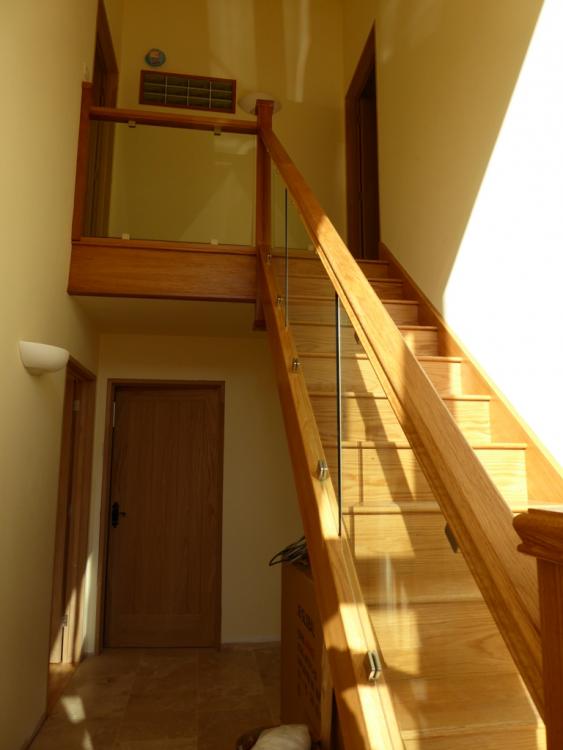
-
Front door, does it have to be at the front?
Jeremy Harris replied to Lingwood's topic in Planning Permission
There's no planning regulations that stipulate stuff like this nationally, it all comes down to your local authority planning policies and guidance. Some publish design guidance, some don't. I've personally never seen a reference to any policy that says the front door has to be at the front, and planners tend to work on the basis of the side that will be the "major elevation" when deciding whether a proposal fits into the "street scene" or not. Our new build has the major elevation facing the road, but the drive coming in from the side, so all along the front of the house is fencing and a newly planted hedge. I think we could easily have not had the front door at the front, if it were not for the building regs requirement for fire escape. The internal layout would have been difficult to arrange with doors at the sides, and still comply with building regs. Worth having a look at your local authority planning policies and guidance, to see what's there. -
Unless you live in one of the odd areas where Openreach don't own the local network (Hull and parts of East Yorkshire springs to mind as the only one I can think of right now) , then all non-cable broadband is just a re-packaged BT Openreach service for the local loop. It's broken down a bit finer that that, as the backhaul maybe a fibre backbone that's been sold on twice, for example a fair few re-sellers buy backhaul services from TalkTalk who have in turn paid for the hardware access from Openreach, or, perhaps, a cable provider. All is rarely as it seems with broadband, as I found out last year when hunting around. We'd been with the Phonecoop here (old house) for years, with fast ADSL2+ from our unbundled exchange about 100m away. For that connection the Phonecoop were just re-selling a BT service. At the new house we originally went with the Phonecoop again, based on their good customer service they given. However, the ADSL at the new house was grim, and when I looked into it I found that the Phonecoop seemed to be buying the copper service from BT and the backhaul from TalkTalk, not that they make this public, AFAICS.
-
I think there will always be room for negotiation, but will just add a note of caution. An acquaintance recently had a new house built, on land they already owned, going down the main contractor route. Although he and his wife have run their own businesses successfully for years, I don't think he knew much about building work. He trod the fairly common path of getting an architect to design the house and get planning permission, then went to tender for a main contractor to build the whole house. He had quotes in from a few builders and selected one. As there always are when building a house, a few minor things changed as they went along, but nothing that should have had a major impact on price, in my view (I've seen his plans). When they got to the end of the build, the bill from the contractor was £20k more than the quote, on an original build cost of around £120k, IIRC. The reason given was changes in spec from the client plus increased material costs, both of which are in dispute. Needless to say the client was not at all happy, and so is still battling with the contractor over this increase, but I don't think he'll win, as he did not have a firm price contract with the main contractor, he just accepted a quotation. Firm price contracts are fixed in price, fixed price contracts are not fixed in price - variation is allowed for some things, like exchange rates pushing material costs up. Quotes are very often treated as an estimated price, neither a firm or fixed price and a quotation should be a firm price but very rarely is in practice. This last point is where I think a lot of people come unstuck, they believe a quotation is the actual price they will pay at the end, and often it isn't. One thing we found was that very few builders have a properly drawn up and negotiated contract procedure. They give a quote, perhaps with their standard terms of business, and expect to be given the job on that basis, with them having the freedom to adjust the final price as they go along. This is fine as long as the client is kept informed every time something affects the final price, and a good main contractor should do this regularly, so the client knows each week or so what the changed final price will be. Some don't do this, as in the case of my acquaintance, and then the client gets a nasty surprise at the end. We didn't go down the main contractor route, but we did have two main contracts, one firm price contract with the ground works company (roughly £50k in our case) and another firm price contract with the house build company (who built the foundations and weather tight and insulated house frame and a detached garage) that was a bit over £60k. I drew up both contracts, and agreed them with the contractors, with agreed stage payment plans. From the discussions I had with several companies during the tender stage I don't think many usually worked to any form of written contract at all. So, my advice would be to choose a main contractor that has priced realistically for your area and try to agree a firm price contract, rather than accept a quotation. There is always a risk with a firm price contract that the price will be a bit higher, as the contractor will build in some risk contingency to his price, but for you the advantage it that you know what the final price will be. The other down side with a firm price contract is that it limits your options to change things as they go along - each change needs an agreed variation to the contract. Alternatively, agree a fixed price contract, or accept a quotation, and ensure that there is a clause requiring the main contractor to discuss price changes with you on a regular basis.
-
Looking at that data sheet I can't see any reason it wouldn't be OK. Although it's labelled as a glazing sealant, that really just means it bonds well to glass and ceramics. I found (by accident) that Dow Corning 799 ("Glaze & Go"), stocked at my local Screwfix, sticks to damned near anything, and is nice and thick, so it doesn't slump and works a bit like a grab adhesive. I used it to bond PVC trims in place and it worked really well. 795 looks to be pretty similar to 799, as far as I can tell. One nice thing with these neutral cure sealants is that they are easy to clean up (before they've cured) with IPA. When I was bonding all the 6mm PVC trims around our windows I ended up not bothering to get exactly the right amounts of sealant behind each, because it was easy to wipe a rag soaked in IPA over afterwards and clean off the excess.
-
I'll have a look later, as I remember having to hunt around to get some good data, as I was concerned about both flow rate and maximum working pressure. I do know that, in practice, there doesn't seem to be any noticeable change when I switch the softener to bypass. The arrangement I have is a straight length of 22mm cold main, with a 22mm tee, then a full bore ball valve, then another 22mm tee, all as close together as possible on that pipe run. The tees have very short 22mm pipes connecting to full bore ball valves, and those ball valves are connected to the inlet and outlet of the softener. This means that I can close the inlet and outlet ball valves and open the one in the main feed and bypass the softener completely if I need to. If there was any appreciable pressure drop with flow then I think I'd have noticed it, as I've certainly had it running in both configurations. I'll have a look later and see if I can find the data, as I'm sure I did have a data sheet with the pressure drop info on it. As an aside, and a slight note of caution, there seems to be a potential problem if you operate the valves I have in the wrong order. It only happened once, but I'd shut off the water by closing all three valves by the softener, rather than go downstairs and turn off the incoming supply (just laziness - I was working in the services room and it was an easy way to turn the water off). The mistake I made was to open the bypass valve, leaving the two valves to the water softener closed, to pressure test the new work I'd done. I then opened the outlet valve to the softener first, then the inlet and then closed the bypass valve. What happened was that the softener valve system didn't like having a higher pressure, for just a second or so, on the outlet and it started filling the brine chamber to way over the normal level. It took me a while to fix things, by manually doing three or four regen cycles (you can manually force regen with a screwdriver in a slotted fitting on top of the meter box) to lower the brine level, then I had to flush things through with loads of water. This only happened once, and the thing to remember is to ALWAYS open the inlet valve first, and the outlet valve last, that way the problem cannot occur. There was nothing very clear in the instructions for our unit about this potential glitch, and having now stripped and rebuilt the water meter on the cheap unit I bought as a spare I can see how this happens, and it isn't something that could normally happen. It happened (I think) because the meter was just about to start a regen on one of the cylinders when I happened to shut things down. Had the valve cam not have just started to open the servo port that moves the main valve this couldn't have happened, so in some respects it was pure chance that I shut it down at the worst possible point in it's internal cycle and then made an error when opening the valves. Ours now has a notice on top reminding us about the valve opening and closing sequence!
-
That's annoying. I'm pretty sure our old ISP had this and the one we're now with here (with a slow VDSL2 connection), PlusNet, have the same, it shows how much you've used when you log in to your account. Any reason for sticking with BT, rather than using a reseller? It seemed to me, when I was looking around a few months ago, that generally BT weren't the best value. Mind you, trying to make a fair comparison was not easy, it was a bit like trying to compare energy suppliers. I've come to two conclusions: a) The price comparison web sites are pretty useless, and I get the strong feeling that they steer you towards whoever is paying them the most. b) The pricing strategy of all these companies is deliberately designed to be as confusing as possible to customers so that the best deals are really hard to find.
-
Terry, I have no flexible hoses on our Sunamp PV, and it didn't come with any, there were just 15mm copper stubs sticking out the side to connect to, so I plumbed it in with solid pipe, the same way as a thermal store would be plumbed in. Like a thermal store, the Sunamp PV is pretty heavy, so isn't going to move anywhere. The water softener is a different issue, as the internal twin cylinder unit is quite light and just sits loosely inside the outer case, that is also the brine container. There's enough risk of movement that I thought it did really need flexible connections, particularly as it has 3/4" BSP plastic threaded fittings. I didn't like the idea of risking cracking those by any strain caused by fitting rigid pipes, so used a couple of short, large bore, flexible hoses to connect it. The hoses supplied with the Harvey units are a bit like large washing machine hoses, and apart from the small bore they were also way too long for our installation. It's worth looking around for the best price on the twin cylinder water softeners, as I think we paid less than £800 for ours. Unfortunately I can't recall where we got it from, I'll try and remember to have a look this evening to see if I can find out. I know I bought it online, and that I spent ages looking around to get the best price. As far as I've been able to work out, all the twin cylinder softeners use exactly the same internal Harvey assembly, just in a different case. The spare one I bought is a Crown, but under the lid it's absolutely identical to the TwinTec, just a different casing. Yes, I read your latest entry. Nice to see that internal flow diagram, as I still think it's a clever way to use a couple of NRVs to make a "primary" re-circulating system.
-
Any chance that the guy you're buying from will let you have the plans and surveys? There are copyright issues here, that would need to be resolved between you and whoever did the surveys and drew the plans, but it may well be that these can be resolved for less money up front that repeating the process with another SE/architect. I think it would be unusual for a barn conversion to have not had a survey as a part of drawing up the plans for PP, if only because few architects, or architectural technicians, would take on such a task without having accurate dimensions and a feel for the feasibility of the conversion. If the seller won't oblige, then can you find who drew the plans up, from the planning file, and approach them directly? We did this at first, even though we wanted to build a completely different design of house to the one on the approved plans for the plot. We contacted the architectural technician who had both drawn up the plans and dealt as the agent for the owner when getting PP, and he was very helpful. We'd have used him, rather than me taking the DIY route and designing the house myself, had he not retired in between us making an offer and completing the purchase!
-
Not sure what Nick has used, but I used some high modulus, neutral cure, silicone to stick some difficult tiles to plywood a few years ago, and found it was easy to do, worked well and lasted for several years (until we replaced the bathroom). I even "grouted" these troublesome tiles with the same stuff, which also worked OK. This was in a wet area, too, the ply panel that had been added to the back of our shower when someone fitted an electric shower, so was constantly getting wet. The only difference between that panel and the tiled wall alongside was that the grout on the tiled wall would grow black mould and the sealant used on the bit at the back would go slightly pink. A quick spray with diluted bleach used to fix it, but that shower did give me a long-term hatred for tiles. When I replaced the whole bathroom a few years ago and fitted a mixer shower, I panelled all the walls with Multipanel, best decision I've ever made, no grout, no mould and a quick wipe and it comes up like new. The new house bathrooms are all finished with Multipanel, for the same reason.
-
I've not seen a router with a usage logger, but it should be possible to do, if you have a router that will run something like OpenWrt, I think. If I log on to my account with my new ISP I can see the usage data now, which is useful. I'm far and away the biggest user in our household, so just monitoring my use gave me a rough idea of how much we needed per month when I was shopping around a year or so ago. I found that, allowing for usage by other devices in the house, we were not going to need more than about 20Gb/month, but as it happens we've ended up with an unlimited service anyway.
-
I've just checked and Pipestock it was, 19mm bore flexis with 3/4" BSP ends: https://www.pipestock.com/hose-fittings/metal-braided-hose/metal-female-x-female-bsp Click on the "more info" button and the spec comes up. These are also the ones I used for the ASHP, which also needed "full bore" flexible hoses. They have an EPDM liner so are OK for potable water (the liners in our accumulators are also EPDM).
-
Ground test for basement feasibility
Jeremy Harris replied to vivienz's topic in General Construction Issues
As, I think, some here know, we have active cooling, set up by just reversing the ASHP into cooling mode (easy to do on many models that use a 4 way valve defrost system). In cooling mode the ASHP uses around 400W, and as cooling is only needed in hot weather we're pretty much certain to be generating maybe ten times that much power from the PV system, so effectively the cooling is at no cost. Like you, we find the cooling works pretty well, too. I have ours set to a flow temperature of 12 deg C in cooling mode, which seems enough to keep the floor surface at around 18 deg C in hot weather. Enough to cool the house without being cool enough to pose any risk of condensation at all. -
There are some usage apps around, I downloaded one some time ago to get an idea how much we used, this one: http://www.thinkbroadband.com/tbbmeter.html