Jeremy Harris
-
Posts
26430 -
Joined
-
Last visited
-
Days Won
360
Everything posted by Jeremy Harris
-

Western Isles build - questions on builder responsibilities
Jeremy Harris replied to mbon75's topic in Scotland
FWIW, we're in the South of England, and every build company I got so far as to get into detailed discussions with were the same, we had to provide site security, skips, scaffolding as they required, a WC and potable water and hand washing facilities. It seemed pretty standard to me for these to be the self-builders responsibilities. The exception were ground works companies. All those I spoke to included the provision of a portaloo, water bowser etc in their Ts and Cs. -
FWIW, I think that the arrangement of NRVs inside the Sunamp PV, to effectively isolate the inner loop when the heater and pump are on and there's no DHW flowing, is pretty clever. Nice and simple, with no motorised valves. I like elegant and simple design like this!
-
TBH, we would have used ICF, I'm sure, if it wasn't for planning restrictions that pretty much forced us down the timber frame path. Timber frame wasn't my number one choice of build method, but we had a choice where the only two external finishes that would have been acceptable (given that we're in an AONB, opposite a GII listed mill, in a CA etc) were local Chilmark stone (horrendously expensive - it comes from a closed quarry that has to be opened up specially for any order) or native timber, specifically larch or oak. With no real choice as to what the external finish could be, it then seemed to make more sense to use a timber frame with timber cladding rather than come up with a way to use rustic timber cladding on ICF (could be done, but not quite as straightforward to fix).
-
Yes, almost. There is no primary side, but because of the arrangement of NRVs there is effectively a pressurised loop inside that needs a small EV. The NRVs are to allow recirculation through a loop of the main pipework when charging, without needing flow through the unit.
-
Electric shower vs. instant water heater
Jeremy Harris replied to Crofter's topic in Bathrooms, Ensuites & Wetrooms
Indeed, and for a very good reason! I used to sail a friends yacht, whilst he was working in Dubai, and I would take it over to France for him so he could have a holiday without breaking the UK "60 day" tax rule. It had an 8hp Stuart Turner inboard, that would invariably start easily when moored up, but which I never managed to get to start when at sea. I well remember a pretty scary night, on my own, totally becalmed about 20 miles of the French coast, with a flat battery (so no lights) and in the middle of the shipping lane. All I could see was the loom of the Île Vierge light on the horizon, whilst the yacht drifted about in circles. Every time a large ship came close all I could do was shine a torch on the sail, in the hope that they would see it.............. -
I'd say not. Accumulators take up a fair bit of space if they are to hold a decent volume (they only hold less than half their rated volume as pressurised water), the membranes have a finite life (typically around 10 years or so) and they do need to be emptied and have the pre-charge air pressure checked at least once a year. If you can manage without them then that's what I'd do (and we have two 300 litre ones plus a 100 litre one!).
-
Electric shower vs. instant water heater
Jeremy Harris replied to Crofter's topic in Bathrooms, Ensuites & Wetrooms
I repaired a very old Stuart Turner hot water recirculating pump a few years ago. Fantastically well made bit of kit, and what's more I could buy spares to fix it. The housing and impeller were very nicely machined bronze castings, and the thing just oozed quality when taken apart. -
The great MVHR duct debate.
Jeremy Harris replied to MikeSharp01's topic in Mechanical Ventilation with Heat Recovery (MVHR)
Not as easy as it seems! I have a birectional micro-thermistor flow sensor, retrieved from an old glider variometer. It has two very, very tiny thermistors, barely visible to the unaided eye, mounted in a hole so that one gets cooled by air flowing one way and the other gets cooled by air flowing the other way. They are self-heated by a constant current power supply, that has to be accurate and ideally temperature compensated as well. I made up a circuit using an instrumentation amplifier (an INA122) to amplify the tiny voltage from this half-bridge and feed it to an A to D on a microcontroller, and added temperature compensation separately, using a DS18B20 sensor, as I just used an off-the-shelf current source, an LM334, and that isn't temperature compensated. The voltage change is non-linear with air flow velocity, so needs to be corrected, and that means you need a calibrated air flow meter to set the thing up. In my case, I had access at that time to an aircraft instrument test set, which includes a variable speed pump and calibrated flow and pressure sensors, so I was able to just connect the two tubes and do the calibration that way. It would certainly be possible to make something like a mini-wind tunnel, with a bit of duct, some "egg box" flow straighteners and a model aircraft brushless motor, prop and speed controller. This should be able to create a linear airflow at the right sort of air velocity range, and then something like the flow meter I've already got could be used to calibrate the motor speed against flow velocity. All told it would be a bit of work, but is certainly do-able. The RPi A to D should be OK, and the RPi can read one-wire devices like the DS18B20 as well, so all you need is a bit of analogue front end stuff to condition the signal to a level that the RPi A to D can work with. -
The great MVHR duct debate.
Jeremy Harris replied to MikeSharp01's topic in Mechanical Ventilation with Heat Recovery (MVHR)
I used short sections of 150mm PVC duct through the external walls, bonded in and sealed, then used brown plastic external grills that just fit on to the 150mm duct and screw to the wall. I chose brown as mine are on the larch cladding, plus I needed to make up some wedges to deal with the slope of the cladding overlap. I'm about to replace them with some cowled stainless terminals, for two reasons. One is the imbalance problem on windy days I mentioned earlier, the second is that the intake grill is hard to clean on the plastic terminals - it collects fluffy seeds and spider webs. These are the plastic grilles I have now: http://cart.vacuumsdirect.co.uk/index.php?p=product&id=377&parent=46 and the stainless ones I've bought are 150mm versions of these (but I bought mine on ebay for a fair bit less!): http://cart.vacuumsdirect.co.uk/index.php?p=product&id=392&parent=46 Internally I used the fairly rigid aluminium flexible duct to connect to the MVHR, not the very flexible stuff with the wire spring inside, as that has a fair bit more flow resistance. This is the flexible stuff I used: http://cart.vacuumsdirect.co.uk/index.php?p=catalog&parent=38&pg=1 -
S-Box (and other pop up socket options)
Jeremy Harris replied to Barney12's topic in Electrics - Kitchen & Bathroom
To be honest, if I hadn't had the experience I've had with pulling tools off my bench by snagging the leads, the safety thing would never have entered my head. The odd thing is, people who've seen my workbench setup invariably remark on what a good idea it is to have the sockets on the front, so the leads don't trail over the bench from the wall behind. Every time I have to say that it was the worst idea I've ever had and that as soon as we move the sockets are coming off! -
I varies enormously from hour to hour, even minute to minute some days, with a large seasonal variation, too. For us, November/December are usually the worst months; I think it was the November before last where we had virtually no generation at all for around a week. We have a 6.25 kWp installation, facing pretty much South, inclined at 45 deg, and that generates around 6,000 kWh/year. We were lucky, so got in when the FIT cuts were just starting, so although our FIT is still less that the cost of retail electricity, it's not bad. IIRC, our FIT plus export income last year was about £1000. The PVGIS web site has a tool for predicting what you will get for any location and panel orientation and angle, and in our case it's usually within about 10% of what we really get: http://re.jrc.ec.europa.eu/pvgis/apps4/pvest.php#
-
The great MVHR duct debate.
Jeremy Harris replied to MikeSharp01's topic in Mechanical Ventilation with Heat Recovery (MVHR)
Sure you can borrow it David. It's pretty easy to use, but the readings do move around a bit as the conditions change outside, so ideally choose a still day to do it. It's got a bit of felt glued around the top cone to press up against the ceiling without causing damage. IIRC, the top cone is a 150mm PVC duct adapter, which fitted over our terminals OK, and I think should fit over most domestic terminals. If you PM me your address I'll chuck some new batteries in it and pop it in the post to you. The process I used was to go around and measure all the flow rates, fresh air in and extract at full boost, and write down the average readings I got. I then looked at how these compared with the regs for extract rates, and guessed at some values to reduce each by, as they were all going to be way over the regs requirement - it was really about getting the ratios between extract rooms about right at this stage. I then adjusted the extract duct flow rates to get them in about the right extract ratio, and didn't worry about the fresh air in ones. Next, I turned the system down to normal speed, and measured again, adjusting the fresh air in feeds to get the sum of the extracts = sum of the fresh air feeds. This meant the system was in balance, in that the air in was the same as the air out. Finally I checked the extract rates again at full boost to be sure they exceeded regs requirement (I knew they would, as they were close to it at trickle ventilation rate). I also checked the sum of the extract rates with the sum of the fresh air in flow rates to see if the system was still in balance at full boost. Mine was out by around 2% at boost, IIRC, which I decided was good enough. -
Give them a ring and ask to talk to Joe Blair, he's great on the phone, not so great on email! There's also a very good AT working in the office, Trish, and sh'll find Joe wherever he happens to be (he spends a lot of time on the road, dealing with customers face to face). I'll PM you with more, rather than post it here.
-
Electric shower vs. instant water heater
Jeremy Harris replied to Crofter's topic in Bathrooms, Ensuites & Wetrooms
There's a couple of show caves up there, open to the public, like Smoo and something bone cavern (can't recall the name at the moment). None of the cave systems are big, but they are interesting because the outer parts of some were inhabited at some time. I've got a book somewhere on the caves of Assynt, I'll try and dig it out, as I was last up there over 30 years ago and my memory isn't that good! -
Quick tip, Viking House are no longer connected in any way with MBC Timberframe. Sadly, the owner of that website is using photos I took of our house without my authority and with misleading, and in some places wrong, information. I won't air the rest here, suffice to say I'm taking action to sort it, as he refuses to stop using my photos, despite several requests. Take a look at the MBC website here: http://mbctimberframe.co.uk/ They are now based in Gloucester in the UK and I contracted with them, and them alone for our build, and was extremely happy with their service. Costs have increased since our build, by a fair bit, I believe, primarily due to the material cost increases that have been hitting all builders recently. However, if you want to adjust costs since 2013, then our passive slab foundation, weatherproof insulated frame, guaranteed PassivHaus standard airtightness (with air test), delivered and erected in West Wiltshire, cost about £420/m² (net internal floor area - so the sum of the ground floor and first floor room floor areas), IIRC. That cost also included ground floor underfloor heating pipes in the slab and all the foundation prep work, except for the rough levelling of the site and the basic level of coarse stone over the house footprint that our ground works chap laid. Our house was structurally a bit more complex than standard, as it was room in roof and so had rafters hung from a large laminated timber ridge beam, with a similar ridge beam out over the gable, and because I wanted the entrance hall to be the full 6m height of the inside of the house, there were some additional costs involved in engineering the frame to allow this open space (essentially just extra timbers and reinforced concrete beams for two internal load bearing walls). It may have been as much as £30/m² cheaper if we'd had a standard truss roof, I believe. That price includes all the internal stud walls, with door openings, laminated timber lintels over a couple of internal doors to take loads from above and all the internal service void battens (50mm x 50mm in our case). That price also includes the roofing membrane, counter battens and slate battens, to the pitch I gave on the plans to suit our chosen slates. I'm not sure how helpful the above is, as I don't know for sure how prices have changed since 2013, other than they've gone up a fair bit. If you want to know a bit more about our build, then I tried to keep a running record of it, here: http://www.mayfly.eu/ PS: The photos of our house on the MBC website are being used with my blessing, it's the other place I'm having an issue with over copyright misuse
-
Electric shower vs. instant water heater
Jeremy Harris replied to Crofter's topic in Bathrooms, Ensuites & Wetrooms
Yes, the Portpatrick supply was from a part loch, part reservoir, up in the Rhins above the village, and it was pretty peaty water. Funny you mention that band of limestone. I spent a week on holiday inside it, with a handful of caving friends. It was a hell of a long drive up to Sutherland from Cornwall, in a Renault 5 Turbo................. -
The great MVHR duct debate.
Jeremy Harris replied to MikeSharp01's topic in Mechanical Ventilation with Heat Recovery (MVHR)
This may help, it's the report I compiled for BC, to show that the ventilation system complied with the regs. It's complete over-kill, building control would have been happy with far less detail! Mechanical Ventilation and Heat Recovery system Test Report.pdf -
Electric shower vs. instant water heater
Jeremy Harris replied to Crofter's topic in Bathrooms, Ensuites & Wetrooms
There's a good market for smaller places for just a couple, people just like us! We always seek out the smaller self-catering places in rural areas, and they are in short supply. Given that there are quite a few people in our general demographic; retired, no kids at home, like peace and quiet and have a reasonable disposable income, I think you could do worse than focus at that end of the market. For example, we would happily pay somewhat over the odds for somewhere that is cosy, sleeps two and is comfortable and in a quiet location. From my perspective, if it's a bit quirky that adds to the charm - not quite so for my wife! Oh, and we quite enjoy holidays out of season. We've spent Christmas away (not self-catering, but the hotel on Burgh Island......), spent a week last October in the Windmill and spent New Year in the log cabin by the lake, when the temperature outside was about -8 deg C and the lake was frozen. So perhaps look at keeping it available through the winter, too. -
The great MVHR duct debate.
Jeremy Harris replied to MikeSharp01's topic in Mechanical Ventilation with Heat Recovery (MVHR)
Frankly I'd not get too hung up on duct flow rates if you go for a radial system like ours. You can calculate things out to the nth degree, but there are so many variables around in practice that at best your calcs will be within around 50% of the measured flow rates. I spent an awful lot of time doing calculations, only to find that in practice they were miles out! A good example is the kitchen extract. To meet the max extract needed by BRs, I fitted two ducts to that terminal. It's running in balance with one of those ducts throttle down to the smallest restrictor disk and the other with a disk that's around 2/3rds the maximum, so a single duct would have easily met the regs. One thing I forgot above - don't make the mistake I made of fitting the intake on one external corner of the house and the exhaust on the other. In our case the slightest breeze throws the balance and flow rates out a lot, and I've got some cowled stainless external terminals that I intend fitting, with the intake cowl pointed away from the wind that blows along that wall, to try and fix the issue. Practically it doesn't seem to have any noticeable effect, but it does make the flow rates at the terminals leap around a fair bit when you are measuring them. -
Electric shower vs. instant water heater
Jeremy Harris replied to Crofter's topic in Bathrooms, Ensuites & Wetrooms
Just to add to the mix, we regularly have holidays in just the sort of place that Crofter is building. Our last one was this windmill in Devon last October: http://devonwindmills.co.uk/ (I'll own up that the owner, Vince, is a flying friend of mine - but I'm not trying to advertise for him, honest). We've stayed in places like a converted pigeon loft in the Lake District, sailing boats on the Broads, a log cabin by a lake, heated by a water source heat pump, even a rented "cottage" at the South end of Sanibel Island, Florida, right on the beach by the old light house. Everywhere we've ever stayed, I think, has needed something fixing, and I've usually had a go at fixing it, rather than call the owner! I would guess a fair few guests would do the same, so things really do need to be locked down, as near maintenance free as you can make them. My wife's greatest cause for complaint anywhere we've stayed has been the shower, without question. I'm not that fussy as long as it works, but she does like a decent shower. My greatest cause for complaint is noise. The water source heat pump in the log cabin made such a noise that we'd not stay there again. The same with the idyllic "cottage" on Sanibel, the A/C was very noisy and had to be on because Florida is sub-tropical and we couldn't sleep without it on. I've fixed jammed radiator valves and refilled the water in an oil fired combi that had a slow leak and lost enough pressure that it stopped working - no morning shower! So, I'm either a fairly typical self catering guest, or an example of the guest from hell that fiddles with everything, but it might give you some idea as to why I think that the simplest possible and most foolproof system you can come up with, would be best. -
The great MVHR duct debate.
Jeremy Harris replied to MikeSharp01's topic in Mechanical Ventilation with Heat Recovery (MVHR)
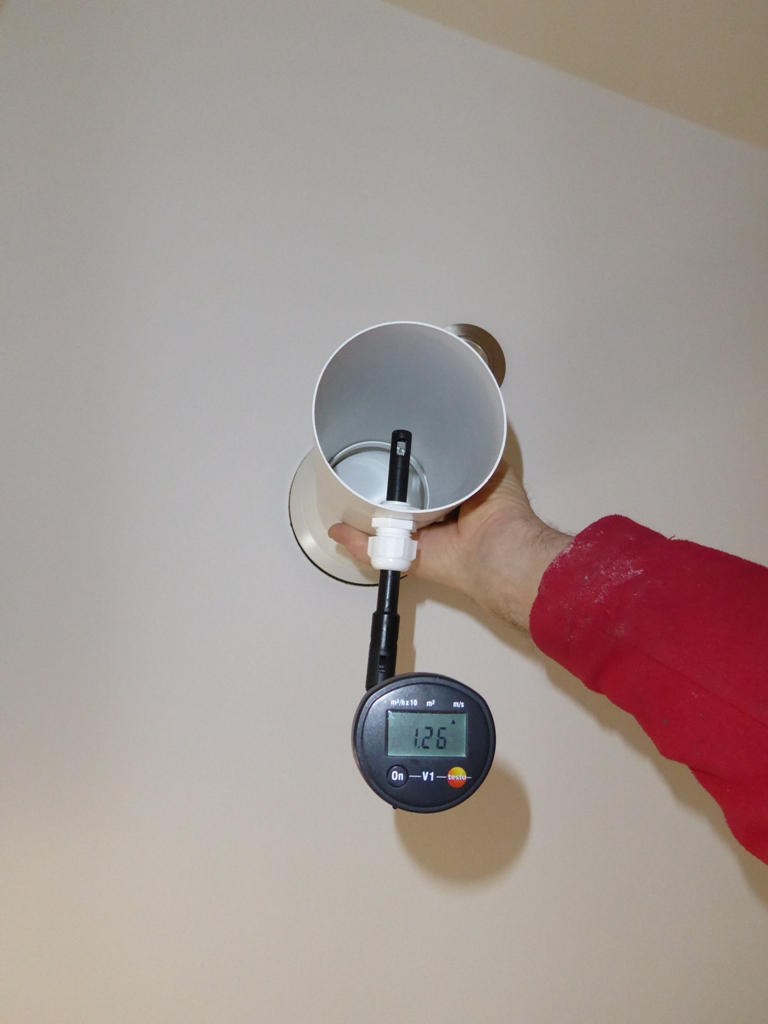
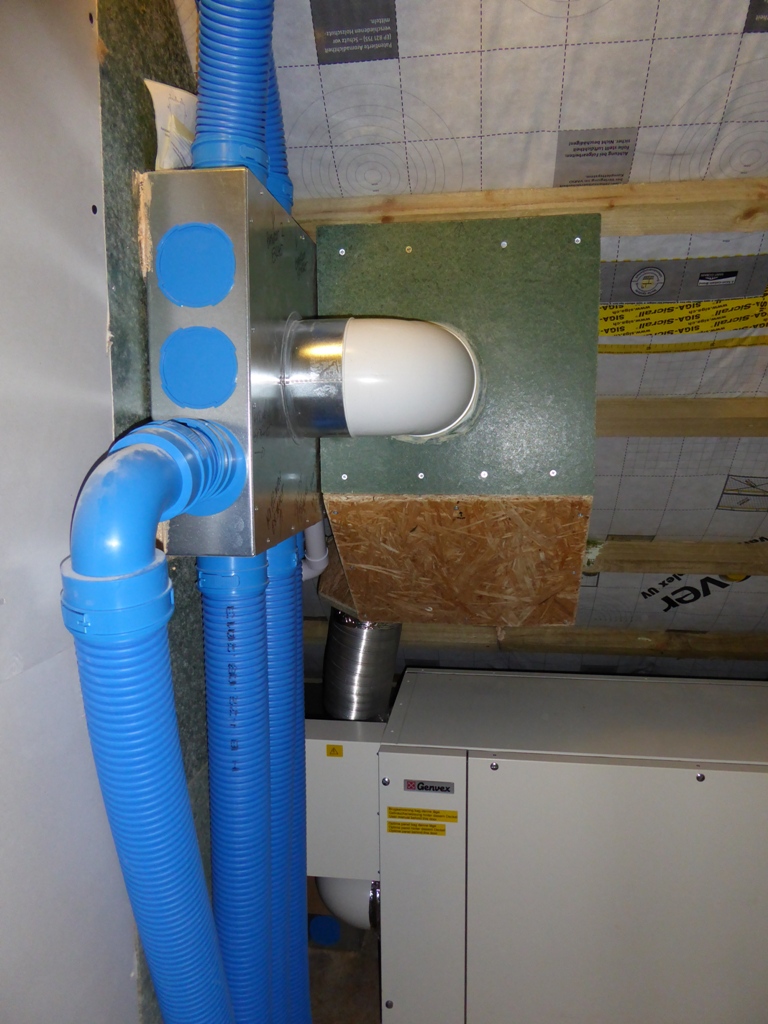
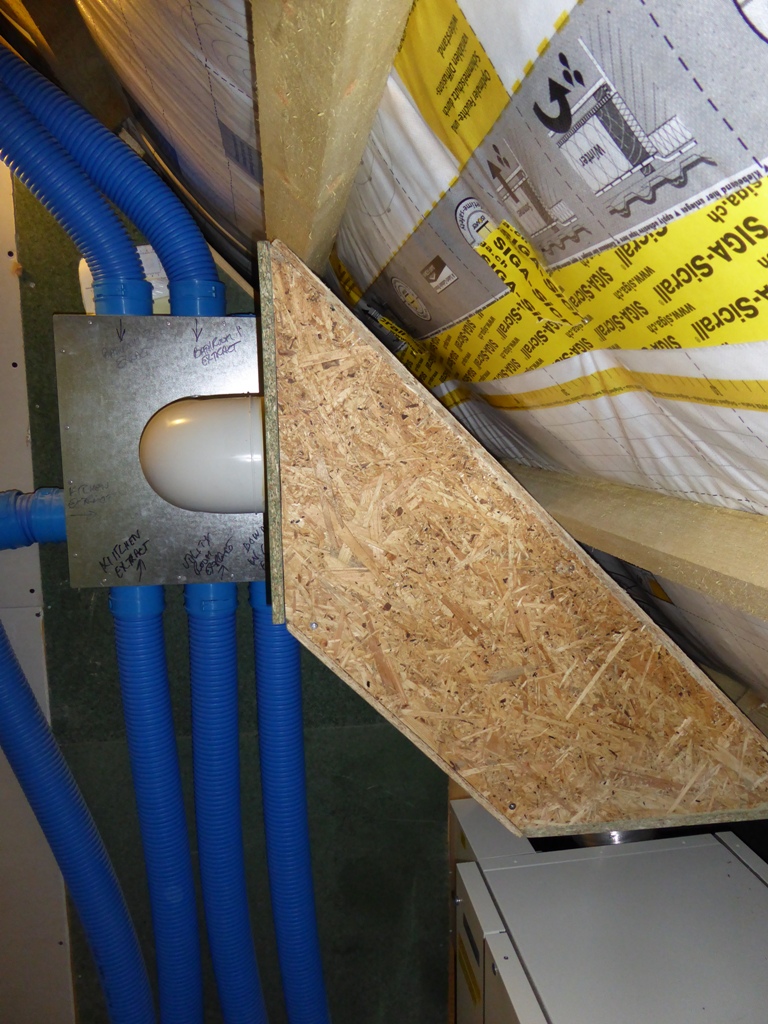
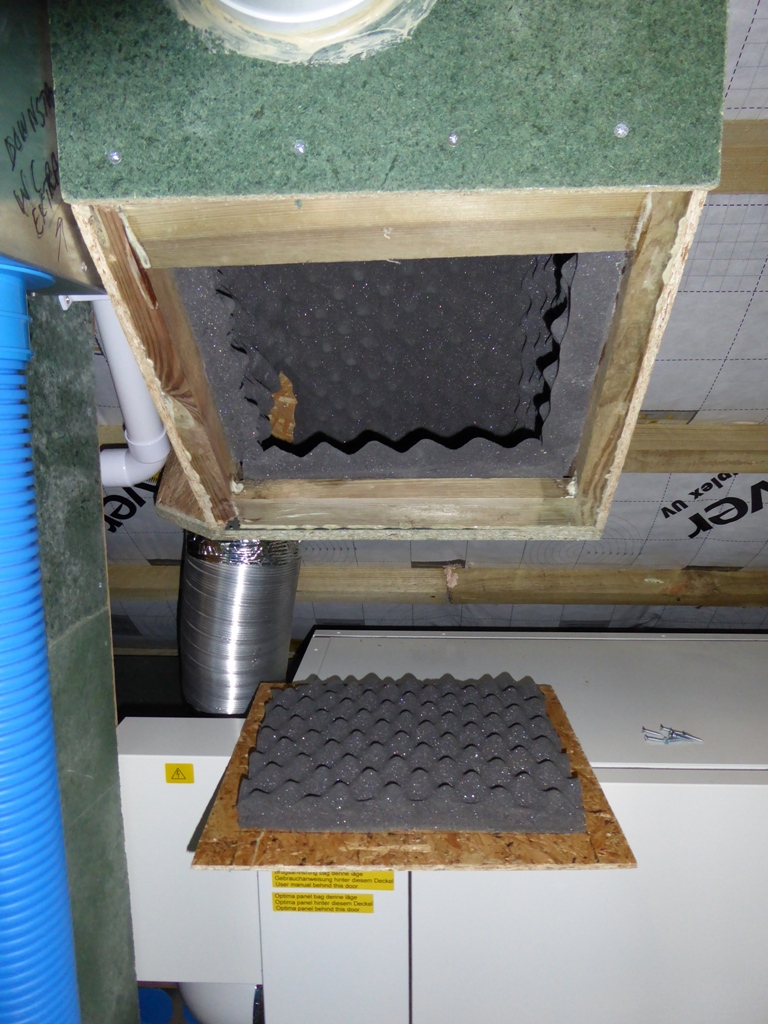
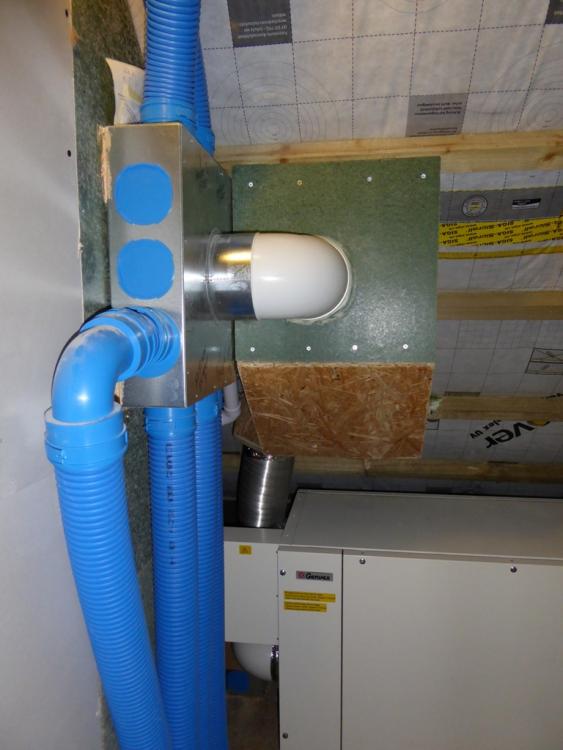
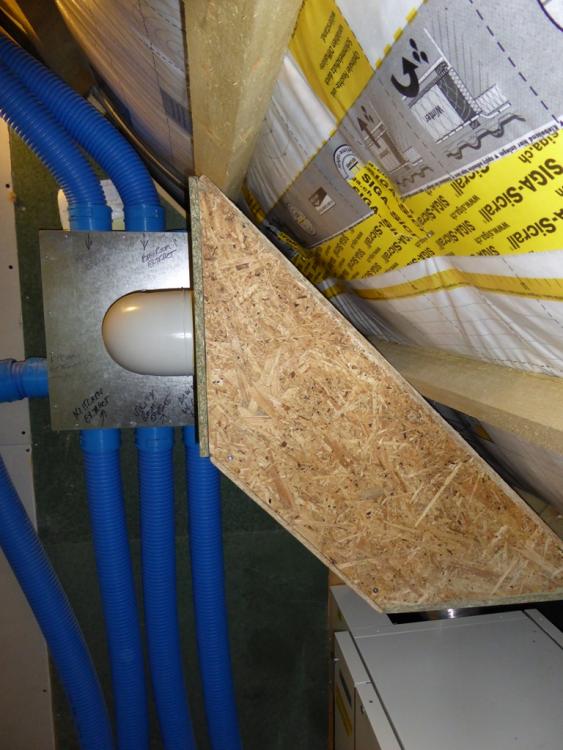
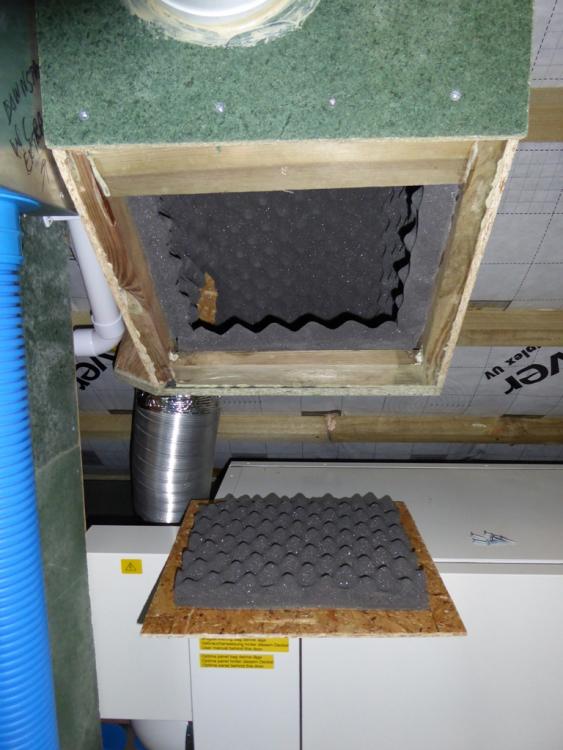
All I can comment on is the way I designed our system, based on first principles of air flow in ducts, the building regs requirements (which are more than a little odd in places) and our personal desire for a silent system in normal use. I also wanted to DIY the install, and had no skills in working with ducts. I started with putting terminals on the CAD plans where there would be the longest possible air flow route through a room, to allow the longest transit time and ensure the best possible chance that the air coming into the room would diffuse out across the whole room volume. The logic of this applies equally to extract terminals, as they are pulling air in from under a door, or through a doorway. For example, in our living room the entrance door is in one corner, so the air feed terminal is in the ceiling of the diametrically opposite corner. Next I looked at duct systems, and concluded that the Swiss designed HB+ (made under licence now by around three or four companies) 75mm OD, "semi-rigid" smooth bore plastic ducting was the easiest to DIY install. I bought a sample terminal and duct fitting on line, had a good look at it, and decided that's what I'd use. Running the ducting was, realistically, something that could only be outline designed first, as the alignment of the ribs in the Posijoists dictated where the ducts had to go, and my CAD plans didn't have the exact position of every joist rib! So, I put all the ducts in, and for safety ran double ducts to the kitchen extract terminal (the HB+ original design includes provision for two ducts per terminal - not all the copies of it do). Once all the ducts were in and I knew the exact fitted length, the radius and position of curves in the ducts and the exact positions of the manifolds, I went back to first principles to calculate the flow rate in each duct at the building regs mandated ventilation rate. I found that I was generally within the low noise range of under about 2.5m/s in most of the ducts, except for the longest run, to our bedroom, where I was around 2.8 m/s at 3/4 of maximum boost, and over 3m/s at full boost. I decided to just see how it panned out, as I could, if need be, run another duct to that bedroom along the eaves space if it turned out to be too noisy. I hooked up the MVHR, mounting it on old-style Mini exhaust rubber bobbins (there's a bit here about it: http://www.mayfly.eu/2014/04/part-thirty-mvhr-details/) and made an error, in not fitting the recommended silencers in the main ducts that feed the manifolds. This was me thinking the plenum effect in the manifolds would act as silencers, I was wrong! I then set about setting the system up, by fitting restrictor plates inside the manifolds to control the flow rate in each duct. I made up a home made flow meter, by buying a (still in calibration) second hand hot wire flow meter from ebay for around £30, and then gluing some PVC duct reducers and pipe together to make a cone and flow straightening pipe to take the flow meter. Here's a photo of it in use - anyone is welcome to borrow it, but it's no longer officially in calibration (not that I think for one moment that matters much - these things are very stable unless damaged, and BC seem not to be bothered): To be honest, balancing the individual ducts was the worst part of the job, as it meant doing a measurement at a terminal, seeing what the flow was, running upstairs, opening the manifold, adjusting the restrictor plates by punching different rings out, then going back and repeating the exercise. What's more, there are interdependencies, because the plenum pressure changes with every flow adjustment................ Thankfully it's a one-off task, and because there's no flow adjustment at the terminals, the noise is lower and you can pop them off and stick them in the dishwasher to clean them, without fear of messing up the flow rate settings. I mentioned earlier that I didn't fit silencers, even though Genvex said they should be fitted to the room side of the unit (fresh air feeds and extracts). The reason was there wasn't room to fit ready made silencers, and as above I wrongly thought the plenums would do the job. So, I ended up making custom built absorption silencers, lined with acoustic foam (the fire resistant stuff). They aren't pretty, but they work incredibly well, there is no noise at all from any duct, except when the system is on full boost, and even then the noise is only just audible, and not enough to disturb sleep (not that it's likely that anyone in our household would be sleeping when the things on full boost, anyway. Here are some photos of one of my custom built silencers, the extract side one. The fresh air feed one is just a rectangular box, lined with acoustic foam and sat directly onto the top of the extract manifold, which is on the floor, out of sight behind and to the left of the MVHR. Front view of extract silencer Side view of extract silencer Internal view with the front cover unscrewed Not sure if this helps or hinders, Mike, but we did end up with a system that changes the air in the house about once every 2 1/4 hours, seems to keep it very well ventilated and is pretty much silent. Several people here have visited and heard it running, and they may well be able to give an independent view as to whether they thought it was as quiet as I think it is!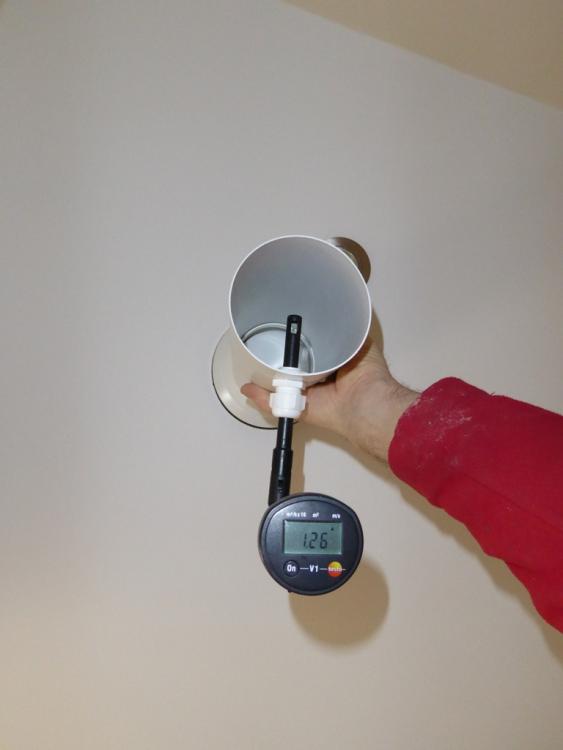
-
It is, and it can be addressed if anyone has the will to do so. My last job involved having some new labs and offices built and we were stung for around £300k in S.106 charges. They were all listed, and were mainly road improvements, like fitting a junction with traffic lights, making a bit of road cycle-friendly and improving a notoriously dangerous T junction. I read the agreements carefully when they came back from our legal people, and the standard conditions were included. These state that the payment of the S.106 monies had to be made before the buildings were first occupied, that the monies were listed against specific road improvements, and that if the local authority failed to undertake the stated improvements within 5 years of the payment of the monies then we were entitled to that money back, plus interest at 1% (I think) above the B of E base rate for the five year period. In general, ********** Council made their road improvements very quickly, within three or four months of the payments. ********** Council were totally different, and didn't undertake any of the work at all. After five years I rang my successor to remind him that he needed to get the S.106 back, as I'd driven along the hill and seen that the road junction work hadn't been done. He got the legal people to claim it back from the council, with interest. Sadly the bit of road that was to be improved using that money is now even worse than it was. Sometimes I really don't understand how local authorities can be so stupid. I think the main issue is probably that very few developers ever look back to see if S.106 work was actually completed, and the S.106 is considered to be an official bribe to get PP, so written off by them at the time of payment. If I'm right, then it would seem that some local authorities just keep the S.106 money and use it as general funds, which is specifically against the way an S.106 should operate.
-
I think some of it is to do with the design approach, too. Taking a standard design and trying to improve the airtightness and overall thermal performance is probably going to be a fair bit more expensive than coming up with a new design that is specified from the start to meet higher performance standards. My informal observations around building sites, and visiting houses being built by companies who were contenders for our build, indicated that the majority were taking a "sticking plaster" approach to getting better performance. I'm certain this adds a fair bit to the cost, as, for example, trying to get a conventional trench foundation system and cavity wall house to a spec much above building regs minimum levels requires a lot of work in detailing. I'm pretty much convinced that the conventional block/brick cavity wall type house is right at the end of its development cycle, and that to take the next step towards improving energy efficiency builders really need to look "out of the box" at new methods of construction. Unfortunately, there seems a fair bit of reticence amongst builders to build something they are unfamiliar with, and although I can understand that, I do think it's holding back performance improvements in our new housing stock.
-
Interestingly, there doesn't seem to be a direct correlation between build cost and thermal efficiency, as far as I could tell when going around getting quotes. One thing we did experience was companies quoting for their "standard" product when we'd specifically asked for an insulation and airtightness spec. It did mean that we got to compare things like the price of a standard 140mm SIPs frame, that just met building regs, with a passive house spec frame that significantly exceeded them. In one case (I won't name the company, but they were the most expensive of those we approached), their 140mm SIPs offering, on a passive slab foundation, was 20% more expensive than the passive house spec company we used in the end. I have a feeling that self-builders are treated a bit differently when it comes to pricing by some companies, but I've no real evidence to prove it. There seemed to be an analogy, at times, between self-builders paying through the nose in the same way yacht owners do if they aren't careful. When I owned a boat I always bought stuff from the "fishermens" chandlers, rather than the "yotty" places, as it was often half the price................
-
Electric shower vs. instant water heater
Jeremy Harris replied to Crofter's topic in Bathrooms, Ensuites & Wetrooms
In the 16 years I lived down near you, I can't ever recall having an immersion heater fail, so I suspect the water isn't as acidic as that in some areas of Scotland. Our kettle used to always look like that when we lived down there, too! One thing we did notice in Scotland was that the water always had a brown tinge. We rarely used the bath, but when we did a full bath looked like it was filled with weak tea.