Jeremy Harris
-
Posts
26430 -
Joined
-
Last visited
-
Days Won
360
Everything posted by Jeremy Harris
-

What would you do about this?
Jeremy Harris replied to recoveringbuilder's topic in Building Regulations
I agree, 30mm would almost certainly not be noticed by a BCO. The existing staircase looks as if it might fit OK if against the wall, so one option might be to just wait until the house is signed off and then move the staircase over and adapt the landing to suit. -
Ban on Sale of Coal / Wet Wood
Jeremy Harris replied to Ferdinand's topic in Stoves, Fires & Fireplaces
My brother used to supply seasoned firewood as a sideline to his landscaping business, gave him an income stream in the winter, when landscaping work tends to go a bit flat. He converted a Dutch barn on the farm for seasoning cut logs, used to stack them up on a floor made from pallets, to get air circulating underneath. He charged a premium for dried (usually 18 months to 2 years old) hardwood logs and made a reasonable income for a few years. The problem he found was that there were always suppliers undercutting him by selling what were claimed to be "dry" logs, but which were really cut a few months earlier. Lots of people just buy on price, and seem not to care about getting a clean burn and a decent heat output. There are, sadly, a lot of ignorant people who will burn anything, and who don't give a damn about the consequences. This isn't helped by the way bags of wet logs are sold at places like our nearest filling station. Some look like they were only felled a few days earlier. -
Do I need an air tightness test??
Jeremy Harris replied to selfbuildrookie's topic in Building Regulations
Our build company provided a guarantee that the house would be 0.6 ACH at 50 Pa or less ( they actually achieved 0.43 ACH @ 50 Pa when the house was tested). The final payment of 20% of the total contract price was dependent on them meeting this requirement. I'd be inclined to try and get a builder to contract to meet the spec you want, TBH, just to save pain and grief down the line. -
Ban on Sale of Coal / Wet Wood
Jeremy Harris replied to Ferdinand's topic in Stoves, Fires & Fireplaces
The concern with coal and wood burning isn't so much the CO2, but the harmful particulates. There's plenty of evidence to show just how harmful they are relative to vehicle emissions. I recall comparing the particulate emissions from wood stoves to that from diesel cars some time ago. Can't remember the exact numbers right now, but one wood burning stove is roughly equivalent to having several diesel cars parked on your drive with their engines idling, in terms of particulate emissions. -
The UPS could be an off the shelf one, with all the various power bricks needed plugged into it. I only opted for a DIY solution because I fitted the modem at the other end of the house from the rest of the kit, and once I'd decided that we needed battery back up it seemed to make sense to just power everything via DC from the batteries.
-
How to dismantle a sofa for disposal...
Jeremy Harris replied to Ferdinand's topic in General Self Build & DIY Discussion
I suspect it depends very much on where you live. There is a charity in Salisbury that help the homeless, and they both look for furniture to use for accommodation they find, and sell it in their shop to raise funds. They were more than happy to collect stuff from us. I found Freecycle very effective at getting rid of stuff, too, but you need to be aware that there are a few entrepreneurs operating within Freecycle that take stuff and then sell it on Gumtree, eBay etc. I gave away a boat (not allowed to sell it as it was home made, so under EU regs couldn't be sold), then got contacted by a chap miles away in Somerset who'd seen an article I'd written in a boating magazine and expected me to provide an after market service. He wasn't a happy bunny when I told him that the boat had been given away free, as it was unlawful to sell it. It might be possible to vet Freecycle people, perhaps. Maybe arrange to meet them on neutral territory and sound them out, first. -
How to dismantle a sofa for disposal...
Jeremy Harris replied to Ferdinand's topic in General Self Build & DIY Discussion
If you don't want strangers coming around (which I can fully understand in the circumstances) then how about one of the charities that collect stuff for free? We have a couple locally, who were only too happy to take some of our left-over furniture, and as @ProDave says, they are a well respected make and look to be in fairly good condition. The charity that collected our surplus wardrobes came around in a small furniture van with a couple of chaps and had them out of the house and away in ten minutes. -
I run all our home network stuff from a home made UPS, for just this reason, although we've not gone as far as getting VOIP 'phones. We used to get quite a few power cuts, and losing connectivity was a PITA, especially as a lot of them would only really be brown outs; enough to cause the modem and router to reboot, and they took far longer to come back up than the duration of the brown out. It's also slightly more efficient to have everything powered from DC, I think, as the UPS power supply feeds a constant voltage to a bank of sealed lead acid batteries and then the DC from those runs the modem, router, switch etc, via PoE.
-
Not sure it's standardised, TBH, as I've found that some fittings seem to have a much finer thread than others (caught me out when swapping over one make of valve for another once).
-
Temporary heat source for UFH: Willis heaters
Jeremy Harris commented on oranjeboom's blog entry in Kentish RenoExtension
It comes down to the maximum volume of water in the unit/system, I think. I'll see if I can dig out the relevant bit of the regs later, it'll be buried away in Part G somewhere. Edited to add: Found it. The regs are relaxed for systems with a total water volume of less than 15 litres, which is how the boiling water taps etc can get away with not having to run vent pipes as shown above (I think the boiler on ours holds about 5 litres, or thereabouts). A UFH system with a couple of Willis heaters is probably going to be over 15 litres. As a rough guide, 100m of 16mm UFH pipe holds about 11.3 litres of water. Not sure what the volume of a Willis heater is, but the chances are that you've got more than 133m of UFH pipe, anyway, so will be over 15 litres system volume.- 159 comments
-
- 1
-

-
- willis heater
- ufh
- (and 1 more)
-
The arguments for running it all the time, versus only at set times, really come down to the nature of the system and personal preference, I think. In reality, an ASHP that's on all the time, even an inverter controlled one, will cycle on and off when the heating requirement is modest, as there is a lower output power limit, not determined by the variable frequency drive inverter, but determined by the range over which the variable expansion valve can operate. We have a small inverter controlled ASHP, and although it may appear from the flow temperature display that the unit is operating all the time, in reality it's regularly cycling on and off at low output levels, as can be seen from the power meter we have wired in line with it. Our ASHP (rated at 7 kW max output) can't deliver less than about 1.5 kW output, that's as low as the refrigerant control valve will allow it to continue working. All variable output ASHPs will have this limitation. As our house rarely needs more than about 500 W or so of heat, the thing cycles on and off a fair bit if left on all the time. I prefer to only run our ASHP for ~7 hours overnight, both because it's a lot cheaper to only run it at the E7 off-peak rate, and because that results in lower grid emissions from our electricity usage (the grid tends to be a bit less carbon intensive overnight in the heating season). This works for us as the floor slab retains a lot of heat, which then keeps the house warm through the following day and evening. It also means that the ASHP tends to work a little bit harder overnight, but the advantage of that is that it usually doesn't cycle on and off as much.
-
Do I need an air tightness test??
Jeremy Harris replied to selfbuildrookie's topic in Building Regulations
Yes, challenging in the sense of the impact it will have on meeting the overall requirements in Part L1a. -
Do I need an air tightness test??
Jeremy Harris replied to selfbuildrookie's topic in Building Regulations
There are only two cases where you don't need to do an airtightness test: The first is if the house is part of a small development where no more than two houses are to be built, and where the builder has demonstrated compliance on another house of the same type, with a pressure test, within the preceding 12 months. The second is if a default value of 15m³/h.m² at 50 Pa is used when calculating the DER. The first case almost certainly doesn't apply to most self-build, I suspect, and the second case will be challenging to meet, as it implies a pretty dreadful air permeability level. -
Just the one cable is all you need.
-
Welcome. Generally there's no requirement for drain runs to follow any plan, all they need to do is be compliant with building regs. They should be inspected by a building inspector, but with a new build that's part of a larger development not every house may get fully inspected. The key thing is that the drains, both surface and foul, have to comply with the requirements in Part H ( https://www.gov.uk/government/publications/drainage-and-waste-disposal-approved-document-h ). As long as the builder is complying with the regs, then all should be OK.
-
We've found that our 52mm thick triple glazing is pretty effective at reducing noise levels. The only sounds that are really noticeable through it are when heavy rain is blowing directly at it. Traffic noise etc is very well attenuated. Most of our windows use a 4mm - 20mm - 4mm - 20mm - 4mm section, and I suspect that it's the two 20mm spaces that make the difference. We have some glazing in the doors that's thinner, with a 6mm - 16mm - 4mm -16mm - 6mm section and that's not as good at keeping noise out, although still much better than the double glazing at our old house.
-
The panels we were planning to use initially were made by a company called Unisolar: http://uni-solar.com/ Their UK distributor seemed to just disappear overnight, some time in 2013. I've had a quick look around and can't seem to find them for sale here though.
-
I'm concerned about the real level of soundproofing that you will get from two facing doors. When I was working I used to stay away in hotels a lot, and some rooms use the two facing door method to form a sound lobby and some arrange the doors to be at right angles to each other. The ones with doors angled to each other were a great deal quieter than the ones with the doors facing. Hotel rooms generally have pretty heavy fire doors on rooms, so are probably better at keeping noise out than most domestic doors. The other experience we had was a house we lived in years ago that had two parallel extensions out the back, separated by a gap that was a bit over 2m wide. Sounds used to reverberate in that space, enough for it to be annoying when trying to watch TV. I'm not sure exactly what the problem was, but suspect that it may have been similar to the effect you get when walking through an alleyway, where any noise seems to get amplified by reflections from the walls. I think it would be pretty straightforward to make a dividing wall very well soundproofed, without an air gap. There is a lot of information about doing this available, as it's a common problem, plus there are standards now for reduction of noise transmission through party walls. A lot of commercial buildings have a need for high levels of sound attenuation between rooms, too. We had labs at work where we needed to separate areas than needed to be extremely quiet from areas where there was equipment making a fair bit of noise, and the designers of the building did a very good job at making the walls attenuate noise. Might well be worth looking at how much attenuation a well-designed wall would give, and also look at ways to reduce sound from reflecting from surfaces. This latter point can be as important as making the structure fairly soundproof, by reducing the sound pressure level right at the surface of walls.
-
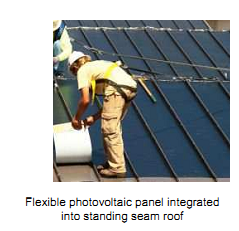
We were going to use them originally, and our planning consent included dark grey standing seam roofing with very similar flexible panels to those you've shown. A fair bit lower in efficiency, but they seemed a bit easier to install. The only tricky bit seemed to be getting the cables to run neatly. My plan was to run the cables from the top, along the ventilated ridge. We had to change our plans and get our planning consent amended, as the company that were selling the flexible panels disappeared, and we couldn't find an alternative at the time. Here's the photo that I included in our D&A Statement, showing the roof detail:
-
Our external walls are essentially two stud walls, made from 38 x 89 timber, clad on the outer surfaces with board, with the 300mm gap between the outer skins filled with blown cellulose. It's a bit spooky as to how well this attenuates sound. Our front wall is adjacent to the drive and we can't even here big trucks backing up. Usually the first we know that we have visitors is when the door bell rings, or if I spot them on the CCTV. It takes a bit of getting used to, though, living in a silent house. It would be very easy to use the same construction method for in internal wall.
-
I agree with the above about the 1.95m gap. Just making a thicker internal wall will give the same level, probably better, of sound suppression, I'm sure. Our external walls are extremely good at keeping out sound, yet are all timber. The secret seems to be the thick layer of dense blown cellulose insulation, perhaps together with the twin stud wall design, that isolates the inner and outer skins from each other. Also, if that space is external, then including it inside the envelope will reduce the heat loss a fair bit, by reducing the external wall area. Challenging set of requirements, for sure!
-
Not sure your conclusions about the apparent COP are valid TBH, and may be a bit misleading. COP for any particular ASHP is almost entirely determined by two main external factors; the temperature differential between the outside air temperature and the heat pump flow temperature, and the humidity of the outside air. The flow temperature doesn't normally change at all between leaving the heating on all the time or having the heating come on and off, so any change in COP you're seeing has little or nothing to do with how you're choosing to run the heating. The most probable cause for a slightly better COP, aside from mild weather, is possibly a change in the average humidity over this period. Moist air contains more heat than dry air, as the heat exchanger in the heat pump can condense the moisture out and recover heat from the water vapour as it changes phase from gas to liquid. Also, the point about switching a heat pump off during the day being less efficient is incorrect. There are significant advantages to only running a grid powered heat pump overnight, and having it turned off during the day, as the grid tends to produce much lower CO2 emissions during the night than it does during the day. Running costs are also almost halved, as overnight electricity can be around half the price of day time electricity. It doesn't matter where you buy your electricity from, as there is only one national grid supplying every home and business, so all the "green" suppliers do is effectively buy offsets so that someone else pays for the CO2 produced by the energy they re-sell. It doesn't make the grid any less carbon intensive to use a "green" supplier, other than possibly some of their revenue being directed towards building more renewable generation, perhaps (not sure that's true, really, either). If you want to check the emissions from the grid at any time, then this site is useful: https://gridwatch.co.uk/co2-emissions . You can check the current grid emissions from that site at any time to see how "green" the electricity is that you are consuming. Finally, we run our heat pump from 00:30 to 06:30, during the off-peak period, and let the heat stored by the UFH in the floor heat the house for the remainder of the time. This is close to the least harmful way to use electricity, in terms of the impact on emissions.
-
The tree removal, as site preparation work, should have been zero rated for VAT, but now you've paid it I'm afraid you can't claim it back. You could try asking the tree contractor to refund the VAT charged in error, perhaps. Fees for things like surveys attract full rate VAT normally, so you have to pay it I'm afraid, and you can't claim it back, either. The exception is if the setting out work is done by a contractor that's also doing ground works, foundations etc, as a part of a package, when the setting out fees can be included in the package and zero rated.
-
Temporary heat source for UFH: Willis heaters
Jeremy Harris commented on oranjeboom's blog entry in Kentish RenoExtension
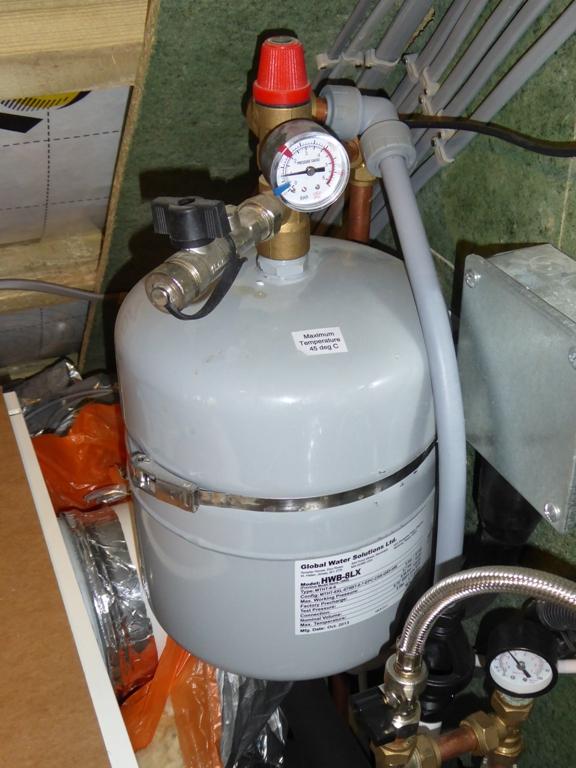
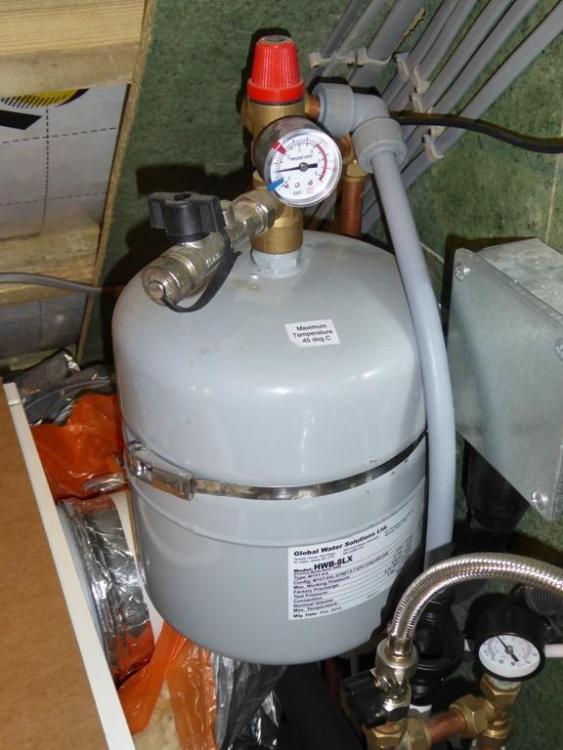
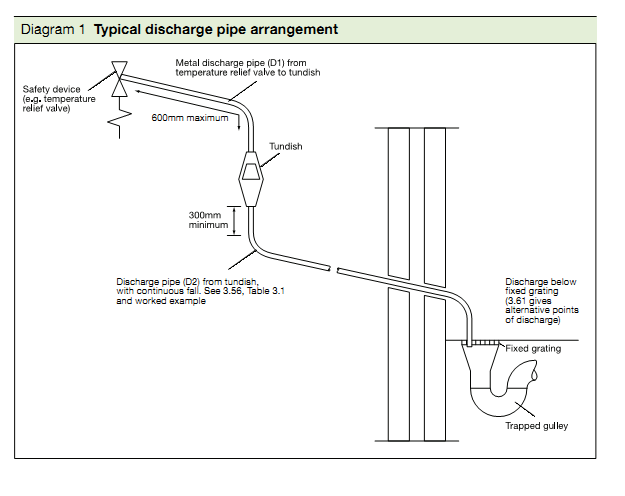
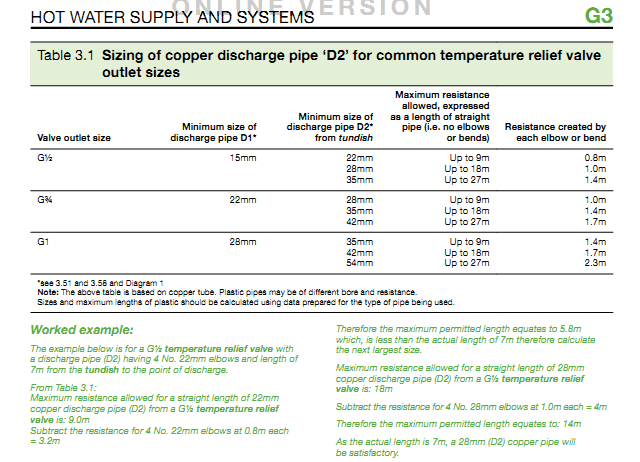
Not sure if this helps or not, but I've just taken a couple of photos of our UFH expansion vessel: The bit with the cap on at the front is the fill loop connection. I've added red and blue max and min markers on the pressure gauge, just so I can see at a glance if it's in the right zone. The fill loop is the flexi that can be seen at the bottom (I use the same flexi to fill the UFH and the buffer tank, they are separate). The feed down to the UFH is the copper pipe right at the back. The bit of grey pipe is the overflow from the PRV, OK in this case as the maximum temperature is restricted by the ASHP, so plastic is OK in this case. If there is a risk that the temperature could get very high then the overflow needs to be in copper. The black plastic tundish can just be seen at the bottom of the pic. Here's another view showing the tundish fitted to the waste pipe: The drain from the tundish feeds down to a large diameter drain that runs through a trap downstairs. This trap is kept topped up by the water that is drained from the water softener, so cannot dry out. The same drain is also used for the PRV outlet on the buffer tank (that one is set to 1.5 bar, because of the tank limit) and again plastic is OK as the buffer cannot ever exceed the ASHP maximum temperature (the ASHP cannot ever get hotter than about 60°C even under fault conditions). For Willis heaters I think you would have to assume that, under fault conditions, the water could exceed 100°C (because of the pressure) and so make sure that the overflow, tundish and drain followed the requirements in the regs for the safe discharge of boiling water and steam. Details are in Part G3: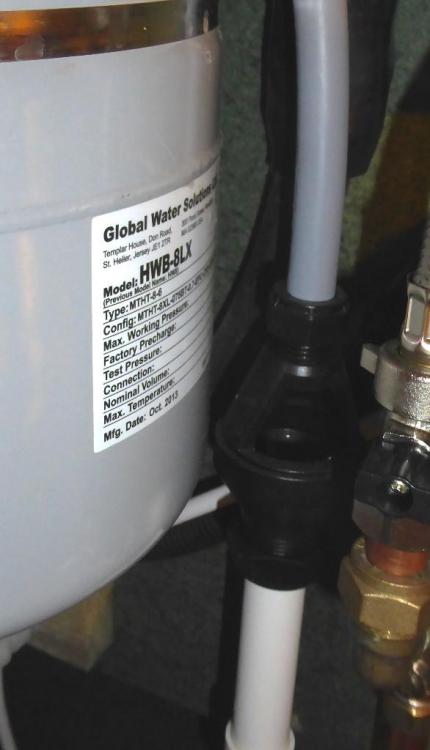
- 159 comments
-
- 2
-
-
- willis heater
- ufh
- (and 1 more)
-
I'm out of this debate, as it's getting personal now.