


Jeremy Harris
-
Posts
26430 -
Joined
-
Last visited
-
Days Won
360
Everything posted by Jeremy Harris
-

Is this one reason there is a permanent UK housing crisis...
Jeremy Harris replied to Bitpipe's topic in Housing Politics
I've worked within several different flavours of government, and honestly could not distinguish between them in terms of party. When I started work, there was a Conservative government under Heath, that was almost unbelievable in terms of the way it tried to deal with inflation (by creating inflation). Then there was the Wilson government, the highlight of which was the massive rise in unemployment, followed by Callaghan. The memorable feature of this time was that inflation seemed to be sort of under control, but ended up with the country in industrial turmoil, with strikes etc galore. The Thatcher years started well, but quickly became probably the worst government I ever worked for. I felt a deep level of discomfort at the way she increasingly seemed to take on the role of Head of State, rather than just Prime Minister. She was, I believe, a significant cause of the selfishness we see in society now. I dearly wish that the Falklands conflict had never happened, both because I'd still have three friends who were killed and because I believe that Thatcher would probably not have been re-elected without it. Major ran a surprisingly competent government from my perspective, despite the public image he had. The notable thing about his period of office was that he was pretty effective at getting the Civil Service to work well, probably the only PM who made some sort of effort to ensure things got done within government. Then there was Blair, the second worse period of government that I had the misfortune to experience, and someone who was remarkably similar to Thatcher in many ways. It's a toss up as to whether he was more or less despicable than Thatcher, in my view. Thatcher was at least honest, if deeply unpleasant, whereas Blair was inherently dishonest and constantly tried to corrupt government from within by trying to get the Civil Service to break all long-standing codes of conduct and lie for him, or support his own lies. Colleagues resigned and gave up their pension rights over some of Blair's antics, something that I never saw happen under Thatcher. Gordon Brown was pretty much a non-entity as far as any impact he had within government itself. I suspect he was too focussed on the economy to be bothered with how his government actually worked. Cameron was PM of the last government I worked for , and he was only in office for a short time before I retired, so I didn't really have time to form a view. The only notable thing as far as I was concerned was that he took right and proper steps to reduce the size of the Civil Service quickly after coming into office. Should have been done years earlier, as it had been allowed grow out of control when Blair and Brown were in office. -
I suppose there's also an argument that the "MCS premium" was just redistribution of the government subsidy, from those that invested in systems to those that installed them. Looked at from a monetary perspective there was may even have been a short term benefit to the government that was greater than the FiT subsidy payments, in that a part of the MCS premium would have ended up as tax revenue. Be interesting to try and see how the numbers work out.
-
Is this one reason there is a permanent UK housing crisis...
Jeremy Harris replied to Bitpipe's topic in Housing Politics
@Delicatedave, Depends what you define as investment. Pretty much all government revenue comes from taxation, and most of that revenue ends up being spent on stuff within the UK. Whether government should invest in stuff or whether that investment should be left to private enterprise is a good question, though. My experience of managing a fairly large government procurement, and having seen the results from quite a few other major procurements, is that, in general, the government (any government) is pretty incompetent. Government systems mean that there is a high degree of risk averse behaviour, and this drives indecision. Every entity that does business with government knows this, and has learned how to turn it to their advantage. I would say that government should avoid any form of direct procurement of anything if at all possible. The programmes I've been involved with that have allowed a main contractor to make investment decisions, with appropriate incentivisation so as to drive costs down, have, without exception, been delivered on time and under budget. Those managed by government directly have all, without exception, come in late and over budget. Having spent 35 years as a Civil Servant, the very last thing I'd ever want to see is the state running any form of industry. The level of incompetence within government has to be seen to be believed. When you say "we as a nation are not looking after our own people " who is the "we"? I think the biggest failing we have in modern society is that people never seem to think it is their responsibility to earn a living, save for their retirement, spend time caring for others, be unselfish etc. It seems we have a culture of selfishness, where it's all about greed and a sense of entitlement. We need to change things so that this crazy view that the state should somehow look after people as if they were children all their lives is knocked into touch, so that the majority who can work, do work, and contribute to the funding needed to look after those who, for whatever reason, either cannot earn a living or need care. -
Good question. We generate a bit under 6 MWh/year, from a 6.25 kWp PV installation. We're on the older 50% deemed export arrangement and our export payment (which is currently 5.38p/kWh) comes to about £160/year. We export pretty close to 50%, despite diverting excess generation to heating hot water and charging my car, and trying to use the dishwasher and washing machine when we're exporting. Days when we generate over 30 kWh are pretty common in summer, and we can only soak up so much of that in heating hot water etc. To get an answer as to whether the additional cost of an MCS installation can ever be recovered we need to know what the MCS premium is for a PV install. My guess this has come down a bit from the profiteering days when massive premiums were being added, as the remaining PV installers struggle to retain business. It's probably nothing like the doubling of the true installation cost that we see with things like heat pumps, and which may well have been the case during the PV boom years. Even if the MCS premium is only around £1k, then it looks like it would add significantly to the payback period for any installation, just from the export payment, and I'm inclined to think that a non-MCS installation, so foregoing the SEG payments, might make more sense, especially if there is a real effort made to maximise self-consumption. I've been thinking for a long time about adding battery storage to increase our self-consumption, but even for a DIY install it looks marginal in terms of any return on the investment.
-
House naming..need inspiration
Jeremy Harris replied to SuperJohnG's topic in General Self Build & DIY Discussion
One of our "banned" words was Willow, along with Mill and Orchard! We ended up with Mayfly Barn because I'd already been using the domain name Mayfly for years, we found the new house covered in dead or dying mayflies from the stream a couple of years ago, and there used to be a barn and stable on our plot from the date of the earliest map we could find (about 1780) until about 1980 when they were pulled down. Being clad with larch the house also looks a bit like a barn. -
House naming..need inspiration
Jeremy Harris replied to SuperJohnG's topic in General Self Build & DIY Discussion
Not sure about Scotland, but here you have to follow the local house naming guidance and have any proposed name approved by the local authority (who charge you for the privilege). We were given a list of words we could not use in a house name, some because of common sense and some because those words were already in use locally. -
Is this one reason there is a permanent UK housing crisis...
Jeremy Harris replied to Bitpipe's topic in Housing Politics
Hard to answer, but in practical terms most of the money that the government spends is spent within the UK. Sure, some high profile projects make it seem as if this isn't the case, but a look at our balance of payments shows that the money we spend outside the UK isn't much, when compared to the massive chunk spent within the UK. Whether we like it or not, we're just a small island nation that used to be an industrial and manufacturing hub, but which has become a financial and service sector hub over the last 50 years or so. Some may look on that as being the choice of a government, but the reality is that there are some truly massive industrial and manufacturing nations that can produce stuff for a fraction of the cost that we can. If the UK wanted to remain an industrial and manufacturing centre then the only way to do that would have been to drive down costs, and it's a hard fact that a major element of manufacturing cost is wages. If the UK wanted to compete with, say, China, then it would need to reduce wages and increase productivity to match. I cannot see any government being prepared to support a policy of wage reduction, in order to remain globally competitive. What's become clear over the past few decades is that governments (with the exception of totalitarian regimes) do not have much control over what happens to society within the nations they govern. The greatest influences on society here are probably big US corporations, like Facebook, Amazon, YouTube etc, who can literally shape the way large numbers of people think and behave. -
Is this one reason there is a permanent UK housing crisis...
Jeremy Harris replied to Bitpipe's topic in Housing Politics
Not sure about this, really. I believe that sometimes people vote for people (or things) because they believe they won't change their personal circumstances in a negative way, and sometimes vote for people (or things) because they are annoyed, fed up or just disillusioned with the way things are going. I believe that one thing that the very much faster pace with which "news" and information travels now has radically changed the way people vote. Once upon a time many people just voted on the basis of what they read through the filter of their chosen newspaper, or what they heard on the radio or TV. Now that information space is dominated by social media opinions and "influencers", who in turn are being hijacked by those who wish to push a particular narrative. The one positive thing to come from this is that there now seems to be a growing scepticism regarding some that much of the popular material spread via social media is either misleading or just completely untrue. I think we have to thank a few high profile social media users for highlighting this, albeit unintentionally in the case of a few. Maybe the message that clickbait is a sure fire indication that someone's trying to spread a lie will become more widely accepted, but somehow I doubt it. There seems to be a section of society who will always want to believe the impossible, or improbable, it's how some of the more infamous tabloids have been so popular for decades. -
Private water treatment - space needed?
Jeremy Harris replied to Rendall's topic in General Plumbing
Depends almost entirely on the quality of the water coming in. The first thing to do is get a water sample analysed, as that will tell you pretty much all you need to know. For example, these are the test results for our borehole water, with the maximum allowable values listed: From this analysis one thing stands out, the level of ferrous iron dissolved in the water is unacceptably high, at 0.48 ppm, versus an acceptable upper limit of 0.2ppm. This dictated that we had to fit a filtration system that would oxidise the ferrous iron to ferric iron, and filter out the precipitate. In turn, this filtration/treatment system needed a minimum back flush flow rate (for cleaning out the sand/Aquamandix filter bed) of about 35 l/m. 35 l/m was too high to be met from just a pump, so that meant installing two, parallel connected, 300 litre pressure tanks/accumulators to provide the initial high flow needed. These two tanks set the amount of space needed, as they are around 650mm in diameter each and stand about 1500mm high. The analysis could show anything, really, and if it's like our water, may have a significant impact on how much space you need for the filtration etc. As a bare minimum you will need space for a pressure tank/accumulator, plus a jumbo 10" filter housing (fitted with a 5µ filter) and a UV disinfection unit. The size of pressure vessel/accumulator, if not determined by things like filtration media backwash rates, will be set by how often you want the pump to switch on or off. Pumps have a recommended number of on/off cycles per day, and the more often they are turned on and off the quicker they will fail, as they only really wear during the first second or so after being turned on, before water pressure has "floated" the impellers off the internal thrust bearing. The minimum size of pressure vessel is probably about 100 litres, which will store about 40 litres of water under pressure, meaning the pump will turn on after ~40 litres have been drawn off to refill the vessel. We store about 250 litres of water in our pressure vessels, and that means we can take a couple of showers before the pump kicks in, but this is probably overkill for most houses. As our water is fairly hard, we also opted to fit a water softener, although whether that's located in the water treatment plant room or the house is really a matter of choice. I fitted ours inside the house, just to make access more comfortable in winter.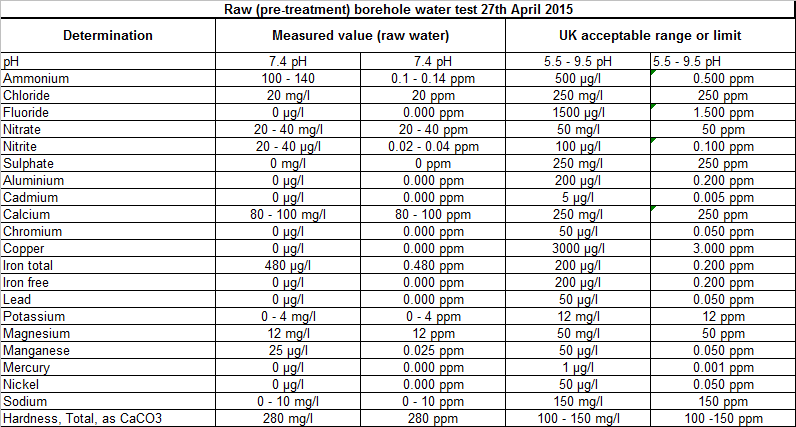
-
Is this one reason there is a permanent UK housing crisis...
Jeremy Harris replied to Bitpipe's topic in Housing Politics
I've direct experience of reporting to a government minister for a time, when I was programme manager for a fairly big procurement (at the time my delegated budget was £1.38bn, believe it or not. . . ). He was a nice enough chap, but really hadn't got much of a clue about the nuts and bolts of his job. I had a routine briefing with him once a month, for maybe an hour or two at most, and almost all of that time was spent with him trying to work out how to spin progress, and the inevitable problems that arose, further up his political food chain. I learned early on that he had zero interest in actually delivering a bit of kit that would make a real difference. I don't think it's realistic to expect any politician to have any real interest in making significant changes to society. Politicians have a very limited ability to do much, and they all, without exception, tend to prioritise staying in power (once they get there) over doing anything unpopular that has any chance of making any real difference. As @AliG mentions above, the really powerful levers for change (or rather stasis) in society are the everyday wishes of the majority. The majority vote for things that don't negatively disturb their life, and don't care too much about anything outside that. You might get some "Islington Idealists" ranting about the need for more social housing, for example, but see how they react if someone comes up with a plan to build that social housing in their back yard. Interestingly, we had a fair bit of unexpected support when we submitted our planning application. Some of those who had objected to a house being built on our plot years earlier had changed their minds. At least two of those, plus the view of the Parish Council, I think, changed their minds because the plot had become so overgrown with brambles and weeds that it was a real eyesore, and they took the view that having a house on it would be an improvement. I don't think they really wanted to see our house built, but building it was the lesser of two evils in their view. When I mentioned that the village should think about writing a Neighbourhood Plan, and include in that provision for affordable housing for people who'd grown up in the village, it received a very lukewarm response. There was a lot of noise about the need for affordable homes, but no one seemed to want them to be near where they lived. -
Yes, our experience is that this can happen. I originally started off by trying to control the slab temperature, on the basis that if that was held to a target value relative to the outdoor temperature it would effectively self-regulate. Despite my best endeavours I never managed to get this control system to work OK. I think I know why, and it was probably related to where I chose to fit the slab temperature sensor. I embedded a DS18B20 sensor in the slab, under an internal stud wall and pretty much equidistant from UFH pipes running either side. My thought at the time was that this should make the sensor relatively immune from variations in heat loss from the surface of the slab. The snag seemed to be that the time lag between heat being applied to the floor and the sensor measuring a temperature rise was just too long. By the time the sensor started to register an increase, the UFH had already pumped too much heat into the slab, so the temperature would overshoot. The overshoot could be controlled by reducing the flow temperature, which reduced the amount of sensible heat that went into the floor before the system shut off from the temperature rise. I ended up removing my control system completely and reverting to a wall thermostat. By using one that has a hysteresis of 0.1°, together with careful control of the flow temperature, I've found that that the overshoot can be kept down to under half a degree, which seems OK.
-
What's the practical difference between a thin floor with UFH and radiators, as far as this goes? Stability is going to be governed by the thermal time constant of the house, I'd have thought.
-
Is this one reason there is a permanent UK housing crisis...
Jeremy Harris replied to Bitpipe's topic in Housing Politics
My friend's mother had a real problem accepting that he had a long-standing mental health issue. He'd been on antidepressants, prescribed by his GP, for decades. They did no good whatsoever, and were completely the wrong sort of treatment for him, but back then GPs seemed to just dole out antidepressants like Smarties. I have a suspicion that this was partly because they either weren't trained to deal with mental health issues, or, perhaps, they just couldn't be bothered to spend time on getting an accurate diagnosis. The revelation in my friend's treatment came about when he started seeing a doctor who understood the subtleties of different mental health conditions and made an accurate diagnosis. The daft thing is that any of us that knew him could probably have steered a doctor in the right direction years earlier, as we knew that he'd become obsessed about particular things, to an extreme degree. I can remember him carrying a sack and shovel in the back of his car and stopping to sweep up any mud he saw on the road, as he was convinced that someone would skid on it and kill themselves. I've lost count of the times he asked me to check things in their house. Worrying about electrical fittings was a constant issue, everything from getting me around to check for invisible water damage to his garage lights, to the safety of their immersion heater or boiler wiring. For a long time I could just go around and be seen to inspect and test something he was worried about and that would calm him down, but as his condition got worse nothing any of us could do would convince him. -
Sorry, typos, should have been sensible heat. . . I'll edit it so it makes sense.
-
Is this one reason there is a permanent UK housing crisis...
Jeremy Harris replied to Bitpipe's topic in Housing Politics
Agreed, but if you look back you'll find that the idea was a lot older. One of the strongest proponents of it was probably Richard Crossman, back in Harold Wilson's government during the late 1960's. By 1990 the outrage at the way people were being treated in mental institutions had grown to the point where action had to be taken. The problem was that the government of the day was intent on allowing things to just sort themselves out, rather than take positive action to ensure that adequate alternative care provision was put in place. To some extent I can understand the pressure that was being applied. A good friend of mine in the 1980s suffered from an obsessive-compulsive disorder, and was a danger to himself, and those around him at times. I well remember getting a call from his elderly mother late one night, who was terrified the house was going to burn down. I went around to find that he'd become obsessed with the idea that the wiring behind the wall lights was dangerous, had turned off the power to the house and was going around lighting candles. No amount of reasoning would calm him down, so we called out his GP. The GP sedated him, then suggested that he really needed to be sectioned, to get the treatment he needed. It came down to his mother and myself to agree to this, and he was forcibly taken away to Bodmin. I visited him many times during his stay there, and it was incredibly grim. It was much like visiting a prison, but once inside the locked doors it really was like Bedlam, totally chaotic, with a mix of some patients who were just tranquillised to the point where they could do nothing at all, and others running around screaming. In the end, a group of us petitioned that he be allowed home, on the basis that he wasn't getting treatment in the institution, and if anything it was making him worse. The turning point came when he was allowed home and started treatment at a day centre. They taught him coping strategies that, over a period of months, meant he was weaned off the array of drugs he'd been taking for years and started to live a more or less normal life. This experience taught me that, if properly managed and funded, care in the community can be positively life changing. The idea is sound, but it relies on two things that were in short supply at the time it was introduced; adequate funding and people who really care. Society in the late 1980's/early 1990's was far from being caring, it was probably the period when selfishness really started to dominate over selflessness in British society. Whether we can blame any government for that I'm not at all sure, as there were other influences at work as well. -
Is this one reason there is a permanent UK housing crisis...
Jeremy Harris replied to Bitpipe's topic in Housing Politics
Back in 1975 I was taking home about £90/month, and my rent for a bed sitting room, galley kitchen and "bath cupboard" was about 58% of that. When I left home, the advice I was given was that an affordable rent, or a mortgage, should be around 1/3rd of my income. 22% was unrealistically cheap, IMHO, and 34% sounds pretty much spot on, but both are way lower than I was paying out in rent 45 years ago. -
Is this one reason there is a permanent UK housing crisis...
Jeremy Harris replied to Bitpipe's topic in Housing Politics
A great deal of the mental health crisis stems from the shift from institutionalised mental health care, to a system that was supposed to provide "care in the community", but which in reality fell through the cracks to be dealt with by an inconsistent and poorly funded network of local authority, NHS and charity operated care. The flavour of government doesn't matter, as "Care in the Community" arose from the growing feeling in the 1960's and 70's that our system of institutionalised mental health care was unfit for purpose and dehumanised those with mental health issues. Much as I hated Margaret Thatcher, I cannot blame her for being the person in charge when it rolled out, as there was a 20 year plus head of steam behind abolishing mental health institutions, and it was driven by a Labour/Socialist idea from many years before. The major flaw in the policy was the assumption that local authorities would be able to provide an adequate level of care, when they were being subject to cuts in their spending and major changes to their income stream (like the Poll Tax). Had the baton for providing de-institutionalised mental health care been passed to the NHS, together with the funding needed to make it work, then I doubt we'd be in the position we are in today. -
To be fair, all the utility companies inherited mountains of inaccurate and incomplete data from the old corporations and boards that had gone before. It's just a fact of life that big civil engineering works very rarely actually record the "as built" configuration of things like electricity, water and gas connections. The unknown water pipe running down our lane was dated by a neighbour, who still lives in the house his father built. He said the pipe dated to 1934, the year the local water company ran mains water to the village. That water company got nationalised into a local water corporation, then that was amalgamated into a larger water board, then that was privatised into Wessex water, and records just got lost and mislaid along the way, if they ever existed in the first place. They aren't alone, either. Ships are even worse, and may not only have wiring, plumbing and ventilation systems running in places that aren't shown on the plans, but they may even have bulkheads in the wrong place. On a domestic level, how many houses actually have plans showing the true position of pipes and cables etc? Probably none, in reality, as these are laid "where they best fit" and are rarely ever added to plans afterwards. The same goes for even quite large buildings. The last big programme I was involved with included an additional cost of a couple of hundred thousand at the end to survey the true run of all the services in the building and add them to the plan set. This was an "extra" and not something that most clients bothered to pay for, apparently.
-
This is just the way things have evolved over the years. Back when the first water corporations started putting in water pipes, they tended to record where they were, but this would have been on old maps, and often with a fair degree of inaccuracy. Those corporations gradually got swept up into water boards, and inevitably records were mislaid or lost. The water boards were privatised, and there was another round of things getting mislaid or lost. Often there are no "as built" plans of areas of any network or major bit of infrastructure. Years ago, I was asked to lend a team with a small ROV to try and find the water outlet grid that feeds water from Scammonden Reservoir to the water treatment plant. My guys spent two days up there, and eventually discovered that the true position of the big outlet was around 100m away from where it was marked on the dam drawings. It seems that when the dam was built in the 1960s the engineers decided to reposition the outlet from the planned position, probably because they came across something in the ground that made that the easy fix. No one ever bothered to amend the drawings, so when my guys went up there in the late 1980's it was like looking for a needle in a haystack. The DNOs are in much the same position, except the electricity distribution network gets changed more frequently. The network is subject to occasional damage and repairs, plus the local distribution parts won't have been mapped, anyway, in all probability. The only way they can find out what's really there, in terms of an accurate position, is to do a site visit.
-
Heat capacity works reasonably well, as it determines how much sensible heat a given volume, or mass, of material will store for a given temperature differential. Take our ground floor insulated slab as an example. That has a volume of about 9m³ of concrete, and a mass of around 18 tonnes. If that's heated to 2°C above room temperature then it can store about 36 MJ, or roughly 10kWh, of sensible heat that can be delivered (more or less) to the house.
-
Is this one reason there is a permanent UK housing crisis...
Jeremy Harris replied to Bitpipe's topic in Housing Politics
I suspected as much, which is why I added this caveat: Interesting to see how the young entrepreneur seemed to have made loads of money in ten years from buying up former council stock and renting them out, though. Thought his Ferrari was a bit OTT, though, like his trainers. . . -
They almost certainly don't know exactly where their cables run. Our DNO had no idea there was an underground LV cable running diagonally across our plot, we found it, dug it out and then had to send them a photo to prove it it was really there (lower left in this photo): Same goes for the water company, they told us, in writing, that they had no pipes in the area. When we dug across the lane to put in a drain, we found a cast iron water pipe. Called the water company and they sent a chap around who confirmed it must be one of theirs and then added it to their plans. The usual way these things work is that they get the landowner to send a plan, then they send a chap around to look at what's really there and make a plan as to how best to come up with a solution. The trick is to intercept that local engineer and discuss possible routes, etc, as that way there's a better chance of getting something that best meets your and their requirements.

-
It's OK, I think we know he really means high heat capacity. . .
-
The DNO will almost certainly want to route the HV cables along the safest and most direct route. They may have good safety reasons for not wanting to put an 11 kV underground cable along a particular route, best to try and talk with them to understand their reasons for choosing the route. The issue with any new building is that it's the erection of the building that is potentially creating a problem for the DNO, so their view will be that the costs for making the installation safe fall to the person creating their problem, which is the person erecting the new building. They're looking at this from the view that they have the right to run overhead cables along the present route, and they are content that this installation is safe. If something is changed that impacts the safety of their network, then their view will be that it is whoever makes that change has to pay the full costs incurred by it. We had a similar issue, with an LV overhead cable and pole that was getting in the way of where we wanted to build our house. The initial approach to the DNO made it clear that we would have to pay the full cost of moving the pole, running new cables, etc, as we were creating the problem, not them. Things changed when we found an unauthorised underground LV cable crossing our plot, as it had no wayleave or easement to be there, so we asked that they remove it. Removing it meant moving the pole with the overhead cable, so we came to an agreement where we split the costs of all the works and granted them permission to re-route their underground cable around the edge of our plot.
-
Is this one reason there is a permanent UK housing crisis...
Jeremy Harris replied to Bitpipe's topic in Housing Politics
I lived in a bedsit in a terraced house Shepherd's Bush for a time in 1974. The rent was £5 a week (~£21.50/month) for a small single room (roughly 3m x 2.5m), with a sink and two ring cooker in one corner, plus a gas fire. The bathroom was shared with the tenants in three other rooms. Electricity and gas were both via a coin meter. There was no TV, 'phone etc. Allowing for inflation, the rent for that single room would be about £157/month today, but I doubt very much that anyone would put up with it, or even that it would be lawful to rent it out. Watching that TV programme last night, private landlords were charging around £250 to £300/month for the smallest rooms in a house, but all were far better than the bedsit I lived in. I moved to a ground floor apartment in Harrow in 1975. That had a single bed sitting room, small galley kitchen and a "bath cupboard" (literally, the bath completely filled the floor area and had to be stepped into through a curtain from the kitchen), but the apartment did have a telephone line. The toilet was shared with two other ground floor apartments. The rent was £12/week, (a bit under £52/month), equivalent to about £305/month today. Gas and electricity were via a coin meter It looks as if rents today might be a little bit higher than they were in the early 1970's, but not massively so.

