Jeremy Harris
-
Posts
26430 -
Joined
-
Last visited
-
Days Won
360
Everything posted by Jeremy Harris
-

Insulated raft - ICF suppliers warnings ?!?!
Jeremy Harris replied to BotusBuild's topic in Foundations
Not sure about fibreglass, but one of the things I looked into when thinking about a rodent barrier around the slab was using buried crushed glass. Our borehole has bags of crushed glass poured in around the outside of the lower section of perforated pipe, and one of the borehole chaps mentioned that it was good for stopping things digging. Also works to keep slugs at bay, apparently. They don't like crawling over it. -
I don't think you understand the responsibilities of a ship's Captain. He did not disobey any orders at all. He considered that his ship, which he was in command of at the time, was at greater risk from a submarine attack than an airborne attack. That was entirely his decision to make, not anyone else's. He got it wrong, but at the time we knew that the Argentinian Navy had two capable submarines, and we knew that our ASW systems were not very effective in very deep water (the assumption had always been that we'd need ship protection ASW primarily in relatively shallow waters along our Continental Shelf). The submarine attack threat was such that the Task Force used the entire warstock of sonobuoys in running a 24/7 barrier, and manufacturers here started producing replenishments as fast as they could. In addition, ASW assets were ripple flying, 24/7, on antisubmarine patrols. As a former submariner it seems probable that Capt Salt was more acutely aware of the submarine threat then others. It is completely normal for the captain, and other exec officers, to try and get their head down when the alert state is low. No one can stay awake and functional 24/7 for days on end, and it's normal practice to try and get rest whenever the opportunity arises. The failing was that the AAWO and his deputy were away from the ops room, and when they returned they failed to alert the captain as the AAWO didn't believe the threat to be real. The PWO should have checked the AAWOs view and as a precaution, put the ship on Air Warning RED which would have automatically caused the captain to be alerted. FWIW, the reasons for not making the whole BoE report public aren't my view, it's actually written in the report itself! How many years have you spent working with RN personnel? From 1976 until 1992 I was stationed on an RN base, flew with RN personnel pretty much every week, ate in the Wardroom every day and I remain good friends with quite a few RN personnel that I used to work with back then. I also lived in an RN quarter from 1976 until 1984, with serving personnel as neighbours all around.
-
House naming..need inspiration
Jeremy Harris replied to SuperJohnG's topic in General Self Build & DIY Discussion
Got to be one of the funniest ones so far! -
House naming..need inspiration
Jeremy Harris replied to SuperJohnG's topic in General Self Build & DIY Discussion
Looks like it. Here's where "stumpy corrupted salads" is, in the middle of the Alaskan wilderness, near Prudoe: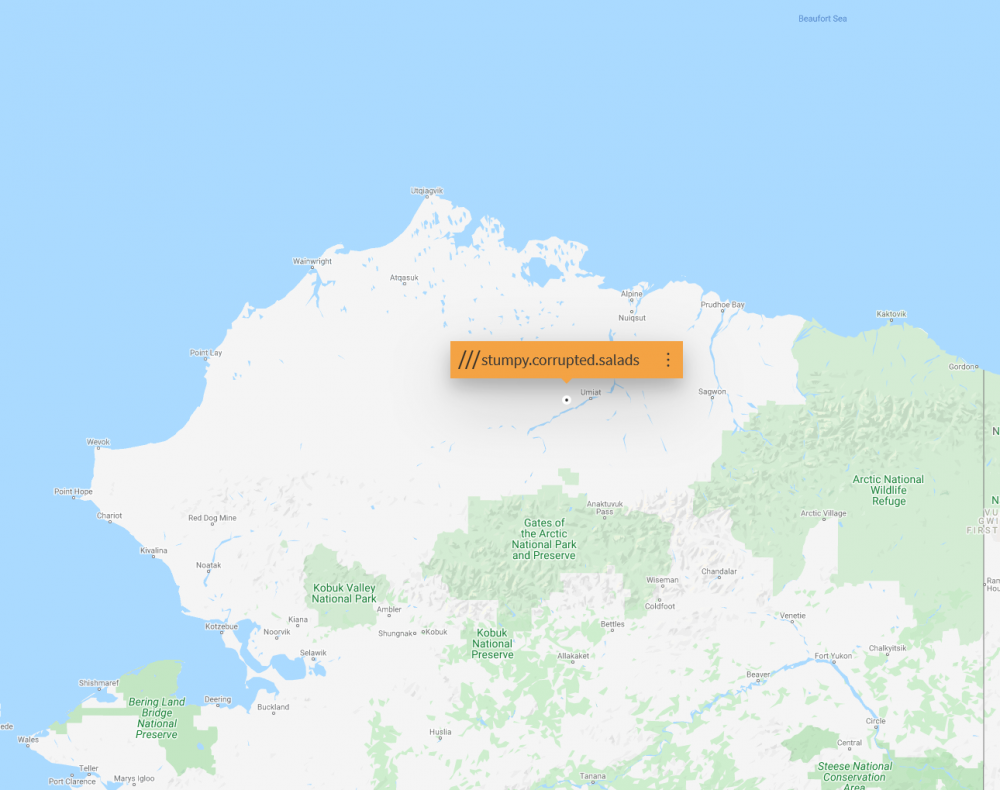
-
Keeping it Internally Down to a Dull Roar
Jeremy Harris replied to ToughButterCup's topic in Waste & Sewerage
I just wrapped some 100mm acoustic rock wool, left over from lining the stud walls, around our pipe. I boxed the pipe in with 18mm OSB, with that plasterboarded and skimmed over the top. Seems to work OK. -
Yes, the inverter will limit or cut out at 253 VAC. I'm in a similar, but less severe, position, where our voltage never drops below about 243 VAC, even in the coldest, darkest, weather, and often rises to around 250 VAC. Our inverter often limits at 253 VAC on sunny days. I've been trying to get the DNO to reduce the tap on the local transformer, to no avail. They could easily drop a few percent and still be well within the allowable supply tolerance, and we're close to the end of the run from the transformer, so if we're seeing high voltages then those closer will be seeing even higher voltages. In theory, if you report a consistently high supply voltage the DNO will come out, put a voltage logger on the supply and then take action if they record the same. In practice they seem to just ignore requests like this, or have in my case. The UK supply voltage that the DNO must keep supplies within is 230 VAC +10% -6%, so 216.2 VAC to 253 VAC.
-
Can't abide things being misrepresented. Bloody hassle having to précis and re-type text from a typewritten paper document that's a bit too faded and tatty to scan, though. Not sure why that report is still in a folder on a shelf above my desk, either, but then I'm not good at throwing old stuff away.
-
House naming..need inspiration
Jeremy Harris replied to SuperJohnG's topic in General Self Build & DIY Discussion
W3W gives "corrupted salads stumpy" for the entrance to our place. Not sure what the street and house naming team at the council would think about that. . . -
Insulated raft - ICF suppliers warnings ?!?!
Jeremy Harris replied to BotusBuild's topic in Foundations
Yes, their is a requirement to install a rodent barrier around the periphery of an insulated raft. AFAIK, this has always been a standard requirement. We installed a layer of heavy duty galvanised steel expanded steel mesh around the outside of our insulation upstand, with this being buried ~200mm down into the stone sub-base. The expanded metal mesh extends up behind the lower section of cladding and the air gap along that area is filled with stretched out commercial stainless steel pan scourers, to allow air flow up behind the cavity but keep vermin and bugs out. We were given this specification long before the foundations and house were built; IIRC the need for this came from all the passive slab suppliers we contacted. I think I remember reading something in @tonyshouse blog that he'd had slight rodent damage to his wing insulation. -
As mentioned earlier, it's not an issue. We have a DNO main, plus two runs of SWA that feed our garage and treatment plant respectively, plus a run of Openreach Duct 56 with a 28 pair cable, all running in the same trench. The only separation requirement is the 100mm between the power cables and the 'phone cable. We put the power cables in one corner of the trench, the 'phone cable duct in the other corner, so they were well over 100mm apart.
-
There's loads of critical content missing from your summary. I have in front of me the unredacted CINCFLEET BoE report, as a photocopy of the original typewritten report. What you've written is not in that report, and distorts many of the facts. Where it came from I don't know, I suspect a bit of dodgy journalism from the sound of it. This is events as reported by CINCFLEET in the BoE report: In the days prior to the attack the TG had been achieving reliable airborne detections out to 160 miles, and as a consequence of this, together with attacks being concentrated on the NGS group closer inshore, they stopped going to Actions Stations and State 1 Condition ZULU when at Air Warning YELLOW. The decision was made for the TG to only go to Action Stations when the Air Warning state was RED. On the day of the attack, the two attack aircraft were detected at a range of about 40 miles by the 965 on HMS Glasgow. HMS Glasgow went to Action Stations and fired Chaff D, believing the detections to be valid and reported them to the rest of the TG. HMS Invincible had radar paints at 30 miles and 50 miles range but CAP subsequently failed to find them. The AAWC onboard HMS Invincible did not accept HMS Glasgow's target classification as valid (perhaps because there had been many false classifications that they believed were induced by ESM) and declared the contacts to be spurious. This was relayed to the other ships in that group, including HMS Sheffield. ZIPPO 4 was not called by AAWC and the Air Warning remained YELLOW (YELLOW was the normal operational state for the TG within the TEZ). At about 15 miles range the two Super Etendards passed HMS Glasgow and turned towards HMS Sheffield. At the time of the attack, HMS Sheffield was operating overtly, with all systems transmitting. It was later suggested that this could have had an impact on the ability of her passive sensor suite to detect the AGAVE radar on the Super Etendard. The false detections the fleet had been experiencing had led the AAWC on HMS Invincible to believe that the supposedly false AGAVE detections were really Mirage III radar detections (Mirage III was not considered to be a threat at their position). Both CTG and HMS Sheffield had intelligence suggesting that an AM 39 attack from a Super Etendard was possible, but Capt. Salt disagreed with CTG on the level of this threat, and was convinced a submarine attack was more likely. At the time of the attack HMS Sheffield was running an anti-submarine attack course, regularly turning through 90° on a zig-zag course. Just before the attack, HMS Sheffield's AAWO was in the Wardroom, and his deputy had gone to the head. The captain was in his cabin. There was no exec officer to make anti-air warfare decisions in the ops room. Some of the anti-aircraft weapons were unloaded and not ready for use. When the anti-air warfare officer was recalled to the ops room he was convinced the air attack wasn't real, as he believed that they were beyond the range of the Super Etendard. He failed to alert the captain and get him to come to the ops room. He later admitted to not having read the intelligence confirming that the Super Etendard now had an AAR capability, which significantly increased its operational range. The AAWO took no action to defend the ship, no chaff was fired and the ship was not ordered to turn head on to the oncoming threat, but remained on her anti-submarine attack course. He was found negligent by the BoE. The BoE also found that the PWO was negligent, in not taking defensive action to protect the ship earlier. Neither of these charges was made public at the time, for fear of impacting on morale and public opinion. The AM 39 hit HMS Sheffield amidships, and destroyed the computer room, the FAMR / FER area and breached the Firemain water pipe to the fire fighting systems. The fire that developed from the burning propellant and Dieso from the FAMR Service and Ready Use tanks that had been hit by the missile created large amounts of smoke that hampered fire fighting. Of the four fire pumps, C was damaged by shock, K was running but stopped at impact and would not restart, L stopped at impact but was restarted and N was defective. This left HMS Sheffield with minimal fire fighting capability. The lack of the Firemain pressure left just external boundary cooling with buckets and portable pumps as the only means of fighting the fire. The fire burned out of control until 041750Z when, aware of the tactical situation, and aware that the Sea Dart magazine was at risk of exploding, Capt. Salt gave the order to abandon ship. At that time HMS Arrow and HMS Yarmouth were alongside trying to assist with external firefighting, and they took off what remained of HMS Sheffield's crew. Only one body was recovered, the remaining nineteen, including three friends of mine, went down with the ship when she sank whilst under tow four days later. For pretty obvious reasons this is an incident that remains close to my heart. On the night that we heard that HMS Sheffield was hit, I went to a club with about a dozen others who knew members of her company. We sat in complete silence for the whole evening, just drinking. Not one word was spoken about those we had known, nor about the attack. I clearly recall being outraged a few days day later, when the manufacturer published an advert in a defence magazine for the AM 39 declaring it undetectable, with a photo of HMS Sheffield, on fire, in the background. AFAIK, the only major difference between the redacted report issued at the time and the unredacted version that was given a limited distribution (my copy was originally marked Secret - UK Eyes B, but it has now been officially declassified) was mention of the ship's company being bored, the negligence of the AAWO and PWO, some confusion as to whether the missile warhead had exploded or not (it had, but it suited PR at the time to suggest that it may not have), the prior experience of Capt Salt (a submariner) and his number 2, a FAA Officer, and the various details of the technical shortcomings in the fleet air defence systems. A later analysis of events suggested that MI had underestimated the capability of the Argentinian Air Force, by unfairly comparing it with the, largely conscript manned, Argentinian Army. The Argentinian Air Force were highly professional, well-trained and very capable. As it happened I'd flown with them in the UK a few years earlier, at the time that they had placed an order for some Mk 23 Lynx helicopters from Westland. We were still doing weapon acceptance trials on the RN HAS Mk 2 at the time, and some of their guys came down to Culdrose to see the A/C first hand. They seemed pretty competent to me. As a side note, about fifteen years after the loss of HMS Sheffield I flew with one of the pilots from HMS Invincible who had flown the CAP, looking for the aircraft that HMS Glasgow and HMS Invincible's radars had detected. He was still kicking himself because they didn't find and engage the Super Etendard's when they were still beyond attack range. He did get a DFC for his part in the attacks against the missile batteries in the Falklands, though.
-
House naming..need inspiration
Jeremy Harris replied to SuperJohnG's topic in General Self Build & DIY Discussion
Same for us. Until not long before we moved in we were "plot adjacent to Willows". Didn't seem to cause any problems for anyone. The only slight embuggerance was getting SSE to change the address to the proper one. Took me maybe a dozen 'phone calls over a period of more than 6 months before we finally got the address corrected with them, and even now there is a typo they made that seems impossible to get corrected (does mean we know when data has originated from SSE, though. . . ) -
All mine exit out the bottom of the enclosure (where all the knockouts are) and then most run horizontally around the garage walls, with just the SWA feed and a bit of conduit over the earth electrode wire coming vertically up from under the thing. I'm not sure that there's much of a risk of spread of fire along inside 20mm conduit, TBH. My guess is that the wires would turn into a twisted molten mess and block any gap up pretty well, stopping air getting in and allowing any fire to spread. Probably more of an issue with larger trunking, perhaps, but it's easy enough to just stick those intumescent fire stop pads inside trunking.
-
If the cable run is 30m (allowing for a bit to run up walls etc) and the system is a 16 A one (so nominal 3.68 kWp, often referred to as "4 kW") then I'd opt to keep the voltage drop well below the normal 5% allowable, just because of the potential nuisance of having the inverter start to limit on voltage a bit earlier than it otherwise might. 4mm² SWA over that distance would have a voltage drop of about 5.77 V at 16 A, so when the inverter hits the upper cut off voltage of 253 VAC, the voltage at the incoming supply end would be about 247.3 VAC. This is probably a bit tight, TBH, and if it were me I think I'd up the cable size to 6mm², as that reduces the voltage drop to about 3.79 V, so the supply voltage at the incomer can rise as high as 249.2 VAC before the inverter will hit its limiting voltage. Also, if the garage is that far from the house and incoming supply, I would consider installing an earth electrode and making the garage a TT installation. It's OK to export the earth out to a detached garage, but IMHO I think it's preferable to have it referenced to the local true earth potential.
-
I've done this in the garage/workshop. Fitted the plastic CU etc inside a steel industrial-type enclosure. I did it as much to keep dust and muck out as anything else. I just have runs of conduit coming out of the steel enclosure and running around the walls to the outlets etc. I also fitted a 4 pole 20 A contactor in there, to switch the two radial power circuits. I have that hooked up to emergency stop switches, so the power can be easily isolated.
-
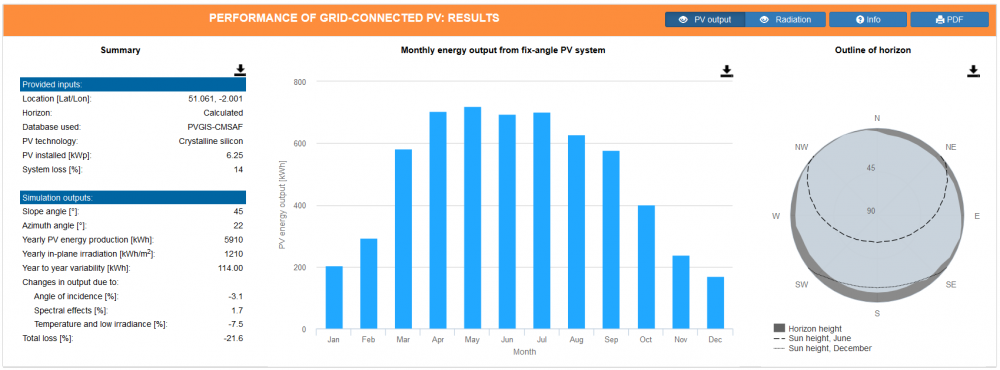
As a guide, this is a plot of the generation from a 6.25 kWp system, facing a bit west of south and angled at 45° at our location: It illustrates pretty well how PV generation drops a great deal around October and doesn't pick up again until March, making it less than useful for heating.
-
If fitting an isolator switch in the tails, then I can highly recommend this one: https://www.cef.co.uk/catalogue/products/1667266-100a-dp-electricity-meter-isolator-switch Fitted one recently and was really impressed, probably the best terminations I've seen for something like this. I've no connection to them, other than as an impressed customer.
-
Not usually, no. We had our supply put in before I'd fitted the caravan hookup box as our TBS. The DNO just left a scribbled note in felt pen giving the value they'd measured for Ze and reminding me to make sure the TBS was a TT installation. TBH, I'm not even sure that the supplier who fitted the meter did any checks, although they may have done. By the time the meter fitter came around I already had the earth electrode in and the small CU wired up, with just a pair of tails left ready to connect to the meter. The only snag with doing it this way around is that you can't test the installation until after the meter is installed. Not a problem for me, but it could mean an electrician coming out twice, so it's probably better to get both the DNO supply and meter fitted before you get the TBS installed. Good idea to provide an isolator switch, as not all meter fitters are installing them now. Makes life a lot easier if the suppliers side can be isolated from the consumer side.
-
I sized our system by fitting the maximum number of panels that I could physically fit on the roof! Not very scientific, but it seems to have worked out OK.
-
You really need to read up on what really happened, rather than rely on half truths you've picked up from unreliable sources. No one knew that the Super Etendard had the range it did, as there was a false assumption that the Argentinians didn't have AAR, when it turns out they did. That's why the section of the Task Force that HMS Sheffield was in was only at Air Warning State Yellow; the assumption was that, at their range from the Argentinian bases they were outside the effective range of the Super Etendard. HMS Sheffield never went to Actions Stations or DC State 1 Condition Zulu, as the attack was not detected until there was visual contact with two incoming missiles (one hit, one missed and ditched).
-
Note the wording carefully. How often does a warship ever go to State 1? That's because you wrote this: No such thing happened. Ships sail within active conflict/combat zones all the time without being at State 1. At the time that HMS Sheffield was attacked she wasn't even at State 1, despite being on patrol within the TEZ during an armed conflict. She was on Defence Watches, Air Warning State Yellow and Damage Control State 2 at the time of the attack, according to the BoE report. That's a pretty relaxed state, and one of the BoE report observations was that boredom by some members of the crew, due to the apparent lack of action, may have played a role in the response to the attack.
-
Nothing at all happens when an inverter limits export. The panel voltage rises slightly, but that has no effect on anything. The noticeable effect is that the output from the inverter may stay closer to its maximum rating for longer, rather than going up and down a fair bit. Our system very rarely actually generates the 6 kW that the inverter is rated at, as most of the time the 6.25 kWp array can't generate anywhere near maximum. We self-consume as much as we can, but to some extent having lowered our overall energy use works against this. Hot water is the main consumer of excess PV generation, plus we try and run things like the dishwasher and washing machine when the system's generating, but most of the other loads don't easily lend themselves to only being on when we're exporting.
-
My experience is that there might well be a bit of an outcry amongst the ship's company if fry ups were off the menu!
-
First off, you can fit any size PV array you wish, there is no restriction from any DNO on the number of panels or the panel total power output. There is an arbitrary distinction between a maximum AC export limited to 16 A per phase system and one that can export more than 16 A per phase. This is a left over artefact from the old FiT system, that used 16 A per phase as a notional break point between only having to notify a DNO of any PV installation and having to seek approval from the DNO. If you choose to fit more PV capacity than the notification limit (which is a nominal 3.68 kWp), but don't want the hassle of getting DNO approval for such a large export, then you can just install an inverter that is limited to 16 A per phase maximum export. This doesn't have a massive impact, as most of the time any PV system won't be generating anywhere near its peak output. The issue of MCS approval applies to any system, irrespective of size, if you wish to claim the SEG payment, currently about 5.5p/kWh for exported power to the grid. If you don't wish to make use of the SEG scheme, then there is no requirement for MCS approval, the system just needs to comply with the regs in the same way as any other domestic electrical installation. Whether the SEG is worth having depends very much on personal circumstance. We have a 6.25 kWp PV system, that is limited to ~6 kWp by the inverter. We're on the FiT, but our export payments are similar to the SEG rate, we get 5.38p/kWh at the moment. Last year we received a bit under £150 in export payments. You need to work out whether such an income is worth the additional cost that might be associated with having an MCS installer do the work.
-
How much time have you spent at sea in RN warships? Between 1976 and 1990 I spent an average of two to three weeks a year on sea trials. FWIW, the fire in HMS Sheffield had sod all to do with deep fat fryers, they aren't even mentioned in the BoE report. I've dug out my old typed copy of the CINCFLEET BoE report and that states clearly that the fuel for the main fire was, quote: I suggest that, rather than try to justify some mythical electrical regulation that either you, or someone you know, has led you to believe is true, you take the time to look at reality. The regs generally err on the side of caution, so when there is nothing in them to support your view that a risk exists, I suggest that may be because there is no appreciable risk. If further evidence is needed, then we have a 95mm² Wavecon DNO main (not the supply to our house) running in the same trench alongside two runs of SWA running from what was our TBS CU. The DNO main supplies the house across the other side of the lane, one of the SWA runs is a 6mm² run that goes a bit further around the edge of the plot to supply our garage, the other is a run of 2.5mm² that turns off that boundary trench to supply our treatment plant. Also in that trench, but spaced to the opposite lower corner, is a run of Duct 56 that carries a 28 pair 'phone cable, that connects to several houses further up the lane. The DNO laid their cable at the same time as we laid our cables and the Openreach duct. No one had the slightest problem with it, nor did they need to, as there's no appreciable risk from doing this.