Jeremy Harris
-
Posts
26430 -
Joined
-
Last visited
-
Days Won
360
Everything posted by Jeremy Harris
-
I'm a bit obsessive when it comes to labelling cables. During the saga of the sale of our old house, when the buyer forked out for the surveyor's recommended electrician to do another EIRC, the chap was a bit taken aback by the labels on every wire, including ring final starts and ends, etc, and the labels on every circuit. I can't see the point in spending time working out what wires run where and then not sticking a label on them. That just makes work for the next person who comes along and has to play detective. It only takes a few minutes to label stuff as you go, and saves a great deal of hassle later on.
-
I've had a cheaper Brother label printer for a while and it's invaluable. I label pretty much everything with it, cables, pipes, switches, you name it, it has a label on it. I've lost count of the number of times all these labels have saved me hours of head scratching later, trying to remember what does what. It's very easy to just get on and do stuff, thinking that you'll remember why you did it and what it does, only to find that you come back to it a year or two later and can't remember what goes where.
-

Any experience of the GS200 small ASHP?
Jeremy Harris replied to DamonHD's topic in Boilers & Hot Water Tanks
Be interesting to see how you get on. You will need to make sure that the build isn't at all airtight though, as all that extract air must be easily replaced with air from outside. Trickle vents in the windows most probably won't be enough, and will probably be a bit noisy with the volume of air that will be drawn through them. Building control should be fine as long as the extract rates in the regs are met. -
Any experience of the GS200 small ASHP?
Jeremy Harris replied to DamonHD's topic in Boilers & Hot Water Tanks
In this case, there is a requirement to comply with building regs as it's a new build ( @Thedreamer's installation with this unit providing the extract from two bathrooms plus a utility room). -
Any experience of the GS200 small ASHP?
Jeremy Harris replied to DamonHD's topic in Boilers & Hot Water Tanks
But that doesn't comply with building regs, does it? 17.5/s doesn't even meet the intermittent ventilation extract requirement for a utility room, the regs require that any non-continuous ventilation provide 30l/s for a utility room and 15l/s for a bathroom: Two bathrooms and one utility room adds up to 60l/s, so the ~50l/s from this unit won't be enough, as I mentioned above, and an additional 10l/s of extract will be required from one of the rooms. We can probably ignore this additional 10l/s of extract from the replacement air requirement, as it only needs to run for maybe 20 to 30 minutes, but that still leave the need to provide ~50l/s into the house for the few hours it takes to re-heat the cylinder.. The real issue is that there will need to be air vent(s) into the house with an equivalent area to a 160mm diameter hole.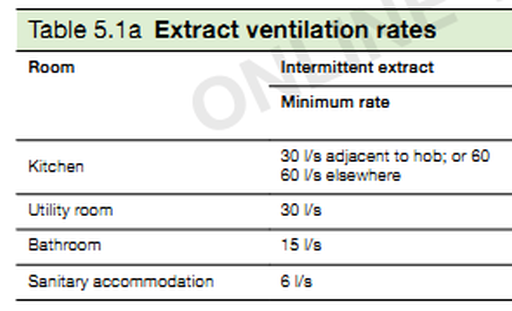
-
Any experience of the GS200 small ASHP?
Jeremy Harris replied to DamonHD's topic in Boilers & Hot Water Tanks
It would make the trickle vents howl a bit though! In order to keep the intake air velocity down below the 2.5m/s noise threshold, the sum of the areas of the trickle vents would have to give an equivalent area to a 160mm diameter hole through the wall. 50l/s is a lot of air to try and deliver through lots of small holes. To comply with building regs you need to make the bathrooms extract at 15l/s and the utility at 30l/s. -
choose decrement delay over u-value for room in roof?
Jeremy Harris replied to MarkyP's topic in Heat Insulation
Solar also reduces the heat on the underlying roof by about 16% to 18%, because of the energy it extracts from the sun. -
My experience is that it's always the plug that gets warm, rarely ever the cable. Cable ratings are pretty conservative, and it needs a high load for a long time to get the cable a bit too hot, not something that's likely to happen with the short load duration from something like a washing machine or dishwasher. The weakest point is usually the fuse in the plug getting hot under high load, which then overheats the line pin, which in turn overheats the contacts in the outlet, causing them to reduce the spring contact force on the pin, adding to the problem.
-
The kitchen in our old house had two singles and a double daisy chained from one spur off the ring when we bought it. Luckily, the last single in the chain was just the igniter for the gas cooker and the one before that was just the cooker hood, but the double at the start of the spur had the dishwasher and washing machine plugged in. Can't understand why whoever did it just wired these as a long daisy chained spur, as it was dead easy to just break the ring and add them to it, needed about two feet of cable and didn't even mean chasing up the wall, as there was a buried bit of rectangular trucking behind the tiles that led down below the worktop (not ideal, as it wasn't deep enough, but there was only about 150mm of it).
-
Yes, most probably. Depends on how that socket is wired and the way other outlets are wired on that circuit though, as it's not unknown for DIY changes to have been made that aren't safe. If there's only one cable in the back of the outlet, then that indicates that it's most probably a spur off the ring. There's no problem with changing this to a twin gang outlet, just a matter of isolating the supply, checking the wires are truly dead and changing the outlet over. Only thing to watch is that the supply to that spur is really coming directly from the ring. If not, then further investigation needs to be done. If it's wired as a part of the ring final, then there's no problem at all, either. You can often check this by looking to see the number of cables coming in to the rear of the outlet, if there's two, then that's a good indication that it might be part of the ring, although this isn't foolproof, if there's been some amateur electrical work done. Easy enough for an electrician, or someone competent with the right test gear and knowledge, to check whether or not two wires feeding an outlet are part of a ring or not, though. The reason for checking that two cables coming in are really a ring is because it's possible that someone has fed another spur from an existing spur. This could then result in the cable current rating being exceeded if the mid-point single is changed for a double. It's something I've seen done, most commonly in kitchens where additional spurs have been added for washing machines, tumble driers, etc. Two 13 A outlets are usually[1] OK on a single 2.5mm² T&E cable, as it will be typically rated at 27 A in many situations. More than two outlets from a single 2.5mm² spur could potentially exceed the cable rating with high current appliances, and even two outlets may exceed the cable rating if it's buried in the wall. [1] Assumes that the cable is clipped direct.
-
Any experience of the GS200 small ASHP?
Jeremy Harris replied to DamonHD's topic in Boilers & Hot Water Tanks
Yes, but those are the flow rates for continuous ventilation, using MVHR, PIV or low rate continuous ventilation. Building regs require higher rates for houses that are not fitted with MVHR, 15l/s for bathrooms and 30l/s from a utility room, so if two bathrooms plus a utility room were connected to this unit there would still be a need for an additional ~10l/s intermittent extract in one of them. The problem is that the building regs requirement for intermittent extract fans assumes that they will only be run for relatively short periods of time, maybe 20 to 30 minutes or so. Using one of these ASHPs with the intake ducted to extract from the bathrooms and utility would result in the run time being a lot longer. The spec sheet gives a run time to heat the full 260 litre cylinder from cold of 10 hours 38 minutes. For all that time there will be around 50l/s of cold outside air being drawn into the house through the needed 160mm diameter equivalent outside air vent. -
Depends very much on where you live, I think, as I'd guess most people may have tended to use a contractor close to them. There are some other threads here covering this topic that might be helpful: https://forum.buildhub.org.uk/topic/6558-resin-drive/ https://forum.buildhub.org.uk/topic/12375-bonded-gravel/
-
choose decrement delay over u-value for room in roof?
Jeremy Harris replied to MarkyP's topic in Heat Insulation
Which raises a very good point about knowing the conditions that prevail at your location, before making decisions on design and construction. I failed to do this. I assumed that the weather data from a station about 10 miles or so away would be close to the conditions at our site. I was wrong, but only began to realise this when we were doing the groundworks, and found that we had temperatures close to 40°C towards the excavated rear of the plot. The only thing I changed in light of this was the MVHR, switching from an ordinary passive unit to an active one that included an air-to-air heat pump. That wasn't enough. What I should have done was change the glazing for something like Sage glass as well. Hindsight is a wonderful thing . . . I've been recording the temperature outside every 6 minutes for several years now. It's consistently between 1.5°C and 3°C warmer in summer than the temperature recorded at the nearby weather station. I'm pretty sure this is just due to being in a well sheltered position, with very little wind most of the time. -
Any experience of the GS200 small ASHP?
Jeremy Harris replied to DamonHD's topic in Boilers & Hot Water Tanks
Yes, but that still means that for a few hours per day the vents into the house need to bring outside air in at a rate of around 50l/s. The problem isn't connecting the extracts, it's dealing with the replacement outside air into the house. For minimal flow noise the velocity through the external replacement air intake vent into the house needs to be no more than 2.5m/s, so that means a 160 mm diameter equivalent vent need to be fitted into the outside wall somewhere to bring in the ~50l/s replacement air for that being drawn out by the heat pump. That's likely to create a bit of a cold draft, as well as cool the house down for much of the year. Also, having a ~160mm hole through an outside wall will have a pretty massive impact on airtightness, and make it challenging to get the DER to an acceptable level. This is the major snag with any simple exhaust air heat pump, that doesn't have a properly integrated MVHR, with air balancing system. The Genvex that you have, and the similar Nibe units, get around the problem by balancing the internal and external flows such that the MVHR part remains efficient and the replacement fresh air delivered to the house is also heated by the heat pump. The simple units don't do that, they just suck air in one duct, and out another, at a fixed rate, all the time they are running. If they are ducted outside, so they draw in outside air and discharge the exhaust outside then there's no problem at all, other than a reduction in COP in cold, damp, weather, much like any other ASHP. I think the thing that causes confusion, and has been discussed previously when the Ecocent has been debated, is that the heat all these simple integrated cylinder ASHPs extract has to come from somewhere, and if that heat is drawn from inside the house then the house heating system has to work harder and longer to keep the house warm, as it needs to heat the cold replacement air that has to come in from outside at the same rate as the unit is extracting. If the hot water cylinder is required to deliver 6 kWh worth of hot water per day (about enough for two people) then that 6 kWh of heat has to come from somewhere. If extracted from the outside air, like any other ASHP, then that heat is coming from the sun, in effect. If extracted from air inside the house then almost all the heat will have been provided by the heating system, at least during the heating season. The heating season will be extended if such an arrangement is used, too, as the house will need an additional 6 kWh of heat per day, so that probably means heating the house for a month or two longer every year. The only Ecocent installation I've heard of that used semi-internal air and worked pretty well was a chap on Skye who had one installed such that it drew its air from a South facing conservatory, and where the replacement air into that conservatory came from a workshop with a combustion stove. This arrangement meant that the air in the house was unaffected, so there were no cold drafts or need for additional heating, and as they tended not to use the conservatory in winter cooling it down a bit wasn't an issue. -
It's not just adverts, though. These big datasets on individuals can be used for everything from enabling insurers to vary premiums (or refuse cover) based on data that's been collected, to enabling financial institutions to adjust how they deal with you. In countries with private health care the data can be used to determine how much you pay for health care. Big data enables selective and personalised treatment of individuals based on covert data acquisition from their "private" lives. The big companies that are gathering all this data (Google, Amazon, Microsoft, Facebook, etc) know far more about individuals than any government. They know key financial information, age, address, 'phone numbers, email addresses, devices used, everything searched for, bought, or looked at on any connected device, patterns of work, holidays, your sex life, you name it, they know it.
-
Any experience of the GS200 small ASHP?
Jeremy Harris replied to DamonHD's topic in Boilers & Hot Water Tanks
Not surprised that they don't mention the air flow rate, TBH. You will have to ensure there are big vents into the house to let enough air in, so best not to aim for a good airtightness level. Those figures show that the heat output is a fair bit lower than I'd assumed, but when the heat pump is running you will still need to allow for around 50l/s of outside air freely flowing into the house to balance the air that the heat pump is extracting from the house. This is the primary reason I decided to not opt to use an Ecocent, as the very high airflow rate into the house, together with the need to provide a much higher heat input to the house all the time that the heat pump was running, meant that it was going to have a significant impact on overall energy use. If these units are installed with both the intake and exhaust ducts running outside the house, then the COP reduces, but that is more than offset by the big reduction in drafts and heat loss from the house. -
TBH, it's not always easier to use ready made units. Our downstairs WC has the soil stack box in the corner, so I had to position slim bathroom units off the wall, and then ended up having to cut and shut bits to get them to fit and to get the toilet pan waste pipe to fit. Probably took me longer to mess around with the thing than it would to have just framed up a custom unit and fitted some off-the-shelf doors to it.
-
I approached this by measuring the shower flow rate at our old house, which we were happy with, deciding to use the same for the new house, and then looked at the waste size needed for that and concluded that even 24l/m was a massive overkill. I fitted a 90mm McAlpine top access trap, that had a 40mm outlet, so I used a straight ~2m run of 40mm pipe to the top of the soil pipe stack. In practice, the biggest flow restriction seems to be around the periphery of the lid bit. Doesn't take much in the way of soapy stuff to slow down the flow around that narrow slot. The 40mm pipe easily copes with our ~10l/m shower. Biggest nuisance is cleaning the lift out top bit, which is a bit of a fiddly job.
-
Love the use of CAD (Cardboard Aided Design) . . . I made a mistake and set the worktop in our downstairs WC too high (made the error of using 150mm kitchen kick boards when bathroom units use 120mm). 30mm may not sound much, but it's surprisingly awkward when compared to the same units we have in the bathrooms that are set at their standard height. Our bathrooms are 880mm from floor to top of worktop, and the WC one is 910mm. I'd suggest that as low as 850mm might be OK, not sure about going down as low as 800mm, although having the basin on top, rather than inset may make a big difference (our basins are all inset, so only stand around 30mm to or so above the worktop). Our bathrooms and WC all use the same pattern of standard built-in bathroom furniture units, that seemed to be exactly the same size as the ones I fitted to our old house, about 15 years ago.
-
Probably wise. The Panorama programme about the extent of Amazon's data capture was pretty astounding, even for someone like me that's suspected it for a long time. Interesting to find out that they plan to increase the voice recognition capability so that they can analyse all speech their devices capture (not just that before and after the "Alexa" trigger word") with the aim of using that to better target advertising. The aim would be to pick up words like "holiday", or "illness" and then use that to improve the personal profiles they have of everyone who has ever used Amazon. Also pretty interesting to read the article by one of the researchers for the programme, who discovered that Amazon have logged the time, date, location, book being read, even every page turn on his Kindle. There were something like 30,000 separate data items just covering his use of this device. Makes me glad I use a non-internet connected Pocketbook as an ereader.
-
Any experience of the GS200 small ASHP?
Jeremy Harris replied to DamonHD's topic in Boilers & Hot Water Tanks
So, are you planning to use this with the very high air flow rate for this unit somehow integrated into an MVHR (problematic, as it gives a massive air flow imbalance) or as a stand alone extract system, with no MVHR? The Joule unit was, I thought, designed to just have two external terminals, one drawing in outside air, the other discharging cooled exhaust air, pretty much like any outdoor ASHP, but just with the pump itself inside the house. Drawing air from inside the house would work, although it will significantly increase the heat loss from the house when the heat pump is running (the heat loss would be about the same as the heat delivered to the hot water, so the heating system would need to replace this "lost" heat). It's worth looking at how much air needs to flow through a heat pump to deliver the specified output. The heat capacity of air is typically about 1.2J per litre per K. If the cylinder capacity was 200 litres, and the minimum temperature was 35°C and the maximum 55°C, then the water in the cylinder is going to need about 16.8 MJ of heat energy delivered from the heat pump. If the heat pump takes 2 hours to heat the tank, then that means it has to deliver about 2.33 kW (J/s) of heat. If about 2000 W of this heat comes from the air flowing through the ducts, and if the heat pump is working with a differential temperature of, say, 25°C (pretty much how it may operate when drawing air from inside a house and discharging it outside) then it's going to be shifting about 67 litres/second of air through the ducts. The building regs extract rate from an intermittent bathroom extractor fan (no MVHR system) is 15l/s, that from a utility is 30l/s, so extracting from three in-use rooms would be a bit high in terms of extract rate, but two hours is a lot longer time period than needed (10 to 15 minutes would be OK usually). This unit is going to extract around 4 kWh of heat from these rooms, so not only will the heating system need to provide this heat (accepting that maybe 10% might be recovered from the hot water use - most will go down the drain) but the air vents in the house will need to allow 67 litres per second of cold outside air in to balance the extract air flow. That's a fair bit of air, so will need fairly large air vents into the house, and probably create some unwanted cold drafts. -
We've found that our house seems to be pretty effective at blocking RF, too. We don't get much of any sort of signal here, but the house does seem to block a lot. We don't have any foil anywhere, so I can only assume that it's the blown cellulose that is attenuating the signal, together with the sputtered metal coating on two panes within the 3G glazing.
-
I built a new house today...
Jeremy Harris replied to NSS's topic in General Self Build & DIY Discussion
True, but as above, it seems I've had it without being aware of the fact, so it may not always be a serious disease. -
Any experience of the GS200 small ASHP?
Jeremy Harris replied to DamonHD's topic in Boilers & Hot Water Tanks
Why should the heat pump not work as well in winter? Our experience has been that ours seems to work with a COP of well over 3 (often over 3.5) in winter. These direct heat transfer heat pumps are a bit more efficient, as the condenser is in the water cylinder, so even if run at a higher water temperature I'd by very surprised indeed if they don't deliver a COP of at least 2 in sub-zero conditions. Even a COP of 1.1 is cheaper than using direct electric heating, and the outside air temperature would probably need to be around -20°C or so for the performance to be that poor. How does an externally ducted heat pump like this provide ventilation? ESP tried to integrate their Ecocent with an MVHR and when I looked at the data the results didn't look at all good, due to the gross imbalance in the MVHR part. The air flow rate through the ducts of one of these units has to be very high, much higher than that through an MVHR, just because of the low heat capacity of air. I've also seen some claim that the cool air output from a unit like this can provide cooling inside the house in summer, if the exhaust duct has a valve to redirect air inside the house. Five minutes with a calculator reveals this to only have a very limited impact, probably not worth the hassle of the additional ducting. These heat pump units are usually rated at between 2 and 3 kW heat output, so they will provide enough hot water to recharge the tank in about 2 to 3 hours, then they will shut off. Solar gain on a hot day can be around 800 W or so per m², so it's pretty easy for a house to receive a few kW of heat for more than just a couple of hours, plus there will be times when the need for hot water does not align with the need for air cooling. -
I built a new house today...
Jeremy Harris replied to NSS's topic in General Self Build & DIY Discussion
I find rats quite fascinating. A schoolfriend kept pet rats, and they don't deserve their bad reputation, in my view. They seem to be pretty intelligent, and care for their young carefully. I suspect we only think badly of them because they happened to be the host for the fleas that carried plague, or may be because they often live in big sewers. Their reputation probably wasn't helped by the super-intelligent rats in the series Doomwatch on TV, years ago. I remember thinking about rats getting into the house by swimming around the trap in the toilet after watching that programme.