


Jeremy Harris
-
Posts
26430 -
Joined
-
Last visited
-
Days Won
360
Everything posted by Jeremy Harris
-
 Sounds a lot of faff just to get a good night's sleep. We manage just fine with no heating in the bedrooms. They sit at about 18°C or so, which seems to be about right. Right now the bedrooms are sitting at 18.4°C, but I expect they will cool down slightly through the day, as the cooler air from the MVHR lowers their temperature a bit. We find that the bedroom tends to gain about half a degree overnight, probably from body heat into the room. The key to this was adding more acoustic/thermal insulation into the floor void than needed just to reduce sound transmission. I fitted 200mm thick dense rock wool into the underfloor void for just this reason. That seems to be enough to limit heat transmission upwards from the warmer rooms downstairs, as long as we keep the bedroom doors closed.
 -
We used the Kytun aluminium dry verge, which doesn't need much of a projection. Our roof is "slate", so we used the thinner version, but they do something very similar for tiles: https://www.kytun.com/c/tile-dry-verge/8
-
Is this one reason there is a permanent UK housing crisis...
Jeremy Harris replied to Bitpipe's topic in Housing Politics
Yes. I don't agree with the content of his tweets, but it's interesting that the court took the view that the police had acted unlawfully. The notable point seems to be that this judgement makes it clear that expressing a personal opinion, even if it is controversial, should not be considered to be an offence on its own. -
We've found that the temperature we find comfortable has been creeping up over the past year. The thermostat is now set at 22°C, whereas in our old house we had it set at about 21°C, perhaps a bit lower. Right now it's a comfortable 22.1°C, although the heating didn't come on at all last night, as this stormy weather seems to be pretty mild.
-
Is this one reason there is a permanent UK housing crisis...
Jeremy Harris replied to Bitpipe's topic in Housing Politics
There's a report on the BBC about the judgement: https://www.bbc.co.uk/news/uk-england-lincolnshire-51501202 -
A ring main is a wiring configuration that a DNO (Distribution Network Operator, the electricity delivery company) might use in the LV (Low Voltage - typically 230 VAC in this case) power distribution network. They will sometimes use a ring main in order to reduce the voltage drop, although they are only usually found in an urban environment, where the configuration can work OK without needing lots of additional cable (somewhere like a housing estate, for example). In rural areas DNOs more often use a radial main configuration. The cable size will usually be the same for either main configuration, although for a long rural area LV run the cable size may be increased to reduce the voltage drop. A ring main also gives a degree of fault tolerance to the supply, in that the ring can be broken and power will still be delivered to some end users. A ring final is a domestic wiring configuration where the cable is configured into a ring, fed at both ends. The reason for using this configuration in a domestic installation isn't primarily to reduce voltage drop, it's to allow thinner cable to carry a current in excess of that which it could carry safely in a radial configuration. For example, ring finals are commonly wired with 2.5mm² cable, that can safety carry 27 A when clipped direct to a surface. However the over-current protection for such a circuit will often be a 32 A circuit breaker. Safety depends on the ring final being complete and unbroken, so that current can be shared around both sides of the ring, from the consumer unit to the outlet(s). If a ring final circuit is broken it present a potential fire hazard, as the over-current protection device will have a higher current rating than the cable. It is for this reason that one of the very first checks when doing a periodic inspection is ensuring that the rings are complete, by testing continuity and resistance where they terminate in the consumer unit.
-
First off a "ring main" is something the DNO use in their LV power distribution system, and is not something usually found within a domestic installation. A ring final is the looped circuit used for domestic power distribution. As @ProDave says, there's no reason not to split a ring final into two radials, and there isn't often a need to increase the cable size. 2.5mm² T&E is OK for up to 27 A clipped direct, so with 20 A protection is fine. It would only need to be increased to 4mm² if there was something causing the cable current carrying capacity to be reduced, like running it through insulation. The original reason that the rather bizarre, and uniquely British, ring final arrangement was introduced was because of a copper shortage in the 1950's when the new regulations were being framed. Prior to that British homes had been wired with radial circuits feeding round pin outlets with no plug fuse. Quite why we've stuck with it is a mystery, as there are a lot of advantages to using the same radial configuration that just about every other country uses.
-
Is this one reason there is a permanent UK housing crisis...
Jeremy Harris replied to Bitpipe's topic in Housing Politics
All the ITC did was artificially prop up the price of tin for a few years, which kept the UK mines "profitable" for a year or two longer. It delayed the inevitable, as the fundamental problem was that there was a global surplus of tin and other nations around the world could produce it as a much lower price than we could. Arguably, we should take into account the environmental and human impact of these cheaper producers. They often created a great deal of pollution, had labour practices that we would consider unacceptable as well as having poorer social care systems. However, we're not a colonial power, and should not seek to impose our moral values on others. The only power we have is if we, as a society, choose not to do business with states that don't meet our own threshold for what is reasonable. However, we are all essentially hypocrites. I, like most here I suspect, am typing this on a Chinese manufactured laptop. I don't approve of the totalitarian Chinese Marxist regime, but have to accept that pretty much every bit of electronic equipment that I use has components that are made in China, perhaps under working conditions that we would find wholly unacceptable. Our government has absolutely zero control over this; they have no power at all to restrict imports from China, even if they wanted to. -
This is our experience, in total: We fitted a Sunamp PV, a very early pre-production unit, in 2015. It had a few teething problems, but after about three months it worked flawlessly until we chose to swap it for a new Sunamp UniQ 9 kWh unit in October 2018. The Sunamp UniQ was essentially unfit for purpose from the day we received it. It failed to provide hot water several times, Sunamp were less than helpful and the only way I managed to get the thing to work was to reset the control box every day. Failure to do this would result in there being no hot water. Nearly a year ago, I finally managed to get a response from Sunamp. They ignored one of the major failures we'd had. the main contactor failing; I replaced that at my own expense as they just failed to respond to repeated requests. Around ten months ago they got around to supplying me with a replacement control box and sensor assembly. Since fitting this, the Sunamp UniQ has worked flawlessly. It seems as reliable as our original Sunamp PV. Whether this is a true indication that all units are now reliable I don't know, but so far it looks OK.
-
Is this one reason there is a permanent UK housing crisis...
Jeremy Harris replied to Bitpipe's topic in Housing Politics
This isn't actually what happened, though, is it? It might sound like there is some evil force suppressing the working man, in some sort of parody of the early days of the Industrial Revolution, but in reality what happened is that we got beaten at our own game, often by nations that we had once colonised. Our cotton mills closed because they were uncompetitive; other nations could produce cloth at a lower price. Our mines closed because the cost of production exceeded the price that their products could be sold for. I've personal experience of his. A very good friend, best man at our wedding, was a mine captain at Wheal Jane mine. He, along with all the miners there, earned a very good living, until the tin mines in Indonesia started producing ore at a fraction of the price. Within a year that mine, and all the others in the UK, closed, as they just could not compete. The same applies to pretty much every manufacturing industry in the UK, our costs rose to the point where we became uncompetitive. How would you propose that we retain highly uncompetitive industries in a global market? Bear in mind that the UK lost the ability to impose its own import restrictions when it chose to join the EEC, so we had no means of preventing cheaper goods being imported. -
Is this one reason there is a permanent UK housing crisis...
Jeremy Harris replied to Bitpipe's topic in Housing Politics
What Orwell got wrong was that we've ended up in a position where governments are not the controlling, all-seeing, force in our lives, that role has been well and truly taken over by companies like Google, Amazon, Facebook, Microsoft et al. No nation on earth has anything close to the data gathering, storage, analysis and societal control that these companies can wield, with the possible exception of a few authoritarian regimes that try very hard to prevent these companies from being able to influence their people. Whether the actions of states like China, North Korea, Russia etc are acceptable is a matter of personal opinion. One thing is for sure, the government of the UK is hopelessly outgunned by the resources available to any one of these global super power companies. -
Not sure that Agile pricing with direct electrical heating can come close to gas. It seems to average around three times the price of gas, from the tracking I've been doing over the past few months. For us, E7 with an ASHP is slightly cheaper than mains gas, but not by a lot. The ASHP seems to have an average COP of well over 3, so that reduces the price, relative to direct electric heating, to about 1/3 or less per kWh. Worst case heating for us, in very cold weather, can be around 36 kWh/day, but that's rare. We tend to use maybe 8 or 9 kWh per day, and, by using E7 at 8.148p/kWh and the ASHP, this costs about 2.5p/kWh, which is close to the cost of using mains gas.
-
Is this one reason there is a permanent UK housing crisis...
Jeremy Harris replied to Bitpipe's topic in Housing Politics
For the very simple reason that we are part of a global free trade economy, and other nations could produce goods, or provide resources, for a much lower price. Rational government cannot fight global pressure, especially not when constrained by having to comply with EU trade regulations. If a country can produce something for a fraction of the price that the UK can, and the UK is unable to impose any meaningful restrictions on imports from that country, then ordinary people are going to always buy from the cheapest supplier. This isn't the government dictating what happens, it's ordinary people. People willingly choose to buy goods produced outside the UK when they are cheaper, and that drives more expensive UK producers out of business. -
Is this one reason there is a permanent UK housing crisis...
Jeremy Harris replied to Bitpipe's topic in Housing Politics
I'm convinced that the reason we ended up with BJ as PM had little to do with either him, or the policies of the Conservative party, but had everything to do with Corbyn being unelectable. Idealism makes for grand sound bites, but as you rightly say, extreme socialism is inextricably bound to authoritarianism, as the majority will never willingly vote for the restraint on personal freedom that Marxism implies. If anyone doubts this, and doubts the inequality that Marxist socialism always delivers, then they only need to look at states like China. The shame of it is that one might have hoped that the Labour party would have learned this lesson from their disastrous spell with Michael Foot as leader, but no, the Marxist nutters in what used to be called Militant, which re-branded itself as Momentum, still fervently believed that they could bully members of the Labour party, and cause democratically elected Labour candidates to be deselected, in order to try and grab power. Thankfully, the British electorate had the common sense to see through this tactic, and return the worst result for Labour since 1935. The shame of it is that their insane actions have helped to destroy any meaningful opposition, and our form of government always seems to work best when there are checks and balances applied to the power of the ruling party by Her Majesty's Opposition. I reckon the stupidity of the Corbinysta faction may have set the Labour party back by ten years or more. Last time we saw a similar extreme left Labour leadership we had over 10 years of Conservative government, followed by another 13 years of what amounted to a right of centre Labour government that, for at least 10 years, was little different to the government of Thatcher. -
We have a 9 kWh Sunamp to provide hot water for the two of us. It's heated by a mix of excess PV generation (from a 6.25 kWp array set at 45° and facing about 20° west of South) and an overnight boost from E7 electricity if needed. It's just about OK for our hot water needs; we use a bit over 3 kWh per person per day, so there's a bit in reserve. Our house meets the passive house standard and so doesn't need much heating, maybe around 1.5 kW in very cold weather and an average of maybe 300 to 400W in the heating season, maybe a bit less. To heat the house from stored heat in a Sunamp in cold weather we would need at least 2, probably 3, 12 kWh Sunamp units. Each could charge at their 2.8 kW max rate during the 7 hour off peak period, but the charging period would be extended because we'd be taking heat out to keep the house warm at the same time as they were being charged in very cold weather. For heating we use the much cheaper option of an ASHP, that mainly runs during the E7 off peak period. That heats our ground floor slab with UFH, and the slab stores enough heat to keep the house warm through the following day, usually. The key figure missing is your heating energy requirement. My guess is that this will be massively higher than the electricity usage, given the age of the house, and that may well means that it's impractical (and very expensive) to use a tariff like Agile and try to rely on energy storage. You will need enough heating capacity to meet the coldest winter weather. We have a massively over-sized ASHP (a 7 kW model) and under-run it to provide our worst case heating power of about 1.6 kW when it's -10°C outside (doesn't happen often, but we have had spells of a few days when it's been around -5°C overnight and barely above freezing all day). One snag with using thermal storage for heating is that you need to invest in enough of it to meet the cold weather use case, but that then means it will be massively oversized for the heating requirement for most of the year. This doesn't matter so much for an ASHP, as it's a lot cheaper to buy (we paid £1700 for ours).
-
Each relay will need over current protection, but this may well be built in. The wireless relay units I have around the house all have built in fuses, so worth checking whether the units you plan to use are the same.
-
Is this one reason there is a permanent UK housing crisis...
Jeremy Harris replied to Bitpipe's topic in Housing Politics
Pretty much my take on it. I picked up the "using lounges for bedrooms" bit. too. As a student I shared a house with four others, and we each had a bedroom plus use of a shared lounge, kitchen and bathroom. No one ever used the lounge, the landlord might as well have used it as another bedroom. -
Just double checked our drawings. We have 253mm deep Posijoists with a 400mm spacing over a span of 4,286mm. It's a pretty stiff floor, and got a great deal stiffer when I bonded 12mm thick bamboo flooring to the 18mm T&G boards. It does still have very slight movement, though. If you walk across the bedroom floor the oak chest we have at the end of our bed tends to make a noise as the floor deflects slightly. TBH, it's not really a problem, and I've found that sticking some felt pads under the corners of the chest has pretty much stopped the noise. Some bounce/dynamic deflection is inevitable with any suspended floor, the issue is really what is personally acceptable. In general, I think our timber first floor is pretty good, and a fair bit better than the deflection in a friend's fairly newly built house that has a beam and block floor. The movement in that is surprisingly high, more than I would have expected, TBH.
-
Bear in mind that you can have several outlets per radial, the limit is set by the total load per circuit (typically 20 A for a radial). Most household loads are now pretty small, and the worst that can happen if you do overload a circuit is that it will trip, with no harm caused. Depends on the rating of the relay. Circuit protection is all about selecting over current protection ratings such that nothing downstream can draw more than its rated current. So, for example, a 13 A outlet cannot draw more than 13 A (as it's protected by the fuse in the plug) so the over current protection device only needs to protect the cable, which, if it's a 2.5mm T&E will have a current rating of 27 A if clipped direct (not run in insulation). If you fit a relay downstream of the over current protection device, then either that relay needs to be rated for a current that is higher than the protection device rating, or the protection device current rating needs to be reduced to the relay maximum current or below. The over current protection device can either be an MCB (miniature circuit breaker) or an RCBO, which adds a residual current device to an MCB in the same housing. An RCD, on it's own, does not provide any over current protection, it's there to detect earth leakage faults only.
-
How many ways do you need?
-
Looks like you may be right, but at least it means that you should be offered the chance to switch at the end of the contract, rather than them just upping the cost automatically.
-
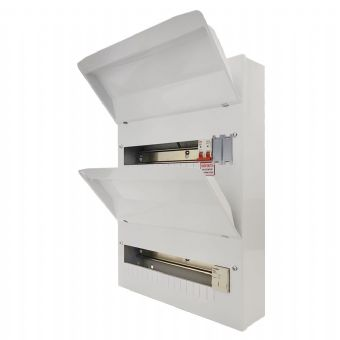
Double decker/stacked/duplex consumers units are OK, like this: If you have the room, get the largest case size you can though, as it's always a lot easier to work on one where there's plenty of room.
-
Just seen this: https://www.bbc.co.uk/news/technology-51493935 It seems that from now on we won't have this hassle, as suppliers will be obliged to offer customers the same rates when their contracts expire as a new customer would get.
-
John Ward has some details and diagrams here: https://www.flameport.com/electric/socket_outlet_circuits/ring.cs4 and here: https://www.flameport.com/electric/socket_outlet_circuits/radial.cs4
-
Bounce is just a term for deflection under a dynamic applied load. It needs to be below the level where it will cause annoyance, and depending on the room, it can be annoying at a pretty small value. If there's furniture near the centre of the room, for example, even a few mm of movement as someone walks across the floor can result in noise, as one leg and then another loses support from the deflection, making it rock. Our first floor is made from 253mm deep Posijoists, on 400mm centres, with 18mm OSB flooring, then a bonded layer of 12mm bamboo, with a maximum unsupported span of 4.2m. That still has a small amount of bounce, enough to make a chest at the end of the bed make a small amount of noise.

