Jeremy Harris
-
Posts
26430 -
Joined
-
Last visited
-
Days Won
360
Everything posted by Jeremy Harris
-
 My rafters are I beams, with an 10mm gap and then and additional length of stud timber nailplated to the lower member. The outer face of the I bean rafter is clad with 22mm OSB as sarking and to give racking stiffness, and then counter battened, a layer of breathable membrane and then battened for the slates/PV panel frames. Internally, there is a layer of Isover VCL fastened to the underside of the additional stud with 50 x 50 battens. The plasterboard is fixed to these battens. The Isover is taped with Siga tape and run partway down the internal VCL board on the inside of the walls and then taped. The cellulose was pumped in through holes in the membrane on the inside which were then taped over with patches and Siga tape. The thermal bridging through the OSB web is negligible, and is reduced by only being a 2D thermal path, because of the insulation that's blown in tight to the sides of it. Overall our roof U value (corrected for thermal bridging) is a fraction under 0.1 W/m².K
 -
Garden time - rebar reeds
Jeremy Harris replied to Lesgrandepotato's topic in Landscaping, Decking & Patios
Kept me awake at night did that thought, when our retaining wall was being built. Had an elderly (and, I found out later) slightly senile neighbour above (to the right in the photo) of this lot, it was like a bloody punji trap: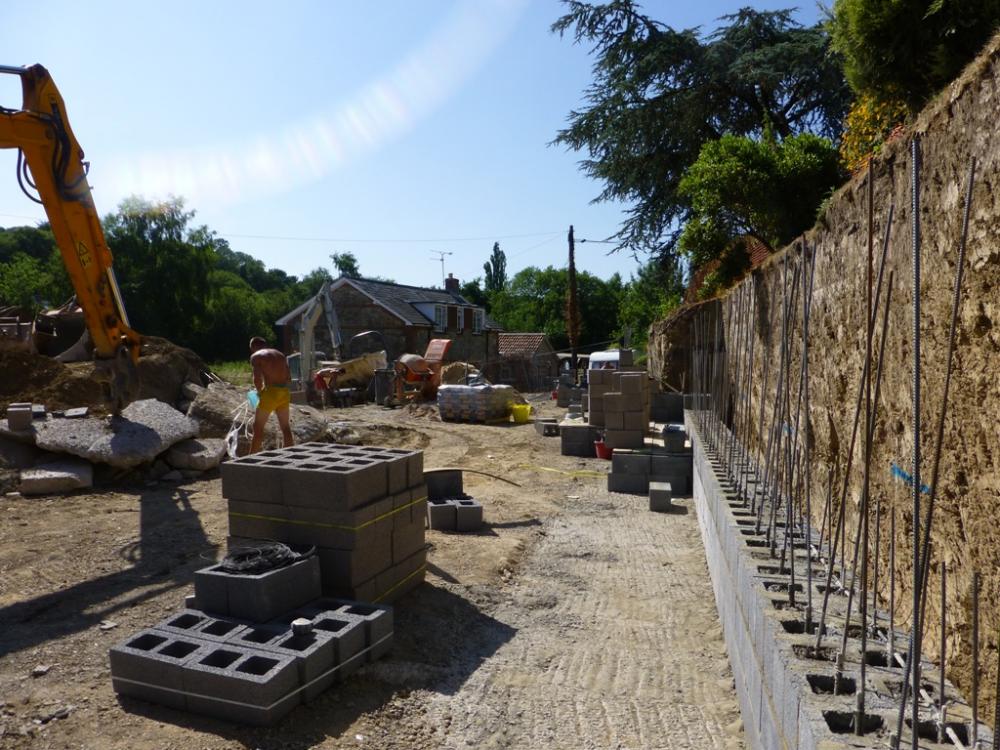
-
Someone on here noted from some of my posts that I was drinking lots of tea (a consequence of having a boiling water tap that makes it too easy to just make loads of cups during the day). I stopped drinking tea, with the exception of one cup with breakfast, and felt really bloody awful for a couple of weeks. The only thing that made sense was that I was suffering from caffeine withdrawal. Although tea has only roughly half the caffeine of coffee, I was probably drinking ten or twelve mugs a day, which meant I was probably taking over 900mg/day of caffeine. The "safe" limit that seems to be recommended is around 400mg/day, but it seems I'm more sensitive to the stuff than that, and get irritable, have stomach upsets and suffer from mood swings on a lower daily intake. Stopping drinking loads of tea every day, and cutting right back on my alcohol intake did cause me a fair few unpleasant side effects, but now, many months later, I feel a lot better each day and tend to stay far more level-headed than I used to. I've also found Ibuprofen to be a cause of stomach upsets and mood swings. I was taking them like smarties to ease the pain and inflammation from buggered knees and a persistent shoulder problem (still on the waiting list to get the thing fixed). Switching to using Diclofenac ointment (Voltarol) eased that, although it doesn't seem as effective as Ibuprofen or the Naproxen I had on prescription (Naproxen really did have nasty side effects for me, even when taken with Omeprazole to try and control the stomach problems). I've come around to the view that the fewer drugs we take the better, as a general principle, and that includes caffeine and alcohol.
-
Bear in mind that the holes may have to be offset from the connections on the ASHP, to allow for pretty long large bore flexible hoses. I failed to do this and just used short (300mm long) flexible connections and had a lot of vibration transmitted into the house. When I swapped these out for 900mm long ones, run in a big loop, the problem completely went away. The MIs for the heat pump did specify using long flexis, IIRC they said use 1000mm long ones, but I'd assumed that the shorter the pipe that was outside the better, in terms of lower heat losses. It was an annoying error, as it meant draining the system down to replace the hoses.
-
I can't add anything to @Ed Davies description, it sums up perfectly what's needed. Pity some of the mass produced house builders can't get their heads around what is, in essence, a pretty straightforward thing to get right. I'm particularly concerned by some of the SIPs builds, where I fear we're going to see a repeat of the Barratt fiasco with their first foray into timber frame and a failure to understand interstitial condensation that caused so many early (1970s/early 80s) homes to have problems.
-
Sadly, as @PeterW mentioned, you have to use the Multipanel adhesive to get their warranty. I'm convinced it's just gripfill, but with a higher price tag, as it smells the same, looks the same and behaves the same, which is a pain, but if you follow the Multipanel MIs, and dry fit everything first, you can fit the stuff OK.
-
Ours have been installed for a month or two now, and work brilliantly. Makes me wish we'd opted for loop in ceiling rather than loop in switch, as they make a loop in ceiling lighting circuit really easy, as you just fit the supply cable in the ceiling and fit the remote switch boxes wherever you want to switch a light. The only slight issue is making sure you have access to them, but for us, where we're controlling different downlights with them, it works very well, as it's easy to access the remote switches through the downlighter holes. One nice feature is that they have proper protection over the terminals, which is more than can be said for the Byron/HomeEasy units. I'm not convinced that the latter complied with the regs, as they had what amounted to a chocolate block connector with no protection over the screw holes.
-
I found a few things out about Multipanel adhesive. Firstly, the tubes don't have a very long shelf life, so make sure the ones you get are all in date. I had a couple of duff tubes that had gone hard the first time I bought some, which was a few years ago now. The stuff is solvent based, like gripfill, and I have a strong suspicion it really is gripfill re-branded, but I wasn't going to put that to the test. I found by accident that water-based grab adhesive doesn't bond to the rear of Multipanel at all, as I was using an offcut of the stuff to rest a gun with the Screwfix solvent-free No Nonsense stuff (which is fine for bonding wood to plasterboard etc). Inevitably some of the solvent-free stuff ended up on the offcut of Multipanel and it just fell off when it was set, which is a good indication that it'd be useless for sticking the stuff to a wall with. One problem with using the Multipanel adhesive that I've found is that you don't have much working time at all, especially in warm weather. The solvent starts to evaporate and the stuff starts to skin over within a few tens of seconds, so you really have to have everything ready to go, so you can fit the panels up as quickly as possible after applying the adhesive.
-
Is planning permission required for...
Jeremy Harris replied to deecee's topic in Planning Permission
Unfortunately you will need to wait until the house is completed until you can use PD rights, as they don't exist until the house has been built. Might be worth trying to do a deal with the developer to try and get some materials, like roof tiles, so that your extension will exactly match the garage. As for plans, then this is the sort of small job a builder can do, especially if you can take some photos of the garage being built, so that things like the foundations etc are clear. Real pity that the developer won't budge on doing this, as it would have been a lot easier if they had just been able to lay larger foundations with the initial works. -
For reference with a pretty well insulated house, I run our pump on it's lowest setting and have the temperature set so that it's around 25 to 26 deg flow and around 21 deg return. In really cold weather the UFH may be on for around 2 hours a day, but in normal winter weather it's on for maybe an hour or so every other day.
-
People underestimate the impact the wind has on vehicles, I think, even though the sight of high sided lorries on their sides just from high winds isn't that uncommon (had a big curtainsider deliver to me this afternoon, I was his last drop and the driver was not looking forward to his return to base with an empty truck). My first ever commercial flight, and my first ever detachment from the lab I was based at, was to RAF Saxa Vord, right at the Northern tip of Unst, in the Shetlands. The flights were fun, BEA Vickers Viscount from Heathrow to Aberdeen Dyce, another BEA Viscount from Dyce to Sumburgh, then a Loganair Islander up to Unst, landing on what looked at the time to be a brand new runway, constructed by the Royal Engineers (there was a plaque to that effect, but no buildings at all). It was January, so dark when we arrived mid-afternoon, settled into the mess at Saxa Vord then up to do some trials work on one of the radars inside the big "golf ball" on top of the hill the next day. It was a bit windy in the morning, driving up in a Land Rover, but neither of us were prepared for the trip back to the base at the end of the day. The wind had got up a bit, not strong by Shetland standards, but around the 50mph mark. There was a drill for leaving the dome and getting to the Land Rover (which was tied down to rings set into the hardstanding) which involved getting on your knees, tucking a fat rope under your armpit, grabbing it with both hands and when they slid the door open you all shuffled forward on your knees, hanging on to the rope to pull yourself forward, hand over hand. Upon reaching the Land Rover, two people (roped together) opened the rear door and we all piled in. As soon as there were half a dozen of us in the thing they untied the chains holding it down and we drove off down the hill, in the pitch dark, along a narrow lane, with the wind threatening to take the Landy off the hill on every bend. It's the only place I'd ever worked where there are no trees at all and the rain blows horizontally, and often. I have two memories of the place that stand out. The information board in the mess helpfully told us that the nearest railway station was Bergen, Norway, and when I went down to Haroldswick to send my Mother a postcard, I found that it was the most Northerly Post Office in the UK. The really nice lady in the Post Office guessed the postcard was to my mum, so asked me if I'd like a really clear franking stamp, then hand-franked it with a stamp saying that it was posted at the most Northerly Post Office. The hilarious thing was that I wasn't allowed to tell my Mother where I was going, (middle of the Cold War), so she was really shocked to receive it and had to get an atlas out to see where I was. The next postcard she got from me was a month later, when I was working at Akrotiri, in Cyprus, and again she had no idea I was going there. Funny old times back then, we really did think that nuclear Armageddon was coming any minute.
-
DIY electrical work in downstairs toilet?
Jeremy Harris replied to 8ball's topic in Electrics - Kitchen & Bathroom
All the testing stuff is in City &Guilds 2391, and there are on-line tutorials and check exams you can do. There are also a fair few YouTube channels that explain the basics, and, rather curiously, testing misunderstandings often seem to crop up on some of the electrician's forums (and these are people that have done the exams). Part P is really a separate issue, as it's a building regulation, not an electrical installation or testing qualification. Electrical installation inspection and testing isn't a Part P issue, as Part P only covers some aspects of electrical installation. The only tie-up is that in order to show that a new electrical installation complies with Part P (where that's needed) you need to inspect and test the work done, which is where needing some test equipment and knowing how to use it are key. If I was to guess at the most common problems, then I'd suggest that they are things like missing grommets on back boxes, CPCs ("earths") not properly sleeved, wires not secured properly, with no conductor visible and the screws done up tightly (loose terminal screws seems to be a pretty common problem), CPCs not connected to both the outlet and the back box (if it's metal) and reversed polarity (line and neutral the wrong way around) on socket outlets. Most of the above are really just a matter of taking care and having the hand skills needed to do things properly, which anyone can pick up. There are a host of other important aspects to consider, but your best bet for allowable DIY electrical work isn't to stress over what's allowable and best, or good, practice and what's not, but just ask on here and someone will know the answer. I used to teach this stuff years ago, but I still find myself looking in one of the books from time to time because I've forgotten something (I did a couple of weeks ago; as I'd forgotten stuff and had to look it up in the OSG, the On-Site Guide, a handy reference version of the regs). -
DIY electrical work in downstairs toilet?
Jeremy Harris replied to 8ball's topic in Electrics - Kitchen & Bathroom
eBay is your friend. I bought a multitester from there for around £60 (second hand) when we started our build. It's a bit clunky, but does every test you need. Mine's an old Unitest Telaris 0100 Plus, and was in calibration when I bought it. As @ProDave rightly says, calibration isn't essential, but my local place only charge £30 plus VAT to calibrate it. If you want to check one out, then all you really need is an accurate low value resistor, as nine times out of ten the only thing that changes is the low value resistance measurement, and much of the time that's the leads rather than the machine. Plugging and unplugging all the leads a few times often gets rid of any odd low resistance readings (works when testing sockets, too, as does flicking the switch a few times if the socket hasn't been used for a time). I keep a couple of big 50 W (only just to make them easy to use) low value resistors in the bag with mine, a 0.01 Ohm one and a 0.05 Ohm one. I can easily check if the lead null is still OK by just using one of those resistors. As for tests, my crappy old machine will do low value resistance (to 0.01 Ohms), insulation resistance (at both 250 V and 500V), automatic tests of R L to CPC and R L to N, together with the calculated fault current, both at 4.5 A (for non-RCD testing; gives a more accurate result) and also at something like 15mA when testing circuits with RCDs (so they don't trip). It also has a normal auto-ranging AC and DC voltage and current measurement facility, like a normal multimeter. Mine came with the optional 13 A plug calibrated lead, which is very handy. Makes checking Zs and correct polarity at every outlet a doddle, and something you can do in seconds, with no need to take the outlet off the wall (although if doing an inspection you need to take a significant sample of them off the wall to physically check them, anyway). You often see older separate instruments on eBay, too. As a minimum I'd want the capability to measure low resistance (better than 0.05 Ohms, as that's the max in the guidance in GN3 for bonding), the ability to do insulation testing at 250 V and 500 V (a Megger will do this OK) and the ability to do loop impedance testing. -
Very true. I worked out that the RHI payments on a heat pump installation for our passive house would have been around £84 a year for 7 years, not worth having given the premium price that an MCS approved installation adds to the overall cost.
-
AndyT ( Andy Trewin ) formerly of Sunamp
Jeremy Harris replied to Nickfromwales's topic in General Alternative Energy Issues
My second one arrives today, replacing the original, almost pre-production, Sunamp PV that's been working very well for the past couple of years or so. No real need to change it, other than I wanted the greater capacity of the UniQ 9, plus the agreement I had with Sunamp was always that they would like to do an "autopsy" on the cells in my original one, hence the swap. -
DIY electrical work in downstairs toilet?
Jeremy Harris replied to 8ball's topic in Electrics - Kitchen & Bathroom
In general, you can DIY some minor works provided you are a competent person, which doesn't mean being a member of a Part P accreditation scheme, but does mean that you have the knowledge and experience to do work that is compliant with BS7671. The main restrictions are that you cannot do any work in a kitchen, bathroom or shower room as a DIY'er, with only a few exceptions. There's a check list below that may help, but remember that if you DIY any work you may be required to show that you were competent to do so if something goes wrong and you end up facing the wrong end of legal action. I'd wholeheartedly agree with @Onoffs comment about test gear. You do need to test a new outlet to make sure that it's OK, and that doesn't mean just plugging something in and checking it works. You need to know that it's compliant with BS7671 and that means having test gear to test that the insulation resistance is OK, that the polarity of the connections is OK and that the impedance of the fault loop path is OK, and that isn't the sort of kit most DIY'ers will have access to. Part P checklist.txt -
At the time, following a few phone calls and exchanges of emails, SA reached the conclusion that I was competent to install the unit myself. Part of that was because I was the first to use a SAPV as a primary DHW system in a low energy house, so had a few discussions with their technical people about what I wanted, what the SAPV could deliver, and some of the details like feeding it with pre-heated water instead of from a cold main. It was after those discussions, and me asking a few questions on the phone having read the draft MI's, that they agreed I could self-install. There's no certification required, as long as you already have the circuit in place to connect the flex from the SA, as connecting to an existing FCU isn't Part P notifiable, and I already had the wiring in place for the immersion and PV diverter, all signed off from when the house was built. The same goes for installing the UniQ eHW 9, (which is arriving today), although I need to add an additional FCU for the low power control circuitry. Luckily I had a 20A DP isolator fitted for the hot water system supply, so I can add another FCU easily enough without falling foul of Part P (it counts as permitted work without requiring Part P sign off).
-
If there's no external vent, could it be something as simple as a stuck closed AAV on top of the stack? There should be something to let air in at the top, and if there's no external vent then the chances are there's an AAV up in the loft space. Maybe this has just stuck closed. Easy way to check is go up there and check.
-
We're both saying the same thing, different use of terminology. I was referring to the exhaust from the whole unit, not the internal exhaust between the MVHR heat exchanger and the heat pump heat exchanger, which is what @PeterW was referring to. In the Genvex units there are two heat exchangers in series internally; the normal air-to-air MVHR one, then on the exhaust side of that there is the heat pump one. The overall exhaust from the unit is what I was referring to as the exhaust, the air that actually gets exhausted out of the house via the exhaust air external terminal.
-
No, it's like our Genvex Premium 1L in that respect. In heating mode the exhaust air can be very cold indeed, down around freezing or below, so the exhaust air duct needs insulating well to prevent condensation on the outside of it.
-
The Genvex 185 removes heat for DHW from the exhaust air, not the extract air, so as much heat as is going to be recovered and returned to the incoming fresh air already has been. The advantage is that the exhaust air from an MVHR will always be slightly warmer than the outside air, because the heat exchanger isn't 100% efficient. The 185 allows more heat recovery from the house exhaust air, so increases the overall heat recovery efficiency. The downside is really capacity. It's a good unit for a passive house with a low heating requirement and relatively low DHW requirement, but in heat pump only mode for DHW it can be a bit slow to recharge the DHW if used in a house with a high DHW demand, I believe. IIRC, there is a heating element included to allow direct electric water heating if a shorter DHW re-heat time is needed.
-
You might get away with trying an M4 countersunk screw. The hole would need to be tapped out to M4, but with luck an M4 tap should work OK in the existing hole without drilling it out.
-
We have waney edge untreated larch cladding and the colour variation around the house is amazing. There are areas under the eaves that are still almost the same reddish orange it was when first fixed, and there are areas, like the East facing wall that have gone very silver. The sunniest wall, that to the South, is far from being the one that's weathered to grey the most, it still has distinctly reddish orange areas. The West wall isn't as grey as the East wall, for some reason, which is odd as that wall does see driving rain at times. I agree with @PeterStarck that rain/water has a big impact, as we have some staining from where I originally fitted standard flow guttering, and with our 45 deg pitch, slate roof, with lots of solar panels built in, the rate of rain run off exceeded the gutter capacity, so we have two streaks either side of the central gable where rain water run-off has washed the colour out of the larch. They are fading away now, as the cladding turns a more uniform grey. I'm not sure whether or not treating the larch initially would have been an improvement or not. We wanted a very rustic look, as the house is supposed to look a bit like a barn and cart shed that stood on the same site for around 200 years before we built on it, so the colour variation is something we quite like. We definitely didn't like the colour of the larch when it went on, though, it really was a bit "in your face" red.
-
The extension studs are easier to use, as you don't have to go poking around trying to line a long screw up with the thread (often an exercise in extreme frustration, in my experience). At least with the extension studs you can get a sideways glimpse as to where the threaded hole is you're aiming for. We used a few 50mm long screws in the new house, all for the multifunction media plate, which for some reason has a big, segmented, back box with the threaded holes set deeper than normal, plus there are something like 6 or 8 screws. The thing is a nightmare to get the screws lined up, even with 50mm long screws, as they wander all over the place and there are so many cables attached to the front plate that it's not at all easy to get it to fit neatly, or see from the side whether or not the screws are in roughly the right place to hit the threaded hole. I wish I'd seen these extension screws earlier - I bought some a few weeks ago after someone ( @Onoff?) suggested using them in another thread. They do make life a damned site easier, and allow the use of short (25mm?) screws, that are a heck of a lot easier to use.
-
We bought some pot-grown tall (4.5 to 5m high above ground level) trees to provide "instant" screening, and they've generally done better than expected. The olive has really spread out a lot; the bay tree not so much. The two I'm really pleased with are the tall photinia red robins, though. They have put on a spurt of new red leaved growth in the past couple of weeks, and combined with the way the mix of wild cherry, field maple and blackthorn has come on, that's planted down the slope and between the trees and the lane, we now have pretty good screening right in front of the house from ground level up to about 8m or so above the lane. All our trees seem to have eventually done OK this summer. The ornamental cherry trees are doing really well, as is the whitebeam and the silver birch. The standard red flowering hawthorns struggled a bit, one not flowering or coming into leaf until July, but they all seem to be coming along well overall. I need more hedging plants, so will get some more blackthorn, hawthorn and perhaps some hazel and field maples this winter, to fill a few gaps. Irrigation seems to be key. The areas I put in automatic watering have done a great deal better than those without.