Jeremy Harris
-
Posts
26430 -
Joined
-
Last visited
-
Days Won
360
Everything posted by Jeremy Harris
-
Thanks, @joe90, but I have it sorted with two chaps in the village who heard my tale of getting the UniQ upstairs and have volunteered to give me a hand to get the old unit down. The Sunamp PV is a lot lighter and a bit smaller, so it's nowhere near as hard to handle. Last time I just put strops around it and lifted it up one step at a time, and going down will be easier, I'm sure.
-

Air Source Vs Ground Source
Jeremy Harris replied to Big Neil's topic in Air Source Heat Pumps (ASHP)
I did some rough calculations for our house and found that a GSHP would cost around 3 to 4 times the initial cost of an ASHP and would save us around £20 a year in electricity cost. This meant it would never ever recover the additional initial cost during its lifetime, so we switched to having an ASHP (which meant a minor change to our planning consent - ASHPs are a planning issue, GSHPs aren't, usually). In practice I doubt that there's even £20 a year difference, as our ASHP seems to operate with a COP of well over 3, and closer to 4 a lot of the time, so pretty much the same as a GSHP, after you take into account the additional energy cost of running the collector pump. -
There can be some impact from Part M on odd things, I found. I ended up moving our house slightly to the West on the plot to allow enough room for the access ramp to the rear door and the requirement to "enable a wheelchair user to manoeuvre into the dwelling". I was advised that this meant I had to provide a flat area outside the back door (which is at the top of the access ramp) to allow a wheelchair user to turn through 90 degrees and enter the house, together with the normal flush threshold. You don't have to use the front door for wheelchair user access, BTW, any entrance level door can be used to meet the Part M requirement.
-
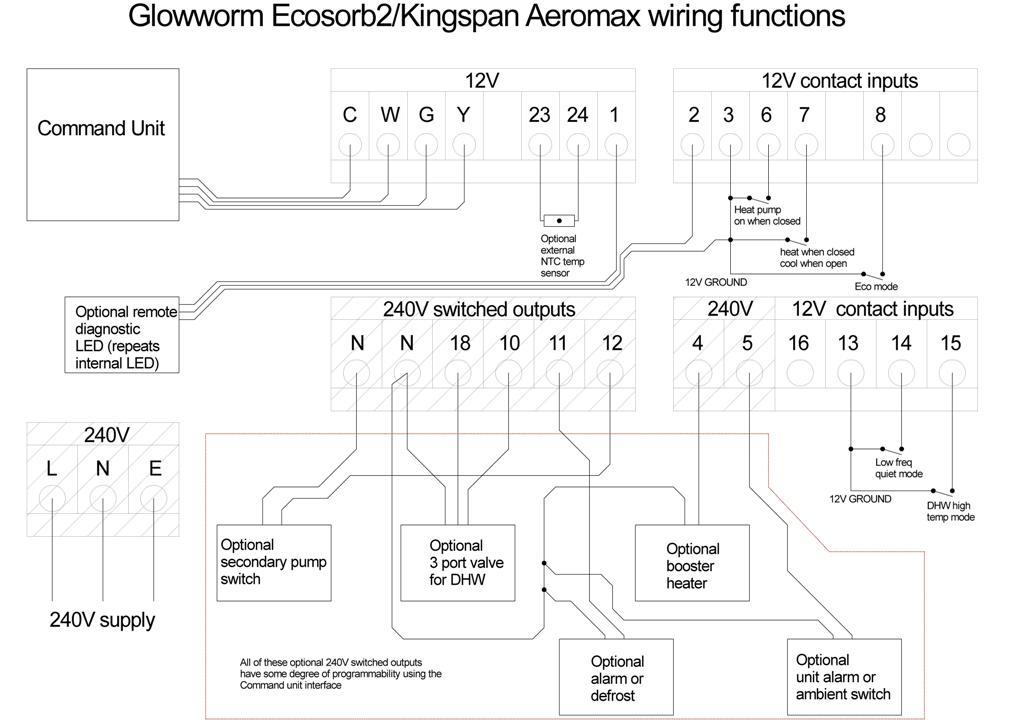
Just wire link 6 and 7 to 3 for now, as that will turn the ASHP on in heating mode. If getting out to it is a problem, then over-riding the dry contact control from the programmer may be an option, although this isn't something I've tried, so can't say for sure that it will work as expected. What you suggest should work OK, I think, from my interpretation of the manual.
-
With a lot of F'ing and blinding... It took me the best part of half a day to get the unit from where it was dropped at the curbside, on a pallet, up our steep drive, up the steps by our front door and into the hall, where it sat at the bottom of the stairs for a couple of days until I'd recovered enough to attempt stage two, getting it up the stairs on my own. Most of the time was spent rigging up timber frames and a tirfor winch, plus a back up safety rope, using some of my old climbing gear, with a length of rope and a couple of ascenders fitted to it and attached to the load so that I could maintain the tightness on the safety rope. I had to use the tirfor just to get my sack truck up the steps and in through the front door. I have one remaining challenge, which is to get the old 55kg Sunamp PV back down the stairs and crated up ready to ship back to Sunamp. Should be child's play after getting the UniQ 9 up the stairs...
-
My experience of having a new boiler fitted to an old CH system was that the power flush (which was mandatory - the boiler warranty was dependent on this having been done) washed masses of crud out of the system, but also highlighted internal corrosion in a couple of radiators, that then developed pinhole leaks at the bottom a few weeks after the system had been flushed. The leaks were exacerbated by me replacing an old system boiler, fed from an F&E tank that was only around 10 ft above ground floor level, with a combi boiler that is pressurised to around 1.5 bar, so the radiators were not only washed clean of crud, but were now operating at around 4 times the pressure they were seeing before. I also suspect that the old system had been run without any inhibitor, or that the inhibitor hadn't been changed for many years. A magnaclean or similar in the return to the boiler is, in my view, essential, as it does help trap a lot of the loosened crud that will remain after the flush, and prevent it reaching the boiler heat exchanger. A lot of boiler problems seem to be caused by crud getting into some of the fine passages in the boiler, and disturbance to the system, like draining it, hose flushing it or power flushing it will end up loosening up crud. Our system was power flushed for around 2 to 3 hours and a staggering amount of crud came out of it. When the guys emptied the power flush tank and cleaned the magnetic filter in it there must have been a good bucket full of solid crud that came out, yet we had no symptoms of this, all the radiators were working fine before it was flushed. I've since flushed the system out with a hose, as we had a problem with an odd incompatibility between two different inhibitors, that arose when I topped up the system after changing the pin-holed radiators and fitting a new towel rail. For some reason the two different inhibitors created a lot of gas in the system and when I drained it what came out was very frothy and milky-looking. Flushing via the drain off points with a hose seemed to work OK. After around half an hour I had clear water running out and felt reasonably confident I'd washed the system clean. Since refilling it with just a single brand of inhibitor we've not had another problem with gas build up.
-
The ASHP will need both dry contact terminals 6 and 7 to be connected to terminal 3 in order to turn on and run in heating mode. Terminal 3 is the 12 V supply 0 V terminal, so you can check with a meter between terminal 3 and terminals 6 and 7 to see if they are switched to 0 V OK. If they aren't, they will float at around 12 V, and the heat pump won't turn on. Watch out when doing these checks, as there are live mains terminals exposed very close to them.
-
I've just (as in late yesterday afternoon) finished installing and commissioning a Sunamp UniQ 9 eHW, with the PV option in the controller. The installation manual that came with my unit is not the one linked to above, and has a different (and simpler) set of wiring instructions. The version of the manual I have is dated 19/7/2018, so is newer than the one linked to. The way I've converted my wiring from the previously fitted Sunamp PV is this: I have a 16 A radial from the consumer unit that runs to a 20 A DP isolator switch for the hot water related electrical systems. This is the same as I had originally to run first an immersion heater in a thermal store, then the Sunamp PV. From that isolator I have a feed to my PV diverter that then runs to the main power supply to the Sunamp controller. This is a length of 2.5mm² T&E. I have another run of 2.5mm² T&E from the 20 A DP isolator to a fused connection unit (FCU) fitted with a 3 A fuse, as the low power, always-on, supply for the Sunamp control box, and my pre-heat circulation pump. From that FCU I have a length of 1mm² cable running to the "always on" low power supply to the Sunamp control box. This is also fused inside the Sunamp control box at 3 A. In my case I have a pre-heat circulation pump that is switched by a flow switch in the DHW supply, so that when any hot tap is operated water is drawn from the buffer tank to a plate heat exchanger that pre-heats the incoming cold supply to the Sunamp. The power for that circulation pump and flow switch also comes from the 3 A FCU. The electrician just needs to provide a standard 16 A immersion radial in 2.5mm² T&E from the CU to a 20 A DP isolator switch near the Sunamp installation initially, perhaps with a FCU for the low power connection. If you're having a PV diverter fitted then the isolator needs to be before the diverter. As far as the plumbing is concerned then it depends on which version of the Sunamp you are looking at using. In my case, the UniQ eHW is used for hot water only, so I've connected the two Sunamp internal heat exchangers together in parallel, with 22mm pipe, and have just a 22mm cold feed (which is pre-heated in my case, but doesn't need to be) and a 22mm hot water outlet that runs to a 22mm thermostatic mixer valve (TMV) fitted to the end of the DHW distribution manifold. I'll be taking some photos and writing up this installation in our blog over the next few days, so you can see what's involved. Best to look at siting the Sunamp somewhere where you can easily fit something that's very heavy. Mine is upstairs and it was an interesting challenge to get a 155kg unit up the stairs and into our services room on my own - took me a whole day just to get it up the stairs! I'd think about the transport route and location carefully, although I found that my 250kg rated sack truck was just about able to handle a UniQ 9, with it ratchet strapped tightly in place. Definitely better to try and not move one on your own, though.
-
Sounds unusual to me. Leasehold has never been common in Scotland at all, as historically few people owned land outright, and the Scottish form of freehold used to be pretty much restricted to land that used to belong to the church and the outright ownership of feudal landlords. The law changed just after we moved back South to remove the old feudal land ownership system, something that was long overdue, as it was an anachronism. Before that almost all land was still under feudal tenure, with the land owner often being the local laird, who had various rights over "your" land and what you could do with it. Both houses we owned in Scotland were under feudal tenure, but in both cases the feu duty had been paid in perpetuity, so there was no ongoing payment to the land owner. Freehold is now referred to as outright ownership, and my understanding is that most leaseholds were converted to outright ownership a few years ago, when the Scottish Parliament introduced legislation forcing this (which is what has been putting pressure on Westminster to do the same). My guess is that this a relatively new lease, set up by the current outright owner. I doubt there will be much information around on Scottish leasehold under current legislation, as it's new, unusual and probably challenging to set up. As Scottish land law is so very different to that elsewhere, and as it has changed very recently with regard to leaseholds, I think the best advice would be to find a good Scottish lawyer who has in-depth knowledge of the way that leaseholds can be structured. My instinctive reaction is one of caution, as I know that the attitude towards any form of tenancy is not generally positive, for historical reasons. I think I'd want to know why the owner wants to sell a lease, as on the face of it that seems unusual.
-
Sorry, missed that earlier. Two reasons, firstly the manifold came with actuator controlled valves at either end, and I'd already got the thermostatic head on the flow side. Secondly, Salus specifying that this actuator has to go in the return side, not sure why, but it may have something to do with the banging that can happen as valves close, as @Nickfromwales mentioned. It seems to work very well on the return, but I could fairly quickly swap it to the flow side to see if it works as well there.
-
Financing Self Build In Parents Garden
Jeremy Harris replied to Johnny Jekyll's topic in Self Build Mortgages
It's an OK book, but just reflects the views and experience of one person, albeit a person who has done a pretty good job of trying to disseminate what he's learned by various means, including that book. I doubt he's made much, if any, money from it, TBH, as it's not a big seller. There are lots of sources of information, some more reliable and accurate than others. Not sure where you've got the idea that one book could, on its own, prevent a cost over-run on a self-build. I'd advise anyone contemplating self-build to do as much research from as many different sources as possible, and carefully weigh up how applicable each source of information is to the self-builder's personal needs. One big advantage of this forum is that there is a massive variety of builds and experience, which means any self-builder here has the benefit of a great deal of varied practical experience, from people that have, in some cases, built several self-builds over the years. With regard to cost over-runs, I think there are few self-builders that haven't experienced some higher than expected costs. We had a cost over-run of around £50k, and I can assure you that I'd read everything I could on self-build (including Mark's book and blog), joined this forum's predecessor, Ebuild, in 2008, 5 years before we started our build, I spent a year (full time, not working) planning the detail of every aspect of the build that I could, analysed the costs, spent a lot of time hunting for bargains (I consider my time to be free) yet we still had unexpected costs. Could I have foreseen those unexpected costs? No, even with the benefit of hindsight I know I couldn't. They were things outwith my control or ability to forecast, in the main. The only thing I would do differently if doing it again would be to increase the contingency in the budget. I'd allowed 10%, and it just wasn't enough. -
Which ASHP are set up to cool
Jeremy Harris replied to Triassic's topic in Air Source Heat Pumps (ASHP)
Yes, it's that simple! Yes, it does. In both cases the temperature that the ASHP will run at depends on what's been programmed into it, either during manufacture or from the command unit, so without knowing the internally stored settings it's hard to be sure how cold the flow will be in cooling mode or how hot the flow will be in DHW mode. My guess is that the internal control board may be set to the default values in the command unit manual. -
Our place was at 20.5 deg C first thing this morning, and rose to a bit over 21 deg C through the day. Heating hasn't come on since last winter, and I doubt it'll need to come on for a few weeks yet. Last winter the heating was on for a total of around 250 hours, spread over about 4 months or so. There were lots of days in December, January and February where the heating didn't need to come on at all, as the couple of hours of heat dumped into the slab the day before was enough to keep the house at over 20 deg C.
-
Financing Self Build In Parents Garden
Jeremy Harris replied to Johnny Jekyll's topic in Self Build Mortgages
I can't really understand why anyone wouldn't want to self-build to a better thermal and airtightness standard than building regs. The cost differential of doing so is down in the noise compared with the other costs involved; a different type of worktop in our kitchen would have covered the cost difference between a passive standard build and a just-meets-crappy-building-regs standard build. Our build ended up exceeding the PHI requirements by a fair bit, but as you say, didn't attract a premium on the price of the structure. We did go for a reasonably good standard of internal fit out, with oiled solid oak stairs, skirting, architraves etc, oiled oak veneered doors, around £7k on stone worktops in the kitchen (which also has solid oak doors and drawer fronts, as does the fitted furniture in the utility room, WC and both bathrooms). We also opted for a lot of travertine stone flooring, plus an MVHR that has an integral air-to-air heat pump, so we have comfort air cooling in summer. The details are all in our blog, but the build cost came to around £1,380/m². The passive slab foundations and insulated and airtight house frame came to around £56k, IIRC, for 130m² of internal floor area. The triple glazed aluclad timber windows and doors (Average Uw of 0.7 W/m².K) were around £8.5k. I did a fair bit of work myself, like fitting the ventilation system, doing the plumbing, helping with the electrical installation, installing the heating/cooling and DHW systems, plus fitting the kitchen, bathrooms, WC, and utility rooms and doing all the internal joinery, so saved a fair bit on labour cost. What we saved from my labour allowed us to have a higher standard of internal fit out, though. We could have fitted out the interior for around 1/3rd to 1/2 the cost had we opted for a lower, but perfectly serviceable, specification. -
Which ASHP are set up to cool
Jeremy Harris replied to Triassic's topic in Air Source Heat Pumps (ASHP)
You don't need the command unit to get cooling to work, provided the cooling temperature has already been programmed into the unit. The command unit sends data to the ASHP to change the settings, which are then stored in non-volatile memory inside the ASHP itself. Changing the Carrier-based units from heating to cooling is just a matter of the way you wire up the 12 V dry contact controls, as shown on this diagram I drew up: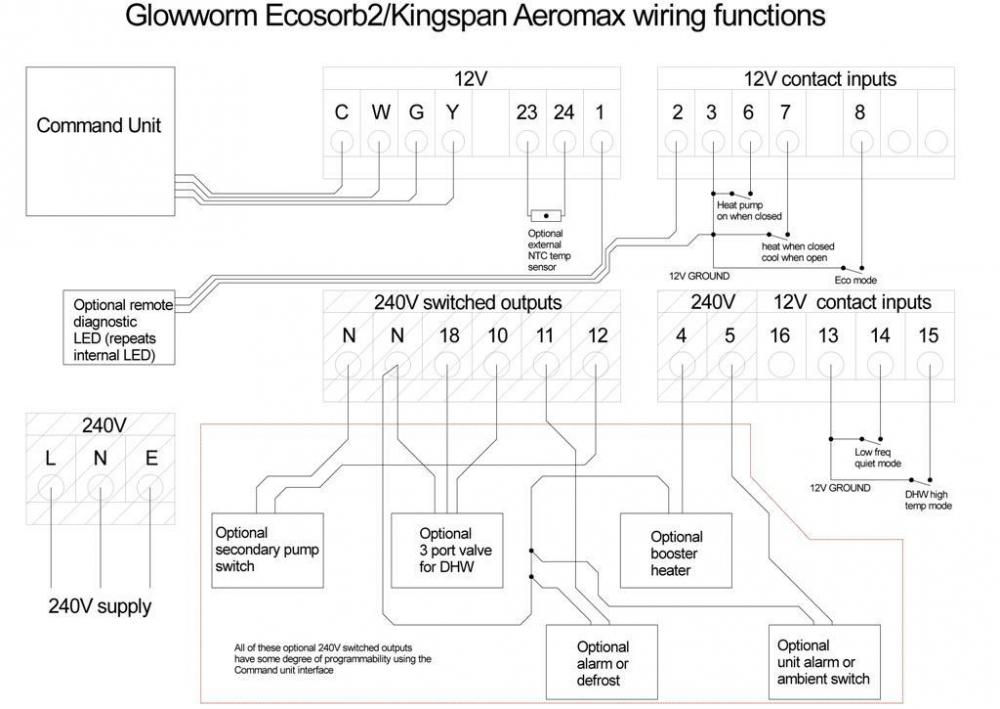
-
I'm tempted to buy one just to see if there's a way to change the temperature differential, or, perhaps, make a new controller for the stepper motor that would allow the differential to be changed. They are under £20, so not a great loss if I end up breaking it.
-
Which ASHP are set up to cool
Jeremy Harris replied to Triassic's topic in Air Source Heat Pumps (ASHP)
Mine's an air to water heat pump and I use the cooling mode to cool the UFH in summer. It's surprisingly effective, and works a lot better than I thought it would. I fitted a second room thermostat to switch the ASHP to cooling more, so we have two, side by side, one controlling the heating and the other controlling the cooling. -
I currently have our system set up with the thermostatic valve on the flow side of the manifold, set to around 28 deg C, and the Salus actuated valve on the return side of the manifold, with the temperature sensors clipped to the flow and return of one of the UFH loops (all our loops are set to flow at the same rate). This is accidental on my part, as I just turned the thermostatic valve up a bit, to make sure it was open, at the time I fitted the Salus actuator. By luck it happens to be set to under 30 deg C, which is why the Salus actuator works as well as it does. Perhaps I should have read the full technical info before I fitted it!
-
Flying in and out of London by helicopter is OK in twin engined one, it's only the single engine helo traffic that has to go in and out along the designated routes. I've blagged a lift into London a couple of times on a helo, but always the same one, an Agusta A109, in and out of Battersea.
-
My Advice for Self-Builders
Jeremy Harris replied to Red2000's topic in General Self Build & DIY Discussion
I think it's also worth noting that most houses in the UK aren't designed by architects, IIRC. I read somewhere a few years ago that only around 10% of UK houses are architect designed, and I suspect that a fair proportion of those may be self-builds. -
I've no idea about Salus valves, as the only thing I've used by them is a stepper motor driven actuator. That works very well, but my experience with central heating valves in various houses over the years is that Honeywell have been far and away the most reliable.
-
Septic tanks and the 2020 law.
Jeremy Harris replied to curlewhouse's topic in Environmental Building Politics
The reason for introducing EN 12566-3 was driven by the fact that leach fields often fail to provide adequate aerobic tertiary treatment after ten to fifteen years, due to biofilm clogging of the land drains which disables the aerobic treatment mechanism that soil bacteria provide. Dig around any old leach field and the chances are you'll find that the soil surround the land drains is black and anaerobic, so the effluent that is running off will have a high BOD. There's a lot of background to this, most of it stemming from EU work (and EC work before that) on identifying and rectifying ground water quality concerns, in particular the contamination of ground water by effluent with a high nitrate content (primarily from agriculture) and that with a high BOD (from industrial processes, agriculture and domestic sources. They didn't start seriously looking at domestic discharges and their impact on water quality until around 30 years ago, and this has led to a drive to reduce pollution originating from domestic effluent disposal, both locally to the property and on the standards that apply to the discharges by water companies/utilities. EN 12566-3 2005 is a consequence of the water quality directive, and was devised as a solution to the inadequacies of traditional effluent disposal systems dealing with waste from less than 50 people. If leach fields worked as a long term treatment solution there would have been no need to introduce legislation requiring treatment plants, but it's been known for many years that they just don't continue to work for more than a decade or so. As an example, in the late 1980's we replaced an old brick built septic tank at my late Mother's farm with a new tank (the old brick one was in the yard and partially collapsed). The new tank was located the other side of the drive, in a field that had pretty good drainage, and we just laid traditional land drains across the field. This tank has only had very light use, as my Mother lived on her own at the farm from then until she died this year, yet when it was surveyed recently we found that the land drains were all anaerobic. There's no indication on the surface, but when a couple of trial holes were dug it was obvious that biofilms had built up around them that had created an anaerobic zone for a foot or so around every drain. The suspicion is that these land drains effectively failed around 20 years ago, and that the tank had been discharging effluent with a high BOD to the ground water for all that time. The problem is that no one can see failed land drains. The effluent still drains away, the septic tank still seems to work OK, so it's an "out of sight, out of mind" problem. The only way to find out if there is a problem is to check at the ends of the land drains to see if the BOD is still OK and that the soil surrounding the drain is still healthy and full of aerobic bacteria, and very few people aver do this - the things only usually get checked when something stops working. -
Just found out why the Salus motorised UFH actuator works so well on our system. The headline temperature differential that it tries to maintain between flow and return is 7 deg C, which is higher than the differential we see on our system, and something I'd just put down to manufacturing tolerances. I've just read the detailed technical stuff on this actuator and it seems that it reduces the temperature differential that it tries to maintain to 4 deg C when the flow temperature is below 30 deg C. That's just about perfect for our needs, and explains why it works better than I thought it would. The main reason I fitted it was because it has a much faster actuation time than the thermal actuators. It's a real bonus to find that it also does such a good job of controlling a low power UFH system.
-
Septic tanks and the 2020 law.
Jeremy Harris replied to curlewhouse's topic in Environmental Building Politics
This has been in the pipeline for around quite a few years, since the EA here (and presumably SEPA in Scotland) put forward plans to comply with an EU-driven plan to firstly have all septic tanks registered and then to try to enforce the use of treatment plants. They have dodged doing both for years, probably because they were "too difficult". When I was dealing with the EA here is was very clear that they weren't really interested in trying to find all the septic tanks that existed and getting them registered, but they were keen on trying to get the use of treatment plants made compulsory. I sensed that there was a certain amount of frustration that Part H still allowed septic tanks to be fitted to new builds. -
The probe isn't a very tight fit inside that pocket, but seems to work OK as it goes in a fair distance. 25 deg C is about as low as that Wunda thermostatic valve will reliably go. I found that I could get mine to go down to about 23 deg C, but it wasn't great at controlling the temperature when down that low. 25 deg C should be fine, I now run our system with about that flow temperature and it seems to control reasonably well, with just a small amount of overshoot above the set room temperature, which you can see on the data that's logged, but can't subjectively feel in the house. I ended up replacing the UFH on/off valve at the other end of the manifold with a Salus stepper motor driven one, as in this post: This is the valve: https://salus-controls.com/uk/product/thb23030/#description