Jeremy Harris
-
Posts
26430 -
Joined
-
Last visited
-
Days Won
360
Everything posted by Jeremy Harris
-
It's a passive slab, though, so no concrete underneath.
-
 One issue may well be that the land doesn't actually belong to anyone. We have that situation alongside part of the stream that runs through our village, and so far it's taken several years to try and resolve and the Parish Council are no further forward. In our case the whole village used to belong to a local landowner, who sold off the individual houses and various plots of land (including ours) in 1915. Unfortunately, the strip of land between a lane through the village and the stream was never identified in that sale, and the original landowner's inheritors in title are adamant that it isn't theirs. It's not possible to build on it, and it's not used for any access, but it is now extremely overgrown and was a contributory cause of flooding around 5 years ago, as the stream is partially choked by all the willows and alders in that strip. In the aftermath of the flooding the PC wanted to get the landowner to clear the obstructions, as they are required to as riparian owners, and that's when it was discovered that the land doesn't belong to anyone. Volunteers now clear it every year, whilst the battle continues to try and establish ownership. In our case no one can claim adverse possession as the land hasn't been used by anyone in living memory (it's only around 20ft wide at the most, and maybe quarter of a mile long).
 -
As I understand it, the retaining wall is a part of the stepped foundation, though, isn't it? If so then it's fine, as long as all the above ground walls of the old house are demolished, as HMRC allow the retention of the foundation when rebuilding on the same plot. My concern wouldn't be HMRC, it would be whether the existing stepped foundation and integral retaining wall is structurally and thermally OK for the new build.
-
That's good news, and great that both companies are responding positively to try and put things right.
-
The simple answer is that if the retaining wall is on the plans, and is required in order to build the house or the access to it, then it can be zero rated. If the retaining wall isn't needed in order to build the house or access then it most probably can't be zero rated. The exception to that would be where there is a retaining wall in a garden that formed a part of an approved landscaping plan, that formed part of the planning approval, when it would be zero rated. The general rule of thumb is that if something is integral to the structure of the house or access then it's zero rated. Anything that falls into the zero rated category is eligible for a materials VAT reclaim on completion.
-
We have a big retaining wall, all above ground, and it was zero rated. For an idea of the work we did, these blog entries might help: http://www.mayfly.eu/2013/07/part-six-there-we-were-digging-this-hole/ http://www.mayfly.eu/2013/07/part-seven-pouring-concrete/ http://www.mayfly.eu/2013/07/part-eight-the-wall/
-
AndyT ( Andy Trewin ) formerly of Sunamp
Jeremy Harris replied to Nickfromwales's topic in General Alternative Energy Issues
Sounds feasible, as long as the charge temperature is controlled. I've noticed that the UniQ eHW pulses the heating element on and off when charging from cold, when the PCM is solid. I'm guessing it does this to make sure the PCM doesn't locally overheat. Once the PCM has started to melt it seems that convection in the liquid works to prevent local overheating. -
AndyT ( Andy Trewin ) formerly of Sunamp
Jeremy Harris replied to Nickfromwales's topic in General Alternative Energy Issues
There's no switching of water pathways, just two embedded heat exchangers and a heating element, and there is now just a single big heat cell. There's nothing mechanical that moves at all in the heat cell, the key is in the formulation of the PCM compound I believe. Although it's sodium acetate based, it has been modified, presumably to make it self-nucleating, and that knowledge is being kept pretty secret by Sunamp. All I know is that when I've pointed a thermal imaging camera at a charged Sunamp PV, it's at room temperature, but when you turn on a hot tap, the outlet pipe gets hot almost immediately. How they control nucleation seems to be key, and not something we're likely to find out easily, I think. -
AndyT ( Andy Trewin ) formerly of Sunamp
Jeremy Harris replied to Nickfromwales's topic in General Alternative Energy Issues
One of the key things that isn't in the public domain (AFAIK) is the way that Sunamp control nucleation and stop and start it. I think this was the key to getting the system to work as well as it does. Others had tried to use sodium acetate as a phase change heat store and not been able to crack the nucleation problem. The additional 1.5 kWh that's stored (over the 9 kWh rating of the UniQ 9) comes from the heat capacity of the sodium acetate when it's hot and liquid, I believe, whereas the 9 kWh base heat storage is from the latent heat from phase change. -
AndyT ( Andy Trewin ) formerly of Sunamp
Jeremy Harris replied to Nickfromwales's topic in General Alternative Energy Issues
Not sure it is, TBH. When the sodium acetate has changed phase from solid to liquid, the energy is locked up within it, so the PCM can cool down, yet still store sensible heat as a liquid. When we were clearing the old house to move I found a sodium acetate phase change hand warmer in a drawer. It was liquid, so I clicked the nucleator and it immediately started to crystallise and get hot. I've no idea how long it had sat "charged" in that drawer, but it was certainly more than 3 years. The PCM 58 used in the hot water Sunamps is sodium acetate, too, so I'd expect the same sort of behaviour. -
AndyT ( Andy Trewin ) formerly of Sunamp
Jeremy Harris replied to Nickfromwales's topic in General Alternative Energy Issues
Hard to say. The thermal camera shows that the thing sits with the case at ambient temperature when it's charged. There's no background activity, just the ~6 W that the control box draws from the mains. -
Blown fibre insulation (definitely NOT blown EPS beads, as there are PVC cables in there) would seem the best bet, but it may well be too small a job, as @AliG suggests. There are other cable-safe insulation types that can be blown in, I think, I can remember seeing vermiculite in a loft once, and that looked like it might be possible to be blown in down a long tube.
-
AndyT ( Andy Trewin ) formerly of Sunamp
Jeremy Harris replied to Nickfromwales's topic in General Alternative Energy Issues
I'd be inclined to agree with @Nickfromwales about the preheat, in that it's an added complication that was useful when we had the much smaller Sunamp PV, and the old thermal store before that, but it's not really needed for the Sunamp UniQ, with it's much greater storage capacity. The UniQ 9 eHW we have now is roughly equivalent to a 210 litre hot water cylinder, but with much lower heat losses, just 0.73 kWh/24 hours when it's hot, and I suspect a fair bit less than this when it's just sitting with the PCM charged but not hot. -
Plate heat exchanger - insulating
Jeremy Harris replied to readiescards's topic in Underfloor Heating
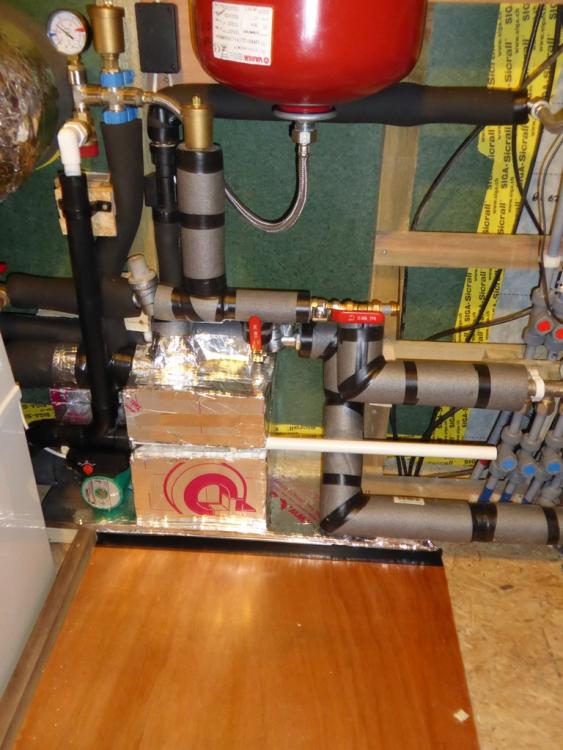
I made an insulated box for ours, using 50mm PIR foam and aluminium foil tape. Seems to work OK and wasn't hard to make. I glued the foam pieces together with low expansion gun foam, then neatened up the outside with the aluminium tape so it looked tidy: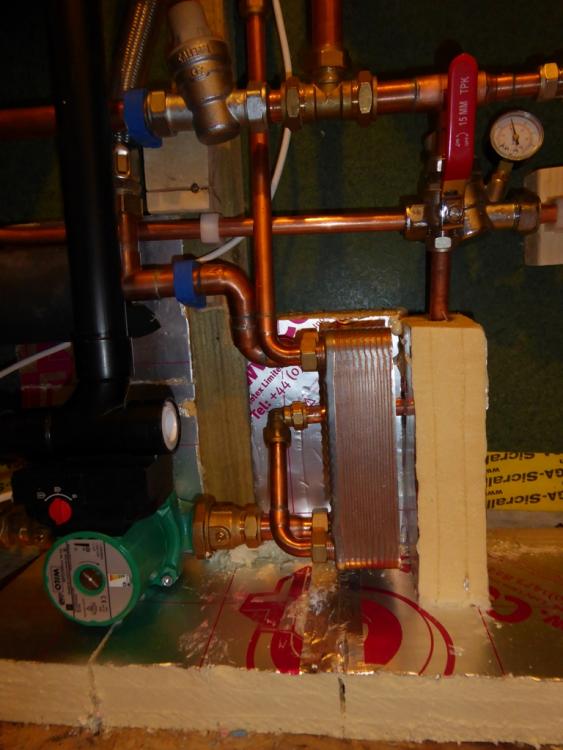
-
The stats I used have a link internally to select whether they run in cooling mode or heating mode. The display shows what they are doing (heating or cooling). I fitted two, one above the other, on the hall wall, with the cooling stat normally set to call at 22.5 deg C and the heating stat set to call at 20 deg C. I have occasionally turned the cooling stat up to 23 deg C, just to stop the cooling coming on in winter, but that's just two button presses. The stats I used were the Computherm Q3RF ones, and are both battery powered remote control units.
-
AndyT ( Andy Trewin ) formerly of Sunamp
Jeremy Harris replied to Nickfromwales's topic in General Alternative Energy Issues
The PCM in a Sunamp will hold a thermal charge for days, as it doesn't store heat as heat, as such. As an illustration, I disconnected the electrical side of our old Sunamp PV on a Friday afternoon, then went away and didn't disconnect the plumbing side until the Monday. Before disconnecting it I decided to just run off some hot water, to be sure it had discharged, and had to wait half an hour with the hot tap running before it ran cold. At a guess I'd say it was still around 2/3rds charged after around 70 hours since the last heat input. -
How many amps does a static caravan need?
Jeremy Harris replied to epsilonGreedy's topic in Electrics - Other
No such thing at 6.5mm² cable, as far as I'm aware. You can easily calculate the cable size needed for a given load (remembering to apply the diversity rules in BS7671) from this handy cable voltage drop calculator: https://www.tlc-direct.co.uk/Technical/Charts/VoltageDrop.html Select the cable type (most probably two core SWA, as you'll need to TT the caravan installation) and also that it will be buried. Select an ambient of 10 deg C, as that's about the maximum soil temperature, then just stick in the 22m length and your estimated load and it will give you the required cable size and maximum voltage drop. As a guide, a 10 kW load at 22m would need 6mm² two core SWA, and I'd guess that 10 kW (allowing for diversity) should be more than enough for a caravan supply. Edited to say that I cross posted with @ProDave -
Is there any benefit to two supplies into one house?
Jeremy Harris replied to Nick1c's topic in Electrics - Other
Looks like you have two 100 A fused supplies, based on the lower cut out fuse marking, so they are both pretty standard 15 kVA* domestic supplies I think. One 15 kVA supply should be enough for a new build, unless it's going to be very large or have some unusually high loads. * 100 A and 15 kVA don't tally (15 kVA at a nominal 230 VAC is 65 A), as the DNO fuse is there to protect their cable, and the DNO nominal 15 kVA rating can be exceeded for short periods of time, plus there is an allowance for the power factor being less than unity, I believe. -
That's an older version of the manual, I believe, the current version is this one (although I'm pretty sure it's in the process of having some minor amendments added, as some things like the sensor cable colours have recently changed): UniQ manual 180719.pdf
-
As an off-topic aside, one of the first applications of EPS as a foundation system was, I believe, as a railway support raft across a bog. Probably better than Salisbury cathedral's foundations. That's reputedly built on loads of straw that was laid down in the water meadow to provide something to build on.
-
I don't think the Sunamp PV is available now, it's been replaced by the UniQ eHW. Both are much the same, in that they have what amounts to an immersion heater element (same rating as one) that runs at 230 VAC. This can accept either power from the grid or power from an excess PV diversion controller. I run ours with a mix of both. We have an excess PV diversion controller that supplies power to the Sunamp whenever we are generating more electricity than we are using, and that has an over-ride capability, either by switching it on manually or by using a time switch to provide a timed boost. I have the time switch set to provide power (if needed) from 04:00 to 06:00, so if the Sunamp isn't charged up it will get up to 6 kWh of boost charge, if it needs it (it will only accept as much charge as it needs then shut off the power). We also have an over-ride button that will just boost charge the Sunamp if needed at other times, plus we can switch off the boost completely for the ~9 months of the year when it's not needed.
-
AndyT ( Andy Trewin ) formerly of Sunamp
Jeremy Harris replied to Nickfromwales's topic in General Alternative Energy Issues
From their accelerated testing I believe they are suggesting over 25 years life, perhaps more, as they aren't seeing any significant degradation so far. My old Sunamp PV (from 2015) is going back to Sunamp for analysis today, so they can get another benchmark for probable life. There's nothing at all wrong with it, it's still working just as it did when I first installed it, but I liked the idea of having a lot more DHW capacity (well over 9 kWh from the UniQ, versus 4.5 kWh from the pre-production Sunamp PV that we had). We've now got enough DHW capacity to last a couple of days, so if we get a cloudy day it won't matter too much, and I can reduce the grid boost usage. -
Is there any benefit to two supplies into one house?
Jeremy Harris replied to Nick1c's topic in Electrics - Other
Complete guess, but I suspect it comes down to the DNO cable rating, and not being able to apply diversity to the storage heater load. We know that DNOs routinely use much smaller cables than would be allowed on the consumer side, so perhaps they chose to run two cables from the same connection on the pole to the house just to get more continuous capacity without an excessive cable voltage drop. Still can't understand why they didn't just fit a single larger cable, though. We've ended up with a pretty massive 35mm2 incomer for some odd reason. No idea why. -
Is there any benefit to two supplies into one house?
Jeremy Harris replied to Nick1c's topic in Electrics - Other
A lot of night storage heaters would explain it. A normal domestic supply is rated at around 15 kVA, so if the place had a lot of storage heaters then it wouldn't be hard to use all the capacity of a single supply for this, which probably explains why the second supply was put in to run them. As both cables are on the same pole connection from the look of it, then I doubt there's a network limitation locally. A new build isn't likely to need more than a single 15 kVA supply, unless it's a pretty big house. Generally it's easier to just get a 3 phase supply if the demand is high, but that wouldn't work easily for a house full of storage heaters. -
True, and anecdotal evidence suggests that the air temperature in the room can be around 1 deg C cooler for a given comfort level because of this effect.