Jeremy Harris
-
Posts
26430 -
Joined
-
Last visited
-
Days Won
360
Everything posted by Jeremy Harris
-

Heating oil prices for the next 20 years
Jeremy Harris replied to Nickfromwales's topic in Boilers & Hot Water Tanks
This falls well and truly into the "too hard to estimate" category, I think. This graph shows the crude oil price between 1946 and 2018, and illustrates just how much variation there has been: You could draw a pretty crude line through that to show the mean, then extrapolate it out to 2038, but I'm not sure it would tell you much, given the very wide fluctuations in price.
-
It's an exceptionally crude bit of kit, that even when produced by a reputable factory looks like it's been made in someone's garage. The only parts that needed accurate machining, rather than bench fabrication, were the barrel and breech block IIRC, everything else is pretty much just sheet metal or tube. The hardest part to make is probably the magazine, as that's a weird affair that feeds rounds in side by side over most of it's length.
-
I gave away a working Sten a few years ago. It had been given to me as a "deactivated" trophy, "liberated" by an acquaintance in the early 1950s, and stored, together with a load of ammo, in his loft for decades. When I stripped it, I found it wasn't deactivated at all; all that had been done was to remove the extractor. As this is just a simple bit of 1/8" hardened steel plate, and as I had access to a drawing, it didn't take long to get the gun working. Terrifying thing to fire, it jumps up violently with every round fired. When I spoke to the chap that had given it to me he said they'd been told to aim at the target's feet, and with luck the second or third round would hit their centre of mass... I may well have a set of Sten drawings around somewhere, I'll try and dig them out.
-
Durisol: that's it - the last pour.
Jeremy Harris replied to ToughButterCup's topic in Insulated Concrete Formwork (ICF)
Congrats on this milestone, and thank God neither of you got hurt by 50kg of rapidly descending concrete... Recently I spent a whole day lifting a 150kg+ Sunamp up to the first floor. On my own. Scary as hell at times. Thank God my old climbing ropes and ascenders (rope clutches) all still worked, and were OK with a load that's around double that they'd normally operate at. -
IVT Ecolane ASHP - any owners out there?
Jeremy Harris replied to readiescards's topic in Air Source Heat Pumps (ASHP)
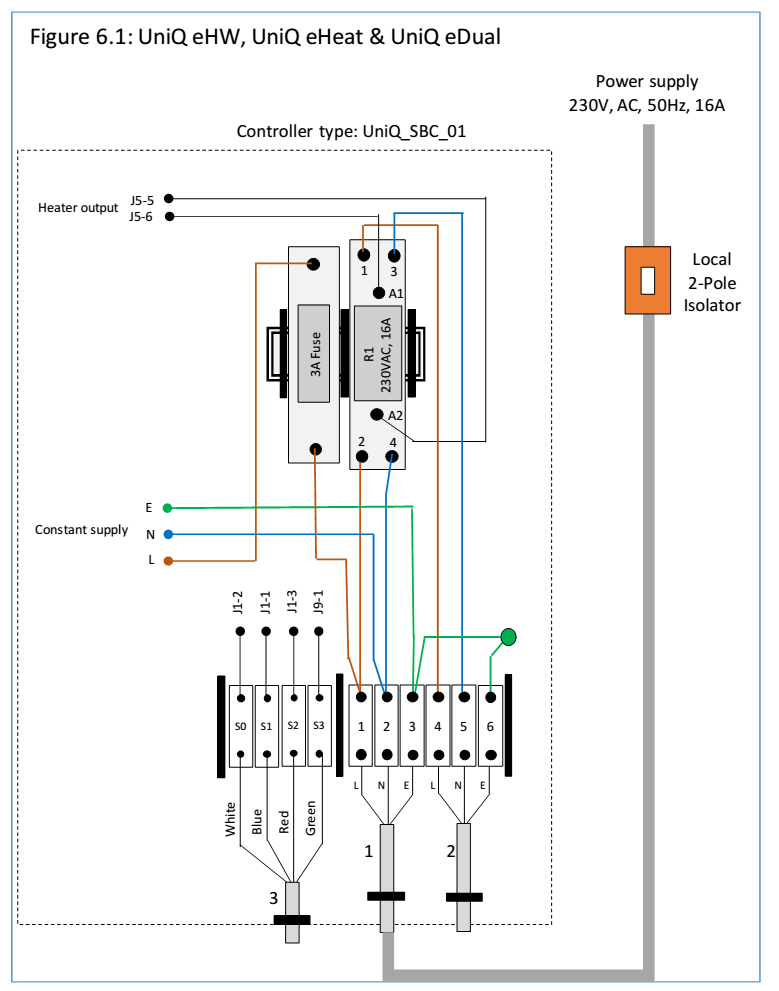
I did mention originally "Looking at the connections in our control box it looks very much as if one of the low power relays is used to switch 230 VAC to A1-A2, which in turn are connected to the coil of the larger DIN rail mounted power relay." I hadn't spotted that our controller was different internally. It's a coincidence that I'd just been looking inside our controller with a view to adding an indicator, driven from the A1 and A2 terminals. Given that the standard way of marking DIN mount relays is to label the coil as A1 and A2, I'm not sure that using the same terms to describe the dry contacts on the SBC_03 controller is that good an idea - it certainly managed to cause me to be confused! -
IVT Ecolane ASHP - any owners out there?
Jeremy Harris replied to readiescards's topic in Air Source Heat Pumps (ASHP)
There's a difference between the two units, our's is as shown in diagram 6.1, with A1-A2 being the power relay coil: One thing I'm going to add to our system is a small box with a panel indicator light, to show when the unit is calling for heat, as at the moment there's no indication of the unit status at all. The old Sunamp PV had four LEDs on the side that showed its status, something I found useful.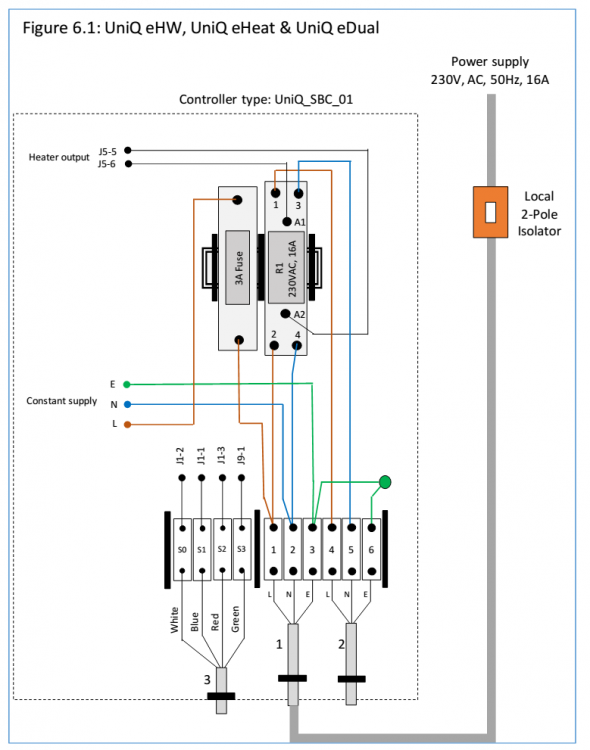
-
IVT Ecolane ASHP - any owners out there?
Jeremy Harris replied to readiescards's topic in Air Source Heat Pumps (ASHP)
I think you're right, the only call for heat is from the low current A1-A2 connections that control the 230 VAC power relay for the heater. Looking at the connections in our control box it looks very much as if one of the low power relays is used to switch 230 VAC to A1-A2, which in turn are connected to the coil of the larger DIN rail mounted power relay. There is room on the DIN rail to add another relay, so it would seem possible to add some form of ASHP control within the control box. The best arrangement may be to just make this a dry contact that closes when there is a call for heat, so that there's isolation between the power circuits within the Sunamp and the ASHP control system. -
Help with kitchen renovation/ 1st house.
Jeremy Harris replied to zoothorn's topic in Bathrooms, Ensuites & Wetrooms
I will admit to being a bit of a Gibson fan, too. I still have the Gibson Hummingbird that I bought on HP around 1970. Not my favourite guitar, but it's close. The favourite is the first guitar I owned, a Christmas present when I was 12, a 1953 Melodija Menges. -
Help with kitchen renovation/ 1st house.
Jeremy Harris replied to zoothorn's topic in Bathrooms, Ensuites & Wetrooms
I still have an old (as in late 1960s) Vox AC30, and it still works! I reckon you've done a bloody marvellous job, and this thread is a brilliant inspiration for others. -
FWIW, I once lifted the lid and pulled the pump up on our system in Scotland, just out of curiosity, so I could see what was in there and how easy it would be to fix if it went wrong. The pump was hanging on a chain, with a length of flexible hose that was around 2" in diameter connecting it to the outlet via a bayonet connector with two levers to disconnect it. It looked easy enough to change, just a matter of turning the power off, disconnecting and lifting the pump out, opening the watertight cable connector and disconnecting the cable, then doing the reverse to drop a new pump in. We never had any problems with blockages at all, although we did take care to treat it just like a septic tank, and not put anything down the drains that wouldn't break up or dissolve.
-
Depends on the usage, but my inclination would be to try and over-size the tank, or keep a spare pump that can be swapped over quickly. The tank size really depends on how long you want the system to collect waste in the event of a pump failure. Two people probably generate around 300 to 400 litres per day of waste water, I think, so if you think you'd be able to swap the pump over within 24 hours if one failed, then you could probably get away with a tank of around this capacity. The other advantage of a larger tank is that the pump wouldn't turn on and off as frequently, as they operate with a float switch. a larger tank will take longer to fill to the point where the float switch turns the pump on, so in theory the pump should last longer, as it's probably stops and starts that cause the most wear.
-
Just fit a pump station, like these: https://www.jtpumps.co.uk/packaged-sewage-pumping-stations-2-c.asp We had one at our house in Scotland, to pump our sewage up to the main sewer in the lane above the house. Worked faultlessly for the five years we lived there.
-
Disabled access
Jeremy Harris replied to Russell griffiths's topic in General Self Build & DIY Discussion
Just to clarify, our ramp has gravel either side at the same level as the paving. The only step is down from the flat turning area to the top of the drawing in the post above, and BC thought that was fine, as any lip would have been a trip hazard. The photo below shows the ramp as built, with the flat turning area just behind the black recycling bin.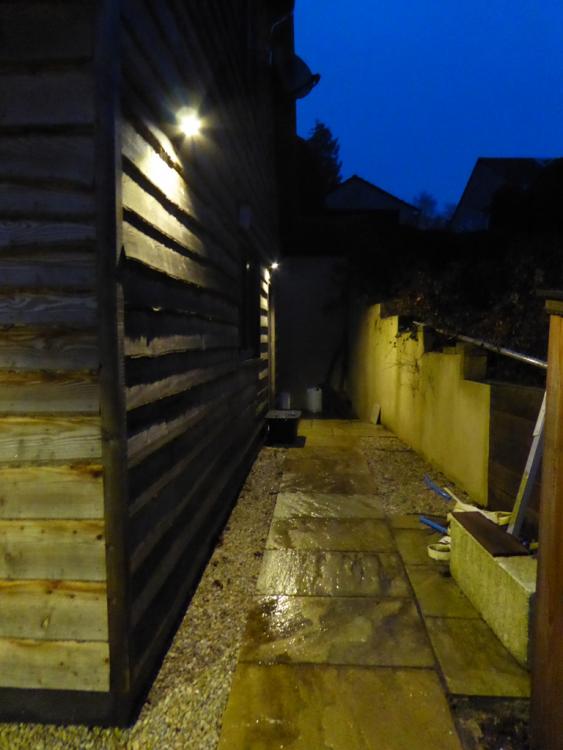
-
Disabled access
Jeremy Harris replied to Russell griffiths's topic in General Self Build & DIY Discussion
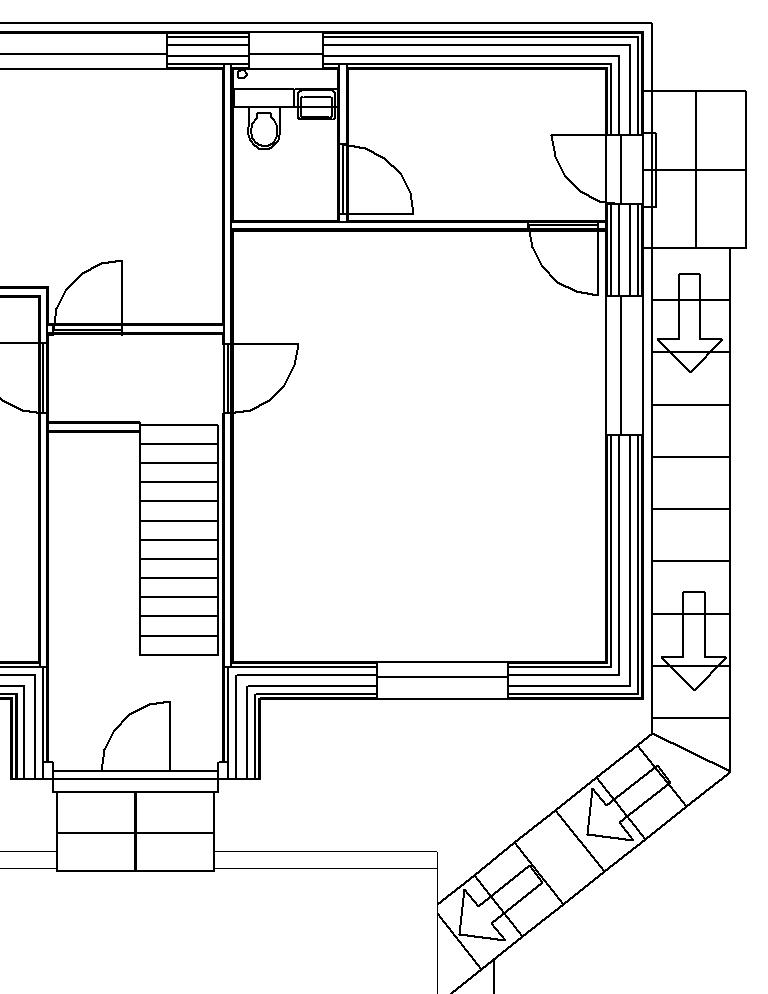
We have a ramp leading to a wheelchair turning area outside the back door. This turning area is flat, and there is a step down from it to the path that continues around to the rear of the house. There's no lip, as that would have been a trip hazard. Our BCO was very happy with the arrangement. The bit of a plan below shows the ramp and flat area. The stone slabs are 900mm x 600mm, so the flat wheelchair turning area is ~1800mm wide by 1200mm deep.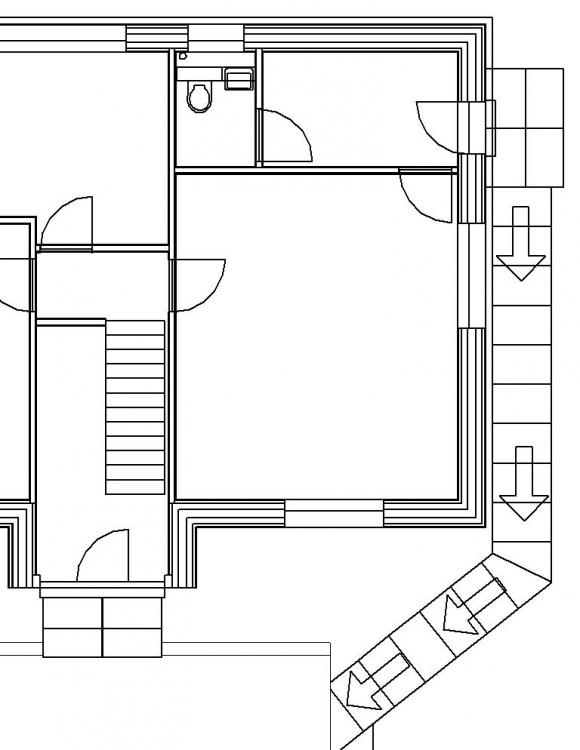
-
On ours the "cold" is just the UFH return, which has been cooled by running around the loop.
-
AndyT ( Andy Trewin ) formerly of Sunamp
Jeremy Harris replied to Nickfromwales's topic in General Alternative Energy Issues
I can't see any means by which the electrical control box on ours can do anything other than enable or disable power to the heating element. There is nothing else that is controllable in the unit itself; ours just has a heating element in the base that's connected to a 3 core power cable, plus a string of temperature sensors fitted vertically into a pocket in the cell to sense the bottom, centre and top cell temperatures. I can confirm that the older Sunamp PV we had worked, in terms of heating hot water on demand, with the power supply to the unit turned off. That suggests that no electrical input is required for the cell to work, in either direction, it just needs control of the charge temperature so as to not cause problems with overheating the PCM. -
The original SA80 was designed specifically to address problems with the SLR in NI. The guys on patrol had to leave their rifles in a rack in the back of the vehicle, as they were too long to be carried when sat down. The terrorist snipers knew this, so took advantage of the fact that the guys had to get out of a stationary vehicle unarmed, and walk to the back to grab their rifle. The other big factor was weight. The guys on foot patrol had to carry a heavy rifle plus heavy ammunition, which created fatigue problems after many hours on foot. The original SA80 was a 4.85mm calibre weapon, to reduce the weight and size from the 7.62mm SLR. Late in development NATO standardised on 5.56mm, so the SA80 was re-chambered to accept the larger calibre, but they didn't reposition the gas port to allow for the slower burn of the NATO ball powder, something that added to the later reliability problems, by reducing the amount of force available to drive the bolt carrier back during ejection and reload. The concept for a bull pup rifle had been around since the 1940s, but there had always been a great deal of resistance to having one as a general service rifle, partly because a short, light, rifle doesn't look good on parade, believe it or not. Enfield was a damned good ROF, and the SA80s they made were pretty good, with the sole exception of the lack of a guard over the mag release button. The latter caused a lot of embarrassment in NI, as guys would get out of a vehicle quickly, then hear the clatter as the magazine fell out, because the mag release would catch on their webbing whilst sat down. That was fixed quickly by retrofitting a guard around the mag release, initially araldited (!) on in the field, with full production runs having the guard spot welded to the receiver. The problems all arose when production was moved to the ROF at Nottingham, because the guys on the shop floor at Enfield knew all the tweaks they did that weren't ever put on the drawings and they didn't pass this on to the guys at Nottingham. The H&K made L85A2 is probably one of the most accurate and reliable lightweight rifles around. Personally I don't like the pressed metal and plastic construction much, as it's far from being "squaddie proof", but it meets or exceeds the specification that was set, and it's hard to see how a lightweight rifle could be made without using pressed metal and plastic parts, and weight is critical. The AK47 is really crap in so many ways. It's heavy, uses heavy ammunition, it's very inaccurate (pick one up and shake it and it rattles, as every part in it is a very loose fit). It's saving grace is that it can be repaired very easily, and tends to be reasonably reliable.
-
That's exactly how the SA80 rifle performed so badly. The Royal Ordnance Factory that designed it and made and tested the prototypes that went through acceptance testing, didn't get the job of mass producing them. The drawings were sent to another ROF for them to mass produce and there were half a dozen critical design elements, including the hardening process of the trigger actuating rod, that weren't on the drawings. The result was around 150,000 really crap rifles being made and put into service. The sad thing is that the exact cause for the problems with the rifle wasn't uncovered until Heckler & Koch won the contract to upgrade all the rifles to the new L85A2 that's currently in service. The first thing H&K did was disassemble and analyse around 100 SA80s, and compare them with the stored reference rifles from the initial batch of prototypes. They found that almost all the reliability problems were caused by differences between the drawings and the prototype rifles, with all the prototypes being far better built and more reliable than the in-service rifles. Pretty impressive spending a day on the range during the initial reliability testing of the first batch of L85A2s. We fired 10,000 rounds in a day through ten rifles, with only two misfires, and both of those were due to blind rounds. Previously, the best the SA80 had done was around 40 rounds before it jammed or misfired, so it was a hell of an improvement.
-
MBC, who are they?
Jeremy Harris replied to Ed Davies's topic in General Self Build & DIY Discussion
I'll PM you with the whole story, as some of it is a bit sensitive as far as this forum (and the demise of it's predecessor, ebuild) are concerned. -
If you just want the unit to deliver a constant flow at 45 deg C, accepting that it will start to run defrost cycles at this temperature, then don't bother with the DHW temperature setting or the dry contacts between 13 and 15 and just load these values into the command unit: 112 = 0 119 = 19 120 = 45 121 = 45 That will set the heat pump to deliver a constant 45 deg C flow whenever it turns on in heating mode. If you want to use floor cooling, then setting these parameters will give you a constant 12 deg C, which I've found to be a good compromise between cooling effectiveness and the risk of floor condensation: 117 = 0 122 = 40 123 = 14 124 = 12 125 = 12
-
I'm pretty sure you're spot on. Our unit came with settings that just weren't anywhere optimum for our requirements, and resulted in the unit trying to deliver flow temperatures that were too high in heating mode, with consequent defrost cycling that sapped the efficiency. I think the main problem is that the companies selling badge-engineered ASHPs just don't understand the products they are selling. I would guess that the reason some of them just pulled out of the heat pump market was because they got their fingers burned by a number of installations that just didn't perform as they could have if set up properly. A positive side effect of this has been a steady flow of bargain heat pumps on to the market, though. Setting up a Carrier unit is a bit tedious, as the settings are far from being intuitive. I had to spend several hours working through them by trial and error to determine exactly what changing each parameter really did. To work out how the climatic curve set points worked I sketched little graphs in the blank pages of the manual. I may have a go at sticking them into a spreadsheet later, as the graphs do help make sense of things, at least for me.
-
There are two separate settings, one for DHW that's a fixed flow temperature, set by parameter 113, the other a variable flow temperature for heating, set by the heat curve that parameter 112 refers to. There are a range of pre-defined, numbered, heat curves that can be selected by parameter 112. All offer weather compensation to different degrees, except for the case when parameter 112 is set to 0. In this case the user defines a custom heat curve using the custom set points in parameters 119, 120 and 121 for heating. For cooling using a custom curve then set parameter 117 to 0, then use parameters 122, 123, 124 and 125 to set the shape of the cooling curve. The settings I use (just for heating and cooling, I don't use the DHW mode) are these, which fix the flow temperature at 40 deg C in heating mode and 12 deg C in cooling mode: 112 = 0 117 = 0 119 = 19 120 = 40 121 = 40 122 = 40 123 = 14 124 = 12 125 = 12
-
The concept of "carbon neutral" with burning wood is flawed because of the large time delays involved. A mature tree converts around 20kg of CO2 into biomass each year, but burning a tree releases the whole of its sequestered CO2 into the atmosphere a heck of a lot quicker. However, the really big issue with burning wood is the pollution it creates, especially fine particulates. Running a wood burning stove can release as much harmful pollutants as having a dozen or more diesel cars parked on your drive with their engines running. The best thing to do with wood cuttings that are surplus is to compost them, as at least that slows the release of CO2 to the atmosphere.
-
You don't need a DHW stat, as the heat pump runs at a maximum of 60 deg C in DHW mode. You can set the DHW temperature using parameter 113 on the command unit. The default setting is 45 deg C.
-
I'm not 100% certain that you can mix dry contact control with control from the Command Unit, so it may be that the time switch may not work as planned. The manual seems to imply that setting parameter 100 to 4 (air to water monobloc with command unit as thermostat) may disable the dry contacts, but it's far from clear if it disables all of them, including the terminal 13 (0V) to terminal 15 (DHW high temperature mode) or not. Mine runs in system mode 2, air to water monobloc with climatic curve and control by dry contacts, and I don't use the connection to terminal 15, so I'm not able to test whether or not it works with the system mode set to 4.