Jeremy Harris
-
Posts
26430 -
Joined
-
Last visited
-
Days Won
360
Everything posted by Jeremy Harris
-
Very true! Just do a web search on "facade fires" and you'll find a lot of really serious EWI fires, some absolutely terrifying in the way that they drip a curtain of burning droplets of molten polystyrene over openings like windows and fire exit doors. This is an old one, but there are others much the same:
-

Help calculating U-Value of ground floor...
Jeremy Harris replied to JohnW's topic in Heat Insulation
The BRE recommendations just simplify and standardise the 3D modelling process, to produce a set of recommendations as to how thermal models can be effectively standardised in order to all give essentially the same results for a given set of conditions, in this case compliance with Part L, primarily. When reading through BR497 it's clear that the aim is to produce a set of rules that can be followed to ensure compliance with building regs, rather than a set of rules that produces a very accurate thermal model. IMHO that's deeply flawed as an approach, as it results in details that may meet the needs of calculating thermal bridging as far as the regs go, but which take no account of the knock on effect of things like interstitial condensation. There's a (rather bold) assumption that water vapour cannot penetrate a building from outside at a faster rate than it can escape, which is patently false for some construction methods and dynamic conditions. I've yet to see an interstitial condensation model that can, for example, model the dynamic condition change such as a cold, damp, night, followed by a warm, hot morning, not an untypical wet of weather conditions in the UK. When I did a simple 2D model of this sort of change in conditions over a period of around 4 hours I found that the standard SIPs sole plate detail resulted in condensation forming under the outer 30% or so of its bearing area, and there not being sufficient energy available through the rest of the day to drive that condensation back into water vapour so that it could permeate back out. A few such cycles would be likely to result in sufficient moisture build up as to allow fungal decay. The solution is relatively simple. Adding a layer of additional insulation on the outside of the SIPs panel, that overlaps for a distance below the sole plate, ensures that the outer edge of the sole plate doesn't cool down to dew point for any likely range of external temperature and humidity conditions. One of my main criticisms of the BRE is that they seem not to take a joined-up approach when looking at either modern methods of construction or dealing with changes to specific building regulations. In the case of thermal modelling it's considered in glorious isolation, as they don't seem to have a systems philosophy when it comes to construction. Arguably, this "consider each element in isolation" approach, which seems endemic in the construction industry, needs addressing. Grenfell Tower is a fair example of how the absence of a joined up approach to materials certification and the application of those materials in construction practice leads to unnecessary deaths. -
Help calculating U-Value of ground floor...
Jeremy Harris replied to JohnW's topic in Heat Insulation
However, with sensible design the edge loss can be reduced such that it's so small as to not be worth considering in the overall U value calculation. With sufficiently high levels of insulation underneath and around the perimeter there's no real merit in bothering to try and semi-3D model the heat loss, as just considering the simple vertical heat loss path gets to within around the third decimal point of the calculated U value. This is especially true if the geometric bridge at the floor - wall junction is mitigated by ensuring that the perimeter insulation is both wholly contiguous with the wall insulation and of a similar overall thermal resistance. Taking our floor as an example, the slab is cast onto 300mm of EPS, with a 200mm thick EPS upstand around all edges that has most of the thickness of the 300mm thick cellulose wall insulation resting directly on top of it (albeit with a thin layer of DPM between the two). The outer edge of the wall insulation is 10mm in from the outer edge of the EPS upstand, but extends inwards over the edge of the slab by ~110mm. With the edge of the slab effectively "wrapped" in thick insulation on the top, edge and bottom, the perimeter heat loss is pretty small, and not worth the effort of calculating in terms of the impact it has on the overall floor U value. -
Help calculating U-Value of ground floor...
Jeremy Harris replied to JohnW's topic in Heat Insulation
25mm of peripheral insulation will help a tiny bit. Thermal blocks still have a higher thermal conductivity than insulation, so don't wholly mitigate the heat loss. Adding perimeter insulation that extends below the slab level helps a fair bit, by increasing the heat loss path length as well as decreasing linear heat loss radially outwards from the floor. You're right in that there are a lot of variables that impact the real-world performance, but the BRE put together BR 497 to try and produce a standardised way of modelling heat loss paths that is "good enough".- 13 replies
-
- 1
-

-
- u-value
- calculation
- (and 3 more)
-
Help calculating U-Value of ground floor...
Jeremy Harris replied to JohnW's topic in Heat Insulation
@Ed Davies is right, to get a true figure the interface thermal resistance needs to be accounted for, although for a well-designed slab with an insulated perimeter it's highly variable, depending on ground conditions, and in practice it doesn't usually have a significant impact. I did model it for our slab and found I had wasted my time, as the edge loss only changed the third decimal place of the total U value, and the tolerance in thermal resistance for all the elements is greater than that. The same may well not be the case for a slab with very poor perimeter insulation though, and there are a lot of those around. In our case, the entire perimeter of the slab has 200mm of EPS outside it, and 300mm of EPS underneath it, so the perimeter loss, even using the worst case thermal conductivity figure for concrete, and assuming that the edge of the slab would be the same temperature as the centre, was tiny. If you want chapter and verse on it then get a copy of BR 497 (it's expensive, though!) as that details all the BRE conventions for modelling heat flow for just about any possible building related component.- 13 replies
-
- 1
-
-
- u-value
- calculation
- (and 3 more)
-
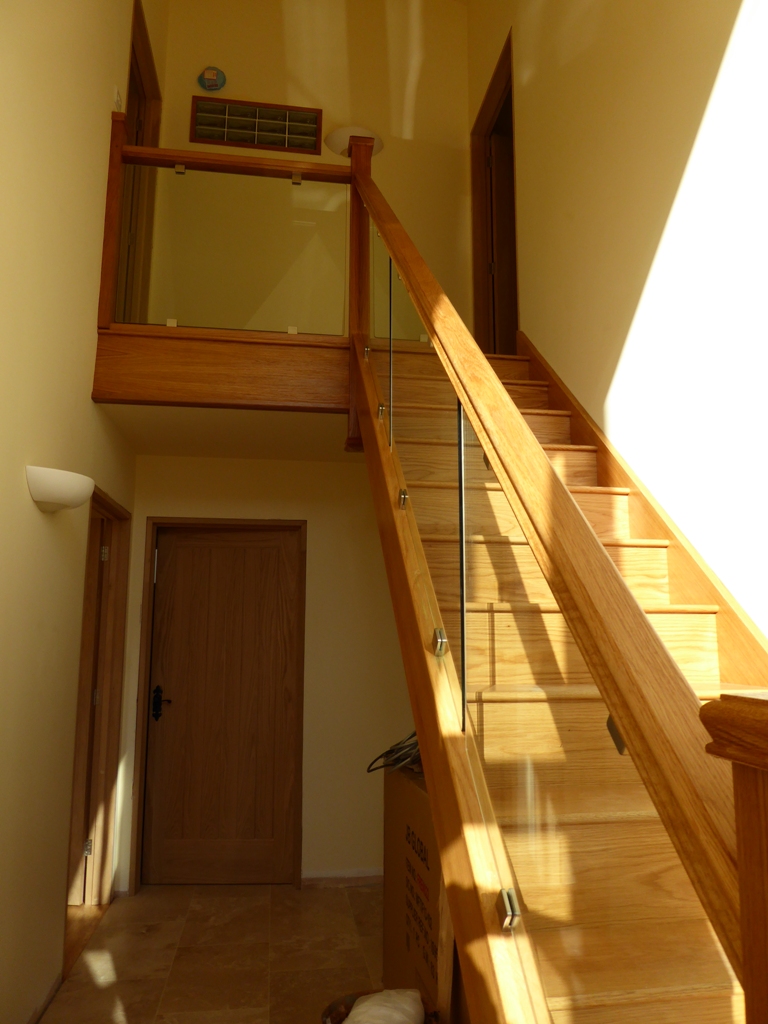
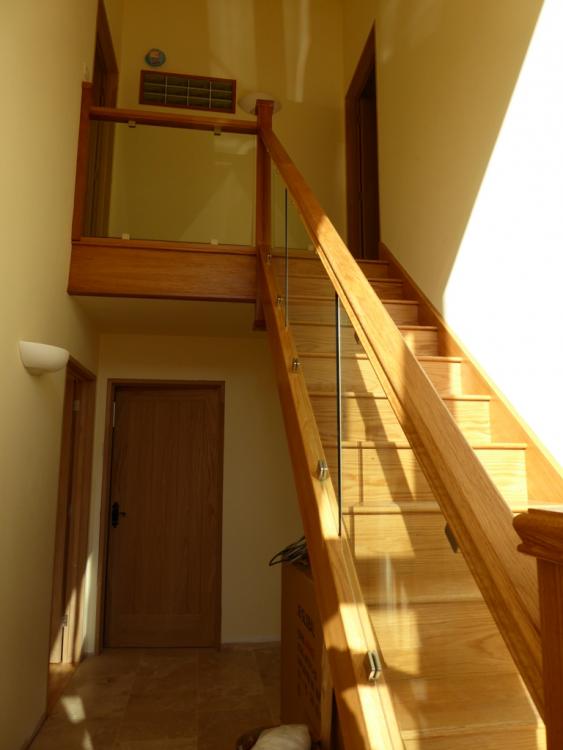
A lot depends on the shape of the stairs. A single straight flight will be a fair bit cheaper than more complex designs. We have a solid oak staircase with 10mm thick glass panels and oak newels and banisters. We also have a matching glass panel and hand rail across the top of the landing. This complete oak staircase, including the 10mm glass panels, cost around £2k, from Pear Stairs. Lead time was around 6 weeks I think.
-
£2000/m2 !
-
Electric Monitors (Sunamp related content!)
Jeremy Harris replied to Barney12's topic in Electrics - Other
For those interested, I've just traced the meters that I've got, they are these ones from : https://www.ebay.co.uk/itm/5-65-A-230V-50HZ-din-rail-Energy-meter-voltage-current-active-reactive-power-KWH/222966886884?hash=item33e9dcb1e4:g:XLAAAOSwsBda7aPJ They measure power, bi-directional energy, voltage, current, power factor and have two energy registers, one that's non-resettable and one that can be reset. They also have an isolated data output, that outputs 1600 pulses per kWh, although I've not bothered to use that function. According to the spec they start working at 20mA, so I'm not at all sure what the "5(65) A" thing is about. -
Electric Monitors (Sunamp related content!)
Jeremy Harris replied to Barney12's topic in Electrics - Other
Not sure what the 5 A bit is about. The double width ones I have seem to work over a wide current range, I've run one at 30 A continuous on my car charger and it's worked fine. IIRC, that one has a maximum current capacity of 60 A. The 0.25 A doesn't match the spec on the side of the unit that refers to 0.5 Wh being the threshold, either. Most domestic electricity meters have a 1 Wh threshold, with anything under that not registering; not sure what the time period is though. The 1 Wh threshold in the spec goes back to the anti-creep resistance built in to the old spinning disc meters I believe. -
(Update) Foundations on a site of archaeological interest
Jeremy Harris replied to Sjk's topic in Foundations
The first site we were going to buy had a lot of buried archaeology; it was the site of an old water mill dating back to Anglo Saxon times. Two big exploratory trenches had been dug at the expense of the vendor, when they got outline PP, and these found lots of evidence for there being a mill on the site going back well over 1000 years. I proposed using screw piles as a foundation solution, to minimise disturbance to the buried archaeology, but this was rejected. A raft was acceptable, but there was an insistence on an archaeologist being present for all excavations, who would have the authority to call a halt to work and order a full excavation of anything they found, at our expense. I had estimates for this and they were very open-ended. The archaeologist said that they were near-certain that there would be significant finds during any excavation work on site, and that the costs were likely to be at least £20k and could be well over £100k, depending on how long they took to excavate and record everything they found. For other reasons we walked away from the purchase, but I had the strong feeling that we'd have had to pull out over the unknown cost of the archaeological work, anyway. -
One example springs to mind. A company with what seemed to be an excellent online reputation, a very informative website, a "proprietor" who seemed highly respected by many people for the knowledgeable views freely shared on internet fora, and whose "proprietor" seemed to be genuine from several 'phone calls and emails, over a period of several months. Having spent a significant sum to go and meet with him and look around his factory and some of the houses he'd built I discovered that he'd not built the houses he showed us, didn't own a factory, in fact didn't even own a car. A check showed that the company was registered to someone else and had never traded, with nothing other than an annual accounts submission showing very little capital and no trading activity. A follow up check using the name of the supposed "proprietor" revealed a prison sentence and couple of failed companies in the past. A bit of digging around on the internet revealed a few other people who were less than happy with this person, including one who lives quite close to us and who lost a great deal of money via him on a system that never worked, and which had been sold with performance claims that were wholly unrealistic. I should have checked out the company and it's supposed proprietor long before I did, as it would have saved me a couple of months of wasted time and the best part of £2k in wasted costs. I was lucky to be able to get away with just this loss though, I think.
-
Hi from Glasgow! Renovating an old terraced house
Jeremy Harris replied to Iain M's topic in Introduce Yourself
Welcome Iain, The spreadsheet that @Ferdinand refers to works out the total heat loss and is here: Heat loss calculator - Master.txt The forum doesn't allow spreadsheet files to be uploaded, so when you've downloaded it just change the suffix from .txt to .xls and it should open OK in most spreadsheet programmes. -
Electric Monitors (Sunamp related content!)
Jeremy Harris replied to Barney12's topic in Electrics - Other
Yes, should do with no problem. I have used the bigger double width ones that have multiple functions (frequency, current, voltage, power, energy total and energy resettable) and they will probably take 25mm² at a guess. -
Electric Monitors (Sunamp related content!)
Jeremy Harris replied to Barney12's topic in Electrics - Other
The cheap DIN rail mount energy meters seem to work very well. I have a few on things like our heat pump and my car charge point and haven't had any problems with them. If you just want a really cheap solution then these ones look as if they'd do the job OK: https://www.ebay.co.uk/itm/Digital-LCD-50Hz-5-30-A-KWH-Power-Energy-Meter-Reading-Single-Phase-DIN-RailBI42/163318470803?epid=12016019726&hash=item26068a1893:g:GfcAAOSwHcFbxidE:rk:1:pf:1&frcectupt=true There might even be space inside the Sunamp control box to fit one of these to the DIN rail and wire it up internally. -
My guess is that it's probably a warranty and liability concern, though. If the unit doesn't have a fault and signals to an external component to do something, which the external component then doesn't do, the responsibility for whatever ensues isn't down to the Sunamp.
-
Checking impressive looking companies on the Companies House site is one of the first thing I usually do, and I will often follow that up by having a look to see what the directors have done before. Always gives a pretty good indicator as to whether a company is real or just a nice looking website. I learned a lesson some time ago that it's far too easy to trust a credible looking website and a chap with the gift of the gab...
-
I'm afraid I don't have the list prices for any of the other models, but would assume that the saving from not having the heating element might be quite small, as the heat cell inside the eHW looks to be near-identical to that inside the water heated models, with the same pair of heat exchangers. My guess is that the parts will be common, with just a blanking plate where the heating element fits at the base. I'd also hazard a guess that they would be reluctant to sell a heat battery without the control box, because the control box provides some protection against the heat battery being over-heated. Might be worth asking if they have any surplus Sunamp PV heat cells available though, as they've now stopped making these I believe and each Sunamp PV had two small, ~2.2 kWh cells with just a heat exchanger inside each. The Sunamp PV cells are a more manageable size and weight when out of the case, and it wouldn't be hard to stack a lot of these together in a well-insulated box and a bit of plumbing to connect all the heat exchangers together in the configuration you want.
-
The current list price for the UniQ eHW 9 kWh model is £1,963 + VAT I believe. There may be discounts available on that price, though. A 9 kWh Uniq is pretty much the same heat capacity as a 210 litre unvented hot water cylinder, heated by an immersion heater. A quick look around seems to indicate that a decent 210 litre DHW cylinder with fitting kit is around £500. The Sunamp is around 1/4 of the size, though, and around 1/3 to 1/4 of the heat loss, so at off-peak electricity rates would probably save around £90 a year in reduced heat losses.
-
Yes, although he won't join here as he still seems to refuse to believe the truth behind what happened to Ebuild. I can understand that, as the individual who caused the mayhem is a very likeable and credible person.
-
Willis heater ASHP backup discussion
Jeremy Harris replied to Nickfromwales's topic in Air Source Heat Pumps (ASHP)
AFAIK, @TerryE just has one Willis heater, but bear in mind his house is built to the same standard as ours (same builder) so is pretty much to passive house standards, maybe better. As such, the heating demand is pretty low - our house only needs 1600 W to maintain 21 deg C when it's -10deg C outside, and @TerryE's will probably be much the same. As such, 3 kW from a Willis heater is more than enough. Our 7 kW ASHP is a total overkill, and only ever runs at a very low power, and then only for an hour or two every couple of days. -
hass io Anyone using Home Assistant
Jeremy Harris replied to readiescards's topic in Networks, AV, Security & Automation
Joking aside, my main concern with home automation is that a lot of it seems to be reliant on current smart phone technology, and there seems to be a fair chance that in ten years time that will have moved on to the point where some current systems are no longer supported. We've already experienced this in other areas, for example, following an iOS "upgrade" the card reader my wife used to transfer photos from her camera to her iPad just stopped working. The solution? To pay Apple for a new one, with a high probability that they'd pull the same stunt in a year's time. Another example, I bought an expensive combined document and slide/negative scanner. A year later Microsoft brought out Vista. My old Windows XP PC died and the new one running Vista didn't support the year old scanner. For me, that was enough to cause me to switch to running one home machine on Linux, so that I could continue to run that year-old scanner. I'm pleased to say that scanner is now over ten years old and still works perfectly with Linux. It still won't work with any Windows release after XP. Clearly there are some home automation systems that are operating system agnostic, so as long as hardware spares continue to be available they will be able to be maintained. However, I think we do need to put things into perspective, by comparing lifetime support with existing systems. Take our old house as an example. It was built and wired in the early 1980's, over 30 years ago. It used light and power switching technology that had existed in exactly the same form for more than 20 years when it was built. As recently as 2012 I replaced a light switch, with no difficulty, as it was an identical standard to one manufactured in the early 1960's. Houses have a long lifespan, and the systems we build into them either have to have a similar lifespan, or be designed to be easily upgraded/replaced without major work. As another example, modern (as in from around the 1960's) house wiring has a life of at least 50 years, probably a fair bit more. The 30+ year old wiring in our old house was still as good as the day it was installed, and I have no doubt that it will be fine for another 30 years or more. Can we say the same for any of the smart home power and lighting controls being manufactured today by a variety of small manufacturers, who may well disappear within a few years from now? It seems that, as self-builders, we have to take account of the limited life of systems that we might previously presumed to last for decades. I think that, if I were considering fitting systems like this, then I'd want to look at ways of future proofing it. Running fairly large cable conduits all over the house, designed to allow new cables to be pulled through without needing to rip out walls and ceilings, may be an option. There may be other options, too, but I think it's well worth thinking about. How many buyers would want to buy a house with an ageing system controlling the heating, cooling, lighting etc that needs an antique smart phone to make it work? -
I suspect there may well be a seasonal effect too. I know I don't feel as motivated to do anything as soon as the nights start to noticeably draw in; there's something about it being dark at the end of a working day that seems to be depressing.
-
Someone here (may have been @ProDave I think) suggested that buying a cheap chemical bog and putting it in the house as soon as the shell was up would be a much cheaper option. For those with a treatment plant, emptying it as required wouldn't be a hassle, although I suspect the blue stuff doesn't do the aerobic bacteria in the plant a world of good.
-
We paid £20 a week for a Portaloo that was serviced by the company once a week. £245 a week seems absolutely outrageous. Makes you want to question all their other prices.
-
He was much more than an idiot, he was a complete and utter PITA. His opening remark on his first visit (which was when the house was ready for the completion inspection) was that he'd never have passed the foundations, as it was "inherently unsafe" for a house to sit on a block of polystyrene foam. Things went downhill from there... He'd been brought back in part time, due to staff shortages, and if I had to hazard a guess I'd say he was in his early 70's. Thankfully, building control sensed there was a problem after his third visit and so sent out the head of building control to do the completion inspection. By that time I'd printed off every bit of evidence I thought might be needed and lined all the printouts up on the kitchen work surface, ready to be checked. The inspector didn't look at any of them, just walked around the house being generally complimentary, and only really checked the disabled access from the back door to the WC. He was there for less than an hour and we got the completion certificate by email around 4pm the same day.