Jeremy Harris
-
Posts
26430 -
Joined
-
Last visited
-
Days Won
360
Everything posted by Jeremy Harris
-
Doesn't look as if they are inverter controlled, AFAICS, which is a bit of a downside. If I had to guess I'd say they were Chinese manufactured units that are being badged and sold as Cool Energy. Have a look on one or two Chinese sites, like Alibaba or Aliexpress and see if you can find a similar looking unit, as that will often be the giveaway that these are direct Chinese imports. Nothing wrong with that, except that the provision of spare parts may well be nigh on impossible in future.
-
Those are Allen head screws, so you'll need an Allen key to undo and replace them. You can either use a conventional "L" shaped set of Allen keys, or it would be better to buy a screwdriver with interchangeable bits, as often they will come with a small selection of Allen head bits. This is what a cheap Allen key set looks like: https://www.screwfix.com/p/magnusson-long-arm-ball-end-metric-hex-key-set-9pcs/8113v and this is a cheap screwdriver set with interchangeable bits that includes Allen bits: https://www.screwfix.com/p/magnusson-ratcheting-screwdriver-bit-set-46pcs/9131v
-
No, worse, far worse - Spencer... It's one thing I can blame my father for, he was a fanatical admirer of Winston Spencer Churchill...
-
It also accidentally meant that the newly born lad ended up with my middle name. I do hope that it doesn't cause to much grief for him has it done for me over the years
-
Beer or wine always goes down well - I made a judgement as to whether they were likely to be beer or wine people and gifted as I thought best, with two exceptions. One was for a great chap who's partner was about to given birth to their first child, so I though a bottle of bubbly might be more appropriate and one was a chap who's young lad was terminally ill and who was fund raising for the local hospice, so I felt a donation would be more appropriate.
-
I think there are two of us here that are approved installers so far, although I was approved on the basis of a couple of email exchanges and a long phone call with their technical chap, rather than doing a course. Since fitting the pre-production Sunamp PV I learned a fair bit about how these things work, and the really good news is that the Sunamp UniQ series are a great deal easier to install, from a technical standpoint, and massively simpler internally. The only point to note when thinking about one is really the weight. It's less than that of an equivalent capacity hot water cylinder when filled, but a heck of a lot heavier as delivered. The weight means that the location for the unit needs to be thought about in more detail, and ideally it needs to be on the ground floor.
-
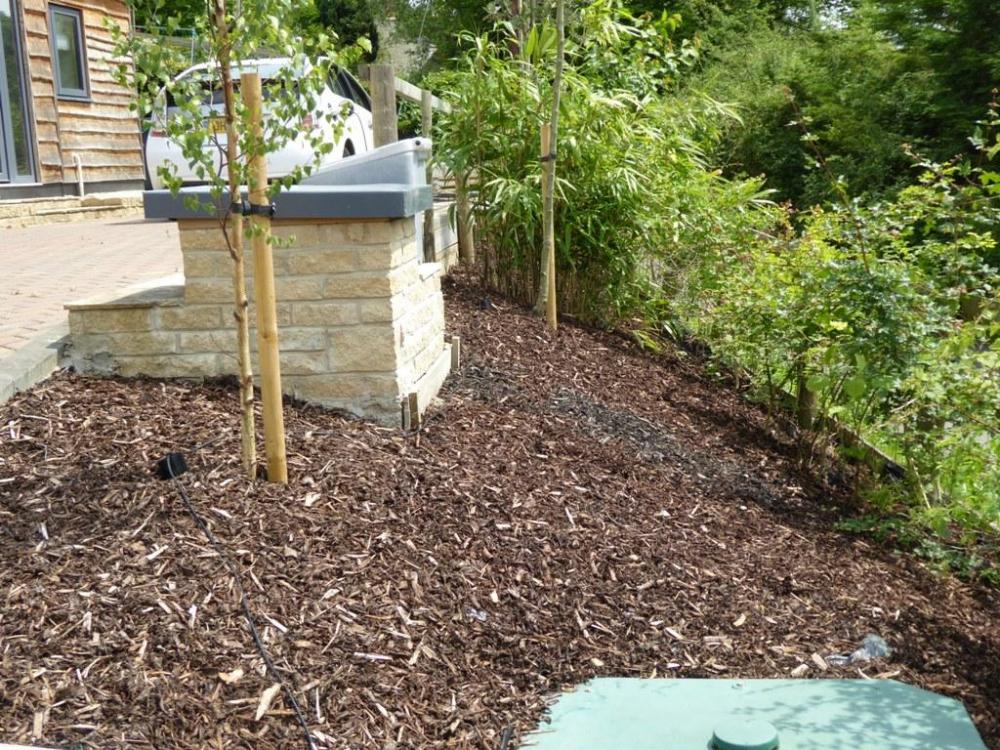
 It makes a massive difference moving the air pump from the GRP compartment in the top of the unit to a solidly built housing. I made a stone chamber on a solid concrete base to house our pump and alarm system. Not only did it reduce the noise so that it's now practically silent, but it also makes checking and servicing the pump a great deal easier.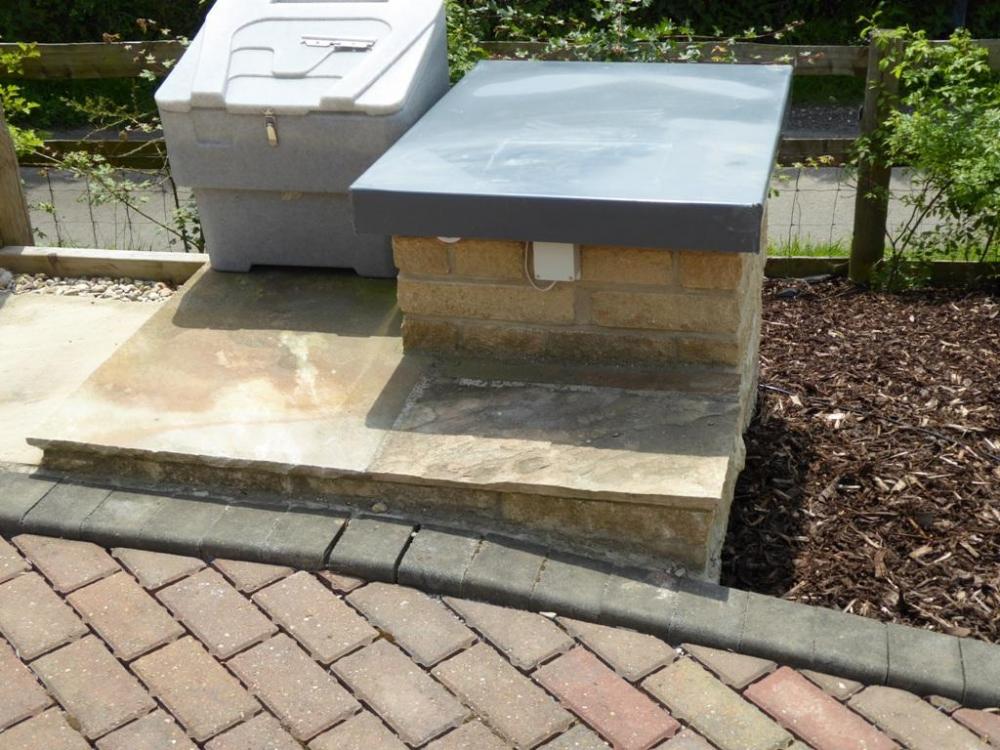
-
You can set two different flow temperatures, one set by the heating curve parameters and another set by the DHW temperature parameter. To switch between the two needs a connection to the DHW dry contact in the ASHP; when that is connected to 0 V the DHW setting over-rides the heating temperature that is set and the ASHP delivers hotter water for DHW. There's also a switched 230 VAC output available from the ASHP to operate a three port valve, so that the flow can be redirected to a hot water tank when the unit goes into DHW mode.
-
I just log data to a USB stick, one file = 1 calendar month. The various sensors are all sampled every 6 minutes and the file format is just .csv, so that I can play around with it easily in a spreadsheet or whatever. I may get around to poking the data down a wifi link at some point, as there's a RPi file server that's on all the time, providing us with a local cloud storage solution. It would be handy to be able to take a look at the data whenever I wish to, rather than have to swap out a USB stick. One problem I found early on, and the reason I now save files monthly, is that it's pretty easy to end up with more lines than a spreadsheet application will handle.
-
Airtightness and first fix
Jeremy Harris replied to dnoble's topic in Environmental Materials & Construction Methods
FWIW, it's vapour tightness that is far more critical than airtightness, as the very last thing you want is water vapour from inside the warm house migrating through the VCL and into the colder timber structure, where it may condense and cause rot. We ran all cables and pipes that went down outside walls alongside a counterbatten, with none fastened to the VCL board (ours used Spano Durelis, rather than Smart Ply, but it also has a green vapour tight coating). Where back boxes has to be fixed to the board, I glued pieces of thin ply to it with quick setting PU adhesive and also applied sealant behind every back box around the screws (easy to do, just blob sealant on the holes and screw through it). This was all down after the air test, but frankly a few screw holes on the board aren't going to make a blind bit of difference to airtightness, what they may do is let water vapour migrate out over a period of years, though, which isn't at all a good thing. -
-
We used to have mice getting into our loft via the cavity walls in the old house, before we had CWI installed. They can definitely climb up inside cavity walls with no difficulty. I spent ages going around trying to find where they were getting in, as it only takes a hole a bit larger in diameter than a pencil for them to squeeze through. In the end I found a tiny gap under a waste pipe that passed through the wall, filled that with foam topped with silicone and they stopped getting in. It was always around this time of year they'd get in, too, looking for somewhere warm now that the nights are getting chilly I expect.
-
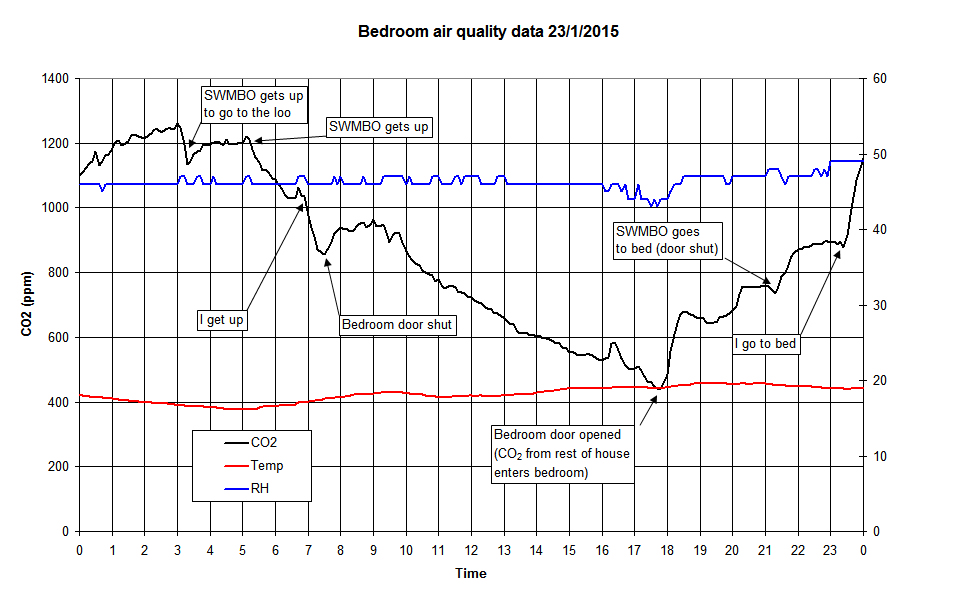
Just found one of the 24 hour plots from when I had the logger located in the bedroom of the old house. I managed to correlate some of the dips with known events, that illustrate how cross ventilation from the bedroom door being opened affected the CO2 concentration. The data seems pretty close to yours:
-
A few years ago I built a small CO2, temperature and RH logger (some here have borrowed it) and was a bit surprised at how high the bedroom CO2 level got in the middle of the night at our old house, even with a small window that's always left open. Interesting to correlate events like the bedroom door opening with a sudden decrease in CO2 concentration; demonstrates well how important cross flow ventilation is in a room (our bedroom door in the old house was almost diagonally opposite the small open window). The concentration levels were similar to those above, and enough to make me feel a bit muggy headed in the morning. Leaving the bedroom door ajar made a significant difference, and lowered the peak concentration down to around 800ppm. The new house has CO2 monitoring and logging built-in, with a display in the hall where things like outside temperature, inside CO2 concentration, RH, plus GPS derived date and time, are displayed. The highest concentration I've seen is under 700ppm, and it only gets that high when there are several people in the house. The bedroom CO2 concentration rarely gets over 500ppm, so is a massive improvement on the old house. I'm convinced that the significant lowering of CO2 level in a house with MVHR contributes a great deal to the "fresh air feeling" that visitors often notice. Damon HD borrowed my portable monitor and did some experiments with the environment in a primary school classroom a couple of years ago, and IIRC he mentioned that there was a pretty good correlation between attentiveness (or the lack of it) with CO2 concentrations of over around 800ppm. I can't remember whether the thread on that is here or lost when Ebuild went down, but it was an interesting read.
-
STROMA certification.
Jeremy Harris replied to TheMitchells's topic in Regulations, Training & Qualifications
I don't have a problem with anyone having to look up a number quickly, the problem comes when you have supposedly competent people who don't, because they haven't had the experience and training to understand that they need to. A good example is cable derating factors. We recently had an EICR done on our old house, and the chap doing it failed to note (despite having been up in the loft and lifted the insulation to check the cables) that the majority of the cables up there were now installed to reference method 101, not reference method 3 as he put on the chit. I spotted it and corrected him, and it wasn't significant given that the power ring finals are fused at 30 A, but it would have been an unsatisfactory if the electric shower was still connected to the unused and disconnected length of 6mm² T&E up there, as that cable would have been under-rated for the load for 101, but OK for reference method C (for reference method C, 6mm² T&E is rated at 46 A, or 10.58 kW at 230 VAC, whereas for reference method 101 the rating drops down to 27 A, or 6.21 kW at 230 VAC). The key is having the experience and knowledge to understand that you need to dig into the book to find the relevant numbers to apply. I got the distinct impression that the chap who was doing this work had just memorised the reference method C ratings and applied them everywhere, without considering the implications of cables under 250mm of insulation. -
Brexit and procurement of joinery from Europe
Jeremy Harris replied to gravelld's topic in Windows & Glazing
I wonder what strategies the UK agents are adopting? Might be an idea to talk to them and see if you can order ahead and pay later on delivery. My guess is that they may be looking at ways to buffer any possible break in their supply chain. -
Horse riding is pretty damned dangerous. IIRC, it's more dangerous in terms of people injured or killed per hour spent riding than motorcycling. I can believe it, too. My first wife was a professional show jumper, who would occasionally do some eventing. She persuaded me to do a cross country on her oldest and most experienced horse (a recently retired grade A show jumper) and all I can say is that it was, without a shadow of doubt, the most exhausting and terrifying thing I've ever done. Show jumping I could just about manage (at a novice level), and I managed to get the hang of basic dressage, but there's no way that I was prepared for the 15 minute hell that was riding around the cross country course.
-
STROMA certification.
Jeremy Harris replied to TheMitchells's topic in Regulations, Training & Qualifications
Precisely why I have a slightly jaded view of the whole accreditation business... -
I've flown hang gliders, paragliders and owned a paramotor that I flew until my knees and ankles told me to stop. The risk from hang gliding or the other forms of foot-launched flying are pretty low, and limited by the fact that you need to be very fit and practice a lot just to get your feet off the ground for the first time. Learning is a long cycle of walking up hills with your kit, then barely getting your feet off the ground before you have to de-rig and carry everything back up the hill. By the time you've got the hang of it (no pun intended) then you've lost a lot of weight, gained a great deal of experience and so are at a pretty low risk of having an accident. Like all aviation, the most risky period, by far, is at the point where you have around 100 hours flying experience. That's the point where self-confidence often exceeds ability, and when a high proportion of accidents occur. Being aware of that, and consciously fighting the tendency to believe you're more competent than you really are, is the key to remaining accident free.
-
Trunking or conduit is certainly better than clipped direct, but unless it's in area where heavy mechanical damage is a possible risk there's no need to do more. Just protect the circuit with an RCBO (I'm assuming that the existing CU is an all-RCBO one) and that'll be fine. Providing overload protection at the point where isolation is required, and where the circuit splits into two 16 A supplies, makes sense, as a DP MCB can give both the required overload protection and act as an isolator switch. SWA is a PITA in terms of termination, so I'd not consider it unless there was no other option. If there is a need for a high degree of mechanical protection then steel conduit is easier and neater to fit than SWA, IMHO.
-
STROMA certification.
Jeremy Harris replied to TheMitchells's topic in Regulations, Training & Qualifications
And you're allowed to do the exam with a copy of BS7671 with you in order to look up those numbers.... -
Brexit and procurement of joinery from Europe
Jeremy Harris replied to gravelld's topic in Windows & Glazing
In my opinion, yes. Given that the UK voted to leave, and that leaving (at least in the short to medium term) is an irreversible process, for a host of good reasons, what possible motive could the EU have for wishing to penalise some of its remaining member states? None of the issues that keep being raised as show-stoppers are any where near as difficult to solve by balanced negotiation as the EU are making them. There are non-EU countries within Europe who manage quite well without being in the EU, even one fairly prosperous country that is not within the EEA. My personal view is that being in the EEA would be a good thing, as I've long held the view that the Common Market was a great idea, it's just the concept of a Federal Europe that I can't see working well. The objections to the EEA seem to be focussed on migration, but as it seems that the majority of problems in UK society that may possibly be related to migration aren't a consequence of EU citizen migration, I believe that the objection to remaining within the EEA is largely a frenzy whipped up by Farage and his cohorts on the right wing of the Tory party. -
I agree, but would add that growing up around really dangerous stuff was a very good way of learning, all the same. The risks were openly discussed and rammed home all the time; and not just the obvious stuff like farm machinery, but also the everyday risks, like those associated with the slurry pit or grain silo. Growing up in an environment where there were a lot of risks all around was a useful life lesson. I think the only negative side is that I grew up with a higher risk acceptability factor than a lot of children my age, which then led to me doing things that many would consider too risky to contemplate.
-
Brexit and procurement of joinery from Europe
Jeremy Harris replied to gravelld's topic in Windows & Glazing
As far as I can see at the moment, nothing much will change until the expiry of the transition period, assuming that there is a deal. The worst case would be if the remainers continue to try and disrupt any deal out of spite, as they seem to be intent on, leaving us with no option but to just have a hard exit next year. How likely that is I don't know, as the government seems to be pretty incompetent at handling the negotiation process, and I don't have a great deal of confidence that they will be able to agree a satisfactory deal in the time remaining. It all hinges on gamesmanship by the EU, I think. They want to send a very clear message to every member state that leaving the EU is a very painful business, so they seem to be going out of their way to make the process harder than it needs to be. It seems the EU is prepared to sacrifice quite a lot in order to get this political message across, although I think that, when push comes to shove, common sense may prevail and a deal will be agreed. It's as much in the interest of the EU to reach a deal as it is the UK, as no deal will hurt several EU states pretty badly. The question is really how much pain the EU is prepared to inflict on some of its member states in order to quell what it sees as a mutiny. -
I learned to drive on the farm, first driving the small MF tractor doing simple stuff, like taking hay out in the link box, then by the age of around 12 to 13 I was driving the bigger tractor and trailer alongside the combine during harvest, driving the baler around (pre-round bale era) and driving the topper out to cut weeds down in the pasture fields. No roll over protection back then, no guards over PTO shafts, and as often as not sod all in the way of effective brakes on the tractor. The lessons learned were key to staying safe, that everything on the farm was potentially lethal and to be treated with respect. Pretty much everyone we knew had either had an accident on a farm, or knew someone that had. Our cow man lost his finger when just lining up a trailer hitch. He was struggling to drop the pin in and, like an idiot, put his finger in the hole to see how out of alignment the hitch was, and at that time the trailer just moved enough to cleanly slice his finger off. A chap on a neighbouring farm lost part of an arm in a baler, when he tried to clear a jam. Apparently he'd turned the tractor off and assumed that as there was no PTO power it'd be safe, forgetting that there are bloody great springs that drive the baler twine arms, and these had enough stored energy to take his arm off. We learned a lot from other people's accidents, and I strongly suspect that the awareness of what can go wrong, and how easy it is to get complacent around machinery, was drummed into me from an early age.