Jeremy Harris
-
Posts
26430 -
Joined
-
Last visited
-
Days Won
360
Everything posted by Jeremy Harris
-
It may help to just print out pages 95 to 99 and then pencil in the margin what your default settings are. Also worth noting that many of the parameters can't be changed, they are just status indications, so only of use in terms of checking what the unit is or isn't doing.
-
It's worth scrolling through all the parameters from 1 to 301 (they are in groups, so there aren't 302 of them - check pages 95 to 99 in the Carrier 30AWH004HB Service Manual) and noting down all the values that are set by default, to make sure they are correct. If you don't have this manual, I've attached a copy below. 30awh004hb - Carrier ASHP Service Manual.pdf Running through all these settings will be useful in terms of checking that the communications are OK with the board, too. It's a heck of a complex bit of kit to programme, given the number of programmable variables and some of the unusual terminology, so running through the settings and checking them against those in the tables on the pages listed above will give a good feel for things.
-
For a constant 40 deg C in heating mode then change the settings to these: 112 = 0 119 = 19 120 = 40 121 = 40 The DHW mode is turned on and off by linking dry contacts 13 and 15, and the temperature of that defaults to 50 deg C IIRC. You can change this by changing parameter 113 (I think!) to the hot water temperature you want, say 55 deg C. The above assumes that the unit is set to operate from dry contact controls (default I believe) and that sanitary hot water (parameter 153) is set to always on (1). DHW will over-ride heating and take priority when dry contacts 13 and 15 are linked, so when there is a call for DHW as well as linking these two dry contacts you also have to switch the diverter valve so that the flow goes to the DHW tank coil. Hope this makes sense!
-
If you just want to heat the buffer to a constant temperature, say 45 deg C, then these settings will do that: 112 = 0 119 = 19 120 = 45 121 = 45 That will set the heat pump to deliver a constant 45 deg C flow whenever it turns on in heating mode.
-

Ramblings on automatically reading meters
Jeremy Harris replied to TerryE's topic in Boffin's Corner
An alternative for reading accurate data is to get a cheap (~£30) second meter installed at the same time as your CU is fitted. I've done this in the house, fitted an Elster A100C meter (https://www.jsgsolutions.co.uk/kwh-meters/elster-a100c-kwh-meter-with-pulsed-output-single-phase.html ) in the tails that feed the house CU. The Elster A100C was chosen because it has an IrDA Tx port that constantly transmits data from the internal registers. It's dead easy to just secure an IR receiver over this port and read data from several registers in the meter that repeatedly transmit serial data at 2400 baud, with a start bit, 8 data bits, 1 stop bit and no parity, with short pulse widths, so a pulse expander is needed to translate the data to RS232-type serial. The data transmitted is a 110 byte frame that includes the meter make, model and serial number, total accumulated import W/h at rate 1, a reserved data register for rate 1, total accumulated export Wh for rate 1, total accumulated import W/h at rate 2, a reserved data register for rate 2, total accumulated export Wh for rate 2, reserved data, status, error, anti-creep, rate 1 time, rate 2 time, power up time, power fail time, watchdog, reverse warning flag, reserved data. By parsing the meter make and model data it's easy to determine the order of the transmitted data, and using this meter as a data collection device has the advantage that if any data logging system glitches no data will be lost, as the registers will just spit out all the data again next time around. Here's the full data sheet on this meter, including a description of all the data that it squirts out: A100C_Operating_Instructions.pdf -
Down here in Part P land that could possibly cause a problem, as it would be a new circuit, so would need an EIC and Part P chit when commissioned. By connecting up the FCU, but not connecting anything to it on the appliance side, those circuits are included in the Part P EIC, and it's then fine under Part P rules for me to connect an appliance to an existing circuit at a later date, if needed.
-
I'm another Torx fan, really excellent for hefty screws. The only problem I've ever had with them was when I bought a set of Torx bits that were massively over-hardened and very brittle. The ends of the bits just shattered into fragments when a bit of force was applied to them. Lesson learned; I only buy well-known brands of bits now, like Wera.
-
I just fitted fused connection units in the bedrooms, together with plywood backing boards behind the plasterboard, so that we could choose to fit electric wall heaters later if we felt they were needed. As it happens they aren't, but I'd guess the extra cost of the FCUs in the walls, ready for them, may have added £20 to the build cost. What's more, having the connection points available for future use has no impact on the EPC or SAP rating.
-
One thing about all these shows where the public are the "celebrities" is that they are really cheap to produce, cheaper even than game shows, I believe. That's a big attraction for the production companies, especially if the show proves to be popular and can command a premium price when sold to broadcasters. I strongly suspect that without shows like these the production companies wouldn't be able to fund the big drama programmes, as they cost an absolute fortune to produce.
-
Critique my house design
Jeremy Harris replied to Moonshine's topic in New House & Self Build Design
We have doors opposite each other on our landing. No problem with building regs as long as the doors don't open out on to the landing, IIRC. -
Looking at the photos above, is it possible to slide something like a thin bit of slate under the outer cill of the window, with a drainage slot cut into it, @lizzie?
-
First time DIY: how many of us?
Jeremy Harris replied to ToughButterCup's topic in General Self Build & DIY Discussion
Wow indeed! I bought the watch (a 1968 Omega Seamaster 300, RN miltary issue) at a surplus sealed bid sale. It had been issued to me in 1973, I handed it back early in 1974 and it was then declared obsolete and sold off, with a load of other stuff. I put in a bid (I think for £20), just because it had been "my" watch at work, and no one else bid so it became mine. Last year we were watching Antiques Roadshow and I spotted a very similar watch, same model, same year, same back markings, being given an auction estimate of £25,000. I took photos of mine, sent them to Bonham's, who agreed to put it in their July sale this year with an auction estimate of £30k. Word got out before the sale, and I was contacted by serious collectors, and I sold it for an undisclosed price that was well over £20k. One thing I learned was that the posh auction houses, like Bonham's, charge really exhorbitant fees, both for the seller and the buyer, plus they have to charge VAT. This means that sellers don't get anything like the hammer price for items like this and buyers pay a lot more than the hammer price, too. I got a fair price for the watch and it's now pride of place in the collection of a private collector. Only around 100 of these watches were made and only a few survive, as they are a divers watch and so inevitably got abused, plus the MOD just scrapped lots of them, only very few were sold. Military watches now fetch daft prices. My everyday watch is the aircrew Seiko 7A28-7120 that I was issued with in 1984, and which was written off when I stopped flying (for work) in 1997, so I got to keep it. That's now worth upwards of £1,000 and rising. Meanwhile, the "fake" Rolex Oysterdate that I bought in Singapore for a few pounds in the early 70's turned out to be genuine, and is now being restored (with some of the proceeds from the sale of the Omega Seamaster 300) and I rather suspect that it will have to be added as a separate item on to the house insurance when I get it back. I've never been one to collect watches, or value them, so it's a bit odd that the past year has seen three old watches of mine become worth a few bob. Just a pity that I never got my hands on my ex-wife's diamond-encrusted Cartier, that was a gift presented to her when we went to a party held by Sheik Isa bin Salman Al Khalifa at his palace whilst on our honeymoon. I bet that's worth a few bob now... -
First time DIY: how many of us?
Jeremy Harris replied to ToughButterCup's topic in General Self Build & DIY Discussion
We're (probably...) just about to move in, after five years. The first year got a lot done, but used all our money and ran into major problems with the water supply, which took close to a year's hard work to sort out. Since then the delays have really been down to me working pretty much on my own on all the thousand and one small jobs that seem to take a great deal longer than they should. It's not been helped by me wanting to get things right, rather than move in and still have a long list of things to do, as I know full well that I'll put off doing things once we're in. The biggest consumer of time and money over the past year or so has been landscaping. Having to change our plans quickly when the neighbour over the lane cut down a ~30ft high hedge threw a spanner in the works, as it suddenly meant that all the windows at the front of our house looked straight into their daughter's bedroom. All told that added around £3k to the cost, from having to buy mature trees and get them planted, together with loads of topsoil, digger work, etc, none of which I'd allowed for. We've also had to replace the fencing above our retaining wall, something I was never happy with but which the previous owners of the house further up the had insisted we fit. Now we have a nice and solid close boarded timber fence running along the top of the wall, which is a heck of a lot safer than the daft trellis that the previous chap was so insistent about. The downside was that it was another additional cost. If it wasn't for a stroke of luck in discovering earlier this year that one of my watches (which I'd paid a few pounds for in 1974) was worth well over £20,000, and me selling it very quickly, we'd not have been in a position to move even now, I think. -
What do you think?
Jeremy Harris replied to canalsiderenovation's topic in New House & Self Build Design
Worth looking at the costs of demolition and rebuild, even if you retain the same footprint, as the VAT bonus from a rebuild makes a fair difference, as well as being able to do away with the inevitable compromises in such a major renovation project. -
A joiner (as in the friend that used to be on Ebuild) advised me that he allowed 3mm at the sides and top of a door, so 843mm sounds close enough, at 2.5mm either side.
-
First time DIY: how many of us?
Jeremy Harris replied to ToughButterCup's topic in General Self Build & DIY Discussion
Don't worry about it, @joe90, the MVHR duct install was just a bit tedious, because of the way the ridges on the ducting kept getting snagged on the Posijoist webs. The real killer was getting the hefty (~150kg plus) Sunamp upstairs. Lots of ingenuity needed, including making up a lifting frame and utilising my old climbing ropes, ascenders etc, plus a tirfor winch. Took all day... Getting the old Sunamp PV back down stairs was relatively easy, I just strapped it to a sack cart and lowered it down the stairs using a figure of eight belayed to the cart with a carabiner and the tail of the rope slung between my legs and over my shoulder, like old school abseiling, to control the descent. -
*rant* pre-application timescales *rant*
Jeremy Harris replied to Moonshine's topic in Planning Permission
I'm also of the view that pre-app advice is a complete waste of time. I opted to put in a full application, as by my way of thinking I would get the same feedback from doing this as from going for paid-for pre-app advice, and if it looked iffy I could always withdraw the application before a decision had been made, change things and then re-submit for free, using the "free go". It made no sense to me to get non-binding pre-app advice from a single officer, who may well not have been the case officer for the full application anyway. Much of the useful feedback didn't come from the planning officer anyway, it came from consultees, in our case the AONB committee, the highways chap, the Conservation Officer and the Environment Agency. We needed to make some minor amendments to keep these people happy, and we wouldn't have had that feedback from pre-app advice. There were five previous planning applications for our site, too, and it was definitely controversial, with a lot of local objection to the application before ours, including 14 separate points of objection just from the Parish Council. -
Kingspan ASHP GMC board issue
Jeremy Harris replied to Gav_P's topic in Air Source Heat Pumps (ASHP)
These are the GMC fault codes: Sounds like good news, @ProDave. As it's giving fault codes it suggests to me that the board is alive and working and only the 12 V supply got shorted. Fingers crossed that replacing the bridge rectifier and fixing/replacing the 12 V transformer fixes it. With luck it will still have retained the settings in the non-volatile memory, too.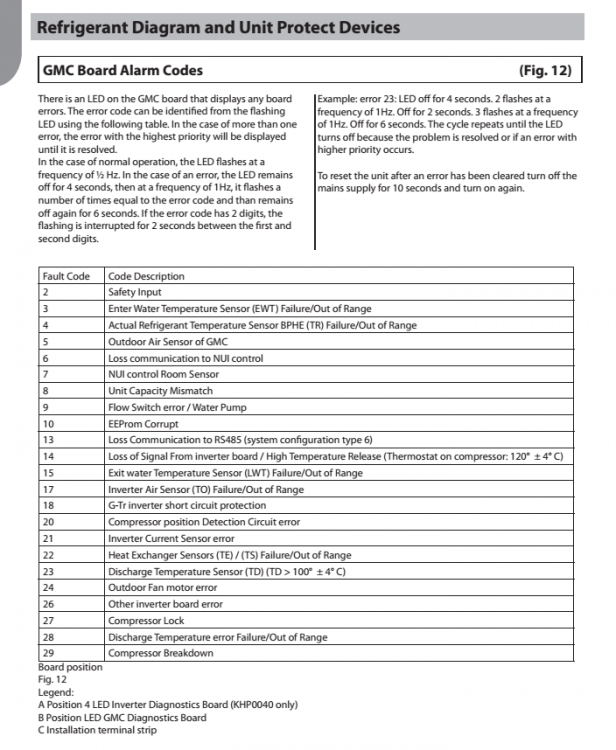
-
I have family on the Island who have lived there all their lives, and we used to holiday there a lot when I was small. The Island has also been one of my regular "fly somewhere for lunch" destinations for years, as it's only a half hour flight from my local strip. As a consequence, it was one of the places we looked at when plot hunting; we spent a week there looking around at everything from bare plots to knock down and rebuild projects. We only found one plot that we thought might have possibilities, towards the West end of the Island, in Wellow, but it was expensive we thought. In the end we decided against it largely because we weren't sure we could adapt to being a ferry ride away from ageing parents (most of whom were still alive then). If not from the Island I suspect it might take time to adapt to living there, as distinct from being on holiday, as it does feel at times as if the 21st century hasn't arrived there yet!
-
Unless you buy oak door lining kits... These seem to be made up of a laminated oak core with oak veneers, so can't be trimmed down neatly.
-
I had this problem and had to rip down linings that were too wide, just because we had a plaster skim on top of the plasterboard. The internal walls are all 89mm wide studs, plus 2 x 12.5mm plasterboard, plus 2 x ~3mm plaster skim, so ~120mm. Damned nuisance to have to do and we'd have been better off just buying oak boards that were 120mm wide and making up the linings ourselves.
-
Kingspan ASHP GMC board issue
Jeremy Harris replied to Gav_P's topic in Air Source Heat Pumps (ASHP)
That board stores all the setting parameters needed to allow the ASHP to function. When a new board is fitted a command unit needs to be connected to download all the setting parameters I believe. I know that if the command unit is disconnected after the main board has been programmed all the set parameters will remain stored in non-volatile memory and the ASHP will function normally (as long as the dry contact control option has been set). Kingspan programmed their version of the Carrier like this, with preset parameters loaded at the factory, and they then shipped ASHPs without a command unit, at least for some models. -
That is exactly where we found mice getting in at our old house. The gap was really small, too small to poke a finger up, but the little buggers could get in and climb up inside the cavity with ease. I filled the gap with expanding foam, to get really deep penetration, let it cure, then cut it back just below the surface of the brick level and sealed all around the pipe with a thick bead of silicone. The reason I used silicone is that the gap was a consequence of the original mortar having fallen out, probably because plastic pipe expands and contracts a fair bit with heat, so over the years it had cracked the mortar.
-
Paving close to DPC / level thresholds?
Jeremy Harris replied to Roger440's topic in Landscaping, Decking & Patios
We got around the water splash problem by fitting 200mm high black uPVC around the bottom of our cladding. Seems to work well. I didn't bother to do this for the garage cladding and as a consequence the bottom of the larch cladding on the garage is looking a bit manky. -
Paving close to DPC / level thresholds?
Jeremy Harris replied to Roger440's topic in Landscaping, Decking & Patios
We did exactly as @Oz07 suggests, works a treat. We have a coarse gravel French drain all around the house, around 100mm wide to over 300m wide in places. The section alongside the patio is around 100mm wide, and at the back door, where the paving comes right up to the door threshold level, we have an overhang on the stone of around 50mm, with coarse stone packed in the gap and the stone paving being about 5mm clear of the threshold. This seems to work very well.