


Jeremy Harris
-
Posts
26430 -
Joined
-
Last visited
-
Days Won
360
Everything posted by Jeremy Harris
-
Wish the old school inspector I had for part of my build was that flexible. He refused to accept the calculator printout, on the basis that I wasn't qualified to use it (despite there being no qualification required in the regs). I then agreed to fit restrictors to positively limit the flow rates to all outlets except the cisterns and he refused to accept me doing this at first, again on the grounds that I wasn't competent (despite the fact that I'd plumbed the whole house). In the end he compromised and agreed to me fitting the restrictors as long as I provided him with photographic evidence of the fitting of each one, believe it or not. All told I had three inspection visits over the space of a month just getting the water installation signed off.
-
The snag is that the embodied energy in manufacturing them is still very high, although that will come down as battery manufacturers both reduce the energy intensity of the whole manufacturing and supply chain (including the mining side of it) and as they include a greater proportion of renewable energy to the manufacturing process (the Chinese are investing massively in this, and Tesla has done a bit by roofing Gigafactories with PV). The sums are pretty easy. A Powerwall 2 will cost around £7500 to £8000 installed (best guess at the moment) and the cells will have a calendar life of between 10 and 15 years, with the inverter probably lasting between 8 and 10 years. If off-peak energy is used to charge the battery pack, at a typical unit price today of around £0.07/kWh, and allowing for a typical round-trip efficiency of about 90%, then the cost per unit of energy delivered from the battery pack will be around £0.077/kWh. If the house consumes 2/3rds of it's total energy use during peak rate time, and if this can be met 100% by the battery pack, say 10 kWh/day (and that's probably an optimistic figure) then the cost saving per day from off-peak battery charging to offset peak rate consumption will be somewhere around £0.08/kWh, or around £0.8 per day. To recover the cost of the Tesla Powerwall 2 just using off-peak savings would take around 25 years, but the battery will be effectively scrap after around 15 years at the most, so will never pay for itself this way. If you add in excess PV charging as well, then that figure comes down a bit, but not a lot, given that peak energy use is during the period when PV will be generating very little. Last time I ran the sums for the Tesla Powerwall 2 against our requirements, with our 6.25 kWp PV array and lower overall energy consumption than your prediction, I came up with a return on investment time of around 20 years. Anything over 10 years doesn't stack up, as by then the battery capacity will have reduced significantly and the inverter will be at the end of its life (power inverters seem to have a typical life of around 8 to 10 years). For us, the 7.2 kWh Sofar battery system almost breaks even at the 10 year point, but not quite, as of a few weeks ago when I looked at the costs again. Prices of those systems are dropping though, whilst Tesla Powerwall prices seem to be increasing.
-
I keep a running spreadsheet of battery system performance and pricing, and none yet look worthwhile in terms of any benefit to the environment, nor do any come close to covering the capital outlay through life. The closest to look as if it may, possibly, make sense in a few years time is the Sofar system (around £3,000 including VAT for a 7.2 kWh system), as the capital cost is lower, plus it offers some performance advantages, including a limited ability to run off-grid during a power cut. For us the latter is an attraction that might swing us towards buying one in a year or two, although we know that we'll still never recover the investment, and we have 6.25 kWp of PV, facing more or less South, on a 45 deg pitch that slightly improves winter performance. PV generation for us still falls off a cliff in October each year, and we don't start to generate anything meaningful again until the beginning of March, and that has a big impact on the usefulness of energy storage, either as heat in the Sunamp Uniq eHW 9 that we have, or in any battery system. To all intents and purposes you can forget about being able to get any excess PV generation for around 3 to 4 months of the year, the very time when the heating demand and other household energy demands, like lighting, will be greatest.
-
Yes, it's a slight distortion in the version of SAP that we were assessed under, and the grid is certainly getting cleaner, with the increase in renewable capacity, and decrease in coal, but the the grid still emits around 58 million tonnes of CO2 (2018 predicted outcome, 2017 was 60 million tonnes CO2), which with the generated annual energy fairly stable at around 336 TWh. The 2017 CO2 grid intensity data (all fuels, including nuclear and renewables) was 225 tonnes of CO2 per GWh of generation, so about 0.225 kg CO2/kWh, but that excludes all the distribution losses (typically around 10 to 15%, I believe), so the reality at the point of consumption is a CO2 intensity figure of closer to 0.25 kg CO2/kWh. Assuming a condensing gas boiler with an efficiency of 85% (on the low side of what's reasonable, IMHO) then burning gas this way generates around 0.211 kg CO2/kWh. A 90% efficient condensing boiler decreases this to about 0.2 kg CO2/kWh. My guess is that the electricity grid might reach parity with an efficient gas boiler in around 10 to 15 years time, looking at the current trends, but that's about the lifetime for either a gas boiler or an ASHP, so the better environmental solution for the nest few years would be an efficient gas boiler, looking to change to a heat pump, CHP or other less CO2 intensive solution in 10 to 15 years time.
-
Welcome @andy, With that sort of annual energy use then it's worth looking at the costs carefully. 6,000 kWh p.a. will cost somewhere around £1,000 p.a, assuming a standard single tariff, rather than an off-peak one, and assuming no PV self-consumption. The battery will never ever pay for itself, or come close, even with direct electric heating. With a heat pump to reduce the demand, plus a Sunamp to reduce the DHW demand, then no battery will come close to covering its cost, and especially not the very expensive Tesla Powerwall - it will die from old age long before the cost has been recovered. Your heating demand and DHW demand seem to be back to front to me. It's more normal in a well-insulated house for the DHW demand to be higher, or no more than equal to, the heating energy usage. In our case just nearly 2/3rds of our energy goes to heating hot water, for example. However, assuming your 2000 kWh for hot water is accurate, then that equates to around 6 kWh per day, allowing for holidays. A single Sunamp UniQ 9 kWh model can meet that requirement with energy to spare, and can be charged by a mix of excess PV for around 8 months of the year and direct electricity for the remaining time. It's debatable whether it's worth using an off-peak tariff for winter use, as the standing charge and day time unit price may well make that a more expensive option, but as tariffs vary widely across the country it's worth doing your own comparison. The 4000 kWh heating demand seems high to me. Our heating energy requirement is typically around 1500 kWh for a 130 m² house. We use a small ASHP, but it's marginal as to whether that is cost effective, balancing capital investment versus energy cost saving through life. The total cost of our ASHP install came to under well £2000 (with a DIY installation), and that much money would buy well over 15 years of additional electricity, so unless the ASHP lasts in excess of 15 years it won't ever pay for itself. In terms of environmental impact, then it's very questionable as to whether buying expensive bits of kit, that have a significant manufacturing environmental impact, makes sense. If I had mains gas available I'd use it, without question, as it would be far cheaper to run and offer an overall lower environmental impact through life than a solution using a heat pump. You can still combine heat energy storage, using something like a Sunamp, with a high efficiency condensing combi boiler, and so save a great deal of your DHW energy cost, and reducing your overall environmental impact a great deal. However, the biggest difference you can make, in environmental impact terms, is reduce the very high 4000 kWh heating demand. Our house is all-electric, not from choice, but because we don't have a gas supply anywhere nearby. We still managed to get an environmental impact rating that equates to -0.9tonnes of CO2 per year. The latter is roughly equivalent to having our plot covered with 42 mature broadleaved trees, in terms of CO2 sequestration. With an efficient gas combi, plus your 6 kWp of PV and a Sunamp, you could easily get a much better environmental impact rating than this, as we're penalised for using electricity, which is "dirtier" than mains gas by a significant amount.
-

Willis heater ASHP backup discussion
Jeremy Harris replied to Nickfromwales's topic in Air Source Heat Pumps (ASHP)
I paid over the odds for our 7kW Glowworm (a re-badged Carrier 30AWH) ASHP, £1700, including delivery. In terms of plumbing, then this is the biggest job, but still only took me around half a day, so allowing around £200 or so for it would seem reasonable. Wiring was a lot quicker, just a multicore control cable plus a 2.5mm² power cable. It didn't take as long as half a day, but being pessimistic then I could make the same £200 fitting cost allowance. That brings the installed cost to around £2100 (although my DIY installation reduced that a lot), but the same ASHP model (or very similar) can be bought now for around £1000 or less by shopping around, so even professionally installed I think that it should be quite reasonable to pay no more than £2000 at the very most for the installed cost for a unit of this sort of capacity. -
If the ASHP only fires up after the valve are all open then there shouldn't be a problem.
-
Is the 'K' word acceptable here?
Jeremy Harris replied to kaygoo's topic in New House & Self Build Design
Pricing is so location and plot-specific that there isn't a lot of merit in even giving guide prices, unless the offering is so over-priced that the firm can absorb the wide variations involved. There are price guides in terms of price per m² of total internal floor area (all floors) that are reasonable, but again there is a fairly wide variation depending on location, as labour is a fairly hefty chunk of the cost. For a largely turn-key build to a modest standard you're probably looking at over £1600/m², perhaps £2000/m², or if going for one of the really upmarket kit builds, like Huf, then it wouldn't surprise me if the cost was as much as £4000/m². At the other end of the scale, there are members here who have built houses for around £800/m², maybe less, with a lot of their own labour. -
The dwarf stone wall coursing looks odd as well, which isn't helping. We used Bradstone Cotswold Buff laid with a mix of sizes, with the jumper blocks laid mixed up with the two standard course heights like this:
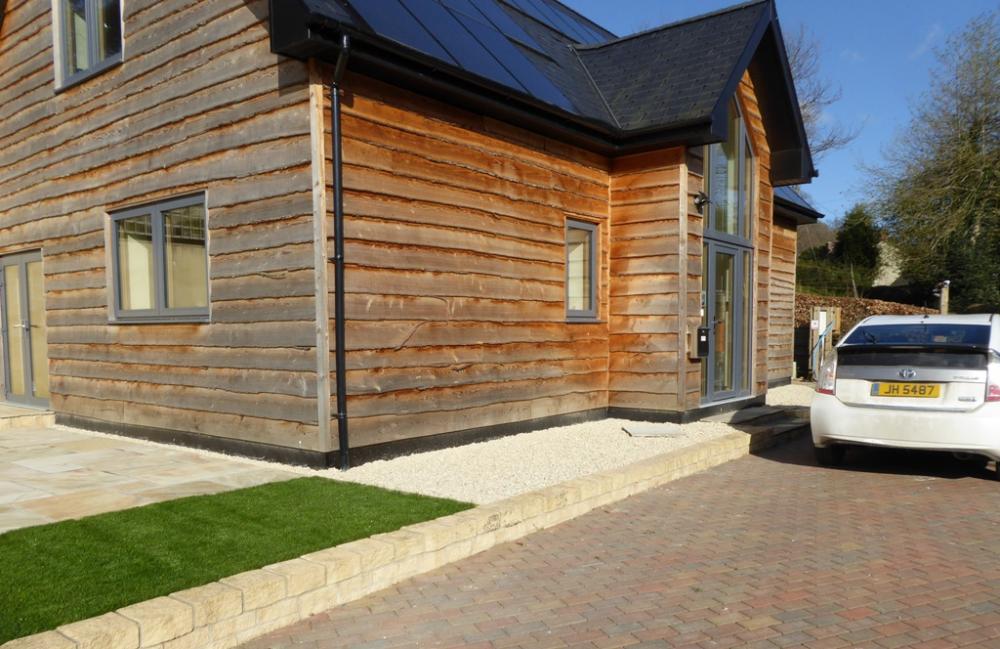
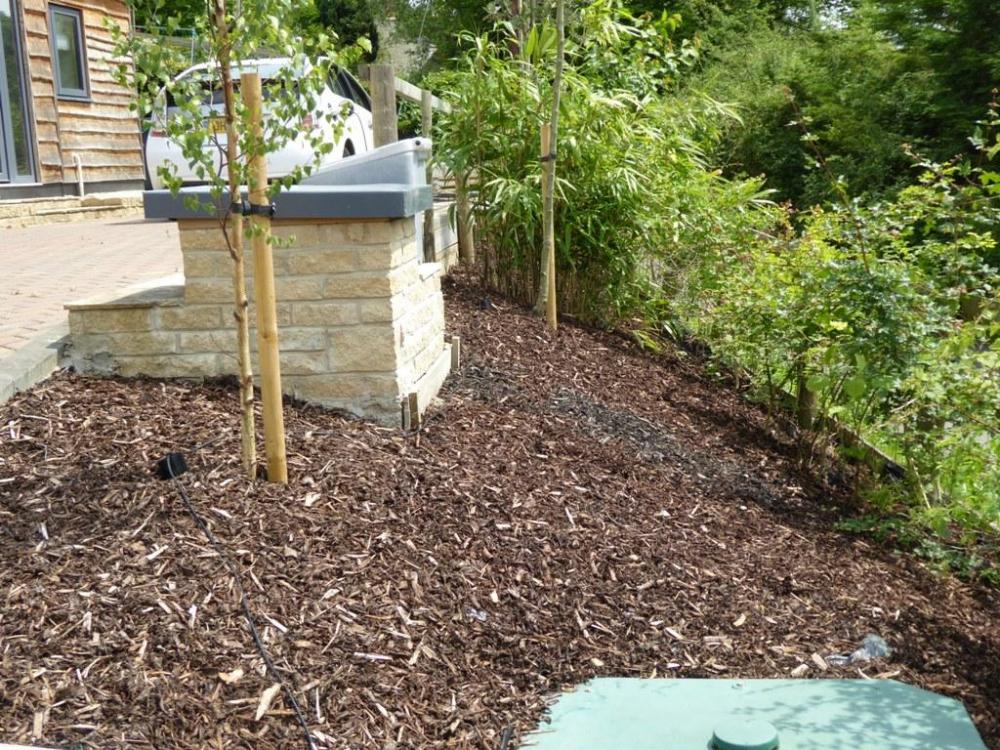
-
My guess is that you don't need one at all, as your system always has either the buffer tank or the DHW tank connected, so there's never a restriction. I needed one as our buffer tank is shut off when the system is in cooling mode, and the UFH valve takes a few seconds to open, during which the ASHP senses the flow restriction and shuts down with an alarm, then restart again around 20 seconds later.
-
I'd wondered if they were required to pass on the VAT for ineligible items to the buyer, in terms of just adding it to the sale price.
-
Is the 'K' word acceptable here?
Jeremy Harris replied to kaygoo's topic in New House & Self Build Design
MBC Timberframe, but I'm fairly sure they don't operate that far North. Our build is in my blog at the link in my signature, and has lots of photos of the build. -
Not sure, TBH, as I don't know how the VAT rules apply to developers. I would have assumed that developers have to follow similar rules to self-builders, with regard to what they can and cannot zero rate, just because I can't see a good reason for HMRC having two sets of zero rate eligibility rules. Then again, perhaps I'm being a bit naive in making such a bold assumption!
-
Is the 'K' word acceptable here?
Jeremy Harris replied to kaygoo's topic in New House & Self Build Design
Our house was a kit, but a bespoke design, built in a factory and assembled on site on 4 1/2 days. It meets or exceeds the PassivHaus standard, too, although it is not a certified PassivHaus. Even the biggest kit house builder, Potton, is sort of trying to up their game a bit, although when we looked at them we were very underwhelmed by the design detail, performance and the quality for the prices they were charging. When we were looking around at builders there was less choice than there is now, I think, as there seem to be a fair few companies around offering a range of supply and build options, everything from just putting in the foundations and building the shell up to offering a complete turn key option (at a price). One limiting factor may be location, as there are some companies that won't offer a supply and build service in some areas (for example the company we used didn't used to offer a service North of the border). Getting a kit-type supplier to provide a service to the outer islands may be a challenge, but I seem to remember that there's a firm on Skye, or used to be. -
I can second what @Declan52 has said, it happened to me in 2015, and I told the tale here: http://www.mayfly.eu/2015/08/part-thirty-seven-a-long-tale-about-water-and-life/
-
AFAIK, the VAT rules are that skips aren't zero rated, no matter how they are supplied or who pays for them, so being a VAT registered company probably doesn't make any difference. As an aside, the self-build VAT rules don't apply to a VAT registered company that's building a house, so some of the advice on VAT here may well need to be filtered with that in mind.
-
I've found that our unit (essentially identical, with an integral Grundfos pump) works fine with the pump on the low or middle setting, but gives an "over-pressure" alarm on the high setting, even with the (admittedly 1/2") bypass valve in place. They don't seem to like running into a system with any significant flow restriction, but they only sense this indirectly by measuring flow back-pressure, rather than flow rate.
-
Looks like it's once again taken time to transfer data to the GMS board. I think the GMC board may be effectively unprogrammed when new, and that perhaps the Command Unit only actually sends data to change setting when a parameter is selected and changed. That would make sense, as there would be no point is storing data to non-volatile memory on the GMC board every time the Command Unit interrogated a setting. It looks as if using the Command Unit as the thermostat and programme may conflict with wanting to use dry contacts to switch to DHW mode, from the sound of it. This isn't something I've ever played with on mine, as I just use dry contact control (similar to the way Kingspan control this unit) and I don't use the DHW function. Best bet might be to get a dry-contact programmable room stat and use that to control the heating, then use a dry contact tank stat to control the DHW. You want DHW to over-ride heating, so the dry contact tank stat can connect directly to the ASHP terminals 13 and 15, which will heat the DHW whenever it needs it, including moving the position of the 3 port valve.
-
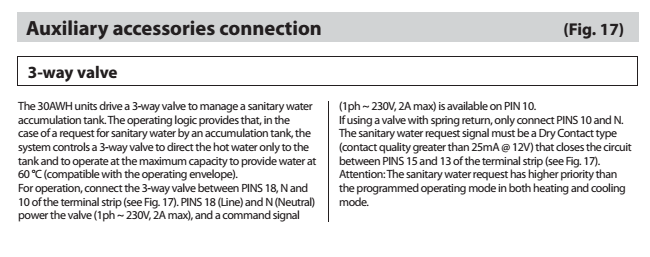
This is the section from the Carrier Installation Manual that references the three port valve connections:
-
My understanding is that yes, it would normally be in the heating position and should move to the DHW position on command. I take it that you have the 3 port valve wired between N and terminal 10? Reading the manuals, the 3 port valve controls seem to be between terminal 18, terminal 10 and N. The description in the Carrier information shows that 18 (L) and N are the power supply to the valve, 10 (L) is the signal. Not sure what this means, but it might be an idea to disconnect the valve and stick a meter between N and terminal 10 and then N and terminal 18 to see what happens when the 3 port valve relay operates. The Kingspan GMC board will have been pre-programmed with a load of settings that don't seem to be clear from their documentation, but the Carrier Installation Manual (copy below in case you don't have it) has a bit more information at the top of page 11 that may help. 30awh004h Carrier ASHP Installation Manual.pdf
-
Just sticking the compressor on a pad of firm neoprene foam makes a big difference to the noise. Making any enclosure from something like block or brick also makes a big difference. The lid of mine is made from two layers of 18mm ply, glued either side of a layer of 6mm neoprene foam, with the underside lined with acoustic foam. The lid is hinged at the rear and has a strip of 6mm neoprene foam all around the edge as a seal. The only slight source of noise I had initially from the box was from the air inlet hole, which I had made from a bit of 40mm waste pipe sealed into the enclosure with sealant and fitted with a rod end type screw cap, with the lid bored out and a mesh fly filter fitted. Noise from that was fixed by fitting an elbow inside the box and short length of 40mm pipe running inside, perpendicular to the pump.
-
Diameter of house mains electric supply cable
Jeremy Harris replied to Pete's topic in Electrics - Other
Indeed the DNO use a completely different set of rules; the "100 A" capacity incoming cable is protected by a fuse that's between 500 A and 800 A at the local transformer, something that would never be allowed in house wiring. I've heard tales of the aluminium core in concentric incoming cables burning back under fault conditions without blowing the transformer supply-side fuse, too. It's another good reason not to accidentally dig through an incoming LV cable... -
The command unit needs to programme the GMC with all the set values, I believe, so what's probably happened is that the values were stored in the Command Unit, but weren't transferred to the GMC until you changed a value. My guess is that at that time the Command Unit may well have transmitted all the parameters that were stored in it to the GMC, which has now stored them. Still worth cycling through all the settable parameters, I think, just to be sure that everything looks right. The chances are that the alarm may relate to a setting not having transferred, with a bit of luck.
-
I suspect the unit will need programming from scratch, check to see what parameter 100 is set to. It should be set to the right mode for the type of controls you wish to use.




