


Jeremy Harris
-
Posts
26430 -
Joined
-
Last visited
-
Days Won
360
Everything posted by Jeremy Harris
-
By far the worst aspect of this seems to be that "gagging orders" have been used to prevent publicity about the problem. Imagine if gagging orders has been used to prevent the publication of the cause of the Grenfell Tower fire - would we be so accepting of such tactics then? Until the true extent of the problem is known, how on earth are people going to know if their house may have a potential structural problem? What is clear is that NHBC is, as ever, acting to protect builders, not homeowners, but then that's nothing new.
-
I've spent an hour or so digging out scientific papers on research into the use of sodium acetate trihydrate as a phase change heat storage compound, and it's been quite interesting. There is work going back decades that seems to highlight two recurring issues. 1) The cycle life of sodium acetate trihydrate when used as a phase change heat storage compound is limited to a few dozen cycles before it starts to degrade. This seems to have been overcome by the specific mixture used in the Sunamp products, as they have now exceeded 40,000 cycles with only a tiny amount of degradation. Some other research indicates that thickening agents may improve cycle life. 2. When charging sodium acetate trihydrate there is a requirement to exceed the melting point (58 °C) by about 20 K, in order to ensure that all of the solid has melted. Failure to do this results in spontaneous nucleation around "clumps" of solid within the primarily liquid mixture. This implies that the charge temperature needs to be around 78 °C, just to be sure that all the PCM has melted. Related to the second issue is the problem of getting heat evenly into the material when it is in the solid phase. The viscous nature of the liquid phase, combined with its relatively poor thermal conductivity (similar to that of water, as far as I've been able to find out) and the tendency of the PCM to form a mixture which is not homogenous (lumps of solid PCM may well float around in the liquid) seems to be the Achilles heel of trying to heat the PCM evenly when using a relatively small area heat source. Heating water from a small area heat source, like an immersion heater of kettle element, is aided a great deal by strong convection currents that readily establish in water as it is heated from the base of a container. It seems that convection in sodium acetate trihydrate may well be nowhere near as vigorous or effective as it is in water, and this may well lie at the heart of the issue over trying to get a Sunamp heat cell evenly charged when it has only partially discharged, I think. One thing seems clear. There have been a lot of researchers working on using sodium acetate trihydrate as a phase change heat storage material for several decades, yet it seems that Sunamp, in conjunction with Edinburgh University, are probably the first to develop and engineer a practical product that uses a mixture of sodium acetate trihydrate, perhaps with a thickening agent to aid long term stability, and possibly an additive to improve the thermal conductivity (graphite powder seems to be something several researchers have investigated to do this).
-
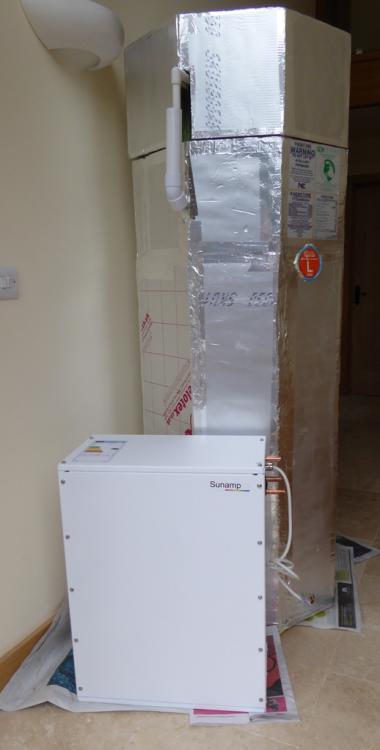
There were two reasons I opted to remove our old thermal store and replace it with a Sunamp. The first was heat loss. Despite adding an extra layer of 50mm PIR foam around the store, foaming it in place and sealing the edges with tape, we were still losing around 2.5 kWh/day from it, and that was making the services room very hot (over 40 deg C in summer) and damaged the oak door between it and the adjacent bedroom. It also made the adjacent bedroom too hot. The secondary reason was to free up space in the services room, as the thermal store took up a lot of room. This is a size comparison between our old thermal store (after I'd removed it), complete with added layer of insulation, and the original Sunamp PV to give an idea of the difference between the two: Using a hot water tank in conjunction with a Sunamp doesn't really make that much sense to me, as you may as well just choose to use a bigger water tank to do the whole job. Although a water filled store will not suffer from the inability to accept excess generated power when it cools below the thermostat set temperature, it will lose a lot more heat than a Sunamp, so over a few days of sporadic excess PV generation I doubt there would a difference between the two in practice. Adding a lot more insulation to a hot water tank, and reducing any heat lost from attached pipes, etc, would, perhaps, even things up, albeit at the expense of a much greater volume taken up.
-

Achieving a clean square cut with plastic 110mm pipe, how.
Jeremy Harris replied to epsilonGreedy's topic in Waste & Sewerage
I've wrapped a bit of square edged paper around pipe before now to mark a dead-square line around the pipe. As long as the paper is wrapped tightly around the pipe and the edges are aligned at the overlap then the line marked by tracing along the edge with a marker will be perpendicular to the pipe axis. For putting a taper on the end of 110mm pipe I used a belt sander, with the pipe resting in a corner and being twisted around with one hand whilst the belt sander was held at an angle with the other hand. To finish the taper off I just used a Stanley knife as a scraper, held perpendicular to the bevel and scraped around to smooth off the bevel and get rid of the fluffy bits of plastic that remain. -
Not at all sure there's any inherent efficiency advantage between the way the heat exchange system works in a Sunamp relative to the way it works in a water-filled thermal store. The only efficiency gain I can see comes from the lower losses from the outer surfaces of a PCM heat battery, as despite the different mechanism for storing heat energy, there's nothing else that I can see that would impact on efficiency to any noticeable degree. There may be a very slight decrease in efficiency for a PCM based heat battery resulting from the need to overcharge it slightly to ensure that all the PCM has changed from solid to liquid, but this is probably tiny.
-
In the UK we use the ellipsoid defined by the Airy oblate spheroid for our OS grid, but the USA (and much of the rest of the world tends to use WGS84, I believe. Not sure how you describe a rectilinear volume with bulges...
-
Some of us who have worked in areas that are less than popular with some of the general public just get used to these sort of biased comments. I've a feeling that my former place of work was the reason I was removed from another forum and then sent a tirade of offensive emails from an animal right extremist closely associated with it, for example. I'd not revealed publicly where I worked (for obvious reasons), I'd only mentioned it in passing in a PM exchange between two other members. Our collective guess is that the forum owner read the PMs and chose to take action on an ethical standpoint, by first editing some of my posts to reverse the meaning of them, then using those edited posts as a reason to exclude me. The fact that I'd never worked in the labs at the place in question, and had a specialism that was far removed from the one that earned the place a bit of a reputation, was neither here nor there - summary "justice" without allowing me to say anything at all was metered out. Mind you, that's trivial compared with having to go out with a mirror on a stick and torch every morning to see if the animal rights nutters have stuck a bomb under either of our cars overnight - did that for years, and had to carry on doing it long after I'd retired. Daft really, as I've never, ever worked anywhere near a lab that performed any animal testing in my whole career.
-
I'm pretty sure it won't work at low speed, as the air flow rate will be far too low and the heating element would just try and cycle on and off quickly. Our post-heater (albeit driven by a heat pump) will only come on when the MVHR is running at boost speed, just to get enough airflow so as to be able to distribute even a small amount of heat. Based on that I'd say Brink are right, but I would have expected their control system to automatically boost the fan speed when the heater comes on, as that's what happens with our Genvex unit.
-
A heat battery, or thermal store, is just a way of storing heat until such time as it can be usefully used. A hot water cylinder is another example, but specifically for providing domestic hot water (DHW) only. A buffer tank is a lower temperature (usually) hot water store used primarily for allowing low temperature heating to run without the need to constantly run the heat source. A storage heater is another form of heat battery that stores heat in heavy, electrically heated, bricks. In terms of what's commercially available at a domestic level, there are only really three thermal store technologies: 1. Hot water, held in an insulated tank. 2. Storage heater bricks, housed in an insulated case. 3. Phase change combined latent heat and sensible heat storage housed within an insulated housing. Dealing just with hot water provision, the choice is between storing heat as hot water in an insulated tank, or storing heat within a phase change material thermal store or heat battery (Sunamp being the only product like this currently available on the domestic market, I believe). There are really three main differences between storing heat in hot water and storing it within a product like the Sunamp: 1. A hot water heat battery needs more volume of water to store a given quantity of heat, so will be significantly larger and heavier than a phase change material heat battery. 2. Because of the size difference, and specifically the difference in surface area through which heat will be lost, a phase change heat battery will lose less heat in a given period of time (typically between 1/4 and 1/3 of the heat losses from a water filled heat battery). 3. A phase change material heat battery stores a large proportion of heat as latent heat of phase change. This energy is "locked up" in the structure of the phase change material when it's in the liquid phase, and is released when it changes to the solid phase, (hand warmers that use sodium acetate and have a small clicker to activate crystallisation are a good practical example of how this heat can be released on demand). In terms of direct comparison, then a Sunamp UniQ 9 has a total volume (including case and insulation) of about 171 litres and weighs about 155kg. An equivalent heat capacity hot water tank, including insulation and case, has a total volume of about 350 litres and weighs about 250kg (210 litres water volume). The Sunamp, being rectangular, may well be easier to fit into a given space, versus a cylindrical hot water tank. Both the hot water tank and the Sunamp will perform similarly in practice, so the difference really comes down to the lower size, weight and heat losses of the Sunamp. Quantifying these isn't as easy as it should be, as the standard heat loss test for hot water tanks assumes that they get cycled and left cool for a time every 24 hours, but based on my tests of adding insulation to a thermal store, and measuring the rate of heat loss over 24 hours, I would guess that a very well insulated 210 litre hot water tank would lose around 2kWh over 24 hours and an equivalent Sunamp UniQ, run at the same temperature, would lose around 0.7 kWh over 24 hours.
-
If you go to France you'll find that metal stud walls are very much the normal method of constructing internal walls. The French equivalents to the big DIY sheds are full of the metal stud stuff and it seems pretty much everyone uses it. Here we seem to have a tradition of using timber studs and have stuck with it, I've no idea why, other than the old "I've always done it this way" problem that I'm sure many of us have encountered. Metal studs are often quicker to put up and will be stiffer for a given section (the Young's Modulus of steel is around 10 to 20 times higher than that for timber), but it's not necessarily a given that steel will provide better soundproofing, as being stiff, and have much less internal sound absorption, means that on it's own a steel framed partition wall probably won't be any better acoustically than a timber one. If built as a double partition, with an air gap, which can be done with steel as it's so much stiffer (less thickness needed for a given stiffness) then the acoustic performance can be very good, but this isn't how normal domestic type steel framed stud walls are usually built. No reason why they shouldn't, though, other than a bit of added thickness. They still need internal insulation plus a decent thickness of plasterboard, though.
-
Council Tax
Jeremy Harris replied to EverHopefull's topic in Self Build VAT, Community Infrastructure Levy (CIL), S106 & Tax
There is law and case law that determines pretty much exactly when a local authority can and cannot charge council tax on a new build. In essence, a house can only be charged council tax if it is on the register and has a current council tax banding. In order to get that it has, by law, to be what's called a rateable hereditament. There is case law that clarifies what can be a rateable hereditament and what can't. A house with no potable water supply cannot be a rateable hereditament, for example. This was the way I avoided our build from getting on the register too soon, I just didn't connect up a tested potable water supply until just before completion. The council can give notice of intended completion to you, which then gives you a period of time before they will start the valuation process, but you can appeal this if you understand the law and case law that applies and can show that the house does not fall within the legal definition of a rateable hereditament. The law and case law has been quoted on here in the past and is all online and easy to check. This post links to the case law that applies (click the right arrow at the top to go directly to the post): This thread is worth a read, too: -
The current range are, I believe, their third generation of heat batteries. I'm not sure what the first generation was, but the second generation was the Sunamp PV that we used to have.
-
Looks like a classic case that illustrates the gulf between some architects and structural engineers. It seems that some architects can only think in terms of an artistic concept, and assume that someone else can turn that into reality without changing their design. We encountered something similar when we went around a few local practices to try and find an architect. One sketched an initial concept that included glass all along the front elevation (which faces more or less South). I asked how we were going to control excessive solar gain and he just shrugged and said something like "Oh, the engineers will deal with that".
-
Depends how well sealed it it, but you might get away without a vent. Only way to tell for sure is to test it and see.
-
IVT Ecolane ASHP - any owners out there?
Jeremy Harris replied to readiescards's topic in Air Source Heat Pumps (ASHP)
No, as the risk is that the pipework and heat exchanger inside the ASHP will freeze when the ASHP is off and the temperature outside drops below freezing. You may well find that you're fine with 45 litres system volume, based on what @PeterW has said about the way the IVT just relies on there being sufficient flow rate, rather than volume. Our buffer can run the UFH with the heat pump off for an hour or two, so limits the number of times it fires up. -
As @Barney12 says, I'm sure they are aware of the issues and are probably working on both the case stiffness problem, to resolve the bulging, and also the design and functionality of the Qontroller. I can only guess, but would think that designing, testing, production engineering and rolling out any fixes isn't likely to be an overnight task, but one that may well take weeks or months to resolve.
-
Don't use a hacksaw, it will bugger up the end of the pipe and damage the seals of the fittings when you come to assemble things. For 25mm MDPE you can just about get away with using the cheap non-ratcheting cutter if you're not doing dozens of cuts. I have both a ratcheting cutter and one like that which @joe90 has linked to, and, TBH, I prefer the cheap one, as it's quicker and only takes a tiny bit more effort to use.
-
Confused by MDPE mains water pipe price variation.
Jeremy Harris replied to epsilonGreedy's topic in General Plumbing
Plasson are far and away the best. More expensive, but much more nicely engineered, IMHO. -
Nice thought, but it was an absolute nightmare getting the 150kg UniQ up stairs, and I really don't want to have to get it back down to send off, then haul the ~60kg of Sunamp PV upstairs in its place, unless I really have to. If there is a modification to the Qontroller that fixes the utilisation issue then that's much easier to implement, as in all probability it could be as simple as blowing some new code in via the JTAG port, or just swapping out the control PCB, and maybe the temperature sensing string. Either of those is a ten minute job, that wouldn't need any heavy lifting.
-
I've heard nothing, but am monitoring the energy it uses from the grid, versus the energy it uses from excess PV generation, together with our generation and import energy, so I can see how big an impact changing the setting last Friday from Option 1 being ON to Option 1 being OFF has made. Last week showed that utilisation of available excess PV generation was poor, around 25% of our available excess went towards heating the Sunamp Uniq, the rest went to the grid. I will have a whole week of data with the changed setting next Monday around midday, so it will be interesting to see how things have changed with the Option 1 setting altered. My gut feeling is that we may be up to around 50% or so excess generation utilisation, but that's still pretty poor IMHO, especially as it's unlikely that we'll have any days where all the excess generation couldn't have been stored in the Sunamp if it would accept a charge whenever there is any spare capacity.
-
You only really need one, and it does have to be above the level of the highest thing connecting upstream of it, or you could just fit a vertical SVP outside, taking it high enough to ensure any odours are away from the caravan.
-
A 50m coil of 25mm MDPE fits in the back of my Toyota Prius OK, as does a 25m coil of 100mm land drain (just!).
-
Joist Hangers: too many holes?
Jeremy Harris replied to ToughButterCup's topic in General Construction Issues
Pretty much every type of wood screw will have a core diameter (which is the bit imposing the bearing stress on the timber) that is around half, or less, of the core diameter of a twist nail. The exception are some types of concrete screw, where the core diameter is virtually the same as the nominal diameter. -
IVT Ecolane ASHP - any owners out there?
Jeremy Harris replied to readiescards's topic in Air Source Heat Pumps (ASHP)
Looks OK to me. -
TBH, 9 times out of 10 it would probably work OK without an AAV, but adding one is relatively cheap and easy and provides reassurance that the pans will always flush and fill properly. With more than one toilet, basin or sink plumbed to the foul drain there is also the risk that a partial vacuum may empty other traps, as it sucks air through them.


