Jeremy Harris
-
Posts
26430 -
Joined
-
Last visited
-
Days Won
360
Everything posted by Jeremy Harris
-
We've had a few, caused, I think, by the interior being a bit too damp when we were boarding and plastering. It was very humid indoors at that time, not helped by the wet and cold weather, and all the plaster pops happened as soon as the house dried out and stabilised, maybe 6 months after being painted. My fix has been to just remove the loose plaster, fill the holes, then sand and repaint the areas. None have recurred, and all looked as if the screws underneath were still very firmly embedded in the underlying board. The filler is at least as hard, maybe harder, than the plaster, so once packed around the screw head I think it seems to hold things securely. I've not felt any indication that the boards are flexing where there have been pops, and get the feeling that the pops aren't from movement in and out, but from lateral movement that's tending to sheer the screw and causing the head to angle very slightly, so pushing the plaster off.
-
If the rainwater storage tank is below ground, then there's virtually no Legionella risk, as the water will sit at around ground temperature, which is usually around 8°C. The loft tank is low volume, just a way to provide the required air break (assuming a two feed system, with the water for flushing being supplied by rainwater with mains water backup). Because the loft tank is low volume, it will get emptied and refilled regularly, so there won't really be a body of water sitting up in the loft for long enough to allow Legionella to multiply.
-

Bringing a derelict UFH system into service.
Jeremy Harris replied to daiking's topic in Underfloor Heating
At rough guess I'd say that once the floor has been initially heated it will probably only take a couple of hours at the most to heat up, less if the flow temperature is increased a bit (although that does run a small risk of overshooting the set temperature, might not be a significant problem though). To deliver 40 W/m² to a room at 21°C needs a floor surface temperature of about 25°C, so a flow temperature of around 30 to 35°C would seem about right (start low, see how it behaves and wind it up if you want a faster response). Guessing the running cost is tough, as it depends very much on the total heat loss, but I'd be surprised if you find that you really need 40 W/m² all the time, or even most of the time. I suspect that you'll need less than half this most of the time, so you can have a guess at the cost from the area and heat output. 30 x 20 = 600 W, so if the heating is on for 15 hours a day, the boiler is 85% efficient and the gas costs around 5p/kWh then roughly 50p/day, perhaps. Re: the boiler, if it's a modern condensing boiler then they work best with a return temperature of around 55°C or so, so a flow temperature of around 60°C, perhaps a bit higher. I used to run ours at the old house at around 58°C flow and found that was pretty efficient, as the return was normally just a bit over 50°C, and the boiler was condensing properly most of the time. -
Always best to look at the actual heat loss numbers as well as the percentage to see if it is worth worrying about, IMHO.
-
Bringing a derelict UFH system into service.
Jeremy Harris replied to daiking's topic in Underfloor Heating
Sorry, missed this earlier. All that will happen with the thicker slab is that the time taken for the UFH to have any effect on heating the room will be a bit longer, as the additional volume of concrete will need to be heated first. Overall I think it should work OK, especially as the UFH is supplementary heating. The UFH will act to keep the floor comfortable and provide background heating and the rads should be able to respond quickly if there's a boost needed. -
What about cooling ?
Jeremy Harris replied to Tim Alsop's topic in Mechanical Ventilation with Heat Recovery (MVHR)
These have a fairly interesting reputation, so very well worth looking carefully to be absolutely 100% certain that the company providing the system and undertaking the installation know exactly how to make the system safe. This is an example of what may happen if the installation goes wrong: https://www.greenbuildingadvisor.com/article/belgian-passivhaus-is-rendered-uninhabitable-by-bad-indoor-air There's also an earlier thread on MVHR cooling here: -
For a 100mm slab, delivering 30 W/m² to the room, with a ground temperature of 8°C and a room temperature of 21°C, the losses through the insulation would be about 6.98%
-
Yes, especially as 30 W/m² is probably a bit higher than would be needed with extra insulation under the floor, due to the reduction in whole house heat loss.
-
With the same 100mm slab, 30 W/m² output from the floor, and 21°C room temperature, with the same 8°C ground temperature, the losses would be around 9.64% for 120mm of PIR, with a λ of 0.022 W/m.K.
-
Exterior Wood Fibre for SIPs
Jeremy Harris replied to davidc's topic in Structural Insulated Panels (SIPs)
Might the issue be caused by the relatively large temperature swings you get? IIRC, you were seeing night time temperatures that were below -10°C and I can imagine that the render, with the insulation underneath, may be going from well below zero at night to a fair bit higher when the sun rises and shines on it first thing in the morning. We've found that it's the east wall of our house that has the greatest weathering by far, and I believe this is due mainly to the clear skies and bright sun early in the morning. The more exposed west side is no where near as weathered as the east side. Also, I've found that we've had more movement in the cladding on the east wall, which again tends to indicate that it may be this wall that sees the highest night/day temperature variation. -
A quick and dirty estimate of losses, assuming the floor is set to deliver around 30 W/m² (which is on the low side for a house built to just meet building regs) gives the percentage heat lost down through a 100mm concrete slab set on 80mm PIR underfloor insulation of around 14.35%, for a room temperature of 21°C. With no insulation under the floor the heat loss increases so that around 4 times more heat would flow down to the ground beneath than would flow into the room (assuming a 150mm thick slab bearing on the ground, it would be worse for a 100mm slab).
-
Building Regs Sign Off for a Toilet Block
Jeremy Harris replied to Triassic's topic in Building Regulations
Activated carbon is great for taking out organic pollutants, but won't do much to remove ferrous iron. It is possible to introduce air to the incoming water, then use a wound filter to trap the ferric iron precipitate, but with 275µg/l of ferrous iron coming in I think the filters would get clogged pretty quickly. -
Building Regs Sign Off for a Toilet Block
Jeremy Harris replied to Triassic's topic in Building Regulations
The max allowable ferrous iron in UK drinking water is 200µg/l, so your water is over that by a bit. Our water is 480µg/l untreated, and 10µg/l after treatment. Whether there are likely to be any ill effects from water with that much iron in is doubtful, in my view. It's more likely to be a nuisance from staining stuff a bit and maybe causing the water to taste a bit metallic than cause any adverse health impact. -
Building Regs Sign Off for a Toilet Block
Jeremy Harris replied to Triassic's topic in Building Regulations
Treating the water to reduce/remove the ferrous iron is fairly easy. I'm using an Aquamandix/sand filtration system to remove ferrous iron from our supply: https://www.gapswater.co.uk/acatalog/copy_of_Manganese_dioxide___sand_mix__Iron_and_Manganese_Removal_.html Seems to do a good job, but does need a fairly high backwash rate to clean the filter every few days, so has to be matched to the demand and pump rating carefully. Best not to over size the filter, as that then needs more backwash, which means having a bigger pump/making the pump work harder. -
Anyone used online 3D printing services
Jeremy Harris replied to Gone West's topic in Tools & Equipment
I've been trying to determine the mechanical properties of available printing filament plastics and found this video which seems to present some sound data from what looks to have been a reasonable robust experimental technique: The carbon fibre filled PETG looks pretty impressive in terms of stiffness, plus it isn't that expensive, from a quick look at UK suppliers. Being twice as stiff as ABS, plus being reasonably weather and UV resistant, makes the CF filled PETG look as if it may well be a good option. From what I've read PETG is also easier to print than ABS. -
The difference for us is that we never drink coffee, only tea, so the tap gets a lot of use every day. Arguably it had too much use during the build, as I ended up drinking far too much tea, just because it was so quick and easy to stop for a cuppa. Not good for your health and well being drinking a dozen cups of tea a day, I discovered...
-
Anyone used online 3D printing services
Jeremy Harris replied to Gone West's topic in Tools & Equipment
Impressive looking quality, and I really like the idea of using the machine to make another version of itself, getting a bit close to a Von Neumann machine, perhaps! I'm still undecided on the machine to buy, as soon as I think I've made up my mind I see another review that makes me think again. Trying to sift through the mass of information available and decide on how reliable and trustworthy it may be is pretty tough. It is even harder when it seems that a fair number of the YouTube videos out there may be really just product adverts, or a bit misleading because the knowledge and experience level of the people making them is very variable. Isn't Fusion 360 solely cloud-based now? I haven't looked at it closely, because I tend to keep all CAD-related stuff on a stand alone, non-internet connected machine, only because the machine I use for this is built using an industrial PC motherboard, that has things like legacy ports (serial, LPT, etc) but no Ethernet or WiFi. -
Anyone used online 3D printing services
Jeremy Harris replied to Gone West's topic in Tools & Equipment
Thanks @Temp. The snag with PLA seems to be that it's biodegradable, and as the holsters I'd like to be able to make will live outside, that might present a problem! From what I've been reading so far, ABS seems to need a hot bed and a higher extruder temperature, and also some form of fume extraction, perhaps, as it can apparently be a bit smelly when it gets hot. -
They look like a good solution. The problem with using rubber grommets in something like this is that they will end up getting displaced as cables are pulled through them. It doesn't take much to dislodge a rubber grommet, and they can be a PITA to get back into place when they come loose with a couple of cables threaded through.
-
Works to an existing access - PP required?
Jeremy Harris replied to Piers's topic in Planning Permission
We had a complaint that we'd built the house with the ridge height above that in the planning consent. Luckily I was able to borrow a Total Station and set it up from the OS spot height pin in the lane, so that the planning officer could see that we were within the allowable tolerance (he said that he usually allowed +/-100mm on any dimension). Wasted half a day or so, picking up the Total Station, setting it up, messing around with the planning officer etc, but the planning officer gave me the impression that he really wasn't that fussed and was just going through the motions so that he could be seen to have acted on the complaint. I got the feeling that even if we had been in error it wouldn't have been the end of the earth. I would guess that planners get complaints like this every day, so know full well what some people can be like. -
We fitted an Itho Daalderop combined hot,cold and boiling water tap and wouldn't be without it. The only thing I wish I'd done was specify the optional larger boiler together with the mixer option for hot water, as that gives near-instant hot water, using mixed down boiling water from the under plinth boiler. We run the boiler on a time switch, so it's off overnight and only on during the day. It doesn't seem to use much electricity, though, as the boiler is very well insulated. I also fitted flow restrictors to the water supply to the hot and cold pipes, to restrict the flow to a maximum of 6 litres/minute. These had the useful side effect of making the tap much more controllable, with no splashing at all.
-
LIDAR data is available from DEFRA to 250mm resolution: https://data.gov.uk/dataset/8b007edd-a886-44ca-9fa0-2ee2efc1248d/lidar-composite-dsm-25cm
-
Funnily enough I was thinking about this earlier today. I was looking at a 3D print of a mountain range and thinking that it should be relatively easy to convert a topographic plan plus a house design into a 3D model that could be printed.
-
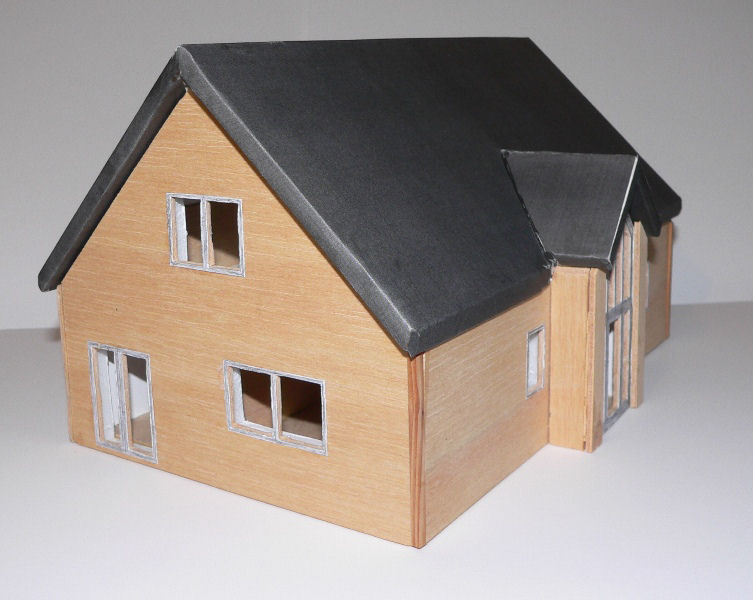
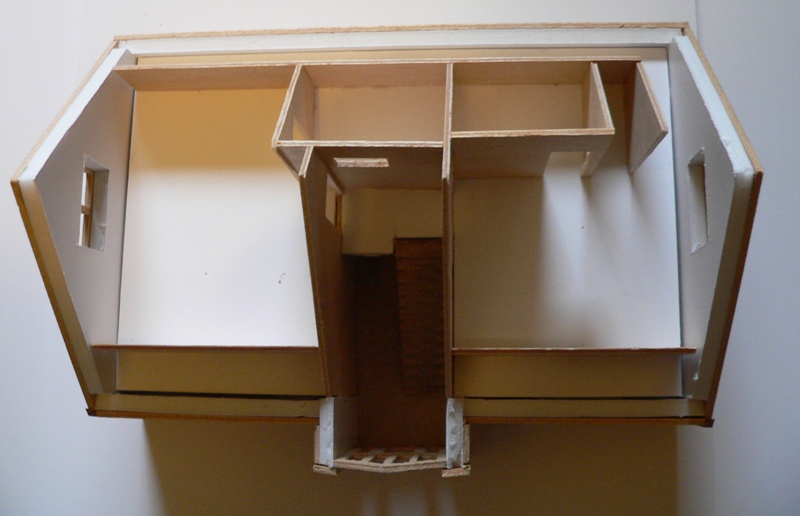
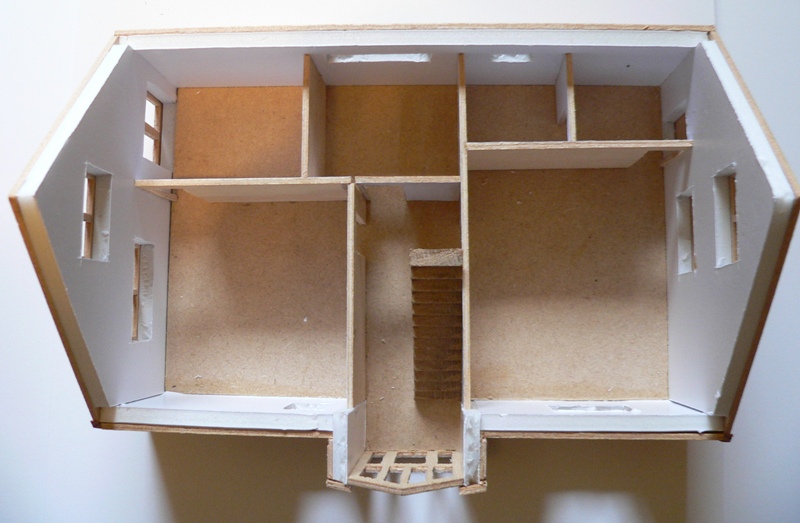
My wife struggled to visualise the internal spaces, too, so I opted to make a model, at 1:50 scale so that I could use plastic modelling figures to give a sense of proportion:
-
ICF's soaking up the plasticizer
Jeremy Harris replied to magnethead's topic in Insulated Concrete Formwork (ICF)
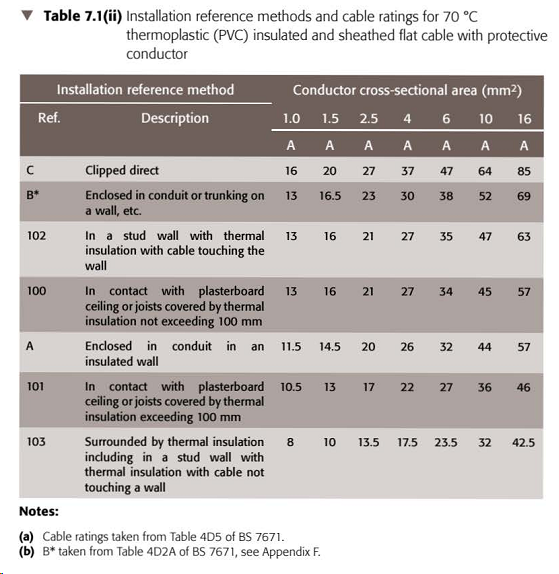
Snapshot of the rating table from the OSG for the 18th: