Jeremy Harris
-
Posts
26430 -
Joined
-
Last visited
-
Days Won
360
Everything posted by Jeremy Harris
-
Not related to your question, but the F.75 error is fairly common and can be prevented, but Vaillant are a PITA over the cause of this. We battled with repeated F.75 errors on the boiler at our old house, and eventually found a 100% solution for them (after more than 20 call outs under warranty). The fault has two known causes, both stemming from the same pressure sensor inside the boiler. The sensor tries to detect the pump pressure "kick" as it starts, but this "kick" is tiny, especially on a big system that has a fairly low flow resistance. The most common cause for this fault is the pressure sensor being blocked by debris. This was the "go to" approach taken by everyone that came to see our boiler - debris must be blocking the sensor, so they replaced the sensor each time, only for the fault to recur a week or two later. For us, it turned out that debris wasn't the problem, as we'd fitted a Magnaclean filter on the return right next to the boiler, and examination of the tiny hole in the sensors that had been removed showed they were clean as a whistle, but it's very easy to see how just a small amount of debris could block this sensor port. So, making sure there is a good filter on the boiler return, and making sure that it's regularly cleaned, is important to reduce the risk that the sensor will get clogged. The other cause is if the system is large and has a very low flow resistance. The problem is that the margin between the static pressure in the system and the tiny pressure "kick" from the pump can be low, especially when all the TRVs are wide open, so making operation a bit unreliable. The boiler will try to fire three times before throwing an F.75 fault and locking out, so this problem can go undetected for a time, as the chances are that one start out of the three will be OK, so no fault will be flagged. The fix for this is a modification kit available from Vaillant to reposition the pressure sensor to a location higher up inside the boiler. Once fitted, this modification kit completely removes the F.75 fault problem. The kit is called an "F.75 modification kit" by Vaillant, believe it or not, although it seems that Vaillant installers may not be aware of it (those that installed our boiler knew nothing about it - I only found out about it from making enquiries on the web).
-
I've found that the most effective way to search is to use a search engine, rather than the forum search facility, and just type your search terms with site:https://forum.buildhub.org.uk at the end. The usual boolean search characters then work (+ for must contain, - for must not contain, " " to enclose specific phrases, etc).
-

Electrician's insulator stripping tool.
Jeremy Harris replied to epsilonGreedy's topic in Tools & Equipment
Spot on here in Part P land, here in West Wiltshire there are no Part P people who have the ticket for inspection and test of third party work. However, @scottishjohn is not in Part P land, so in theory there may not be such a big hurdle to overcome in getting the installation inspected and tested. Certainly we used to be able to get inspection and test here before Part P was introduced, AFAIK. -
Electrician's insulator stripping tool.
Jeremy Harris replied to epsilonGreedy's topic in Tools & Equipment
I've already had about 40 years worth out of them! I'm not a fan of insulated tools at all, with the exception of screwdrivers where it might be useful to tighten a live terminal (very rarely). The reason is that my view is that they encourage unsafe working practices. No one, no matter how qualified or experienced they are should be working on a live installation. Isolate the power and check it's really dead before working on it is the golden rule. -
Electrician's insulator stripping tool.
Jeremy Harris replied to epsilonGreedy's topic in Tools & Equipment
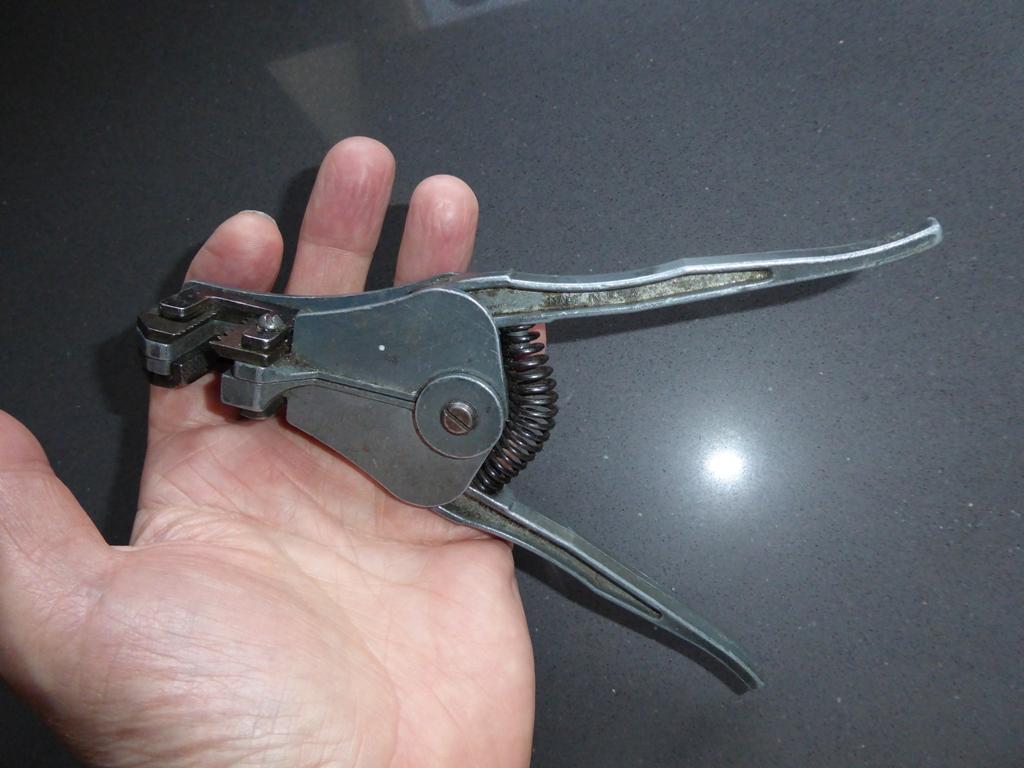
But they last a long time. These are around 40 years old and still work perfectly: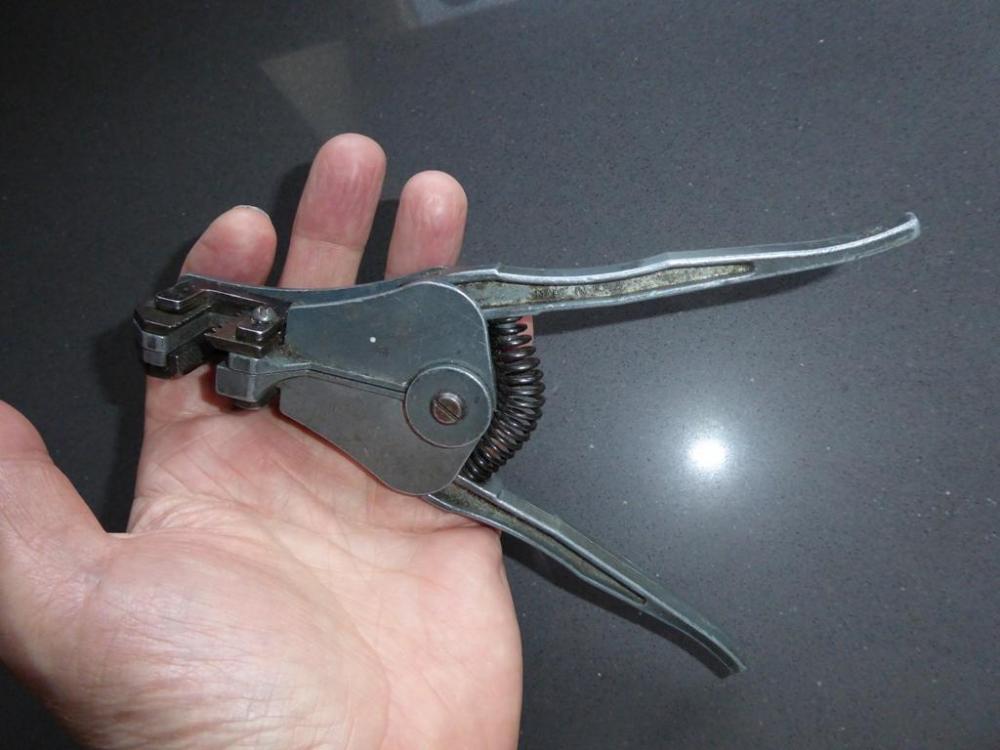
-
Electrician's insulator stripping tool.
Jeremy Harris replied to epsilonGreedy's topic in Tools & Equipment
Some of these are pretty good, some less so. I have a US made one that has replaceable cutting jaws, that I've owned for decades now, and still works OK. It's an Ideal Inc. Stripmaster, and it's OK, but I don't tend to use it all the time, as often I'll just use the notch in my side cutters to strip wire, simply because 9 times out of 10 they are nearer to hand. I've just done a quick search and it seems the Stripmaster is still sold, and looks identical to my 30 or 40 year old set: https://cpc.farnell.com/ideal/45-092/stripmaster-10-22-awg/dp/TL00598 -
They are OK as a very rough and ready indicator that an outlet may be wired correctly; I have one just for that purpose, as a way of doing a quick and dirty check; the three lights on the front are useful for very basic checks. I'd not rely on one for anything other than this, though, TBH. A multimeter is far more useful than one of these, and together with a safe plug adapter (like this: https://www.test-meter.co.uk/kewtech-r2-socket-adaptor/ ) can be used for checking outlets, as well as doing a multitude of other checks. The main caution with any multimeter is to make sure you buy one with decent, safe to use, leads. There are lots of cheap Far East manufactured units around that have test leads that are bloody dangerous, in that they often have poor insulation that may crack over time, probes that aren't really very safe in terms of being adequately shrouded, or cable that has a reasonable cross section. A working second hand meter from a reputable manufacturer is always likely to be a better bet than a no-name new meter.
-
We've been exporting to the grid since around 11:00 this morning. Although it's cloudy, with light showers, we're currently exporting about 1200 W as I type this, and generating around 1500 W. The Sunamp is fully charged, from excess generation earlier, so hot water is "free" for the next day or so.
-
Depends. My consultancy business never came close to reaching the VAT threshold, even though I charged £130/hour. In my case the overheads were just travelling expenses, plus a PC, printer, paper and some software, so never very much in any single year. Biggest single expense was travelling, made up around 20% of my total turnover usually.
-
Funnily enough, I cashed my UKAEA pension in a year or so ago, as it was so small that I opted to just take it as a lump sum. Full marks to them for tracking me down, though, as I'd forgotten all about it, and I've moved house at least 10 times since I worked for UKAEA.
-
GSHP, loops in a lake.
Jeremy Harris replied to Russell griffiths's topic in Ground Source Heat Pumps (GSHP)
The pumping energy problem is non-trivial, though, as it's just down to the energy needed to move a large volume of water. That reduces the effective COP to less than that for a very much cheaper ASHP, so it becomes pointless to use an open water collector system in the majority of cases. A boat can get away with using dual purpose pumps, by using engine cooling heat exchanger water, so the additional pumping demand is reduced, but most domestic systems will need to lift the water up by a couple of metres or so, more for a standing column collector. The volume of water needed is also high, above the 20,000 litre per day limit for licence-free abstraction (and an open loop heat pump is classified as abstraction, even though the water goes straight back from where it came). I was looking at lifting the water around 5 to 6 metres from a standing column system, using a small Kensa heat pump. That would have needed a 600 W pump to be able to deliver the required volume flow through the heat pump, and the effective COP would have reduced from well over 4 to below 3 as a consequence. A closed loop collector system would have reduced the pumping power a lot, down to less than 50 W. When it comes to filtering, then I agree, the semi-self cleaning filters used on ships could probably be down-sized and made affordable for use with a water source heat pump. I've not seen any smaller versions of these through, and the strainers on small boat sea cocks tend to clog even with a moderate water throughput. -
Very true. The state pension isn't paid until you're 65, and is set to change to 68 between 2044 and 2046 (and that's under review). Although I get the state pension now, I think it really should be means tested. I don't really need it, and a large part of it just goes in income tax, anyway, and it seems far more sensible for the state pension to just be a safety net for those that, for whatever reason, don't have any other pension provision. The latter isn't just from lack of foresight, either. A friend of mine lost his pension in the Mirror Group pensions scam, so had to get another job driving buses when he retired from the print works.
-
GSHP, loops in a lake.
Jeremy Harris replied to Russell griffiths's topic in Ground Source Heat Pumps (GSHP)
The problem then is that you need filters and a pump that costs a lot more to run, as it's not a circulating pump any more, but is running open loop. I looked at using a standing column borehole collector system and that had the same problem, high pump power consumption, although the filtering problem wouldn't have been as demanding as with a lake. If the collector loop is closed, then the pump power is a lot lower, as it's just circulating clean heat transfer brine around, with no net lift. The filtering requirement is also a lot less demanding, as the brine should stay clean. The need for filtering is driven by the fine passages in the primary heat exchanger in the heat pump, which has to be physically small in order to keep the volume in the refrigerant circuit as small practical. If the primary heat exchanger size was able to be increased, maybe by a factor of ten or so, then the filtering requirement would reduce a fair bit, but that would have significant knock-on effects for the design of the heat pump. -
GSHP, loops in a lake.
Jeremy Harris replied to Russell griffiths's topic in Ground Source Heat Pumps (GSHP)
One effect of the water source heat pump collectors in the lake next to yours, @Russell griffiths, is that the areas of the lake over the top of the collectors freeze in really cold weather. We stayed there around New Year about 7 or 8 years ago, when it was really cold, and the heat pump in the log cabin was working hard to keep the place warm (made a hell of a lot of noise, too). The next morning it was clear that the section of lake over the top of the collector mat was frozen solid, whereas the area away from it was still unfrozen. This photo shows the frozen area, behind the silver birch trees, whereas the water right in front of the cabin was still unfrozen:
-
GSHP, loops in a lake.
Jeremy Harris replied to Russell griffiths's topic in Ground Source Heat Pumps (GSHP)
Story time: Years ago, a friend I used to go water skiing with, asked me to help make a mooring weight to act as an anchor for a shore winch driven ski wire. This was at the local reservoir, so we opted to cast a concrete weight, using a tractor tyre, laid on a plastic sheet, filled with concrete and loads of scrap metal, with a big iron eye poking out the top. Having cast this thing on the side of the reservoir, we needed a way to tow it out and sink it. We made a raft from oil drums, lashed the weight to it and managed to drag and manhandle the thing into the water. My mate sat on the raft while I towed it out, with the ski boat, to the spot where we were going to sink it. This is where the fun started. The plan was to just cut the rope and let the weight drop. My mate duly cut the rope, then found himself flying up through the air, as the very buoyant raft leapt up when freed of its load. I was laughing so much that I could barely see to pick him up... -
GSHP, loops in a lake.
Jeremy Harris replied to Russell griffiths's topic in Ground Source Heat Pumps (GSHP)
Yes, the pipe would need to be weighted down as the MDPE and biodegradable antifreeze will be less dense than water by a fair bit. -
IIRC, from one quick look during a visit several years ago, the hole is the escape route from the basement, so had to be there and accessible via a door from the basement.
-
There's a long history of using large "cold" water tanks in lofts in UK housing, that suggests that Legionella isn't a significant problem with them, although the water from these cold tanks is only supposed to be used for feeding a hot water system, flushing toilets and supplying non-drinking water taps. The problem with the small tank is how to provide some sort of mains water back up, for times when the main rainwater tank runs low. It's easy enough to do with an additional float valve and supply from the mains that has an air gap to comply with the WRAS regulations, but in practice it means sizing the loft tank so that the level can drop when filling s toilet cistern, but not by enough to trigger the tank to fill from mains water. There are other control systems that could be used, perhaps having an electrically operated ball valve in the mains supply to a smaller tank, that's controlled by a float switch in the main underground rainwater tank, so that the mains water supply is shut off as long as there is enough stored rainwater. The cost of rainwater tanks depends very much on how you choose to do it. A fairly simple system, like that which @Bitpipe has installed, could be a couple of secondhand 1000 litre IBCs, placed in an outside basement area and fed from the roof downpipes, with an overflow system. Coupled with a cheap submersible pump such a system would be fine for watering the garden, and could probably be installed for a few hundred pounds (I think IBC's are around £70 or so each, and a suitable pump for running a hosepipe might be as little as £100). IBCs can't easily be directly buried in the ground though, so would need to be installed in an underground chamber of some sort.
-
There won't be a bug problem where your tank is at all, being cool and in the dark. It's only really large loft storage tanks that present a significant risk, IMHO, as they may well sit for long periods at ideal temperatures for allowing Legionella to multiply (plus, probably, a host of other bacteria that get washed in with the rain water).
-
Fascias and soffits question - need some help!
Jeremy Harris replied to Coops85's topic in Roofing, Tiling & Slating
Best bet might be to ask your architect to resolve it, as it seems to be his/her error. Assuming only 200mm deep roof buildup (which is I assume the main problem) seems a bit tight to me. Our roof buildup is over 500mm from inside face to outer face of the slates (we're also room in roof). I deliberately extended the soffits/eaves overhang out to provide a bit of shading and weather protection for the cladding, but designed this in at the early stages so that the function and appearance was OK. Our frame builder also used thinner ladder frame extensions out over the edges of the roof all around, so that the barge boards and fascias are about 200mm deep, rather than the full depth of the roof buildup. -
Cheap Internet radio wanted. Raspbery Pi?
Jeremy Harris replied to ProDave's topic in Boffin's Corner
I'm with @Ed Davies's option 2, set the IP as fixed in the router. I have a set of fixed IPs right up at the top of the range, just to make it a bit easier to find them. i.e., if my subnet range was XXX.XXX.XXX.0 to XXX.XXX.XXX.254 I set all my fixed IP devices to IPs working down from .254. DHCP allocates dynamic IPs starting at XXX.XXX.XXX.2 upwards. For some reason I've never been able to fathom, this works fine for everything except my network printer. That has to have a fixed IP set in the printer itself, no idea why. Failing to do this just stops printer sharing working reliably for some reason. -
Getting the cables upstairs
Jeremy Harris replied to Big Neil's topic in Consumer Units, RCDs, MCBOs
Usually the cables will just be run up/down through a wall, with them being located/protected as required. Depending on the layout there may be a need to protect the cables, but normally it should be possible to just run them in a safe zone OK without any need for special protection. -
Power to the shed, my first electrical job.
Jeremy Harris replied to epsilonGreedy's topic in Electrics - Other
Even if the air gap is an inch it's still notifiable work under Part P, as it's a new external circuit. -
Power to the shed, my first electrical job.
Jeremy Harris replied to epsilonGreedy's topic in Electrics - Other
Sounds like it's notifiable work under Part P to me, so not a DIY job, I'm afraid. Normally I'd be quite relaxed about stuff like this, but if this is going to be used by people working on your build then I think that your site insurers might need you to ensure that the work is installed, inspected and tested, with an IEC lodged on the part P register to cover it. You might also want to think about whether it's reasonable to export the PE from your caravan connection to this outbuilding, or whether it would be better to TT the outbuilding installation. -
It needs to be big enough to allow for a toilet flush to not pull the level down too far, so that the rainwater pump float switch always operates before the mains water back up float valve. There also needs to be room for the float switch to control the rainwater pump, so that the tank is normally topped up to a level well above the mains water backup float valve trigger point. At a guess I think that a 55 litre tank would be about right, as that would get flushed through pretty regularly and still have room for the float valve and float switch for the pump, bearing in mind that there needs to be an air gap so that the tank overflow is always below the mains water inlet point (can't remember the distance for this, but seem to remember that it has to be two pipe diameters clear).