Jeremy Harris
-
Posts
26430 -
Joined
-
Last visited
-
Days Won
360
Everything posted by Jeremy Harris
-
Be aware that the linked website is STILL using copyright material of mine, despite numerous requests I've made to get the rogue that runs it to take it down. Thankfully some of the images he's been using without my consent have been taken down, but there is a section drawing of our house which I drew up for our building control submission that is still there (no idea where he got it from, it's an edited version of a drawing that's in my blog, though). The website linked to had nothing to do with the construction of our house,despite claims made in the past that they actually built it! Edited to add: I was wrong, the rogue is still using all the photos of our build on his website! If anyone is tempted, then ask yourself whether you'd trust someone that uses someone else's build to advertise their own services, when they had nothing to do with it.
-

Looking to Build and Eco Home on a Budget
Jeremy Harris replied to Pemu's topic in Introduce Yourself
Yes, self builds are CIL exempt, but care needs to be taken with the way that the CIL exemption is applied for in order to be sure CIL isn't applied. The VAT position is a bit complex, but essentially all materials used in the build can have the VAT reclaimed at the end (and the definition of the end of the build may not be completion - it's a bit of a potential minefield) and labour used for the build itself should be zero rated. Materials used as a part of a supply and fit contract should also be zero rated. Some services used during the build, like surveyors, structural engineers, skips, etc aren't zero rated for VAT though. You need to be aware that your local authority may try to start charging council tax before completion. They can start to charge as soon as the property meets the definition of being a rateable hereditament, and that can be met long before completion. There are ways to stop this, by making sure that the house cannot meet the requirements of a rateable hereditament, but some local authorities will try it on (mine did, they even employ someone to drive around building sites, sneak in and see if they think they can start charging). -
planning permission for a boat?
Jeremy Harris replied to scottishjohn's topic in Planning Permission
I believe that residential moorings normally require planning consent, even on a privately owned lake. The regulations may be different between Scotland and the rest of the UK though, so probably worth checking. Here residential moorings seem to be treated in much the same way as a mobile home. The key seems to revolve around the change of use of the land/lake/river/canal. Change of use normally requires planning consent here. -
Oh dear. Our two bedroom house is 130m²... Mind you, our old three bedroom bungalow was only around 90m², and we found that a bit cramped, even for just the two of us.
-
That's a bit of an increase, more than I'd have expected, although it is about 6 years since they did our report, and it was very comprehensive. You can get an idea as to whether or not a borehole may be viable by looking at the BGS website and looking for borehole records near to where you are. I found about a dozen boreholes around our village, so knew that we had a pretty good chance of being able to use one.
-
Happy to give it out publicly, as the chap was very helpful and gave a good service. The chap we used was Tim Baker at http://bahsltd.com/index.htm The cost was £250 + VAT when we used him, but that was a few years ago, so prices might have increased a bit.
-
We are. Prices in NI seem lower, @Declan52 came in at around the sort of price you're looking at, but IIRC he did practically the whole build himself,
-
Welcome. I would guess that most self-builders rarely make a saving in cost over buying a house ready built, TBH. Build costs vary a lot, depending on how much work you do yourself, but a typical self build, with no frills, is likely to cost around £1500/m² total floor area. The really big advantage of self-build is that you get exactly the house you want, where you want it. The old "rule of thirds", 1/3rd for the land, 1/3rd for the build, 1/3rd profit is long gone. Even the big developers, who can build at much lower costs than self-builders, rarely get more than about 15% profit, and some work down at around 10% to 12%. It's really tough for a self-builder to come in at less build cost than a developer, unless doing a great deal of work yourself, and not costing your labour. Some here have built for less than £1000/m², but they are all people that have done a large part of the work themselves, in at least one case including all the brick and blockwork. We used a ground works contractor to level the site, etc, then a timber frame company that laid the foundation and erected the house, including fitting the insulation and doing the airtightness stuff. I purchased doors and windows from another company, on a supply and fit basis, used a roofing contractor for the slates and used a plasterer to board out and plaster the interior. I bought the cladding and employed two guys on a day rate to fit it, and also employed an electrician to do the wiring. I installed all the plumbing, some of the wiring, the heating system, most of the internal joinery, the kitchen, utility room, bathrooms, WC etc myself. With all that work we managed to get our build cost down to £1380/m², but it was a lot of hard work, spread out over a long time. Being retired I was able to put in the hours, though, so my time was effectively free.
-
Very true, @joe90, we were originally going to install a GSHP (it's on our planning consent) but switched to an ASHP when I looked at the whole life cost, which was astronomical when compared with an ASHP. The cost difference was massive, around £2k for the ASHP versus around £8k for the GSHP (both installed cost). The tiny difference in theoretical efficiency (which almost certainly wouldn't have been real in practice, due to collector loop pump running cost over the year) would never have come close to making up for the massive difference in initial cost, let alone the ongoing servicing cost that a GSHP invariably incurs. We could easily fit three replacement ASHPs over the next 30 years or so and still come out on top, although I don't envisage having to do this, as the ASHP just does it's stuff and works, needing no attention other than cleaning cobwebs out of the grill every year or so..
-
VHS or BETAMAX the battle of two technologies relived.
Jeremy Harris replied to MikeSharp01's topic in Boffin's Corner
The bottom line is that 7 kW is the maximum that AC single phase vehicle chargers can support, and I doubt this is going to change any time soon, as there isn't really any need for destination charge points to have more capability than this. Some vehicles will accept multi-phase AC, mine will use 2 out of the 3 phases, if available, to charge at 11 kW, but 3 phase capable destination charge points are rare, as few homes in the UK have 3 phase. 3 phase AC charging allows, in theory, up to 22 kW, but there are very few cars made that have 3 phase on-board chargers that can handle this sort of power. Fast chargers, like those on major routes, are all DC 400V and connect directly to the vehicle DC battery to allow partial charging (usually no more than about 80% to 90%, as they cannot cell balance), but they have all the charger electronics in the charger kiosk, rather than just being dumb AC switched supplies, that use the vehicles own on-board charger. The latter is really the limit on AC charging rate, as manufacturers don't want to fit large AC driven chargers to cars, as it adds expense and takes up valuable space and weight lugging the thing around. Fast chargers do have a direct grid connection, as they typically run at around 100 kW (newer ones are more powerful, 150 kW is becoming more common, and 500 kW is on the horizon). The advantage of DC fast charging, apart from faster charge times, is that the vehicle doesn't need any power electronics, just control signalling to tell the charger when to ramp down and shut off. It is barmy, as there are well over 20 different charge point networks, few of whom use compatible charge initiation methods and most of whom require pre-registration and a subscription. Reliability of fast DC charge points seems OK, with the notable exception of the really appalling Ecotricity network on the motorways. Most Ecotricity chargers are either permanently broken or very unreliable, the only upside being that they are often on free vend because they default to that when they crash (which is very often). The reliability of AC destination charge points is variable. Those provided by hotels, restaurants, etc seem to be fine, it's the crap ones put in by local authorities that are often either broken or useless. -
VHS or BETAMAX the battle of two technologies relived.
Jeremy Harris replied to MikeSharp01's topic in Boffin's Corner
Not really. A 7 kW destination charge point meets the needs of the vast majority of people, as that will charge at around 30mph. There aren't many people that need more than a couple of hundred miles a day of range from a home charger, so an overnight charge at 7 kW is more than enough for the majority. As home destination charging is mainly at night, the impact on the grid or local distribution network isn't that massive, either. Much of the time I don't bother running my charge point as high as 7 kW, especially from around March through to October, as charging during the day at a lower rate, to take advantage of PV generation, seems more sensible, mainly because it's free. -
VHS or BETAMAX the battle of two technologies relived.
Jeremy Harris replied to MikeSharp01's topic in Boffin's Corner
As Elon Musk has said: -
VHS or BETAMAX the battle of two technologies relived.
Jeremy Harris replied to MikeSharp01's topic in Boffin's Corner
Yes, Tesla choosing to price the only M3 available in the UK at well over the £40k luxury VED threshold seems a bad move to me, especially as they had made such a song and dance about the M3 being a "$30,000" car (hell of a joke that one). I think many thought the M3 was going to be around £35k to £37k, but £42.4k is taking the mickey (all UK list price, rather than price after PICG, as that's what really matters, IMHO). Buyers who sell after a year aren't going to care much about the luxury VED rate, but owners for years 2 to 4 probably are, as it adds £1.6k on to the running cost over that time. -
VHS or BETAMAX the battle of two technologies relived.
Jeremy Harris replied to MikeSharp01's topic in Boffin's Corner
I share your concerns about Tesla. Today's Model 3 fiasco has firmly crossed Tesla off my "next car" list. Interestingly, Tesla seems to have a very strong fan club, and can do no wrong in their eyes. Reminds me a bit of the way Apple users used to behave, during the Mac versus PC conflicts that seemed to arise from time to time. The way Tesla have chopped and changed prices, specifications etc recently doesn't exactly fill me with confidence, neither do the antics of Elon Musk (I'm coming around to the view that he's more of a liability to TMC than an asset, now). It looks like some of the bigger players are now going to all have 200 mile plus range EVs in the sub-£30k sector some time over the next 12 months or so. VAG have the VW ID3 and Seat El Born out in the first quarter of 2020, Kia/Hyundai should have stable production of the Kona/ENiro by then, Polestar will have their (more expensive) Polestar 2 out in early 2020, Peugeot will have the smaller/cheaper e208 out around the same time, and Ford are rumoured to have teamed up with VAG to use the MEB platform for a new range coming out later in 2020. All told it's going to be an interesting time, with a lot more choice being available for those who want to drive an electric car. I have to say that once you've driven an electric car it would be really hard to go back to driving something with an ICE. The combination of effortless driving, instant torque and smooth, near silent, driving is really hard to beat. -
I've always quite liked the idea, for several reasons. Having the bedrooms downstairs means they will tend to be cooler, probably quieter and bedrooms don't really need windows, IMHO (I like a really dark bedroom at night). Having no windows frees up wall space, allowing more layout flexibility. The main snag is probably making sure that noise transmission from people walking around in the living rooms above is adequately attenuated.
-
Yet more bad press on mass market developers
Jeremy Harris replied to lizzie's topic in General Self Build & DIY Discussion
The cost of random, unannounced, periodic inspections wouldn't be that high, though, and may well be enough of an incentive to mass builders to cause them to do their job properly. I doubt it would take too many cases where an inspector caused a mass builder to stop work and immediately rectify defects or non-compliances before the message got across that proper works oversight would reduce cost. -
Yet more bad press on mass market developers
Jeremy Harris replied to lizzie's topic in General Self Build & DIY Discussion
One option might be to introduce an unannounced random inspection scheme, where a building inspector has the power to enter any site and randomly inspect anything, at any stage. My experience of just driving past a couple of new developments over a period of two or three years was that there were defects that were pretty obvious, without me needing to get out of the car. On one of those developments, when I walked around one evening with a thermal camera, it was obvious where insulation hadn't been installed and where there were major air leaks around door and window frames. It wouldn't take much to do something like this to try to get mass house builders to do their job properly. In terms of cost I've been convinced for a long time that getting the build right in the first place has to be cheaper for builders than having to undertake remedial work. -
Yet more bad press on mass market developers
Jeremy Harris replied to lizzie's topic in General Self Build & DIY Discussion
Anyone that has experience building control when it was only a public sector service will almost certainly have the same sort of experiences to recall about the way that building inspectors operated. In general they were far, far more rigorous in applying the regulations than the lackadaisical system, we have now, where the majority of new houses are never inspected at all (because that's allowable under the relaxations that came along with privatisation). There's also the inherent flaw in any system where a builder can choose who to contract with for inspection services, in that this process will self-select for more lax inspection regimes. Any inspection company that fails too many new builds is unlikely to win more business from that builder; they will most likely switch to a building inspection company that gives them and easier time. -
Save the world, install an LPG tank.
Jeremy Harris replied to epsilonGreedy's topic in Environmental Building Politics
My point was that this statement doesn't seem to be correct: Not only has the public sector been in a fairly steady contraction for a bit over 75 years, but it's still contracting now, and shows no sign of expanding that I can find. -
Nails, silicon bronze, or stainless steel
Jeremy Harris replied to Russell griffiths's topic in Building Materials
Yes, I've used silicon bronze screws in the past on boats, but not recently. I bought a shed recently that is held together with stainless nails and I have to say it looks pretty good. They took the time to make sure all the heads are in straight lines, and they don't look at all out of place. I'd say that the stainless nails aren't any more obtrusive than the galvanised ones our cladding is fixed with, TBH. -
Yet more bad press on mass market developers
Jeremy Harris replied to lizzie's topic in General Self Build & DIY Discussion
Scary, isn't it? It does really emphasise just how poor the building inspection system is, something that I think we already know, from the many other stories of new builds that don't comply with building regulations, let alone tragedies like Grenfell, where the building inspection system should have picked up the problem of spread of fire from adding flammable cladding. I think there's a damned good case for scrapping private building inspection, making it a well-policed, central government run, function, and instigating a root-and-branch reform that ensures that work is always inspected properly for compliance with the regulations. -
We initially wanted a central vacuum, then stayed in a house with one and very quickly decided that it was far more hassle than either of us thought it would be. With the money we saved by not installing a central vacuum we bought two Dyson cordless ones, one lives upstairs, one down. We had a lot of cash left over from this decision, too. Until you've tried to drag a damned great snake of pipe around you don't realise just how much of a nuisance it is. We found it more of a nuisance than dragging a cable around, and the Dyson is so light and easy to use that there's just no comparison. The only feature of a central vacuum we miss is the dustpan slot in the kitchen. That was the only feature that worked very well, well enough that I'm surprised no one has come up with a small, stand alone unit that will fit under a plinth, and which doesn't need a full central vacuum system.
-
Maybe I'll let you have a whizz around in the i3 if I'm ever up your way (which is a possibility, as we're thinking of having another holiday in your neck of the woods).
-
Save the world, install an LPG tank.
Jeremy Harris replied to epsilonGreedy's topic in Environmental Building Politics
I thought I'd check the veracity of this, as it didn't seem to tally with the near-constant cuts that seemed to be taking place throughout most of my 35 year career. This graph shows how Civil Service numbers have changed over the last century or so: It seems clear that the Home Civil Service expanded massively during WWII, which coincides with the formation of the Scientific Civil Service, not that it was ever a significant part of the whole Civil Service. There seems to have been a steady decline in the size of the Civil Service since WWII, and it is now smaller than it has been at any time in the past 75 years. The plot above is for the Home Civil Service, and does not include the Colonial Civil Service, which was a separate entity (IIRC called the Colonial Service) during the time of the British Empire, nor does it include the Indian Civil Service. I can't find a complete set of data for the Colonial Service, or the other separate Colonial Civil Service bodies, like the Indian Civil Service, but it seems they may not have been that large.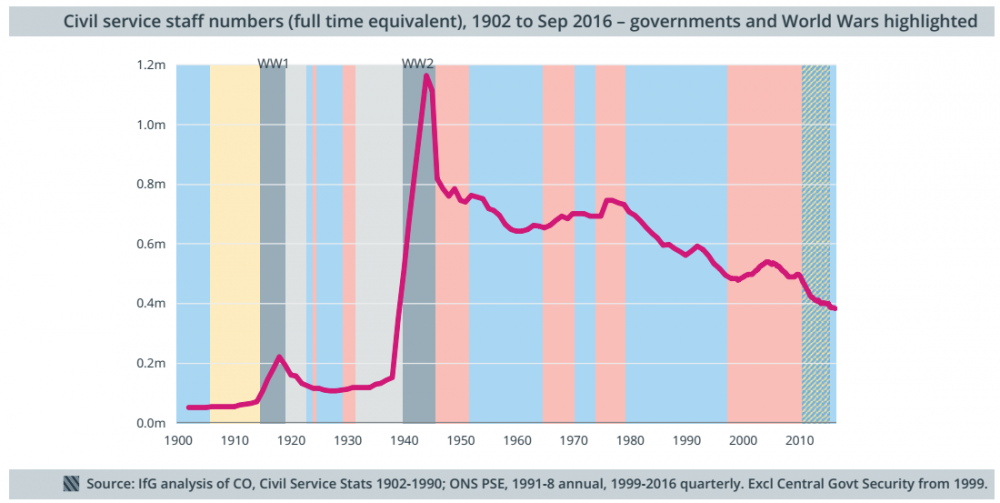
-
Save the world, install an LPG tank.
Jeremy Harris replied to epsilonGreedy's topic in Environmental Building Politics
I'll check tomorrow when I pull the stats out of the house monitor for April, but based on the fact that we were energy neutral by about 08:00, all our hot water came from solar and the heating hasn't been on at all for the past couple of months, I'd guess that we probably used around 3 to 4 kWh. Most of the saving has come from PV generation for most of the day, though, and the ability to store energy for hot water in the Sunamp. When I install the battery system in the next few weeks, I reckon we will be able to run off-grid, in effect, for the next few months. My car has been running entirely on charge from excess PV generation for most of April, and will probably be running mainly on self-generated energy for most of the summer.