Jeremy Harris
-
Posts
26430 -
Joined
-
Last visited
-
Days Won
360
Everything posted by Jeremy Harris
-
Probably UFH, but bear in mind that UFH will always be less efficient than radiators, although for a house with a low heating requirement these losses won't cost a lot. As an example, we have 300mm of EPS under our passive slab, and the UFH heat loss to the ground beneath is ~8% at the maximum heating level.
-

Save the world, install an LPG tank.
Jeremy Harris replied to epsilonGreedy's topic in Environmental Building Politics
Doesn't look like it. Nowt so strange as folk.... -
Save the world, install an LPG tank.
Jeremy Harris replied to epsilonGreedy's topic in Environmental Building Politics
Just to illustrate that there are a wide range of views about climate change, this has appeared in The Times today: https://www.thetimes.co.uk/article/aliens-are-already-here-and-breeding-with-us-says-oxford-lecturer-ck9xp8pbc -
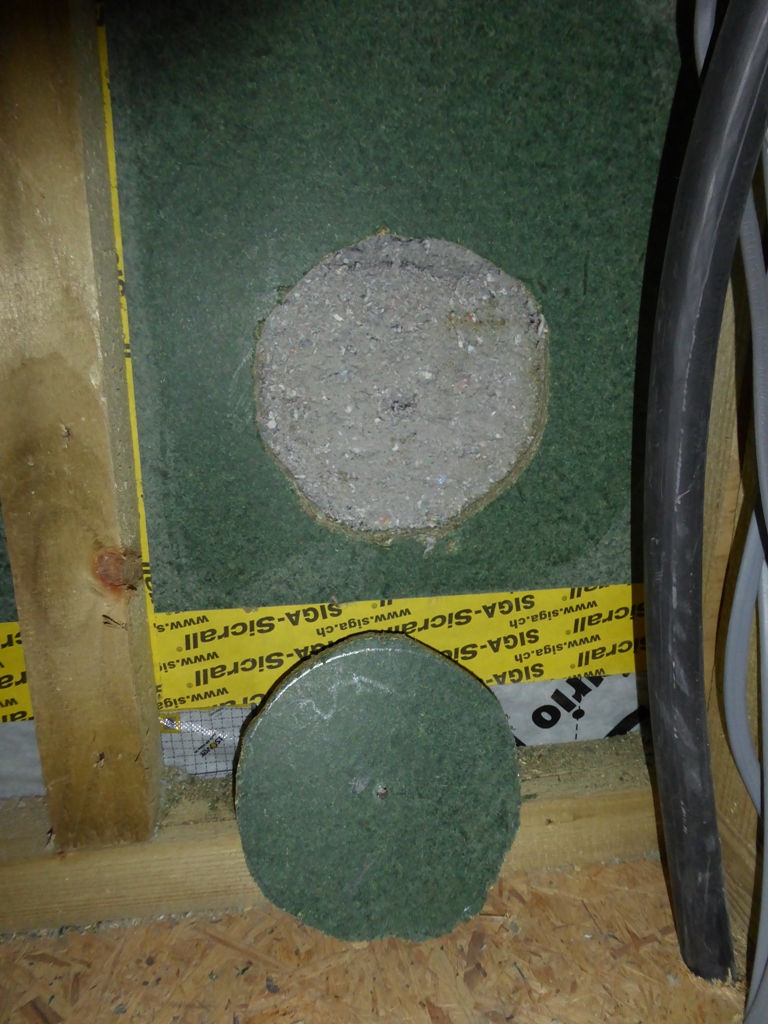
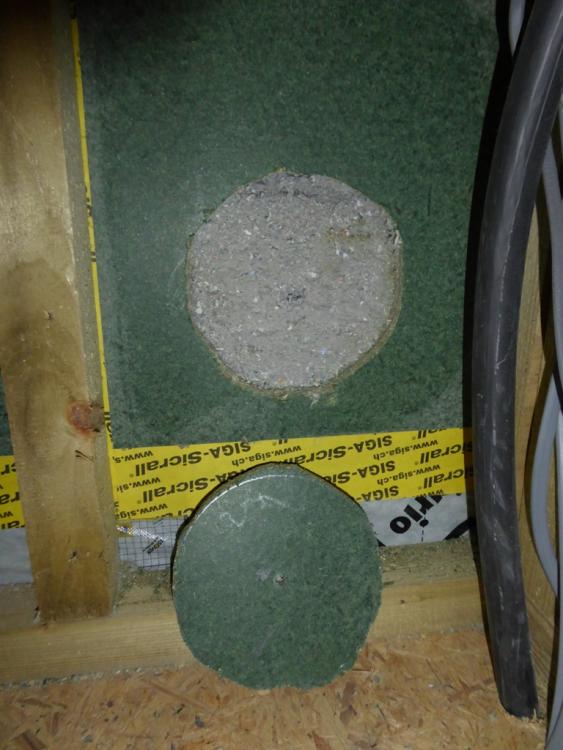
Yes, it seems to form a very solid block inside the wall. I cut a hole for a duct near the top of one of our walls, and this is what it looked like after I'd used a jigsaw to cut a 150mm diameter disc from the inner board layer:
-
I've just checked to see what was in our scaffolder's contract and they charged £1,350 for erection and the first 6 weeks hire, then charged £80/week for every week over. In addition, they charged £120 for each of two lift changes we needed, part way through. Interestingly they zero rated the whole bill, too, even though I didn't ask them to!
-
Grand Designs at Graven Hill starts tonight on Channel 4
Jeremy Harris replied to ProDave's topic in Property TV Programmes
If the boxes had holes in the webs then it would seem to be easy to just blow insulation in. Larger boxes with fewer webs might make this even easier to do. -
We have cracks just like those around our frames, too, where the plaster has shrunk back from the frame edge as it's dried out. I've been going around raking the cracks out and filling them with flexible acrylic sealant, but it's a messy job to do and would have been better done as you suggest.
-
Grand Designs at Graven Hill starts tonight on Channel 4
Jeremy Harris replied to ProDave's topic in Property TV Programmes
Just for the longer decrement delay. The heat capacity of cellulose is a fair bit higher than bonded EPS beads, so has a much longer decrement delay, even though the U value is similar. -
It's been looked at, but the combination of the very low flow rate of air in a roof void, plus the low heat capacity of air, makes it challenging. One company came up with a combined direct exchange evaporator panel (rather like that used by the Portuguese/Spanish hot water heat pumps) connected to the rear of PV panels, that were in-roof mounted. The idea was to both cool down the rear of the PV panels, to increase their output, and extract useful heat for heating and hot water. The problems with this were the price and the need for a massive heat dump outside the house to get rid of the excess heat, as once the hot water is hot the heat needs somewhere else to go.
-
Lots of websites link here, including my blog, which gets hundreds of hits a day, so has probably directed as many people here as any other other website. BuildHub has absolutely no control over who chooses to add a link to this forum. Anyone can post a link anywhere and we would be none the wiser, as it's impossible to even try and control who chooses to do this.
-
First off, we have ridge and eaves vents. Secondly, I do have a temperature probe in the void, and have measured the slate surface temperature, so these are reasonably accurate figures. There is certainly hot air circulation in the void, but as I mentioned before, air has a very low heat capacity so this circulation doesn't move much air (same reason that warm air heating in a house needs either large ducts, or a near-passive level of insulation and airtightness).
-
Just to be absolutely clear, this forum HAS NO CONNECTION WHATSOEVER WITH ANY COMMERCIAL ENTITY. BuildHub is not connected with any supplier, builder, manufacturing company or whatever, and is run completely independently, by an association of volunteer members. Anyone can help run this forum, and the minutes of meetings, etc are available for inspection on request.
-
Our planning officer was good enough to send me a draft of the decision notice, a couple of weeks before it was signed off. It included a clause much like that which @AnonymousBosch has quoted earlier, removing PD rights. I asked him why PD rights had been removed, and he didn't have an explanation, so I asked for this condition to be removed, which it was. A planning condition like this can only be imposed if it's justified by something in planning policy, and in our case it wasn't, so it was taken out before the decision notice was finally issued. This was lucky for us, as had the decision notice have included the removal of PD rights then it would probably have been a lot of hassle to get it amended.
-
Worth noting that the problem in Norfolk isn't private water supplies abstracting groundwater (as they are miniscule, as far as impact on the aquifer is concerned) it's licenced farm boreholes. The law is that you only require an abstraction licence if you draw more than 20,000 litres of water per day from a borehole or other water source. A domestic supply won't come close to this; as a general guide it will be around 150 litres per person per day (so we probably draw around 1.5% of the maximum we could use without needing a licence). Farms will need an abstraction licence, as they will likely use very large volumes for crop irrigation. It is the farm and commercial abstraction licences that are possibly being revoked in Norfolk, not the unlicensed use of private boreholes that don't require any licence. The impact of reduced levels in aquifers is still there, but this varies markedly with the region and the underlying hydrogeology. Where we are, the lower greensand aquifer doesn't seem to vary at all, the level stays a constant ~4m below the top of the borehole all year around and from one year to the next. As for uncertainty, then this depends entirely on how good the hydrogeological survey is. We used a very good chap, who produced a detailed survey, complete with a drilling profile and borehole design. Even though we had problems with the drilling company, it turned out that the hydrogeologist was absolutely spot on, in that the water was exactly where he said it would be (within about 1m, as far as I can tell) and the water quality is also exactly as he predicted, with significant levels of ferrous iron that has to be removed by our water treatment plant. Although the borehole saga was a PITA (as @Mr Punter mentions above), the very best £300 I spent was on the hydrogeological survey, as that took pretty much all the risk out of the initial decision to go for a borehole rather than pay a great deal of money to get mains water to the site.
-
Grand Designs at Graven Hill starts tonight on Channel 4
Jeremy Harris replied to ProDave's topic in Property TV Programmes
The last CNC cut plywood box design used much larger boxes, which went together more quickly. The down side was that they needed more effort to assemble and lift into place. My guess is that they may have deliberately made the boxes smaller in this build, to allow single handed assembly and lifting into place. IIRC, the last GD to use this technique was built by Facit Homes. There were several detail choices I'd question, but I can't see any reason why the basic construction method couldn't be used for pretty much any style of house. I liked the plywood box floor cassettes, too, I'd guess that they made for a very rigid floor. All I'd change in that design would be to have the CNC machine cut preformed holes in the webs to allow services to run through them more easily; should be easy enough to do. -
Grand Designs at Graven Hill starts tonight on Channel 4
Jeremy Harris replied to ProDave's topic in Property TV Programmes
I liked the idea of the plywood box build. This is the second one of those that's been on GD, but this one seemed to go together more easily. The external cladding was not to my taste, but that's just personal preference. The big advantage of the box design was that no lifting gear was needed and assembly seemed to be a relatively unskilled job, the snag being that the extended build time left it vulnerable to the weather. The latter might have been able to be tackled with a roofed scaffold, of the type that seems common around here when working on thatched houses. Got to admire that young couple doing that for their first home, although I was left wondering if their relationship had really survived the build or not. -
There won't be anywhere near enough airflow up the cavity to make a useful difference, and anyway, the air will be warm, as it's being drawn in from outside and heated, and as air has such a low heat capacity little heat is shifted by it. Our ~50mm deep counter battened cavity runs at around 45 to 55 deg C in bright sunshine, measured in the void under the breather membrane..
-
Save the world, install an LPG tank.
Jeremy Harris replied to epsilonGreedy's topic in Environmental Building Politics
Good point, @ProDave, as I think we generate around 1% of the world's CO2, and the problem is really the USA. In terms of per capita CO2 we're around 1/3rd of the CO2 of the USA (5.7 tonnes per head, versus 15.7 tonnes per head). China is less than half the per capita figure of the USA, and not that much greater than the UK, at 7.7 tonnes of CO2 per head. -
The tale of our borehole is documented in my blog (link in the signature below) and may help. The quick answer is that our 53m deep borehole cost around £8.5k, for drilling, lining, grouting, supply and fit a Grundfos pump, pressure switch and manhole cover over the top of it. The pressure vessel, water treatment (if required), disinfection system etc can be as far away as you like, within reason. 50m is no problem at all. Running costs are around £150 a year, including a sinking fund to cover the cost of replacing the pump after around 10 years (should last 20 years though, with luck).
-
I'm afraid it doesn't work like that very much, as when the gap exceeds about 25mm convection currents transfer heat across the air gap. The reason that air gaps of no more than about 20mm are used in double/triple glazing is because if the gap is larger the insulation effectiveness starts to get worse. Also, heat is radiated from the rear surface of the roof covering pretty effectively, warming up the surface opposite, so transferring a lot of heat across the gap, as the air has such a low heat capacity that it doesn't do anything much to slow down the heat transfer time.
-
The larger air gap doesn't make that big a big difference, as the most significant factor is probably heat capacity, and air has a very low heat capacity.
-
Save the world, install an LPG tank.
Jeremy Harris replied to epsilonGreedy's topic in Environmental Building Politics
Arguably any job or profession is in an international market, but, like any career, only a small minority ever choose to work outside their own country. Academia isn't, by any stretch, the only, or even the most popular, choice for scientists, either. In fact there's a well-known saying in labs outside of academia that goes "those that can do, those that can't teach", which tends to sum up the views of many scientists working outside academia. Anyway, as far as the UK is concerned, climate science has been effectively part of government for years, as historically the Met Office (and hence the Hadley Centre) has always been a part of the Ministry of Defence (hence the reason for one of the Hadley Centre scientists being seconded to work with me). The MoD has no reason or cause to try and direct the outcome of UK climate research in any particular direction, as the reason that it's funded by defence is because it helps to inform future decision making, in pretty much every area, from future equipment requirements to tactics and predictive war gaming. Procurement and training changes take a long time from the research stage to operational readiness, usually a couple of decades, maybe longer in some areas, where equipment replacement may only happen every 30 years or more. -
If you chose to connect an earth electrode to a TN-C-S supply PEN conductor, then you're adding another intermediate earth to the network, and that earth conductor then has to deal not just with local earth fault currents, but also those from the distribution network itself. The normal CPC sizing calculation uses the prospective earth fault current to determine the current carrying capacity of the CPC (in this case perhaps the steel armour of an SWA cable). The chances are that the cross section of the SWA wouldn't be adequate for dealing with the PEFC from a network fault, which may well result in the PEN at the incomer rising to a voltage above the maximum allowable of 70 VAC above the local true earth reference (because of voltage drop along the under-sized new intermediate earth CPC).
-
As I understand consumer regulations, the retailer has responsibility for the statutory guarantee period (probably 12 months, I think) and then the manufacturer/supplier has responsibility for any extended warranty period. I suspect that the Lidl store has responsibility for the guarantee for the first 12 months, and this then passes to the supplier/manufacturer for the two years of extended guarantee provision.
-
Save the world, install an LPG tank.
Jeremy Harris replied to epsilonGreedy's topic in Environmental Building Politics
Yes I was. I lived and work in the UK for most of my career, and even when working overseas on detachment was paid the same UK salary, so naturally my experience is of science in the UK. Cherry picking high-level salaries from what is probably the highest paid country in the world is another "regional historic anomaly", isn't it? How many scientists are ever going to become professors? Out of the couple of thousand that worked in the last lab where I worked I think we had two associate professors, both of whom were paid less than I was (there's more money in management than there is in science, by a pretty large factor). For many years I sat on one of the many interview panels we held each year as a part of our graduate recruitment programme, and over that time I did see modest increases in starting pay for new graduates. Unfortunately I also saw a marked decline in general competence and literacy amongst new graduates, so much so that we moved our minimum acceptance criteria upwards, to sift out more candidates before the interview stage. Whether the decline in educational standard was linked to the very large increase in the number of graduates over this period I cannot prove, but I strongly suspect that quantity has won out over quality. I can also guess that commercial pressure in the higher education sector may have some bearing on this, too.