Jeremy Harris
-
Posts
26430 -
Joined
-
Last visited
-
Days Won
360
Everything posted by Jeremy Harris
-
Some do, but it then becomes a critical point of failure. If the fan wears out, then the inverter may overheat and fail, and it's likely that a fan may well fail earlier than the commutation capacitors.
-
Ours is mounted outside, on the north wall of the house, in a place that never gets direct sunshine. This keeps it pretty cool all year around. Most inverter manufacturers offer an outdoor suitable version.
-
One advantage of microinverters is that their commutation capacitors only need to handle modest currents, and so they can use non-electrolytic capacitors. These don't suffer anywhere near as badly as the long-life electrolytics used in much bigger inverters, so realistically I suspect their life could be many decades.
-

Depth of cladding (stand-off from block wall).
Jeremy Harris replied to epsilonGreedy's topic in General Joinery
Certified roofing battens are mainly pink here, now. They were green when we did our roof, then switched to bright blue when were needed more for the cladding. AFAICS the requirement is just that they be dyed a distinctive colour so that roofers can easily see that they are safe to walk on. -
Our groundworks were just levelling the site, putting in service trenches and building the big retaining wall. The passive slab was a part of the TF contract.
-
Perhaps also use the CO2 from a coal or gas power station to enhance the growth of the crops?
-
It really comes down to the expertise and experience of the TF company. Ours did the whole job, passive slab and frame, including all airtightness and insulation stuff, and had a system that was well-matched, so that the passive slab was beefed up with a ring beam around the edge where the internal load bearing frame loads were applied, plus two internal wall foundation reinforcement areas, where there were load bearing walls bolted to the slab. The big advantage (apart from the whole house being thermal bridge free) was that we didn't have to worry about the risk of the foundation not matching the frame, as the same company supplied and installed both.
-
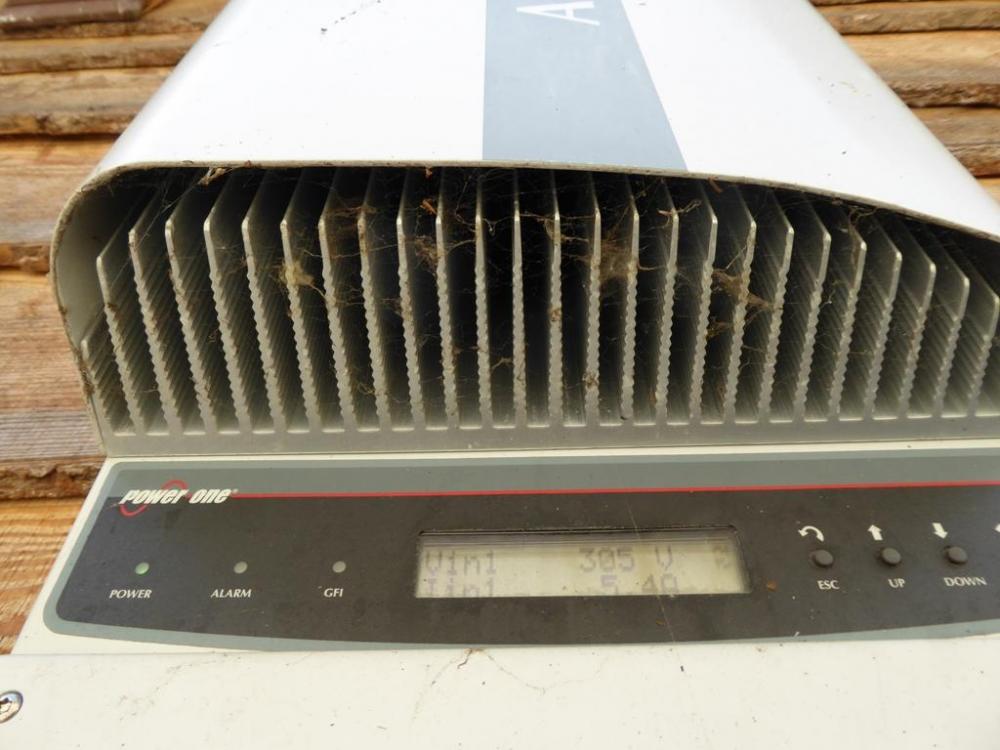
Just been out to look at ours, as I've not cleaned it since last year. Seems to have the usual cobwebs:
-
The only thing to check is that the heat sink isn't full of cobwebs (seems to be a problem with ours - I have to vacuum it out once a year or so) and that it's still functioning. There are no serviceable parts, and I suspect that any "service" might be just a way to apply pressure to buy a replacement inverter. The life of an inverter is probably around 10 years or so on average, perhaps longer if it is in a cool location, shorter if it is in a warm location. Temperature is the biggest factor regarding life, as the most common parts to fail are the commutation capacitors, and these have a life that is very temperature dependent.
-
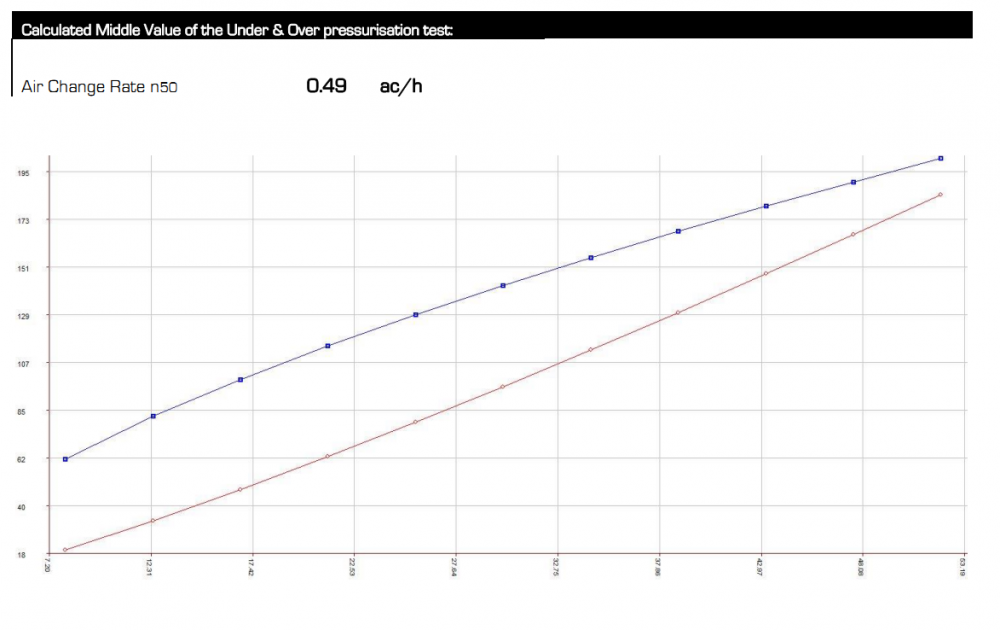
This is the plot from our air test, with pressure differential (Pa) on the X axis and air leakage volume (m³) on the Y axis:
-
Probably very little, unless the house is in an exposed area. Although PHI set the air leakage rate at 0.6 ACH, and the target under building regs for a house with MVHR is 1m³/m²/hr, in reality I doubt that there's a massive benefit from getting much below about 1.5 ACH or so, especially if the house isn't in an exposed location. Wind seems to play a pretty significant part when it comes to heat loss, though, so any house in an exposed area is likely to have a higher heat loss than one in a sheltered area, and would probably benefit more from being well-sealed. Where we are it's very sheltered, so I suspect it's debatable whether our low air leakage really makes a massive difference in practice.
-
Interestingly, if we'd not had the tall vaulted ceilings upstairs, but had taken the airtight layer just behind conventional height ceilings, then our building regs figure would have increased to about 0.67 m³/m²/hr. We had a measured air leakage volume at 50 Pa of 166m³/hr pressurised and 199m³/hr depressurised, so a mean of about 182.5m³/hr.
-
Just a thought, but are we looking at different measurement units here? The UK is a bit weird, in that our building regs don't use the near-standard air leakage/ventilation measurement system that pretty much everyone else in the world uses. In particular, the standard expression for air leakage/ventilation rate in the passive house world is air changes per hour at 50 Pa pressure differential. (ACH for short). The UK building regs specify this in m³/m²/hour, where m³ is the air leakage and m² is the total internal wall/floor/ceiling/roof area at the location of the airtight layer. The maximum allowable air leakage rate is 10m³/m²/hour. There can be a difference between ACH and m³/m²/hr, depending on the design of the house. For example, our air test was done by an Irish company, and they used the "normal" units, ACH at 50 Pa. I then had to convert this to m³/m²/hr for building control. Our ACH measurement was 0.49 ACH at 50 Pa, but the UK building regs figure was 0.6m³/m²/hr at 50 Pa.
-
Fused spur, for human or wiring safety?
Jeremy Harris replied to epsilonGreedy's topic in Electrics - Other
The bloke's right. You need to either fit a fuse or fit a suitably rated MCB to protect the 1.5mm² lighting circuit, as the 2.5mm² (assuming it's a radial) will have a higher rated overload protective device. Often it makes sense to fit a "garage CU", so that the circuits in the shed can be split into a power circuit (with a 16 A or 20 A MCB) and a lighting circuit (usually with a 6 A MCB). -
Architect with ICF experience needed! HELP
Jeremy Harris replied to Northcourt Couple's topic in Surveyors & Architects
TBH, for an extension you're almost certainly going to get a more positive response from an Architectural Technician. This is their bread-and-butter work, and the majority of them are better acquainted with the sort of detail needed to make an extension work well and integrate to the rest of the house. We would have used an AT for our house, as I found one locally who was really great. In our case he retired during the delay between us first finding the plot and completing the purchase, so I ended up doing the job myself (steep learning curve, and not one I'd recommend unless you have a lot of spare time). -
I've been tempted to fit separate IR illuminators, as a way to try and reduce the spider problem. I've also stopped using motion detection in the camera system and installed a separate system that uses microwave doppler sensors and an RF link to switch the DVR on. That seems to work very reliably, but will still get triggered by anything the size of a cat or bigger (funny thing is that large ducks don't trigger it, but even a small cat will).
-
Energy monitoring is definitely one of the most useful things we've had for the past few years. There's no substitute for being able to see just how much you're using at any time as a way of making us think about when to turn things on or off. We shifted a lot of our consumption to the E7 off-peak period in January/February this year, and that's had a significant impact on our bill. The curious thing for us is that we're not seeing a major drop in the bill now that we're not using any heating at all. It seems that hot water, car charging and other loads dominate our bill. In particular, we've had a few days in the past month where we've had the air cooling running in the evening, after the PV system has pretty much stopped generating, and that seems to cost more to run than the heating did during the winter, mainly because we can't easily shift it to the off-peak period. Need to get a battery system installed to be able to reduce the peak rate usage, I think.
-
Don't seem to be for us. The initial monthly DD was estimated to be £48.52 and I had a statement this morning telling me that our account is currently £103.35 in credit and that we used £43.53 in the last month, and that includes running my car.
-
We've been with British Gas, SSE, Iresa, Octopus and Bulb in recent years. All have been equally incompetent when it comes to running the IT side of their business. Octopus were perhaps the worst, with SSE coming a close second. Bulb are not too bad, their systems looks OK but they made really major billing errors on our first bill, charging us far more than we'd used, using a tariff that charged the same unit price for both peak and off-peak at rates that didn't match any of their advertised tariffs. They did sort things out very quickly, though, and have since been OK. None of them inspire confidence, least of all SSE, who took three years to sort of a range of billing errors, even after they had admitted that the problem was their end. As soon as SSE sorted out their problems we switched supplier, as frankly I just couldn't face having to deal with SSE any more. Worst in terms of general customer service was a close run thing between British Gas and Octopus, but the latter get my vote for being the worst mainly because of all the "love and peace" hippy crap and their refusal to use a proper form of address to customers.
-
Yes, we do have an air-to-air heat pump in the MVHR, as well as floor cooling using the UFH and its ASHP in cooling mode. Today it was the MVHR cooling that was on, as the floor cooling has a much slower response, and tends to only be used when we have long periods of warm weather.
-
Spray PUR foam. Why isn't it popular?
Jeremy Harris replied to Digmixfill's topic in Heat Insulation
It's certainly good for sound absorption. We have dry-blown cellulose and it seems to be exceptionally good at both soundproofing and reducing reverberation, something that quite surprised me, as I expected the plasterboard to pretty much remove any effect that the cellulose would have on that. -
You can still have views, but you can significantly reduce the solar gain coming in through the glass. We've done this retrospectively, and it's been far less effective and cost more money than it would have done if I'd realised the scale of the problem and designed it out by specifying a better glazing solution. The main issue is that active cooling is relatively slow to respond, as by the time it turns on there is already a fair bit of heat energy stored in the house. The consequence of this is that the active cooling needs to continue to run for a time after the PV system has stopped generating an excess. Again, by coincidence, we have this situation right now - PV generation has dropped yet the cooling is still running, and probably will for another hour or two. I'm glad I opted to install cooling, but have repeatedly kicked myself for not having invested more in the relatively large area of glass we have.
-
Same here, the results were up on the tester's laptop screen, the pressurisation, depressurisation and average plots were displayed as a graph.
-
It's what we do, in fact it's running now as I type this, and is being powered by the excess PV generation. Far better to try and prevent the heat getting in in the first place though, as it takes time to cool things down.
-
Spray PUR foam. Why isn't it popular?
Jeremy Harris replied to Digmixfill's topic in Heat Insulation
FWIW, I don't think that "wet" sprayed cellulose is used much here in the UK. Dry, pressure blown, cellulose seems to be reasonably wide spread, though.