

Nickfromwales
-
Posts
30313 -
Joined
-
Last visited
-
Days Won
295
Everything posted by Nickfromwales
-
Tres bien .
-
Time to put the sheriff badge on me thinks. Say nite nite .
-
Ok chaps Boots suitably filled, back to business please .
-
Yup welcome aboard ? Can we politely remind you that this is an open minded forum, so @ProDave is free to do whatever he likes in his spare time.
-

Switched sockets - whats the point?
Nickfromwales replied to Fallingditch's topic in Electrics - Other
I'm not familiar with any trend towards radial tbh, other than dedicated circuits like heating control, smokes, alarm etc. Ring main is always our preferred method, but at least 3 rings ( down / up / kitchen ) so not sure about that afaik. Regarding double pole isolation, there is only really a requirement ( or need maybe I should say ) for DP when the appliance is hard wired. If there is a plug and you need to service / replace then you just pull the plug out . Unless you intend to work on something whilst it is connected to the mains then I really can't see the need for DP. -
Do the inverters 'lift' in the event of grid electric failure ( aka a power cut ) ?
-
If that's plasterboard, then it'll be the whole wall if they don't want to come off. Very often, the two won't separate without the surface paper of the PB being damaged / tearing away completely, which will render the board useless. If only minimal break out you'll need to PVA, let it dry, then use a cenentitous ( powder adhesive ) accordingly.
-
Do you actually need to inform them? Is that done to get a '2-way' meter installed and an agreement for the provider to buy off you and at what rate? Was considering a small array to offset my vampire / parasitic loads throughout the day, fitted flat on my new shed roof, when it gets done . Idea was to add to it over time to increase revenue / run other appliances accordingly.
-
The one I bought. I found mine ( elsewhere ) on eBay, and contacted the company directly. Saved the eBay fees so it was a bit cheaper and still free delivery. 4 beers is 4 beers whichever way you cut it
-
No. It will be quite obvious when grouted tbh.
-
25mm stubs can go with the end feed tee, same as with compression. just solder the tee out of position, clean / file away the excess solder, cut back to required length and Roberts your Mothers Brother. That's what I'd do
-
Ok. First schollboy error is the tiles on the shower wall should have gone on first. That way, when you look down the tray at that elevation you'll not see the cut, you'd just see tile on tile as the cut and grout line would be to the left, at the end of the run. Not the end of the world. The cuts aren't that bad tbh. Rectified edge porcelain is a bitch to cut, but I totally agree with you that if you ain't got the tools, stay at home. FYI, my Rubi tile cutter ( 900mm scribe and snap ) cost me nearly £400. It cuts like a laser and I often find it difficult to spot which was the cut and which was the factory edge, I shit you not. Rectified edge porcelain is very often damaged in transit. I religiously check all 4 corners of a tile before I stick adhesive on it and lay it. If it looks like it's had a bump ( come out of a pack with damage to the cardboard ) then I'll run my hands over the corners one at a time to see if a chip or splinter is going to come away. If you don't do this then it's going to bite you on the arse as it's easy to lay a few without realising. Fwiw, I've had many jobs where I've had to smash a tile out after I've fitted a duff one. Shit happens. I don't, however, leave them in and try to 'get away' with it. , that's lazy. Any pics of the floor tile / mosaic issues? PS, I don't often use silicone as the vertical finial finish in a prominent corner, I think it looks tacky and scruffy, even the colured ones. The only thing I'll do, ( as stated above to combat movement cracking and guarantee water tightness ), is apply a thin bead of clear CT1 and then finger it in tight as I can get it. I'll then remove the excess with a lint free cloth and some CT1 MultiSolve spray to make sure it's as inconspicuous as possible. It also doesn't 'shine' like silicone does.
-
Mastic bead aka line of silicone
-
Upgrading ex council house- what to go for?
Nickfromwales replied to Crofter's topic in Central Heating (Radiators)
Sonic sender transmits wirelessly to a receiver in the house. That's why I said add a penalty clause so it costs them not you . -
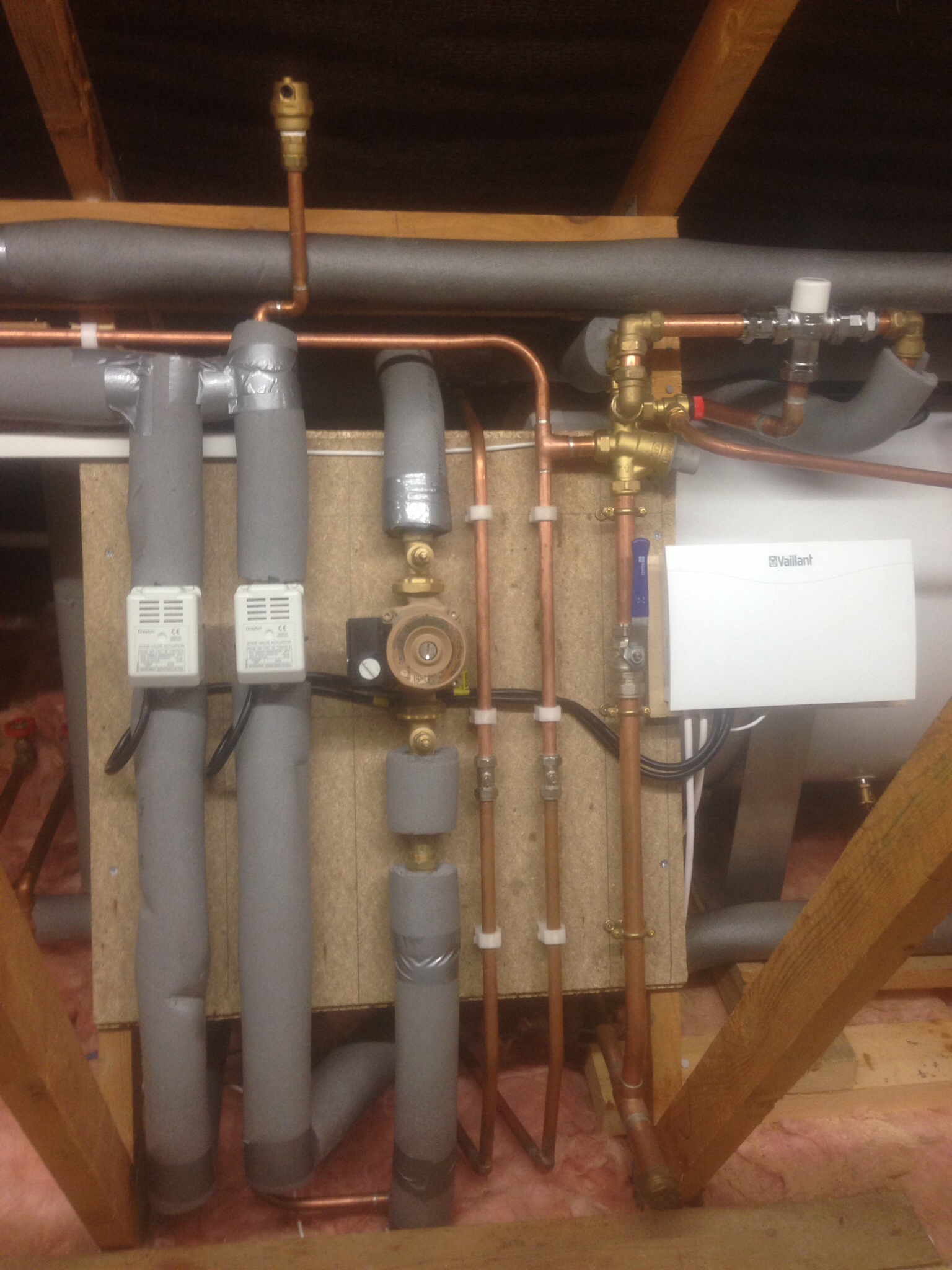
TPRV. Temp and pressure relief valve. D2. Discharge pipe work AFTER the tundish. G3. Certification for sealed hot water systems with volume of 15ltrs or above. Multi block aka control group Focker out. .
-
As long as water gets to them then what the hey Don't forget, if you go for an UVC or have to G3 the install, you'll need a secondary PRedV ( multiblock ) which will come supplied. That HAS to be with the cylinder for G3, even if you have one at the stopcock. They'll also want a NRV ( single check ) on the hot outlet to stop any unwanted mixing of pressures at mixer taps / showers etc from back flow, ( as a failsafe against the secondary PRedV ( at the stopcock ) failing ). Part of that multiblock would be a 5 or 6 bar cold mains blowoff, and also a TPRV, so make allowances for running a 22 or 28mm D2 discharge pipe if your going to need a path through the house to get it to ground level outside.
-
Upgrading ex council house- what to go for?
Nickfromwales replied to Crofter's topic in Central Heating (Radiators)
I wouldn't wish storage heaters on my worst enemy. I lived in my brothers house for 2 years when he moved out to shack up and it was all electric E7 etc. No ta. For simpliclty and reliability just fit an external oil combi, and an electric shower. I'm a fan of cooking on gas, as I can't afford a swanky top notch electric hot plate / induction doobery, so I'd also recommend fitting an LPG hob with electric oven ( dual fuel ). Reports are that a tall ( 47kg ) bottle can last up to a year in a regular household. For the heating system, power flush the existing radiator pipework and fit new radiators and valves. Radiator packs with the likes of MrCentralHeating are cheap as chips, so no excuse there. Make sure that the tenancy agreement allows access to check the oil levels and to include penalties for allowing the oil to run out, ( the cost of an engineer cleaning the filters and unlocking the boiler ). Fit a sonic tank level meter so at the 1/4 empty point you / they can request a refill without having to do anything physical. ASHP will be a non starter unless there are some SERIOUS upgrades to insulation and draught-proofing. They'll be better off at that stage with a direct electric boiler most likely. A house of that nature will require high grade heat for the space heating and dhw, so not well matched to that application at all IMHO. Cost of all of those upgrades vs payback becomes a factor along with longevity of the HP ( with it being overworked ). Without a buffer, all the defrost would be via direct electric too so I'd not even consider it unless you were to oversize the radiators sufficiently to get the target flow temp below 40 / 45oC. A good oil combi boiler a bit over £2k A decent sized tank change of £1k ( with fittings ) Any plumber can fit the whole lot, except when it comes to commissioning you need an OFTEC installer. Best to get them to do the tank and oil lines too, and ask for their insurances against damage from oil leak contamination. Check if you'll need it independently as a landlord too, in case of loss relating from theft. Consider a more recognised and user friendly system so that you'll easily attract tennants, and it's simple to run / use. There will be a good resale value too with a typical house fitted with a good heating and hot water system. -
Turn the cad off and get a spanner out I really need to get cad fluent, but then I'd spend more time drawing the damn things than actually out earning dollars. I design most of my installs the day I turn up to fit them tbh. I just look at the space for an hour or two and work all the crossovers etc out in my head and then draw a few lines and mark locations of things so I can recollect what's going where when I'm underway and then just go for it. I see the job in layers in my head so I can put timbers in, board, lay clips etc, and allow for insulation / brassware accordingly and usually it goes in first time. Usually.
-
Point #1, it's not the wife who'll want it boxed ? Point #2, cracking idea to put the other framed bog in there. Many birds one stone. Shall we extend the 2020 finish to 2022?
-
Just come off the DOC tee and put a 15mm tee in to take the DOC and then dropping down to pick up the cloak.
-
Sounds like valve / configuration issue to me.
-
+1
-
Yup. They're not suitable for hot / cold isolation. Should have been full bore ballofix valves or 1/4 turn WOG valves. That siad, if they're brand new then I very much doubt that they're faulty IF they've not been overtightened into the open or closed position. This is now just down to basic point to point elimination. Literally starting from the stopcock and working out wards, proving each piece of pipe has clear flow through it. Only that way will you find where the strangle is. As there's a lot of gate isolation valves this should be a but easier as you can just use scanners rather than cut the pipe and rejoin it. Get a good plumber to call round and spend a day there sorting this lot out. May be a very good idea to have someone impartial MOT the install and make sure it's fit for purpose before you go any further. If you were closer I'd come out and do it for you, so apologies for my welsh roots .
-
Next thing is turn off the stopcock that is in the pics, the 25x22mm one, connect some pipe to it and see if that's got the same power as the outside tap. If not, the pipes been damaged ( squashed ) underground.
-
Pic 4, are both the top red gate valves fully open? What does that pressure gauge by the PRedV show? Deffo need a test on that outside tap for pressure. Time to start isolating things and finding out where the 'strangle' is. Any good plumber should shoot through this process and find this in a day max tbh.
