
Nickfromwales
-
Posts
30353 -
Joined
-
Last visited
-
Days Won
297
Everything posted by Nickfromwales
-
Ah, my apologies. I thought you were manifolding the hot and cold water system. D’oh!! ?. FYI I do that routinely on my projects. ? hence my knee jerk response. Manifolds for the heating will be fine. ?
-
Very little when it’s designed in. The Vaillant has the 2x PH tanks fully encapsulated in EPS to minimise losses. Would be greater if added retrospectively or done on an UVC / other, but Vaillant have had to do that to maintain ERP rating. Honest answer would be run yours for a quarter and compare bills.
-
Just use 12mm plywood, glued and screwed, but make sure the floorboards are securely fixed down before doing anything as nothing will stay down if there’s movement in the subfloor. Any movement at all. The plywood will form to the undulations better than a rigid / brittle product will, or, lay the cement boards into cementitious flexible tile adhesive and screw down when cured. For the record, I’ve not used tile backer board on a floor. Never ever, and I’ve never had a floor break down because of it. I just don’t like the flexible vs brittle marriage at all. I’ve used the 1/2” thick one to make wet areas up / walk in showers etc, but that’s it. Not lost a patient yet in nearly a 1/4 century of tiling.
-
15mm inlet on the combi = total waste of time putting 22mm on the outlet. The only reason you’d go to 22mm would be to reduce resistance over a VERY long run. To be honest, utilising manifolds with a remote combi is not a very good idea IMO as you’re adding a huge amount of dead leg to each outlet, particularly the basin tap ( high frequency / low volume use ) which will be a PITA. If you want some divisibility then you could do 2x 15mm runs from the combi 1x 1st floor 1xground floor / whatever best divides the system, and just have an isolator ( FULL BORE ) at the combi for each run. The Vaillant 938 is a fantastic boiler with IIRC a 15L pre-heat cylinder ( actually it’s 2x 7.5’s for less physical space requirements ) and is comparable in DHW delivery to a 200L UVC. It’s only Ach’s heel is it’s still only a 15mm inlet & outlet, but with a good cold main you really can’t tell. The time from opening an outlet to actually getting premium temp DHW is massively reduced as it’s always got that buffer ready to go, so definitely a contender for anywhere where longer DHW runs will end up causing inconvenience. Veismann combis seem to have a good following but I can’t really say I’d rate them over the Vaillant if I’m honest. Guess I’m biased because I’ve fitted so many of the Vaillant units without an ounce of grief. Adding a DIY hot return to a heat store boiler will, I’m pretty sure, void the warranty. Ring the various manufacturers to ask, but I think the only heat-store combi I’ve ever seen with a tank and a hot return tapping was the Arirton 27 Plus ( a steaming bag of shit on a good day though, and I’d only fit one for someone I disliked ). The 27 Plus was the old model, they may have renamed it since I saw one of them last. Vaillant 938 all the way if it was me.
-
Not really, with a combi. You can take the edge off a little with a pre-heat aka warm-start combi where the boiler fires intermittently to keep the DHW plate heat exchanger at premium temperature, thus staving off the time you lose waiting for the boiler internals to heat up from cold ( eg the time lost waiting for the premium heat delivery temps to be achieved and output from the combi DHW outlet. Bottom line is NEVER have 22mm DHW pipe work from the boiler to the outlets.
-
Expect a long delay in getting premium hot water out of the hot taps, especially the furthest away. Other than that, no issues whatsoever. Check with the boiler manufacturers installation instruction to see if the boiler has an in-built frost thermostat or whether it is down to you to buy and install one. If the room is prone to super low temps at the worse part of winter, fit an electric tubular heater with its own frost thermostat. Set the boiler frost stat to 7oC and the tubular heater stat to 10oC.
-

Large property, 10 bathroom ASHP Advice
Nickfromwales replied to Jimlad's topic in Air Source Heat Pumps (ASHP)
You could fit a natural gas ‘hybrid’ air source HP and a pair of size 12 HW+I Sunamps, with the SA’s doing hot water only. The SA’s are fitted with 3kW immersions so you can heat the SA’s off cheap rate grid electricity plus you will have boost / failsafe options to boot ( eg full DHW capability still available even if the ASHP goes offline ) plus you can also heat them off the high temp HP via the hydraulic heat exchanger. The 2x SA units will give you the equivalent DHW capacity of a single 600L UVC but with no G3 requirements or annual maintenance schedule ( and related annual inspection costs ) plus very low standing losses compared to traditional cylinders. Have the SA’s set to heat once a night on economy rate electricity ( E7 / 10 ) via the immersions to deal with the bulk DHW requirement with near zero system fatigue / maximised overall system longevity ( as the ASHP will then be moth-balled most of the year ) and just use the HP to top up DHW during the daytime if required. The SA’s ( 2x ) will hold around 26-28kWh of heat energy so will provide probably 8-9 of the daily showers, with gas+hybrid bridging the gaps only. As it’s basically a “commercial” installation in what appears to be an HMO, system longevity ( and increased reliability ) will be an important factor. Remember this will attract ‘non-domestic’ RHI which is a 20 year period but at a lower £rate, so I would look closely at preserving the capital expenditure by increasing the lifespan of the system vs trying to squeeze every ounce out of the RHI as replacing the equipment early will neutralise any benefits thereof. Great that you have wet UFH aka low temp emitters on the ground floor, as ideally you’d have the HP provide space heating at as low a flow temp as possible ( to avoid the gas element of the hybrid kicking in and therefore maximise the CoP ). What about your intended solution for 1st & 2nd floors space heating emitters ? If rads then they need to be over sized to give useful heat at lower flow temps. Alternatively, you could fit 10x 8.5kW electric showers and upgrade the electricity supply ( if there isn’t already 3-phase on site that is ), and then just fit a small 150L HP UVC to provide the rest of the DHW needs ( sinks and basins ). Regardless of the way you provide DHW you will definitely need to boost the cold mains with a single or pair of cold mains accumulators to get anywhere near running a few of these showers simultaneously ( plus allowing for WC’s being flushed / basins being run / utility taking cold water etc ) or, which you may already be planning, each self contained dwelling would need its own cold mains supply ( & meter ) to keep up with peak cold mains demand. Early system planning, and consideration to everything else that will be needed to fortify your base question will be of paramount importance Pointless having a whopper of a DHW system if there’s nothing to force that water out of the outlets ( particularly at the 2nd floor height ). Another option is separate the DHW and heating, as above, and fit 3x 12’s and a pair of low temp ( regular ) HP’s for space heating only. Really needs some numbers crunching tbh. Confirmation on the situation WRT electricity supply 1 / 3 ph would help. 3-ph HP’s are available. ? -
Vaillant Turbomax 837 Boiler - Help!
Nickfromwales replied to Mulberry View's topic in Boilers & Hot Water Tanks
Impeller even ? -
Vaillant Turbomax 837 Boiler - Help!
Nickfromwales replied to Mulberry View's topic in Boilers & Hot Water Tanks
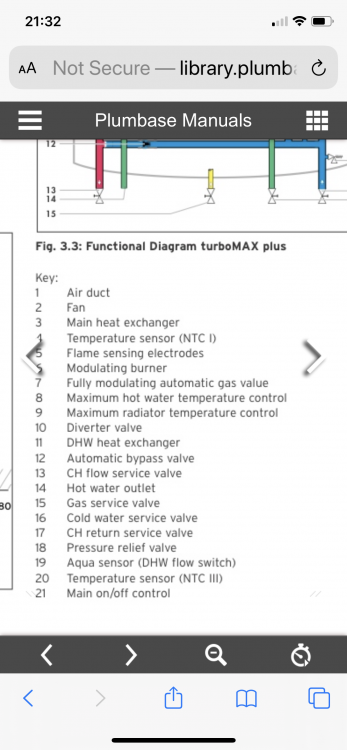
It’s a small propeller type spindle that you can buy as a spare for a few £10’s. Easy enough to change too. https://rover.ebay.co.uk/rover/0/0/99?loc=https%3A%2F%2Fwww.ebay.co.uk%2Fp%2F2256002575%3Fiid%3D173512321204 Try that first and go from there ?? -
Vaillant Turbomax 837 Boiler - Help!
Nickfromwales replied to Mulberry View's topic in Boilers & Hot Water Tanks
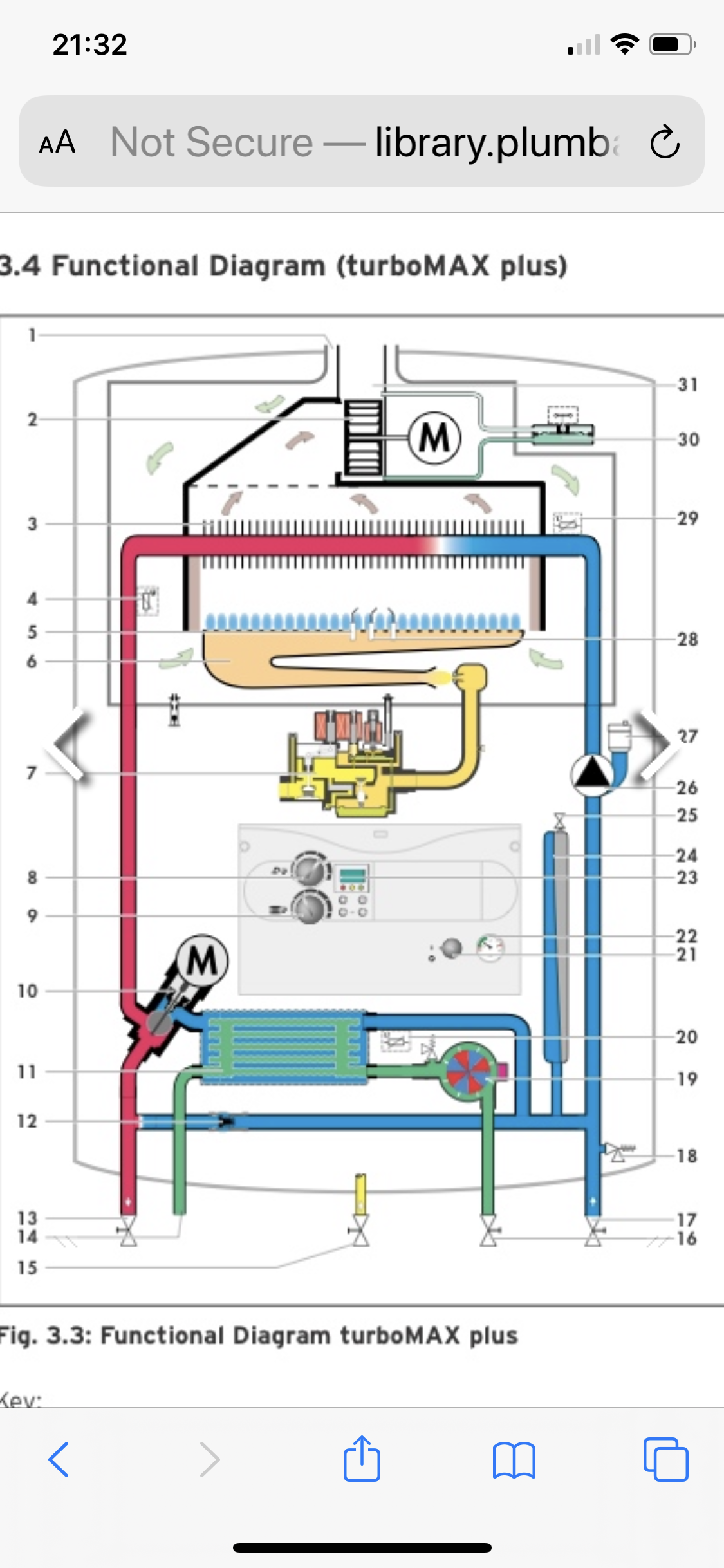
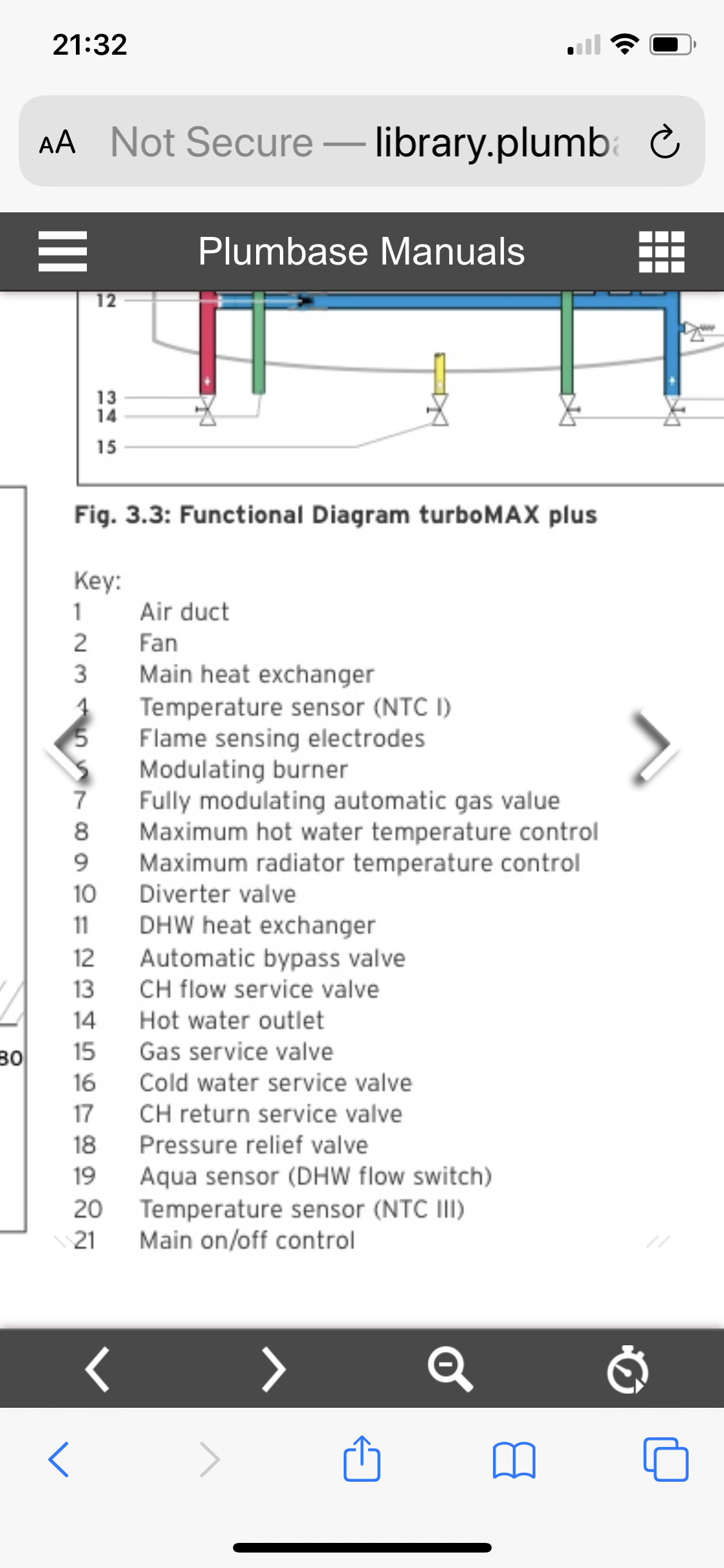
It’s item 19.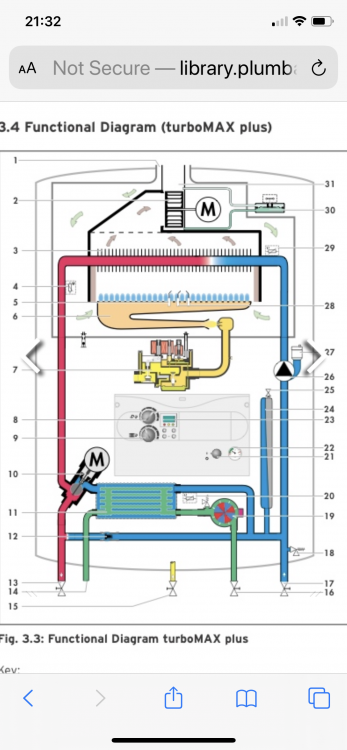
-
Vado is a little over priced, but it’s an entry level ( decent ) brand with good ongoing support / spares. Next jump is typically to Grohe / Hans-Grohe stuff which is legendary stuff. I’ve fitted mountains of both with no recollection of issues with Vado. Is this still a mixer or two separate taps? Beware moving away from a mixer tap as the hot tap just becomes unusable / unbearably hot unless a small TMV is fitted to manage the max temp.
-
Sunamp UniQ HW+i experience? Charge via ASHP?
Nickfromwales replied to oranjeboom's topic in Energy Storage
Ok, everybody remain calm...... I’ll start a new thread and go from there. ? Cup running over at the mo so bear with me ? -
There is a pattern developing where you selectively but carefully quote or gesticulate at any one, or other, particular individual in your replies and responses. It has been noticed, noted, and recorded hence your temporary exclusion, already given. If you wish to publicly (out)cry then it is fair to publicly respond from a moderator point of view. So I will. This forum is the result of a lot of hard work and time ( and money ) investment from a core of members who make up the FMG, and we will, absolutely, decide whom is to reside here and for whom their stay has out grown its welcome. You sir are on the very thinnest of ice. Choose a reason to remain, whilst your agenda is discussed elsewhere. I do not appreciate, or like, your tone. It won’t be tolerated much longer I assure you. Residing here is a privilege, not an assumption. Regards, mod team.
-
Sunamp UniQ HW+i experience? Charge via ASHP?
Nickfromwales replied to oranjeboom's topic in Energy Storage
I'll PM you a couple when I get 5 mins -
Ground floor for bungalow: joists better than a slab?
Nickfromwales replied to Dreadnaught's topic in Timber Frame
I’ll just say “cold ventilated subfloor under a heated slab?” Not in a gazillion years. ? The direction is forward squire, not reverse ! -
Ground floor for bungalow: joists better than a slab?
Nickfromwales replied to Dreadnaught's topic in Timber Frame
Read the blogs and you’ll have a much greater understanding Jeremys blog for one is very detailed and makes an excellent read. -
Popping into the plumbers merchants will get you a price from Uponor / JG Speedfit if you’re lucky. Prices will be high. £100 to Wunda for a turnkey solution is chicken feed IMO and if they provide a design and shopping list then it removes any thinking ( and liability ) on your part.
-
If the wiring ctr gives an on / off steady voltage output then there is no reason they won’t work perfectly. 2-wire do not provide feedback so they’re dumb aka good news.
-
Are the current actuators 2 wire or 4 wire?
-
Liquid damp proof membranes can work really well. It’s just about getting them installed correctly, and then overlaid immediately to protect them from damage.
-
Note : only if it was a 2-storey house
-
By the time you fill the house with ‘stuff’ you’ll struggle to quantify the difference imo. Comparing empty house > empty house is where it would be notable I think but in real life I doubt there’s much in it at all. With a heated slab, the thermal time constant is just so good it’s already above and beyond the requisite to spend out further improving it. UNLESS you’re staying there for the remainder of your days I’d spend the extra cash on something else.
-
That is good, and is probably where I’d spend my money in a TF house.
-
Great point, forgot to mention that one.
-
Don’t waste your money putting plywood / OSB everywhere !!!! Anything significant ( noggins / timber panels for ) can be decided at the outset, and there are some very robust plasterboard ( retro-fit ) fixings our there now so the point is moot afaic. Deffo line the kitchen with plywood, 12/15mm, and the bathrooms too, for utensil / accessory fixings both now and later down, as that IMO has value. Boarding 100’s of m2 for nothing is just good money after bad. As far as acoustics are concerned, I’d say plywood would be a worse choice than double boarding with PB. If you’re really worried about noise / sound, then just double acoustic board the plant / study wall ( both sides ) and full-fill that stud void with acoustic rated Insulaton, likewise with any other problematic locations. Double boarding is twice the cost, simples, so use ones own noggin and just fit a single, thicker PB once . 15mm on the ceilings and room-dividing walls will be as good as 2 layers of 12mm, if you change from regular insulation to acoustic rated at noise specific junctions, so don’t spend out where you don’t have to. Outside / exterior walls can be regular ( cheap ) white 12.5mm board, as you have the blown cellulose TF, so no need for further expense there whatsoever.