Temp
-
Posts
10641 -
Joined
-
Last visited
-
Days Won
43
Everything posted by Temp
-
Not quite sure I follow that but you can't use hangers in a situation where the joist is in tension. The joist would pull out of the heel of the hanger. Even if it didn't it could just pull the steel sideways. I can't figure out from the photos what's supporting the loft floor if you removed the joists/rafter ties?
-
Unfortunately I have a feeling the changes won't help self builders much. As I understand it the council will have to decide which areas are suitable for development and in those areas they won't have as much say about what gets built. My suspicion is that they will designate large sites such as disused airfields or large greenfield areas alongside main roads rather than smaller areas more suited to self builders. I might be wrong but that's what has been happening in my area for some time. There is an area earmarked for housing development that has largely been brought up by the big developers, leaving self builders to fight over plots in villages outside this area that are subject to ever tighter restrictions.
-
Wheelchair accessible property and damp proof membrane
Temp replied to Willow23's topic in Damp & DPCs
Not sure if this will work... https://www.instantstreetview.com/@52.370122,-0.428756,282.1h,2.85p,2.4z The top step is level with the front door. There is a gap in the wall to the left of the steps and you can drive up to that level. -
My reading is that any roof space you added when building the single storey extension counts towards the allowance for the loft conversion. Eg the volume of rooms on the ground floor of the extension don't count towards the allowance.
-
Hep02 do a 45/135 degree bend. https://www.toolstation.com/hep2o-obtuse-bend-135o-single-socket/p78071?store=U2&utm_source=googleshopping&utm_medium=feed&utm_campaign=googleshoppingfeed&gclid=Cj0KCQjw6575BRCQARIsAMp-ksMSj_S-qjzI35-xpbwjrZ9dI1w-M82q8Mq5YLNUtZ621bprbh3HC4oaArK9EALw_wcB
-
Wheelchair accessible property and damp proof membrane
Temp replied to Willow23's topic in Damp & DPCs
My level access area outside the front door extends far enough out from the house that we could put steps down off the sides for able-bodied people and coincidentally expose the vents. We also have beam and block floor. I'm away from home or I would post photo. -
Is this a CIL area? Have you got your CIL exemption paperwork done and notified them of your start date on the right forms? Don't start before then or you loose the exemption.
-
Parking fee for electric connection - have a guess!
Temp replied to Mr Punter's topic in Electrics - Other
Is it cheaper NOT to pay for parking and agree to pay the fines instead ? -
We once lived in a house with a concrete first floor and liked it a lot, so when we built our own we opted for beam and block with UFH on both floors. Can't really tel you the cost hit as we used a builder as prim contractor.
-
We wanted to change and move the approved house back on the plot. The planners fought us for over a year. Then we discovered a letter they had sent a previous owner saying "a larger house further back might be better". When we produced it they gave in and allowed what we wanted. Cost us >£10,000. So its near impossible to predict with any certainty how things will go. Sometimes they can be very bloody minded and other times just agree immediately. Best advice is to try, but be prepared to build the approved house, perhaps with only minor modifications, if it all gets too much. Just don't give in too easily.
-
Funding a Self Build after maxing out on Mortgage..?
Temp replied to Matt5100's topic in Self Build Mortgages
I would speak to a planning consultant. Aks if there is any chance of getting planning permission for two or more houses. If there is a good chance then buy and split the land selling off the bit you arent living in. No CGT if it's part of our main residence you are selling off. -
Must be possible to find someone to do it sooner. What are the limits on who can do it?
-
Osmo uv protection oil doesn't fade quickly so I doubt there will be much change in a year. I tried the clear on new oak and found it way too light. So I used a coat of Danish oil first to get a nice honey colour and the clear to protect it. A year on it's still a nice honey colour so I think the uv properties are pretty good. Before hitting it with the sander I would paint up some scrap cedar and see what happens. The stain might have penetrated unevenly so it might not sand off evenly.
-
Wheelchair accessible property and damp proof membrane
Temp replied to Willow23's topic in Damp & DPCs
Can you post a photo? So as I understand the problem is if it was level immediately adjacent to the house the vents would be blocked. The answer might be to move the level area 6" away from the house to leave a "trough" or gap for air to get to the vents as others have suggested. This gap could be covered with something like a removable linear drain cover to prevent the wheels of your chair falling into it...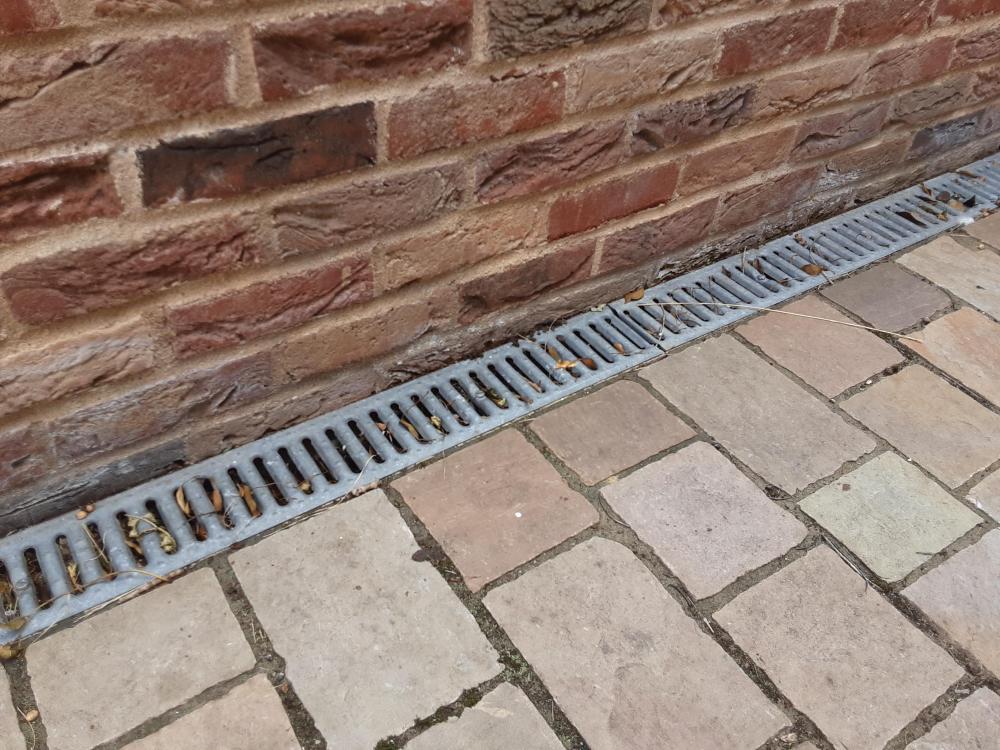
-
Advice required please new tiles with old
Temp replied to Vaders brother's topic in Roofing, Tiling & Slating
+1 They really must fix that. May have to move the whole lot left a bit so they go under the old ones like you say they do on the other pitch. -
Rendering foundation blockwork below SIPS sole plate
Temp replied to Longjock's topic in Plastering & Rendering
I guess you may have looked here already but looks like they have their own EPS system... http://www.sto.co.uk/en/products/external-wall-insulation/downloads.html -
Rendering foundation blockwork below SIPS sole plate
Temp replied to Longjock's topic in Plastering & Rendering
I cant really help answer your question but I know that not all renders are approved by the manufacture for use below DPC so I would contact them to ask about that. -
For my outbuilding I arranged for the top of the slab to be above ground level and slightly smaller than the building so rain running down the cladding would drop onto the ground not the top of the slab. I also raised the frame on a course of bricks and a DPC so no way the frame can sit in water.
-
Two years! Thought I had it bad (about 14 months). Much the same reasons as you listed except for the bats.There are loads about but for some reason nobody ever raised them as an issue.
-
As I recall there are two things that have to be right: * The volume S is important because it has to be big enough to store the storm surge. * The area a is important to ensure it drains away before the next one. I think the area a appears in the equation for S because water can flow out while it's flowing in and taking that into account allows S to be smaller than it otherwise would be. So I believe it's safe to ignore the -a*f*900 term if necessary but that would make the volume bigger. If you want to include it I think you should calculate the required a first then put that in the equation for S. Then when you have both numbers you can work out a size of soakaway that meets both. I should add I've not looked at the BRE doc for ages but that's how I think it works.
-
CML say... https://www.cml.org.uk/lenders-handbook/pcc/
-
Correct
-
It's probably hotter today.
-
Check it doesn't need planning permission first. Eg within 2m of the boundary the eaves need to be <3m high to come within permitted development rules. However I think that's measured at the point furthest from your rear wall. Details in here.. https://www.gov.uk/government/publications/permitted-development-rights-for-householders-technical-guidance Those dimensions sound ok to me. For the brackets I would use something like this that raises the bottom of the posts off the ground a bit. https://go.twenga.co.uk/to?s=9720237&gap=&gat=pla&aagid=48884992022&acid=1017976262&atid=pla-405564714126&aadid=247473114207&mcoid=114135292651&appid=405564714126&gd=t&mcid=166725238&url=https%3A%2F%2Frover.ebay.com%2Frover%2F1%2F710-53481-19255-0%2F1%3Fff3%3D4%26pub%3D5574631662%26toolid%3D10001%26campid%3D5338624526%26customid%3D%26mpre%3Dhttps%3A%2F%2Fwww.ebay.co.uk%2Fitm%2FHeavy-Duty-Galvanised-Concealed-Fence-Gazebo-Post-Support-Base-Bracket-Shoe-%2F114135292651%3Fvar%3D&gclid=CjwKCAjw34n5BRA9EiwA2u9k37T3KqGX8p8ITrqewKeFRaJagIVu38y1rLaNeymfLDUqZ3arwX3BexoCJbQQAvD_B If using pressure treated timber I'd cut the post to height and put the cut end at the top where its sheltered under the roof leaving the deeply pressure treated end at the bottom. Obviously treat the cut end but I reckon it will last longer if you do it that way up.
-
How deep are your joists? Looks like 220mm are ok without sound insulation but 195mm might need it or am I reading the Hickman document wrong?