


Temp
-
Posts
10690 -
Joined
-
Last visited
-
Days Won
43
Everything posted by Temp
-
Will cut to size for extra £5... https://ooznest.co.uk/product/borosilicate-glass-build-plate/
-
Depending on how bad the wet rot is I would be asking my wife how badly she wants to live there. Then get quotes to replace whole roof and use that to haggle the price.
-
High density 7n brick piers for cabin
Temp replied to Mike_M's topic in General Self Build & DIY Discussion
On my outbuilding I dug 2ft x 2ft holes. Compacted soil at the bottom of the holes using a ram, then put in 4" of MOT Type 1 hardcore I had left over from another job, also rammed. Then 100mm of concrete ( or rather I put concrete in until the level was right which was about 100-150mm depending on the hole). My out building is timber framed with oak posts and cladding and a clay tiled roof.- 1 reply
-
- 1
-

-
I think the main problem will be their lack of engagement with you. I don't think you can safely take the fence down without either their agreement or a court order. The latter might be expensive.
-
https://www.independent.co.uk/property/house-and-home/hands-off-that-fence-or-youll-be-hearing-from-my-solicitor-1275693.html
-
How does your title plan compare with the neighbours plan and the OS maps? http://www.land-registry-documents.co.uk/information/land-boundary-disputes/
-
This suggests the 7.5 ton van is big enough.. http://www.dontpanicyoureonlymoving.com/the-diy-mover/what-size-van-do-i-need 1200cubic feet is about 33cubic meters. If you don't fancy driving consider looking for a "man with a van" service.?
-
I think you can drive a Luton type van in a regular license. They are/were around 16cubic meters. Perhaps you can find a big enough van for one trip across the Solent. Van hire can be pretty cheap sometimes.
-
Perhaps box it with Wedi board and tile it?
-
It's measured by digging a hole and filling with water. As I recal the BRE guide has details of the procedure.
-
I think only aerogel is better than PIR. That's very expensive and in it's best form its fragile.
-
This place covers IOW.. https://www.hampshireinsulations.co.uk/about
-
First google hit says they deliver to some parts of Wales and if I've done my sums right it's under £17 /sqm inc VAT. Free delivery over £400. Otherwise £40. https://www.cutpriceinsulation.co.uk/collections/pir/products/quinn-therm-pir-insulation-1200-x-2400-x-150mm Edit: Ah ok the Wales reference had me confused. I see you are on IOW.
-
CIL response timiing
Temp replied to LSL's topic in Self Build VAT, Community Infrastructure Levy (CIL), S106 & Tax
+1 I assume this is a knock down and replace? They are saying the new build will be smaller than the one you are demolishing so there is no cil to pay. Is that the case? This is better than using the self build exemption because there are no strings (no need to live there for 3 years after completion). -
Is CIL Accumalative?
Temp replied to Freddieab's topic in Self Build VAT, Community Infrastructure Levy (CIL), S106 & Tax
I believe the extension would be treated as a new and separate calculation. It's under 100sqm so the CIL would not apply. Even if it did (eg a 113sqm extension) there is an exemption for "self build" extensions. However you have to claim the exemption using the right forms or you become liable to pay it. -
Is CIL Accumalative?
Temp replied to Freddieab's topic in Self Build VAT, Community Infrastructure Levy (CIL), S106 & Tax
Im pretty sure you have that wrong. My understanding is that the 100sqm rule is just a test not an allowance. It applies to the new area before deducting the demolished area. So the calculation would be.. 120sqm is more than 100sqm so the CIL applies to all 120sqm. Then the 25sqm is deducted giving a CIL liability on 95sqm. PS the 25sqm building must be in lawful use to be counted. Eg it must be legal in planning terms. -
LPG gas bottle next to an ASHP = dangerous?
Temp replied to epsilonGreedy's topic in Other Heating Systems
Range of cylinder stores.. https://www.smartfabcovers.co.uk/shop/gas-bottle-pods/gas-bottle-pods/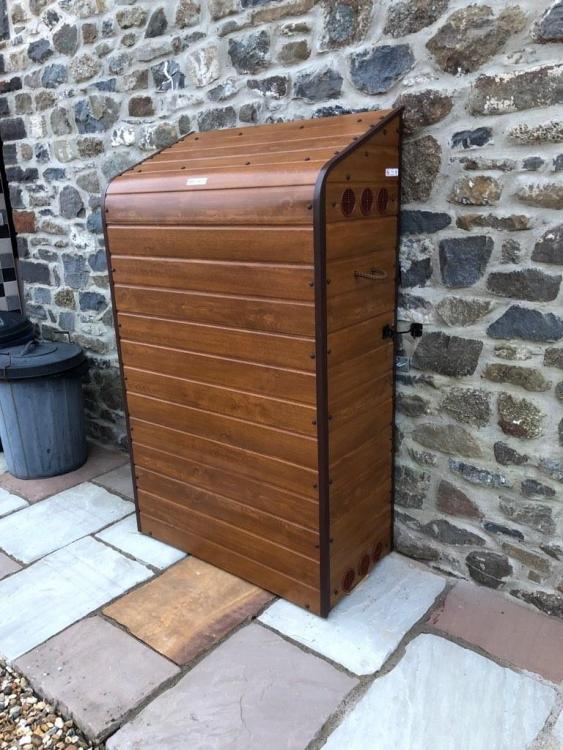
-
LPG gas bottle next to an ASHP = dangerous?
Temp replied to epsilonGreedy's topic in Other Heating Systems
I was going to switch to smaller cylinders but someone pointed out they have a lower flow rate and we gave a 6 ring hob. It's rare for them all to be used at once but has happened. -
+1 Standard blocks these days are 440*215*100. Given you only need 40 the price wont be super critical so i'd probably go to somewhere convenient like wickes and pick up some 3.6N blocks if you are going to knock it down later.
-
I'd take advice from an SE. I really don't like the idea of using hardibacker board for this! Our SE specified 7N blocks with 14N blocks for our chimney and some pillars because we have a beam and block first floor.
-
Excavation, PWA, Back neighbor, Unknown Depth of Foundation
Temp replied to MAR UK's topic in Introduce Yourself
Correct. If you are digging more than 3m from their house or outbuilding then you can go down to the 45 degree line (eg at least 3m deep) without involving the neighbour or PWA. -
Advice on planning permission for shed
Temp replied to Stephen cooper's topic in Planning Permission
+1 As I recall a rear road did once mean PP was required for sheds in rear gardens but thats not the case now. Just check you meet every point on the planning portal site. PS I think the rules may differ for extensions between a house and a side road -
Can someone explain to me what I am missing?
Temp replied to SugarPlum's topic in House Extensions & Conservatories
I think sketches would certainly help. -
Excavation, PWA, Back neighbor, Unknown Depth of Foundation
Temp replied to MAR UK's topic in Introduce Yourself
If you dig more than 3m away you come under the "within 6m rule" rules and the 45 degree rule applies. Example: Let's say you dig 4m away. The 45 degree rule means you can dig down 4m at least before the party wall act applies. In fact you can go deeper because the 45 degree line is drawn from the bottom of their foundations not the ground level. In that case you can dig down 3m without needing to do anything. -
Can someone explain to me what I am missing?
Temp replied to SugarPlum's topic in House Extensions & Conservatories
Are you removing the wall or creating a significant opening between the existing and new? This would change how the weight of the wall above the opening is distributed on the foundations. Typically the load becomes more concentrated. If they are marginal then that might explain why they need upgrading.

