


Temp
-
Posts
10690 -
Joined
-
Last visited
-
Days Won
43
Everything posted by Temp
-
PWA Can you build anything over a neighbour's property ?
Temp replied to Spinny's topic in Party Wall & Property Legal Issues
If that's the only overhang I would allow it. If you want to build your own extension you would build against their wall and fit a wider capping to cover both. If you insisted they move everything back a few inches it would be difficult to build your own extension close to the boundary without it looking naff. No easy way to seal the gap to prevent leaf debris collecting. What mike said.. -
PWA Can you build anything over a neighbour's property ?
Temp replied to Spinny's topic in Party Wall & Property Legal Issues
My understanding is that officially the only thing you are allowed to build on a neighbours land are foundations. I believe they can project under a neighbours land slightly. Overhangs are normally considered a trespass. However the courts don't take kindly to people going to court over a minor trespass. I've heard in some cases they allow the trespass to continue and award you nominal damages instead. That could be very little. -
Long shower waste run - can I avoid a stub stack?
Temp replied to maznaz's topic in General Plumbing
@maznaz See Approved Doc H below.. Para 1.20... Says an AAV is OK. Para 1.22... Says it must be within 750mm of the trap. Should be accessible in case of maintenance. I'd use 50mm pipe.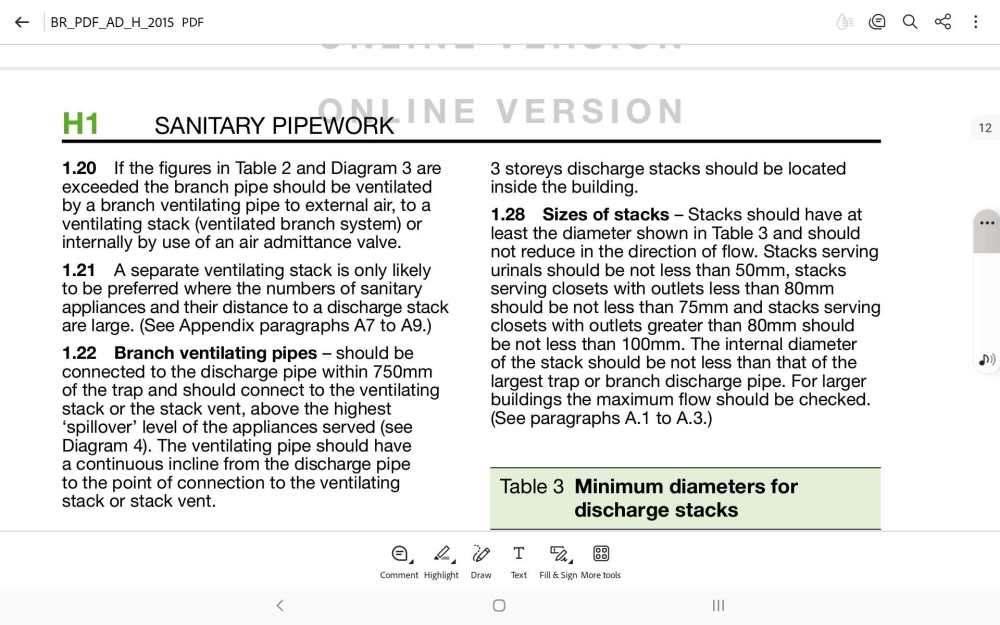
-
PS Remember the 1m height limit next to a highway or you need planning permission.
-
Make it deeper so none of the footing is above ground. Use engineering bricks below ground. Ideally use low efflorescent bricks to help avoid the white salt appearing on the surface.
-
ASHP & Underfloor heating - but what carpet thickness should I use?
Temp replied to Borders Man's topic in General Flooring
Some carpets are available in two versions, one with a rubber backing and the other with a Hessian backing. These have different TOG values. Beware because the small print on order forms normally allows the shop to supply either version at their choice. Many carpet sales staff haven't a clue what a TOG value is so ask to see the makers spec/data or go elsewhere if you can't see it. One told me a carpet we asked about had a TOG value over 10 which was clearly nonsense. -
Scroll down here to the links for Rigid Construction Flexible Construction https://www.pavingexpert.com/setts02
-
Was hoping to avoid rolling my own but that might turn out to be easier. I did find one fitting at a local BnQ that was perfect (even got adjustable angle) but they seem to have discontinued the lengths I need.
-
The Clearview wood burners are pretty good.
-
I'm not a plasterer but perhaps these would reinforce the corner.. Skim coat bead.. https://www.profilestore.co.uk/c/render-plaster-bead/thin-coat-hook-on-bead Corner tape, not sure how strong... https://www.screwfix.com/p/diall-reinforced-corner-jointing-tape-white-30m-x-50mm/981CF?tc=UT2&gad_source=1&gad_campaignid=19823510542&gbraid=0AAAAAD8IdPxgoUiqaNEyp2UQAKsiCamHx&gclid=Cj0KCQjw8vvABhCcARIsAOCfwwpR9074scYSb2Y_pj_lW2CO_Ww-QYDxvjZiI5O48eAA1xb3HK5fWysaAh6KEALw_wcB&gclsrc=aw.ds
-
Interesting. "Are you a developer just trying to make money" was one of the first questions the neighbours and Parish asked me. Hadn't thought about the CIL.
-
Trying to understand Heat Loss and UFH options
Temp replied to yellowbert's topic in Underfloor Heating
We have stone and tiled floors in bathrooms and it's nice to have these warm at times of the year when we don't need heating in the bedrooms. We also have more bedrooms than we need now the kids have left home. For these reasons we find having everything on separate programmable zones quite handy. -
I'd probably just spray it with some diluted bleach. Long time ago Tesco sold thin bleach very cheap but they seem to have stopped selling it. Whatever you use watch out for builders walking on it then your best carpet/wood floor.
-
Can anyone recommend some under cabinet lights for a kitchen? Ideally... Low profile <25mm Tall (so not T5 which tend to be 30-33mm. The recess is only 28mm deep) Mains powered or "plug-in" Approx 40-45cm long to fit 50cm wide cabinets. A 30cm version would be good as well. Ideally just simple lights without hand waving controls. If it has that does it default to ON (or remember it was ON?) when you disconnect and reconnect the power? I want to use a wall switch to turn a set on/off without having to go around hand waving under each one.
-
Make sure you understand this. He's saying 4*8 made from 2qty of 2*8 is stronger than just one large 4*8. You might need something bigger than 8" deep? I think it's to do with knots? Id go with his suggestion and follow the advice above about taking it apart to get into place. If working short-handed Id look at making some "clothes props" wuth a tripod base to support one end. While you bolt the other.
-
If you want to speak I would add a line something like this.. I'm not a property developer, I'm looking to build a home for my family and be part of the community.
-
Starting a business helping Self-Builders, advice?
Temp replied to LDNRennovation's topic in Surveyors & Architects
We used an architect for our self build project. We asked three to quote but he went above and beyond by visiting the site and included ink and water colour sketches of a house he thought would look good on the plot. Later did a street scene the same way. The artistic licence available made his proposal blend in more with surroundings than say Photoshop or CAD would have done. He was great on design but less good on estimating how much it would actually cost. He was also hopeless at doing battle with the planners. Didn't chase them enough for response to drawings. Didn't need him for the build as builder was excellent. -
Percolation test. Draining too quickly
Temp replied to flanagaj's topic in General Self Build & DIY Discussion
Never heard of it being too permeable. Asked ChatGPT which said... Can't really tell you what I would probably do. -
Upgrading roof thermal-element,attic room,already limited headroom?
Temp replied to Neverfinished's topic in Heat Insulation
I believe there is an exemption if its not practical to insulate to current standards. If really stuck I would try proposing something you find acceptable over the stairs an possibly thicker elsewhere? Do you need the 20mm cavity for services? Perhaps look at insulated plasterboard for the inner layer saving 20mm? But check it includes a vapour barrier. Various thicknesses... https://www.insulationuk.co.uk/products/tekwarm-thermal-laminate-pir-plasterboard-thermal-laminate-pir-plasterboard?variant=43041559249077¤cy=GBP&utm_medium=cpc&utm_source=google&utm_campaign=&gad_source=1&gad_campaignid=17325772288&gbraid=0AAAAAoNNCLSLOHgQm4MFd1KJft-3MU8Hp&gclid=Cj0KCQjw_dbABhC5ARIsAAh2Z-QakNYw1edDI7RmZF3flqz89MIRtUIzqLXOB7coP8qIIgOsnww3PqQaApJcEALw_wcB -
I think a sketch is needed. As I understand it between the "fire" and the beam you have a block (or pumice liner?) and a cavity? If that's over 200mm I don't think anything is needed. The top of the cavity will be sealed. Perhaps wrap the end in DPM?
-
Surface water flow attenuation problem.
Temp replied to G and J's topic in Rainwater, Guttering & SuDS
Perhaps.. https://www.cncbuildingcontrol.gov.uk/faqs/calculate-size-soakaway-required-extension/ -
That includes trees, not sure about plants.
-
Perhaps I'm wrong but I calculated the crates needed at about £2500 after the VAT is reclaimed. Just over 100 crates at about £25 each. https://skyplastics.co.uk/polystorm-soakaway-crate-x-120-22-46-20-tonne-1000mm-x-500mm-x-400mm-c-w-clips-shear-connectors-7.html?gad_source=1&gad_campaignid=11823408165&gbraid=0AAAAACepU-YY6R55dqvulcit98fUTrQ93&gclid=Cj0KCQjw2tHABhCiARIsANZzDWrXL3utZmoyuieDmmroFsJzj3egyX4nV9rKUkpDV7aYHLwJHst_RDUaAsp2EALw_wcB
-
What soil type do you have? Have you done a percolation test? That might show a smaller soakaway is needed.
-
Can I use this roofing membrane as my internal vapour barrier?
Temp replied to Co1's topic in Timber Frame
Does the timber frame company require you to use a particular product for warranty purposes?


