


Temp
-
Posts
10690 -
Joined
-
Last visited
-
Days Won
43
Everything posted by Temp
-
We're also on a single track road in a quiet village. Our builder did the base right to the edge of the road and got a contractor to do the tarmac. Don't think he bothered with a road closure. As our drive sloped down to the road he decided to put a metal linear drain along the edge of the road running into a piped ditch. That would have involved cutting the very edge of the road.
-
For the mid span ChatGPT suggests a UB 203 x 102 x 23 with 3m C24-grade timber joists 47 x 170 mm at 400 mm centres. I would shot nail or bolt a timber infill either side of the shear web and use joist hangers. Probably long tail joist hangers wrapping the tail up over the top of the UB and down the other side. Nail both sides. I'm not a structural engineer though!
-
We used the Eclipse on a bathroom ensuite door, although ours has timber architrave around it. The Eclipse works well for us but I would avoid sliding doors anywhere subject to frequent use. They are just so much harder and slower to open and close. Beware sliding doors also reduce the opening width by quite a bit. For example the whole door can't go into the pocket. Nor can handles on the door. There are also stops to prevent your hand/fingers being trapped between the handle and the frame when you open the door. So you need to start with a bigger opening especially anywhere Part M applies.
-
There are different ones for joining sleepers end to end in the middle of a wall.. https://www.aafencing.co.uk/products/rsj-railway-sleeper-post-raw-steel-intermediate?gad_source=1&gad_campaignid=21969916683&gbraid=0AAAAAprPxhDFXMV1bmBp3GKe2A1QdfyEr&gclid=CjwKCAjwl_XBBhAUEiwAWK2hzhe1gySsQvH_494A0E-RH3DyJF19IegcNOGjkPMJk5YEj36gQ4DwOxoCdg8QAvD_BwE I can't immediately see what you use for a T joint. Perhaps you have to bolt two of the above together?
-
VAT 'edge cases'
Temp replied to Alan Ambrose's topic in Self Build VAT, Community Infrastructure Levy (CIL), S106 & Tax
There is a list somewhere of things that you can/can't claim the VAT on. Its on the government Web site. If you are in Tesco buying Paint and Lunch you can't reclaim the VAT on your lunch so you cross it off and put the revised figure on your spreadsheet. Ditto consumables like sandpaper and tools. I believe a cabinet to house a temporary electricity supply is not zero rated. However I've not heard of anyone being asked to prove that all the wire they purchased was actually used inside the house. There is a section in 708 which exempts things necessary to allow the construction of the house. That's intended to cover things like water main diversions or demolition. -
Site and Location plans available from several place online including.. https://www.ukplanningmaps.com/prices/ You would have to pick a suitable scale and work out the plot areas yourself. If most properties are rectangular a ruler and spreadsheet would make fast work of it.
-
Perhaps intended to allow a bit of timber vertically in the corner? Reduces the visual impact of the RSJ?
-
I would reapply citing the change to the 1m rule. If refused on the road issue appeal with pictures. I would put a short section of fence or wall between it and the hedge in case they argue it would be visible in winter? I don't think you need PP for a 1m high fence but a 2m would. Edit: Just read you applied for a certificate of lawful development. Those can only be considered on the rules/law. There is no discretion unlike a planning application. So I would apply for PP.
-
If you have kids perhaps think about life insurance instead. When our aunt died it took years to sell her house. The council soon wanted double council tax and there were ongoing maintenance charges.
-
PWA Can you build anything over a neighbour's property ?
Temp replied to Spinny's topic in Party Wall & Property Legal Issues
I suppose it might be worth checking your house insurance to see if that has legal cover but they won't fight it for you unless they think they will at least get their costs back. -
PWA Can you build anything over a neighbour's property ?
Temp replied to Spinny's topic in Party Wall & Property Legal Issues
Think I mentioned this before.. There is no penalty for breaching the Party Wall Act. At worse a judge might take a dim view of them knowingly breaching the act if it went to court for other reasons. Personally if their 4" of overhang isnt where anyone on your side would be likely to build an extension I wouldn't get too worked up about it. The council might well just approve their deviation from the plans or ignore your complaints. Councils don't have money to get involved in sort of thing. In some areas they don't even have full time planning officers and share them with other counties. If a wind farm is proposed in what the planners consider to be the wrong place they have to rely on neighbours to raise tens of thousands of pounds to pay for landscape experts and photography/computer modelling for the appeal. The planners can't afford any of that stuff. -
You appear to have have two brick piers in the right place to put another beam across, thereby reducing your rafter span in half.
-
I'm not an SE so thought I would ask ChatGPT to suggest a beam for a 4.9 meter span supporting a timber roof and garage door. It replied.. I expect this assumes the wall plate is going on top of the beam so if it were bolted to the sheer web instead it might give a different answer? As for padstones.. You don't have much area according to your drawing so I would use all of it eg 33cm and 21cm long x 103 if it's a single brick. I'd make them two brick courses high. ..but remember I'm not an SE. Let's see what others think.
-
PWA Can you build anything over a neighbour's property ?
Temp replied to Spinny's topic in Party Wall & Property Legal Issues
Is that in an area where you or a future owner of your house might want to build an extension? Would it prevent the extension being built? Pictures? -
How to regain traction...
Temp replied to Mulberry View's topic in General Self Build & DIY Discussion
I think I would try and find an independent expert. Hire him just to do a report on what you have and see if its salvageable. If not perhaps have him propose a new design. Maybe even manage that bit of the project. You may need an expert opinion/report to stand any chance in court anyway. Finding someone might be hard. Is there a governing body or similar? -
I'd be pointing out that it cannot be a continuation of the original development as that wouldn't be lawful. Before restarting any work I would file a new application for an exemption form 7 under the new planning grant. I hope the new planning grant isn't "retrospective". There are appeal cases where that happened and the CIL exemption was lost.. https://assets.publishing.service.gov.uk/media/67501f63b9847955e1632a04/CIL_Appeal_1847779_10_Sep_24.pdf
-
PWA Can you build anything over a neighbour's property ?
Temp replied to Spinny's topic in Party Wall & Property Legal Issues
That might be considered criminal damage. -
Connecting drains at multiple levels?
Temp replied to Alan Ambrose's topic in Rainwater, Guttering & SuDS
For long drops you use a "backdrop pipe" (vertical section of pipe with a bend at the bottom and a bend/access at the top). I might be wrong but I think these days they have to go outside the Inspection chamber and connect into the ports at the bottom. Something like..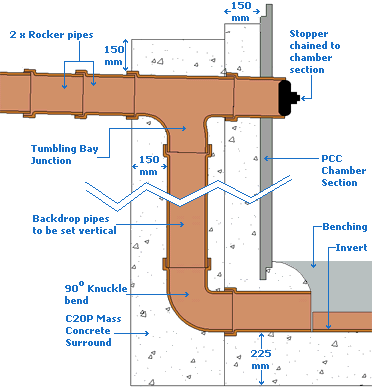
-
Is it worth having a gas connection for self build house?
Temp replied to Wadrian's topic in Central Heating (Radiators)
We wanted a gas hob but there is no mains gas in the village so we opted for a pair of 47kg LPG cylinders. These work very well with a cylinder lasting at least 18 months when we had kids to feed. Now they have left home probably 2 years? Can't remember when we last had to change one. They would probably be too expensive per kWH for heating but the absolute cost for running the hob is OK. -
PWA Can you build anything over a neighbour's property ?
Temp replied to Spinny's topic in Party Wall & Property Legal Issues
Planning Permission doesn't help him. PP only means its acceptable as far as planning policies are concerned. Its quite possible you can get PP but not be able to build for a dozen other reasons. These days drainage can be a show stopper eg Soakaways don't work on clay and the Water Co won't allow you to put surface water into the sewer. Unfortunately there is no penalty for not complying with the PWA and nobody to enforce compliance. It would be down to you to go to court and try and get an injunction which is difficult and expensive. As I understand it judges frequently allow overhangs to continue and award you tiny damages. Once walls have been started it gets expensive for your neighbour to fix the problem so chances are they won't do anything if walls are already going up. Perhaps too late for you but it's always best to discuss plans with a neighbour at the outset. Hint you are likely to build your own extension so you need to figure out a solution that works for both of you before the walls are set out. -
Perhaps check the planning file for your house/estate. Sometimes the planners want a sample submitted. There might be a letter from the builder telling the planners what he's going to use, or take a drive around and see if you can find some other house that has an extension an ask them if they worked it out.
-
Did you dig a test pit to check out the foundation depth of the main house?
-
+1 Soakaways are meant to be a minimum distance of 5m from the house.
-
Possibly Corian ? If it's that it's quite expensive, lots more than Travertine.
- 1 reply
-
- 1
-

-
Planning Permission is required if you don't deal with rainwater run off on site. So if not permeable you will likely need a linear drain to a soakaway to stop water running onto the road/pavement. In many areas you can't put surface water into the sewer.

