AliG
-
Posts
3211 -
Joined
-
Last visited
-
Days Won
11
Everything posted by AliG
-
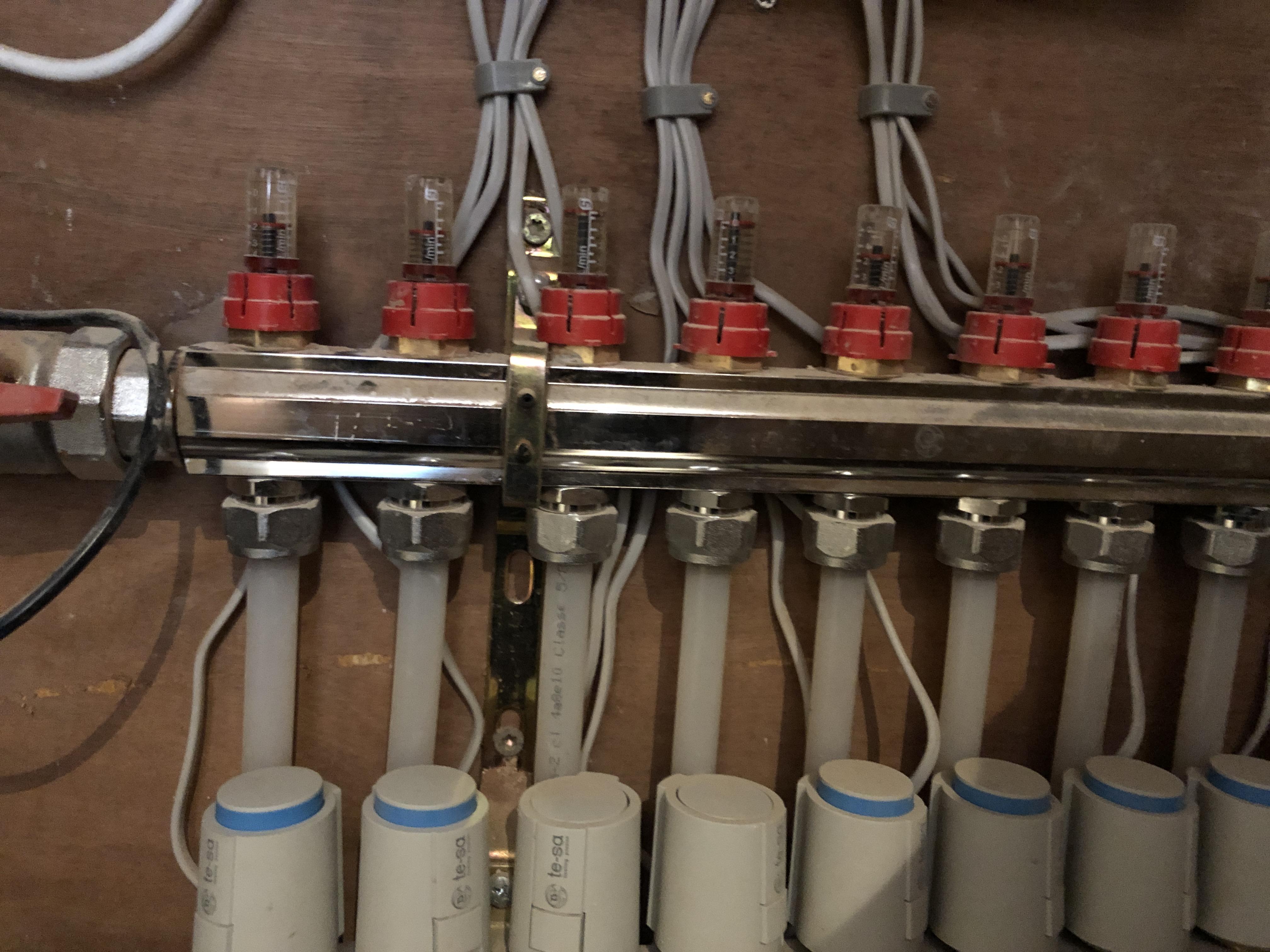
OK. I went and listened to it and turned it the mixing valve up and down. Up to around 1.8 on the mixer valve I get the normal flow rate of around 3l/min. As the valve passes through 2 it hisses slightly like a closing valve and the flow rate begins to slow down. Past around 2.5 the flow collapses to 0.5l/min the stops. I am guessing this means that the mixer valve is broken? The pump runs all the time and as we have maximum flow below 2 on the mixer valve it seems OK.
-
Just coming up for a year. But why would it only stop when I turn the mixer valve up? I am going to turn it again to listen to it, thinking about it, it sounds a bit like a ball valve closing as I turn the mixer valve. Certainly though it was working fine so maybe something is now wrong with the pump.
-
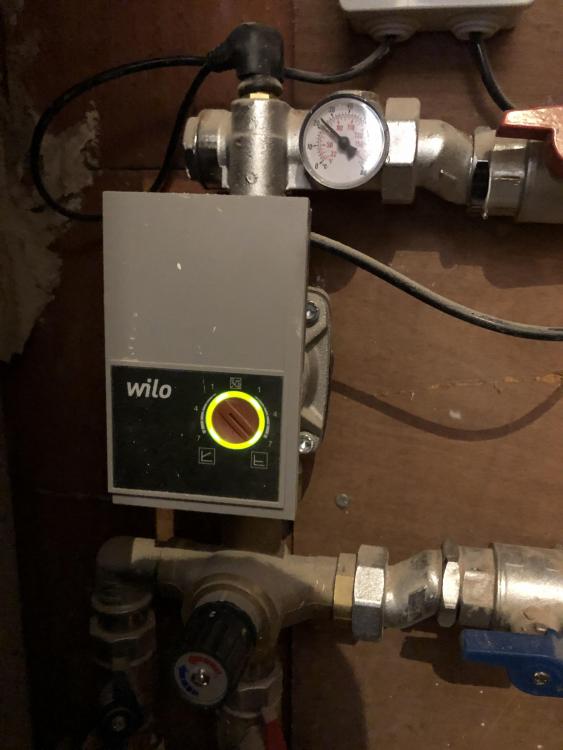
http://www.wundafloorheating.co.uk/wp-content/uploads/2017/02/Wilo-Pump-Yonos-PARA-Operating-Instructions.pdf The pump is running fine, then as you increase the mixer temperature you can hear hissing in the pipes and the flow stops. The pump remains on but I think it stops actually turning
-
Thanks Nick. What is that?
-
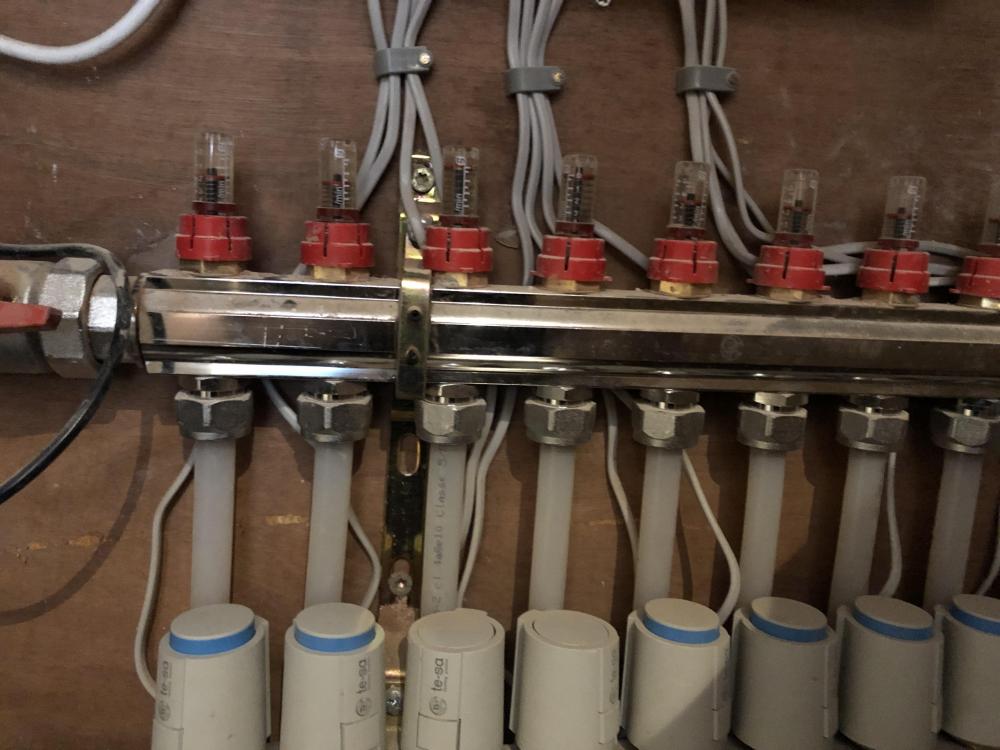
Hi, I will email the heating engineer in the morning, but if anyone knows a simple fix I can try it today. We have 4 UFH manifolds, all has been fine until Friday. The kitchen seemed cold. I thought the thermostat maybe wasn't calling for heat correctly and checked that out. It still seemed to be slow warming up, so I went to the manifold and turned the flow up slightly. What seems to be happening is that if you turn the flow up past a certain point the water stops flowing. Basically any higher than 2 on the mixer which is 22-23C and the flow stops. Even then I had to jack the pump up to maximum to get much flow. The other manifolds are set between 36 and 42 and running as expected. Probably wasn't an issue until the temperature dropped below zero. Any thought?
-
Built in barbecue VAT
AliG replied to AliG's topic in Self Build VAT, Community Infrastructure Levy (CIL), S106 & Tax
It is not, I added it later. There is not definition of a solid fuel cooking appliance, but a barbecue seems to be one. It doesn't say it has to be inside. I will try it and see, I was wondering if anyone had got away with it. -
Instead of putting PIR in the cavity why don't we put it on the inside
AliG replied to AliG's topic in Brick & Block
The bead filled cavity makes a lot of sense to me. We didn't explore it because as I understand it full fill is not allowed in Scotland due to driving rain issues. I suspect this is an area where testing would prove the issues unfounded. The issue is more likely with rockwool and not EPS beads. Personally one of the reasons we went with blockwork is that I don't like looking at the perpends required to ventilate a timber frame cavity. -
Instead of putting PIR in the cavity why don't we put it on the inside
AliG replied to AliG's topic in Brick & Block
I was trying to think about condensation issues and that makes a lot of sense. Also reading the earlier replies, it would be difficult to put services on the outside walls. -
Instead of putting PIR in the cavity why don't we put it on the inside
AliG replied to AliG's topic in Brick & Block
You could argue that this is all moot in that houses are built that way because builders don't like to change and if I am suggesting a change then that opens up the use of any different building method. -
Instead of putting PIR in the cavity why don't we put it on the inside
AliG replied to AliG's topic in Brick & Block
Single skin definitely works as a solution, I am assuming that there are other reasons that it isn't used, such as rain that you mention. I think full fill beads probably work well also as there are no fitting issues, but in Scotland that isn't allowed again because of rain. I can see that when people started to use insulation in the cavity PIR would not have been available, so rockwool in the cavity and plaster on the inside would have been the obvious solution. Now with PIR I don't see why the cavity isn't narrower and the insulation on the inside. My issue with a wider cavity and putting all the insulation in there is that I don't trust bricklayers/builders to ever get it all tightly in there with no gaps. I had mine taped up and foamed in places as I reckoned that would make a big difference to air infiltration, but I still reckon it would all be fitted a lot better on the inside. You are right that you can fix air tightness with wet plastering, but I am not convinced that the insulation works well in the cavity. If I look at areas of vaulted ceiling I have, PIR was cut between the rafter and fits perfectly. Then insulated plasterboard was put over the rafters. Why would a similar build up on internal walls not be a better way of getting the insulation tightly fitted. -
Instead of putting PIR in the cavity why don't we put it on the inside
AliG replied to AliG's topic in Brick & Block
Good points, I am assuming that the decision has already been made to use blockwork. 100mm isn't much, but I am guess that if it is all inside the blockwork it will perform as well as my 125mm split across the blockwork. Fixing would be an issue though. -
Just thinking aloud. My house has a 150mm cavity with 100mm PIR. We then have 37.5mm insulated plasterboard on the inside. I am very suspicious that the PIR will never work as well as it should in the cavity due to air infiltration. This got me to thinking, why not just build a 50mm cavity and put 100mm of PIR on the inside. Then airtightness should be much less of an issue as cold air would likely be behind the PIR. It would also seem to be simpler to build. Steels in the wall would be better insulated and you could eliminate one step in the build process. One negative I can think of is that there would a cold bridge where the first floor goes into the blockwork. But you could insulate the ceilings to deal with this. What am I missing.
-
I am about to start the VAT reclaim process. Do people think that a built in barbecue counts as a solid fuel cooker? It is outside but attached to the house. Would the granite work surface around it count as a kitchen worktop? Thanks
-
Those figures seem fine, it is basically double glazing with one laminated pane. Triple glazing with a laminated pane would probably achieve a 39dB reduction and around a 0.7-0.8 U-Value. Sound laminated panes can take this up to 41-42dB reduction. Here are Rationel's specs for example triple glazing http://www.rationel.co.uk/media/26998/DOP W-EW-160707 AURAPLUS.pdf double glazing http://www.rationel.co.uk/media/1640884/dop-b-2015-05-12-vs2.pdf
-
Has anyone incorporated concealed gutters into pitched roofs?
AliG replied to laurenco's topic in Roofing, Tiling & Slating
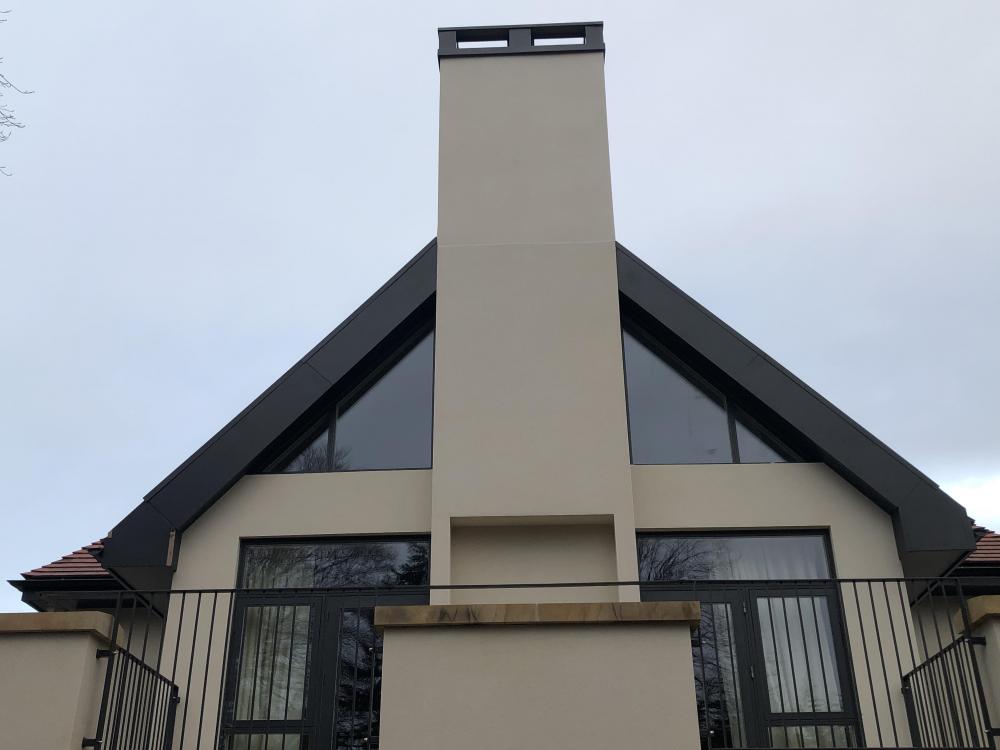
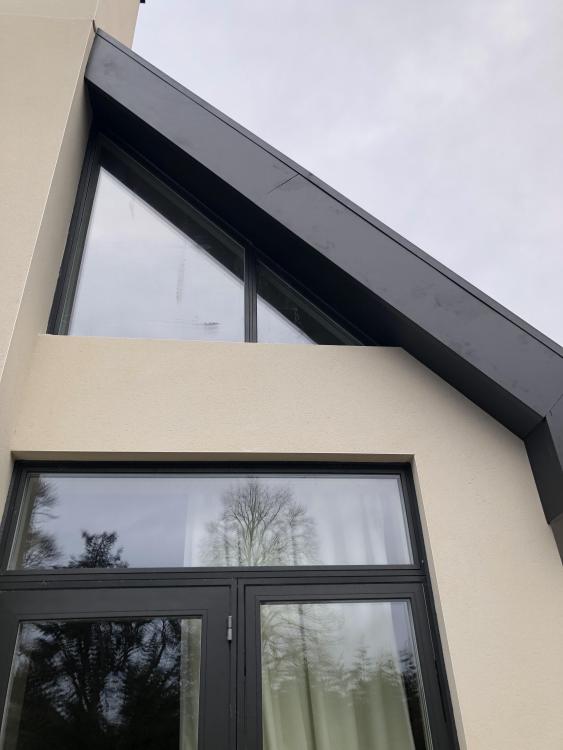
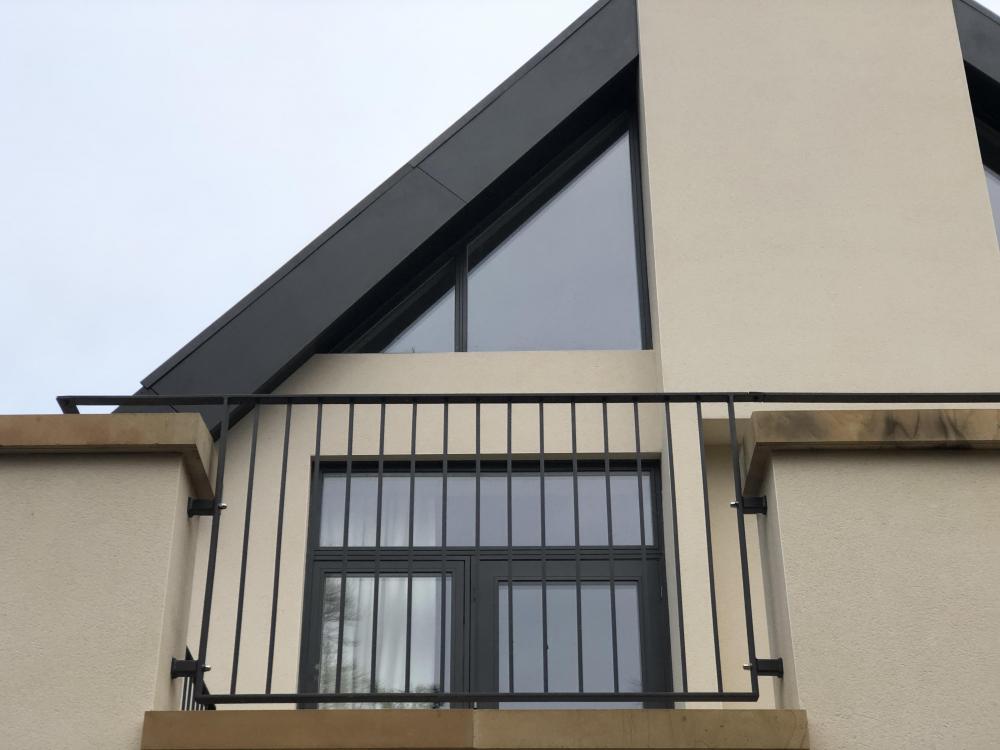
I actually don't know the name of the supplier, it is just a random guy who powder coats things. Annoyingly it appears in dribs and drabs so has taken ages to put up. He turns up in an estate car with a very aggressive dog in the back. It is just aluminium powder coated aluminium sheet so a local powder coater should be able to do it. There was a lot of back and forward on who should measure it and whose responsibility it would be if it didn't fit. The straight areas were OK, but the diagonal on the gable in particular created a worry. The builders built wooden soffits and fascias as they normally would and the aluminium is either screwed or stuck to it. They and the architect spent some time detailing it so that you cannot see the screws. The soffit is fitted first and is just a flat sheet. Then the fascia is fitted, it is l-shaped with a small overhang so that the screws are in the back of the overhang and cannot be seen. This covers the screws in the soffits. The joins have strips of rubber behind them as it was felt that this provides a neater join than some kind of covering strip. Due to building the wooden version and then covering it, it was considerably more expensive than just painting the wood. It may eventually pay for itself after 40 years of not needing to be painted. I just checked the costs and the aluminium plus fitting was 140% of the cost of the underlying wood. I don't have the exact area, but it looks like it probably cost over £150 per linear metre in total. The house has very wide eaves, the soffits are 650mm wide. -
Now that we have an electric car, I reckon that will use around 1/3 of our electricity usage. The house also has an enormous number of pumps, fans etc that run 24 hours a day. Plus I have put quite a few dawn/dusk lights outside. Then we have 5kw of solar panels. This means that we may approach the point where over 50% of our electricity usage could be during the night, but the one third that is for the car can be timed for any time when electricity is cheap and available, This changing pattern of usage creates many possibilities for the grid. Within a few years almost all new generation built will be renewable, we are already there in the western world. Efficiency means that electricity demand ha basically stopped growing, or it now grows well below GDP. Electric cars are not an issue as they can be charged at night when there is ample spare capacity. Their batteries could be used to smooth demand, however, this would considerably increase the number of times that they cycle and the effects on their lifespan would have to be considered. Net I am not worried at all about energy supply. Indeed I was thinking the other day that in the long run, energy may collapse in real terms costs due to the falling cost of renewables.
-
Time has moved on, renewables continue to become cheaper. Originally I though that nuclear was the only solution to low carbon, but increasingly I think that renewables plus batteries will surpass this due to the ever escalating costs of nuclear. A considerable amount of energy capacity exists to deal with peak demand. The use of smart devices and batteries to balance demand across the day would massively decrease the required generating capacity that we have. By distributing wind geographically and offshore, it can pretty much be used for baseload capacity. https://www.theguardian.com/uk-news/2018/jul/10/nuclear-renewables-are-better-bet-ministers-told https://www.skepticalscience.com/print.php?r=374
-
The latest thing propping up the market is Airbnb and corporate ownership. I have rented a place in London for years. Just a basic one bed, near to work. A basic one bed in central London costing around £500k and costing me £1700 a month in rent. I would quite like to buy something so that I can decorate and renovate it, I deliberately stay in a tired place as the rent on something newer would be closer to £2500 a month and it is just wasted money. The trouble is I can't because it has reached the point that hardly anything ever comes up for sale. The building I live in and the one next door comprise almost 200 apartments. There have maybe been 3 for sale in my building in the last year and none in the newer building next door. Over time flats have been bought by nightly let companies. These companies and Airbnb's charge around £150 a night, so more than 2.5x what I pay in rent. Even if they only have 50% occupancy, they have a nice little business. Due to this plus stamp duty, people are less and less willing to move and turnover is falling. I reckon that normally 1 bed flats turn over every 7 or 8 years and there should be 10-20 flats a year for sale, but there is very little choice now if you do want to buy in a more popular area. This is another way that the market has become skewed. The property market is not like the stock market. People actually need homes to live in and there is a finite supply due to planning controls. As this is the case it is appropriate to regulate ownership. At the moment the availability of flats is effectively being reduced by turning them into hotel rooms in cities. In London you also have the issue of foreign buyers using them as a store of wealth. regulation should encourage houses to be used as homes and not investments.
-
K-Rend that would often be used doesn't come in dark grey, most houses I see with that sort of colour on them it is an area of dark stained wood or some other cladding, not render. I do like the aspect of the upstairs windows. Not sure the grey works on the end, I think the issue is the grey gable, it might work better hipped, but it would be more expensive and the hip would cut close to the main roof. Or maybe the end could be white and the area around the garage clad in dark grey rather than rendered. A personal thing is I do not like a door flush with the front of a house, I like it to be set back a little ideally if you can or some sort of canopy to keep the rain off. I think in this case if there is space I would like it sunk into the front a little.
-
As mentioned I am no gardener, but I think cherry tree roots grow very close to the surface so would indeed lift a patio. We have a couple of apple trees at the back and when we started to level off the garden we couldn't go any further as the roots were barely below the surface.
-
Just saw mention of Pyracantha, had to look it up. Might consider it, it does look nice. At the moment the plan is to plant cherry laurel which is evergreen and reasonably fast growing, I did at one point consider mixed hedging with some colour mixed in, part of it is not wanting to wait too long for it to mature. There was a hedge along the front of the site that we took out, most hedges in the area are either box, cherry laurel or western red cedar. This was a quite stringy hedge, I couldn't figure out what it was, and looked awful in the winter. I am not a big fan of deciduous plants in Scotland when they spend a lot of the year looking half dead, especially for hedges. My idea for the cherry tree is similar to the juniper, the original cherry trees were wider than they were tall. I do love a cherry tree in blossom. We did consider getting a landscape designer, but one of the issues is that we just are not big gardeners and I don't want it to end up looking scruffy. Some areas will be planted with meadow matt rather than grass, the gardeners wanted to do it in this area, but I just couldn't bring myself to have the first area people see looking what might appear to be not looked after.
-
@Ferdinand it is indeed supposed to be a modern take on the arts and crafts style. I think when I first considered building a house, my assumption was that it would be quite modern, but that just did not seem to fit this area. The architect came up with the idea of modern arts and crafts and I think he has done a great job. We are in the Colinton area of Edinburgh where there are many original arts and crafts houses. Many of the houses in the area were designed by Sir Robert Lorimer who past a proponent of the style. I think there is a picture of one of his houses in Edinburgh airport. Here is an article on his work. https://canmore.org.uk/gallery/976581 The original house that we knocked down before building this one was in exactly the same colour scheme of white black and red, there was no original intention to copy this scheme, but it just seemed correct as we worked on the design. If you look back at page one you will see pictures of it, it probably would have seemed more arts and crafts originally but had been destroyed by having a UPVC conservatory added, various flat roofed extensions and the elimination of the second chimney and symmetry. I doubt this kind of butchering would be allowed today, but it allowed me to knock down the house. You are right about the blank wall in front of the garage, we did consider making it a more rustic stone, but it is hard to do well and I am not that big a fan. In the end we decided to that there will be a straight hedge along that wall, maybe 3 or 4 feet high to break up the height. Partly it is caused by the shape of the site, it slopes from back to front, the back of he house is dug in around 600mm below the garden and that corner being so far ahead of the rest of the house had to be built up slightly. I am also considering planting a cherry tree in the centre of that steep area in front of the garage. The original plot had two beautiful cherry tress on it, these were the only trees we had to remove as they were very close to the original house. TBH I am not much of a gardener and want something simple and easy to look after. We might put some kind of topiaries next to the front door. We did consider having planters built in around the front, but my wife was quite against it as they will only look good if well looked after. In the end we decided to take the resin right hard up against the house to not have any small areas for weeds to gather. The whole plot is surrounded by mature tress and hedges, it is one of the reasons that we bought it. The building work has taken its toll though, some of the hedges have gone brown at the bottom and I think will eventually need to be replanted. As there is so much planting around the edges, we are planting grass over the rest of the site between the house and the trees. I haven't taken many pictures of the garden as it is such a mess at the moment. There is also a very long retaining wall at the back of the house due to the slope. It is going to be finished in render the same as the house with a sandstone top, we created a semi circle at the end of the house where the wall will become a natural seat. This is the only large job left. One tip if you are buying a plot is this change in levels is very expensive in terms of the requirements to move earth and build retaining walls. It has added quite considerable costs. We are also going to put in a sliding gate powder coated to match the aluminium on the house. A lot fo the houses nearby have wooden infill gates, but I think it is quite unfriendly to close yourself off in this way, it is the only point at which people can see into the site and you will be able to see right across the garden from there.
-
Thanks. Cam from Postboxshop. Quite reasonably priced. Can take a parcel 200x330x200 so you don't need to answer the door for lots of smallish Amazon parcels. https://www.postboxshop.com
-
We have tiles in the hall, kitchen and bathrooms and engineered walnut everywhere else. The whole ground floor of our last house was Amtico and our previous house was solid oak. I really liked the Amtico, after almost 15 years it still looked excellent. The wood stuff looks pretty realistic, although my wife wanted real wood this time. We had it over UFH and it worked really well. We had oak in our previous house. Amtico is much more resilient than wooden flooring where the surface is easier to scratch. Amtico tends to get fine scratches in the surface wear layer, but this is clear and so it is much less visible that a scratch in wooden flooring. Amtico is also much warmer to the touch than tiles and very easy to clean with no grout and being water proof. Wooden flooring does require a degree of being careful and nor dragging stuff across it. This is usually not a problem, but you can still accidentally damage it, a particular issue I found is that I was used to pulling out the plug on the vacuum and dropping it on the floor to roll back in if you forget on a wooden floor, this will dent the floor. Wooden flooring of course can eventually be refinished, but this is a lot of work. Tiles are definitely the easiest to look after floor surface. I also find that the UFH works a lot more efficiently in the rooms with tiles in our current house. Whatever you plan, it is good to decide ahead of time as it affects how you build the floors. If the floor is not absolutely rock solid, tiles will crack or lift and Amtico will show and variations in the floor below it. Downstairs if you have screed or concrete you may still have to apply some levelling screed before putting floors down. On a wooden sub floor you probably need ply if you are tiling it or putting down Amtico. Ideally try and allow for variations in floor depth and try to get all your finished flush with each other. Make sure you allow for finishes below doors and windows, I was in a house where they didn't plan correctly and all the patio doors were a couple of inches off the floor which looked really bad.
-
Has anyone incorporated concealed gutters into pitched roofs?
AliG replied to laurenco's topic in Roofing, Tiling & Slating
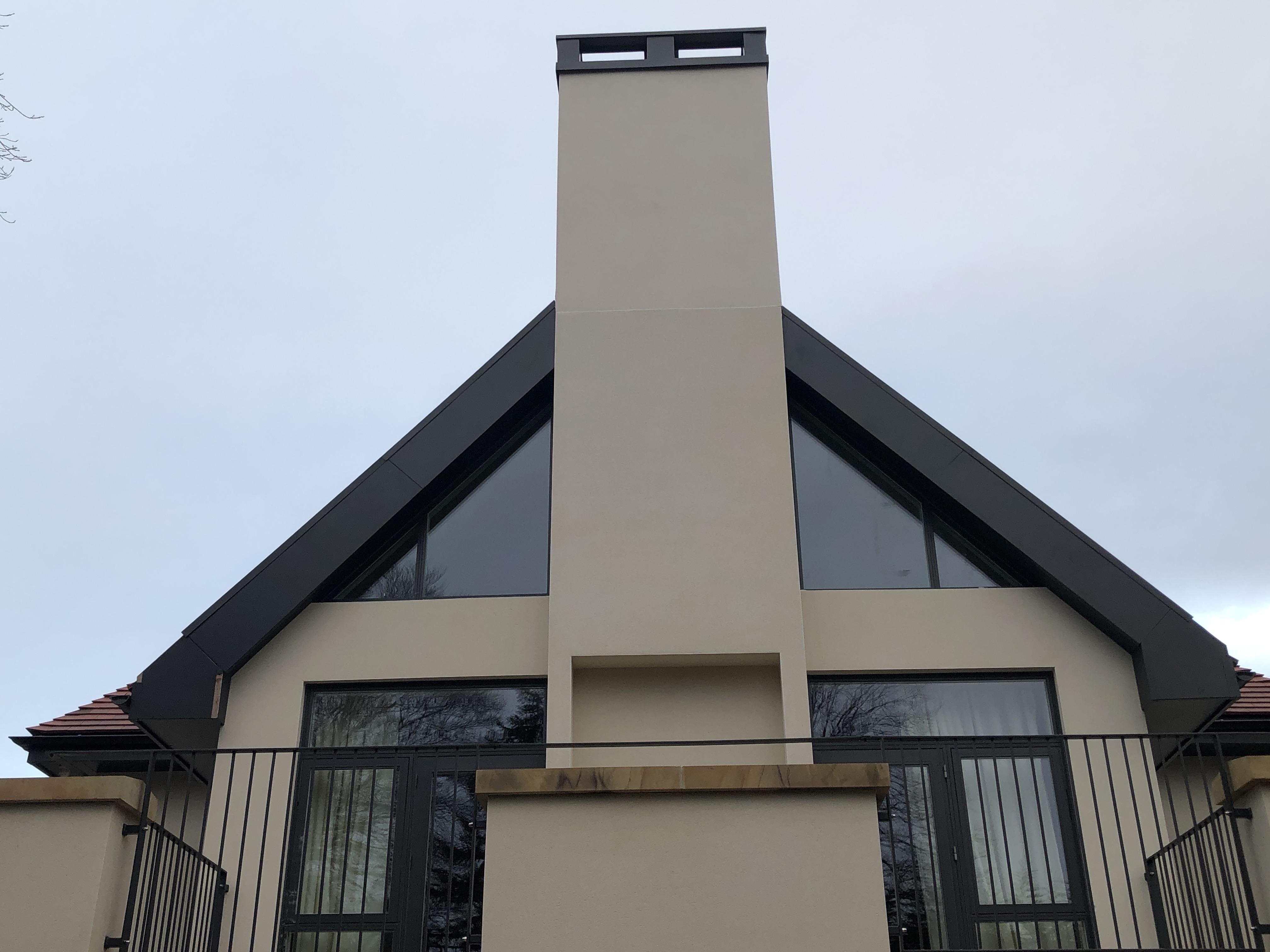
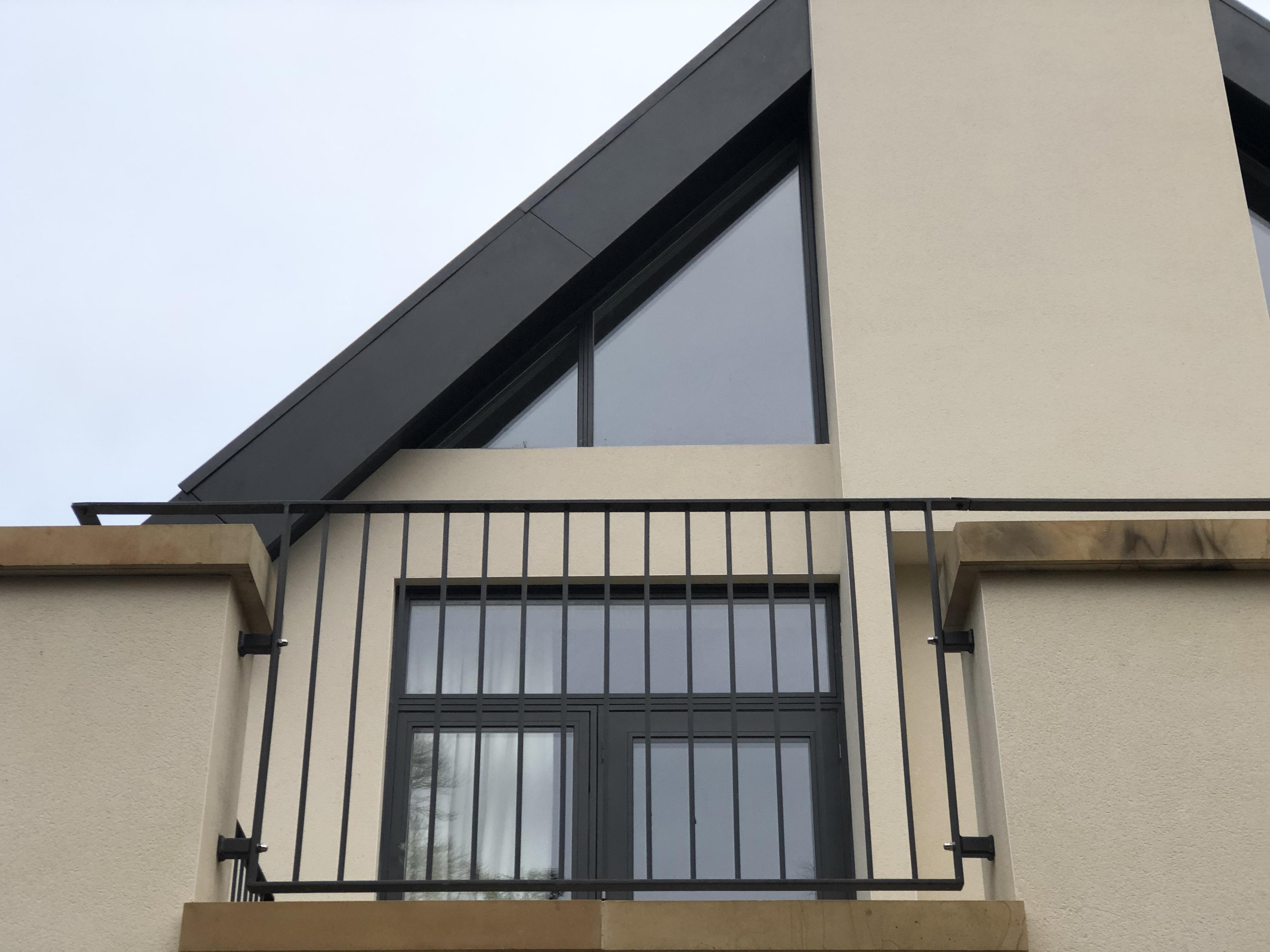
Just took some pictures of my gable end which is clad in aluminium although not with concealed gutters. We are waiting on a couple of small corner pieces.