pdf27
-
Posts
387 -
Joined
-
Last visited
-
Days Won
1
Everything posted by pdf27
-

Laminar Flow in Ground Collector Array
pdf27 replied to bungledlow's topic in Ground Source Heat Pumps (GSHP)
Depends how deep you go. At the surface the ground temperature matches the air temperature and you've basically got an ASHP. As you start to go deeper, the thermal mass of the ground means that the temperature is the average of the last few days - and the deeper you go the longer this average gets until with a borehole it's pretty much constant at the average temperature over a year (~10°C). Correct, heat is coming downwards from the sun. Water flowing through is effectively just widening the area of the collector. Unless you're in monsoon conditions this isn't likely to have an enormous effect - essentially it makes the coil act as if it's buried less deeply. Minimal impact - it really tracks air temperatures over a period of time, sun helps but really isn't a huge deal. Correct. It's better thought of as a low-temperature heat sink which you can reject heat to very efficiently (possibly without even a heat pump) in summer for cheap cooling. Not really - it's broadly comparable with fan power for an ASHP because the heat capacity of liquid is so much higher. COP values include pumping losses as I understand it. Care does need to be taken with the ground loop design though - if everything is in series the pumping losses can stack up, which is why manifolds are often used to run loops in parallel. Pretty much, although in exchange you get a GSHP whirring inside - no fan, but you still have the compressor. This is probably the main selling point for me, and why I'm willing to pay a small premium for a GSHP over an ASHP. Not sure this is a pro - I'd say large area of ground required, so neutral if you have the ground and major negative if you don't. This is the averaging effect - cold snaps usually don't last more than a week or so, meaning you're taking advantage of the mild weather a few weeks (or months, depending on depth) ago when heating during a cold snap. You lose out when making hot water in summer though (the ASHP gets lovely warm air for this), so overall the effect isn't as big as it's cracked up to me. Again, it really comes down to ground area - particular soil types need more or less ground array area for the same heat load. Unless you're drilling a borehole, the effect of this is modest in the grand scheme of things. -
Laminar Flow in Ground Collector Array
pdf27 replied to bungledlow's topic in Ground Source Heat Pumps (GSHP)
Oh yeah, and the proposed way of calculating pump flow is wrong too. What you should instead be doing is plotting the pump pressure versus flow curve (typically called a P-Q curve) on the same axis as the graph shown above. Your operating point is where the two curves intersect, and the flow rate at that point needs to be greater than the minimum ground-slide loop flow rate. Many pumps have more than one operating curve (essentially there is one curve for each speed setting) and this needs to be considered as well. -
Laminar Flow in Ground Collector Array
pdf27 replied to bungledlow's topic in Ground Source Heat Pumps (GSHP)
That's the minimum flow rate of coolant (glycol) passing through the heat pump. This will be set to ensure that in the worst case (lowest ground loop temperature + maximum heat demand) the coolant does not freeze up. Why would they run an inverter-driven pump on the ground loop side? To benefit from it you'd have to run a calibration routine for the ground loop and program it into the heat pump, and the savings would be trivial (tens of watts). -
As an aside from the boiler .vs. ASHP question, why do you want a gas oven and hob? Ovens are almost 100% electric now and this seems to include all the good ones. Having switched over to an induction hob a few years ago there is no way I'd voluntarily go back - just as controllable, vastly easier to clean and when not in use I can use it as an extra area of worktop.
-
Hybrid Off Grid Energy Feasibility
pdf27 replied to Curtis's topic in General Alternative Energy Issues
The building has a flat roof, so they were trying to hide the array behind the parapet. For the calculations I did to get to a 30kW system, however, I used PVGIS and an optimally-orientated ground mount array to work out how much PV was needed for 600kWh in December near Aberdeen. That was for year-round optimisation to be fair - if I give it a near-vertical orientation to optimise for winter (tricky for ground-mount on a windy site) you can get it down to ~24kW or so. It's still very weather-dependent though so you probably want generator back-up anyway. https://www.bere.co.uk/assets/NEW-r-and-d-attachments/Lark-Rise-Interim-Monitoring-Report-171201.pdf is also worth a read here - details of how actual performance compares to modelled. FWIW I think the main thing they missed out on was hot fill for the dishwasher and possibly washing machine - clothes washing and dishwasher is about 12% of total demand, and is pretty easy to shift to DHW from a heat pump. Most dishwashers will take hot fill (and clean better for it, at least in my experience), washing machines are a bit less clear but given the lengths they're going to in order to minimise electrical demand it's a very cheap way of making a sizeable saving.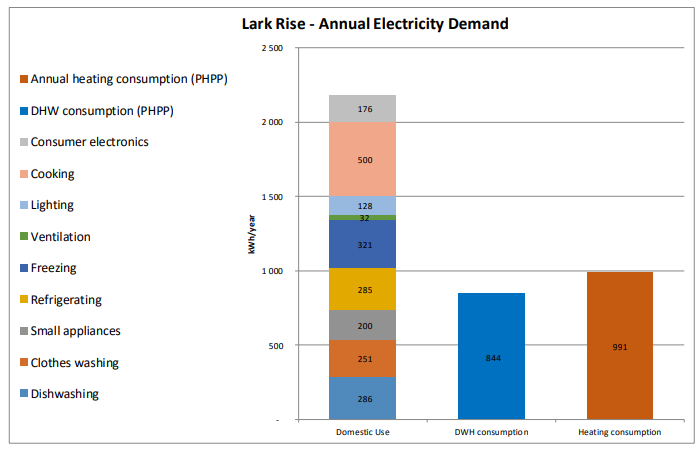

-
Hybrid Off Grid Energy Feasibility
pdf27 replied to Curtis's topic in General Alternative Energy Issues
https://www.bere.co.uk/assets/NEW-r-and-d-attachments/Lark-Rise-Self-consumption-study-by-Energelio-160429.pdf is worth reading deeply if you're seriously considering going off-grid. It's the calculations for how close to autonomy you can get with a ~200m2 Passivhaus in the southern UK with 13kW of PV and a battery of varying sizes. Even with a very big battery (40 kWh in this case), in December it's still importing ~60% of electricity demand from the grid. Per PVGIS for Aberdeen, you'd need at least a 30kW ground-mount system to meet demand in December, which is the hardest month to handle - in the process producing 27,000 kWh nearly all of which would go to waste. You could probably downsize a bit as you're looking at a smaller house, but given how well insulated the example given is you're going to struggle with getting a 50% reduction without going full Passivhaus. Going off-grid with only PV and batteries in the UK is exceptionally hard. Assuming you need 500 kWh in December to give you some margin (most of the power coming from PV throughout the year), you only need a steady-state power of 700W to keep things going which isn't huge. Small wind turbines are very site-specific and a bit of a lottery though - average capacity factor seems to be in the 15-20% region (inferring you'd need ~5kW installed power), but can be very high or low. One interesting note - heating demand is 1000 kWh of electricity a year in this model and DHW another 800 kWh/year. Take that away and over an **average** year, you'll be able to run everything else 100% on PV. In the model the COP is assumed to be 2.8, so heat demand is 5100 kWh/year => equivalent to about 400 kg of Propane. So an LPG boiler plus standby propane-fuelled generator in case you get a week of miserable weather might be a decent option in your case. As noted the power draw will be very low from it - it's only there as a backup for the few times a year that the batteries run out and need a top-up, so fuel burn and running hours will be relatively low. Resale value is going to be higher on-grid and running costs a bit lower, but not shockingly so. It's really important that the house is very low-energy though - the cost per kWh of off-grid energy is much higher than on-grid. If it was my build, at £30k I'd go for a grid connection (mostly considering resale and the faff-factor), but if it ended up being a lot more (£50k+) then off-grid is feasible.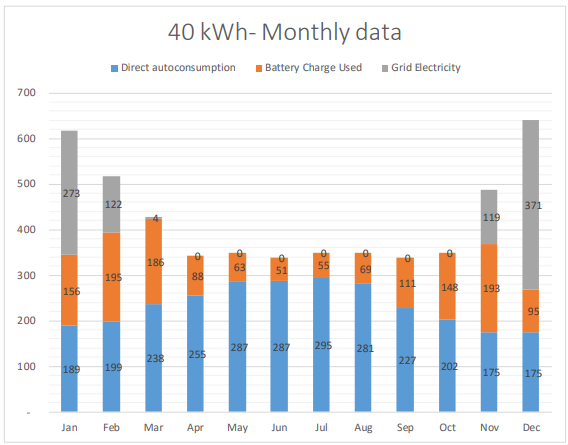
-
Nope - various companies sell a widget which measures how much electricity you're exporting to the grid and feeds it into the immersion heater instead. They were developed back when we had a feed-in tariff and didn't meter exports - you were just deemed to be using 50% of what you generated, so anything extra used on site rather than exported was free. How valuable this is nowadays depends a lot on who your electricity supplier is - most will only pay 0.1p/kWh for exported power, but Octopus are currently paying 5.5p/kWh fixed export rate and much higher on the variable rate (probably temporarily). Since 5.5p/kWh is more than the cost of gas, then assuming you go for an MCS installation then it **may** be worth exporting to the grid rather than feeding to an immersion heater. It's worth noting that an MCS installation adds cost and is only required if you wish to be paid for export. @ProDave can give you chapter and verse on this since he didn't go down the MCS route for his installation and as a result exports virtually nothing.
-
3 phase electric supply from 3 same phase cables?
pdf27 replied to WWilts's topic in Electrics - Other
That depends on how the charger is set up. Chances are it won't work though - the limit is going to be the current pushed down a wire, and 3-phase runs at 415V phase-phase rather than the 230V phase-neutral from a single phase. -
There's usually a very discreet tick box marked something like "include deals you have to switch to directly with the supplier". USwitch doesn't get a commission from them (hence hides them), but they're usually a bit cheaper. When I was looking at the weekend 90% of options were hidden like that, and it's likely to have gone up since - companies feeling the pinch won't want to pay commission.
-
House refused retrospective Planning Permission
pdf27 replied to Temp's topic in Planning Permission
Reading the report, it looks like the objections boil down to two: It's too ugly It'd too big If they'd applied pre-build with a slightly smaller and much more sympathetic design I think they would probably have been fine. -
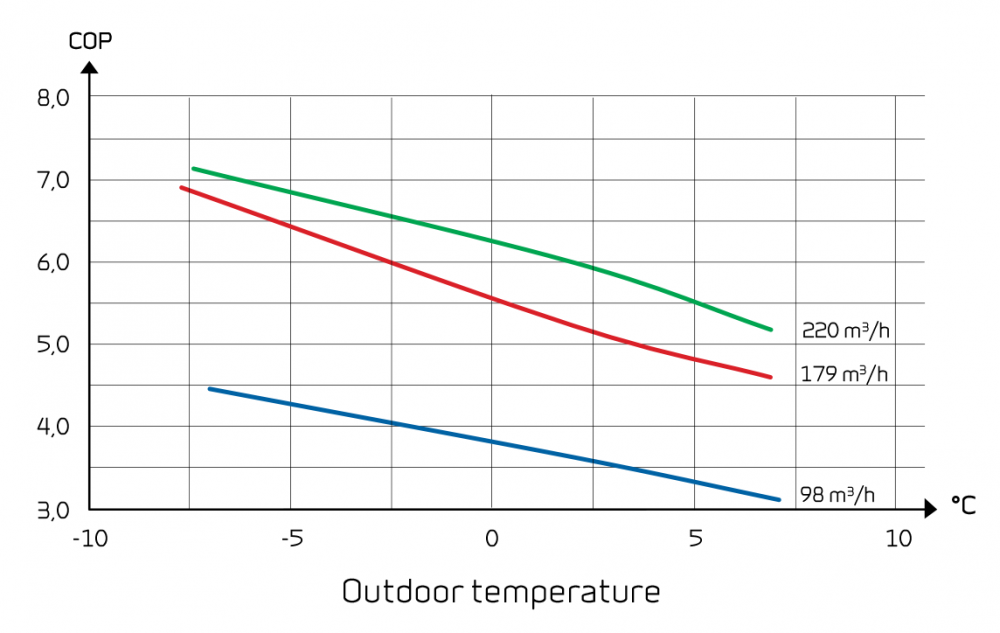
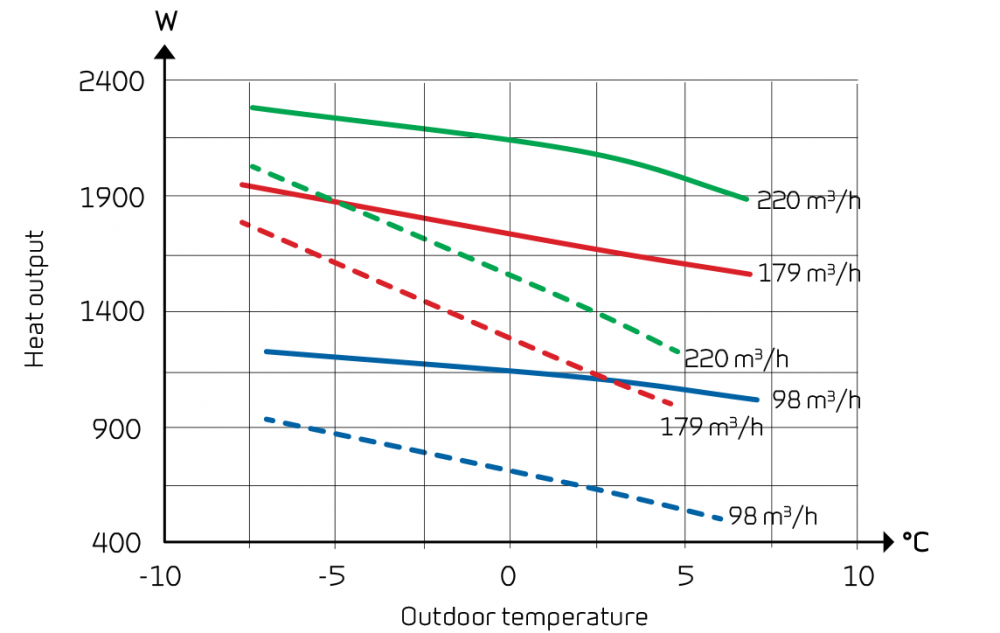
There is normal SCOP data out there for versions of it (AIR and GEO) - the other versions are an exhaust air heat pump only, which is essentially what @Gone West has done as I understand it with a similar system from a different brand. Since they use some of the waste heat for hot water, SCOP will vary depending on how much solar gain you have, etc. so I don't know if they can really calculate it sensibly. They have some under "Technical Data --> Planning Data" which nicely illustrates the problem - you get very high SCOPs because it isn't using the outside air as the only heat source, which is only achievable if you have significant internal gains. The cooling is linked to the MVHR system - as I understand it then it can cool the supply air to 10°C below the temperature of the return air. As it's a reversible system then it'll be broadly similar to the heating graph shown - without very high air change rates you're going to have less than 1kW of cooling. That might work in your situation (our PHPP says 600W of cooling is required for no overheating and never opening a window for ventilation), but will be heavily dependent on house design. Eventually decided against it because the hot water size is quite limiting (180 litres) and the extension tank makes for a very bulky system which doesn't fit well with our house design. Cooling is certainly possible in other ways - lots of people on here have used slab cooling very successfully (running cooled water through the underfloor heating pipes), and it's also possible to put a water-to-air heat exchanger in the MVHR supply duct to provide additional cooling.
-
See https://www.buildwithrise.com/stories/texas-passive-house-weathered-the-2021-storm - in full on ice-storm conditions @-13°C outside with no electricity for days it never got below 10°C internally and as far as I can work out they only moved out because cooking outside on a barbecue in those conditions was rather unpleasant. Having a stove/fireplace is a source of significant thermal losses, so essentially commits you to running it full time during an extended power cut in extreme conditions. If you're frail enough that internal conditions of 10°C for extended periods of time are life-threatening (which certainly happens), you're going to find it difficult to keep a fire going for an extended period of time without assistance as well.
-
That all depends how well you build & insulate the house. If you do a good enough job, a fire isn't required for living safely through an extended power cut.
-
Huge wall of north-facing glass. Good for sunlight, but going to cost £££ to both build and heat. If they're bi-folds then I suspect you'll need a monster of a steel lintel to support the wall above, if not you may find you need pillars to break up the wall-of-glass effect. Chimneys are at or below ridge height. If you're actually using them that may cause issues with smoke, if not you're better off without them. The drawing is a little hard to read (blurry), but am I correct to think that the ground floor room at the front right (East side) has a "feature fireplace" but no chimney, while the one at the front left has a chimney but no fireplace? My understanding is that if you keep anything above the foundations 20% VAT applies to the whole build. If not it's zero-rated. Given how little is left by this stage assuming that the dark grey areas are the retained walls I'm almost certain that the tax saving will be greater than the value of the walls and foundation retained. Note also that you may have issues with tying the new foundations to the existing ones - not insoluble, but adds cost and headaches. For a major refurbishment of a bungalow like that you may find some difficulty in getting people to quote. We got to the stage of a design a few years ago before the 20% VAT thing and people only being willing to quote for a demolish/rebuild due to the risks of finding something nasty killed off the project. A house over the road tried to do this, and then when they pulled up the floor found out the foundations were grossly inadequate and had to stop work and get permission for a demolish/rebuild. Loads of glass, chimneys, existing walls, no PV, etc. makes me wonder if you may have difficulty getting this through SAP. Not something I've really worried about in our case (we're going for the opposite end of the spectrum), but if I've understood correctly even major refurbishments have to meet a reasonable standard for the whole house. Why is the hair salon pointing at your back garden and the storage pointing at the road with a garage door when you can't fit a car in it? Unless there's a very good reason I'd flip it around and put the utility room in there as well, with an inside door off the kitchen.
-
If you think about it, it really doesn't cost very much to wire up an entire car park with cables and plugs. The DC chargers themselves are expensive at the moment, but we're already starting to see the technology to share the power modules across a large number of plugs which gives you a big saving since you only need to size for the normal load and can throttle during unusual peaks. Problem with synthetic fuels is that the economics are horrible, on just about every level. They're optimistic of getting to price-parity with fossil fuels by 2050 or so, mostly because the round-trip efficiency is awful - you maybe keep 50% of the raw energy in the electricity if you're very lucky, then run it in a piston engine with 30% thermal efficiency. That means the cost per mile (ignoring the fact that battery cars have very low maintenance so the cars themselves are cheaper to run) is about 5x higher for e-fuels than for batteries. Depends what studies you read - the whole field is enormously politicised due to the amount of money involved. I've seen claimed values between 20,000 and 200,000 miles, depending on the assumptions made. Those at the upper end seem to be distinctly fishy to me - for instance they always seem to assume that coal will be used for electricity. Possibly, although that might be quite an expensive way to raise the money. Since it all goes to general taxation rather than being hypothecated and is only about £25 billion compared to a budget of £1050 billion, I think the odds are quite good that it'll be covered by an increase in road tax plus general taxation on something else.
-
Not really - it sounds like it should, but the smart bit in a 3-phase meter is exactly the same. All they need to do extra is fit two more of the very dumb current measuring circuits and build in a circuit to add up the sum of the three phases before feeding it to the smart bit of the meter. That's very cheap to do. The big impact of a 3-phase meter is that anybody requesting one is very likely to be anticipating that they will use a lot of electricity. That's good for someone, either the electricity company or possibly metering company - so they're almost certain to eat the very modest additional cost in the expectation of future profits. Probably 6 months or so, although as soon as other people start raising prices I would expect they will too. As I understand it most tariffs are hedged, i.e. they've already agreed to buy the electricity in advance at a defined price. The spot market (where we're seeing very high prices) is a mechanism to balance supply and demand, so if I've understood correctly is only a fraction of the total cost of wholesale energy to most suppliers. Some tariffs are presumably not hedged (e.g. Agile), and other suppliers may not have sufficient cash to hedge well enough and so be exposed to very high market prices. They're the ones we're going to see failing.
-
It isn't just us, the whole of Europe has the same issue. Seems to simply be a matter of supply and demand, so expect very high gas prices this winter. https://www.bloomberg.com/news/articles/2021-09-06/europe-faces-energy-price-shock-with-gas-and-power-at-records
-
Light winds and very high spot gas prices.
-
Should be very little to actually service for any sort of heat pump however, and I'd note that while the glycol will eventually need changing deterioration tends to happen at high temperatures rather than low ones so life should be pretty long in a GSHP application. ASHP is feasible if the costs come back too high, the current expectation is that the cost of a 3kW GSHP (options are Kensa Shoebox or Nilan compact unit) and installation will be no more than £2-3k above the cost of an ASHP which is borderline acceptable.
-
They arguably make economic sense if you need a ton of heating, where the improved efficiency in winter starts to save a reasonable amount of cash. Otherwise, it's very difficult to figure out ways where a GSHP is cheaper than an ASHP over the lifetime of the equipment. It's worth noting that for year-round heat loads (hot water and potentially a swimming pool), a GSHP doesn't add value: ground temperature is the same as the average air temperature where you are, lower if you start pulling heat out of it. That means if you use a lot of heat in summer We're looking at GSHP, but it's fairly special circumstances - heating load is small (2kW) so the cost differential isn't too big, our garden is big enough for the ground loop to go in trenches and I hate the aesthetics of an ASHP outdoor unit. Provided the cost differential can be kept down to a couple of thousand, GSHP is the better option for us. Playing around with spreadsheets suggests that the electricity consumption difference over the course of a year is probably within 100kWh or so however!
-
There's about a million ways of doing it with a timber frame - the standard MBC package works nicely with some margin as does a 300mm I-beam build, and using a brick wall as a rainscreen is pretty simple once the foundation details are taken care of. At the moment I'm mostly trying to work out if cavity wall is realistic for our situation or not a good fit.
-
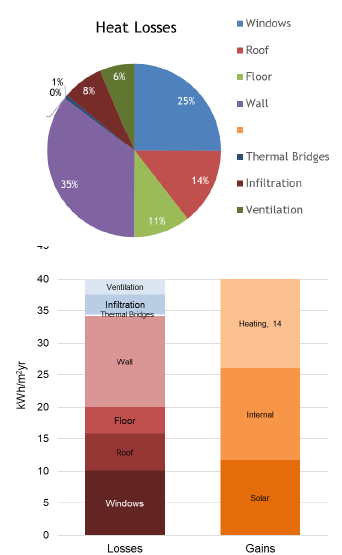
Will have a think - initial assumption was MBC or similar timber frame would be required and that cavity wall would be bunker-like. With the design evolving and the realisation that render boards are much more expensive than we thought, we've ended up with a brick outer skin and cavity wall is back on the table, so I'm only just starting to think through some of the issues. Insulation values are being driven by comfort rather than energy cost - the alternative Passivhaus criteria of 10 W/m2 is essentially a comfort one (drafts and cold internal surfaces translate into feeling cold), that ends up with a low energy cost as a side effect, but that isn't the primary driver. This leaves us a heating load of 1.8kW and cooling load of 650W if we don't open windows at night - so essentially representing a heat wave. Similarly, in addition to comfort airtightness is associated with moisture movement within the structure and thus in the long term to durability, so it makes sense to minimise it. It doesn't force us to go Passivhaus - indeed we are explicitly not committed to it - but it's a decent quality control system and I suspect the majority of people with the skills we're after will be in the ecosystem in some way. Because cooling is a hard requirement for us (my wife is from the US) we're essentially tied in to a heat pump solution - this means heat is very cheap, so we're unlikely to be at the most cost-effective point, but since we aren't trying to go for maximum value-engineering this is acceptable to us. As it happens, the form factor helps us a lot - the cavity wall option has 200mm of Dritherm 32, 150mm PIR under the floor and 350mm cellulose in the pitched roof which gets us to 8.6 W/m2. Since we want a heat pump and a fair bit of PV, we have a strong suspicion that we'll end up hitting Passivhaus Plus without much if any effort so may end up doing that. If we want to reduce heating demand, it's pretty clear that thicker cavity insulation is the best place to go - which happens to be relatively cheap, so means we've got a decent ability to tweak the performance if required. If we do adopt the two layer approach then it's worth noting that the inner layer **is** accessible and so can be tested and fixed, and that the starting point for finding any leaks is inherently going to be lower than for a single layer as the majority of leaks going through one layer will be stopped by the other. I'd agree that the testing requirement makes a single layer in the cavity very difficult to test however, at least for a 100mm inner wall which can't be built up unsupported. The concerns in relying on a single inner layer are that it requires quite a lot of detail work around any wiring chases, etc. and that it is accessible and hence vulnerable to degradation over the lifetime of the house. It is also potentially quite a slow and thus expensive process to chase down leaks - as I won't be doing it myself that's a significant concern. In either case a track record in high performance building will be required - it's possible we may end up choosing the build system based on what the selected builders have experience with.
-
Assumption is that if we go for cavity wall we'll end up using standard concrete blocks and a wider cavity - 250mm is pretty straightforward and would leave us at something like 10 kWh/m2/year keeping the other assumptions the same. Aerated concrete blocks are what the architects had as their default in PHPP and because it worked really well first time they didn't worry about optimising it. We've clearly got plenty of headroom if we go down this route. No decision on cavity ties yet - not really needed at this stage, will look at this in detail later on if required. Because it isn't a tight site thicker insulation versus stainless ties is an easy cost tradeoff to make. Expecting to use wet plaster internally anyway rather than dot-and-dab, simply because it will feel more solid. Thinking is that this layer will end up with lots of holes in it (sockets, floors, etc.) and an additional airtight layer on the outside of the blockwork leaf will make life a lot easier - more upfront cost with reduced cost of rework later. Realistically I'm not going to be able to be sitting on them every day, so a more robust design is important. There's a trade-off here between cost and performance, which I'm trying to understand. You aren't going to have air moving up and down in a blockwork wall, instead it'll be pretty directly in to out through cracks, and two imperfect airtight layers are very unlikely to have the faults lining up with each other. For instance this means that there is no real need to seal around cavity ties perfectly with a peel-and-stick membrane if the rest of the wall is well covered. This increases the chance of getting things right first time.
-
Bumping this as we've just got the PHPP model back for a design nearly ready to go to planning, and cavity wall is looking a lot better than we thought it would. We're planning on a brick outer skin no matter what build system we use (cost + blending in with the rest of the village), and PHPP says that 200mm of Dritherm 32 plus aerated concrete inner blocks and a brick outer leaf is good enough to hit the targets since we've got a very good form factor (~0.15 W/m2K gets us to Passivhaus - the form factor is 2.4 which is one of the best the architects have seen for a Passivhaus). That starts to get interesting as any timber frame system with a brick outer leaf rather than slips is looking like >500mm rather than ~400mm. Airtightness is a significant concern if we go down this route because unlike the timber frames where there are a large number of companies with a track record of delivering a package which meets the airtightness requirements. A 200mm cavity is actually pretty close to a conventional build (150mm), so if there is a builder-friendly way of putting the airtightness barrier inside the cavity that would make getting good airtightness with non-Passivhaus focussed builders a lot easier since we'd only have to control penetrations and roof/window/door junctions. I'm aware of the use of painted on liquid membranes, and our architects have been playing around with some peel-and-stick membranes intended for this sort of application (probably something like this), as well of the use of a parge coat/wet plaster on the inside for airtightness which I'd prefer to avoid. Is anybody aware of any alternative solutions to achieve the same thing?
-
It's worth remembering that the grid operates at multiple different voltages - power distribution around the country is the high voltage grid, while domestic distribution is low voltage. Because there is so much more of it, most of the running costs are associated with the LV grid, which isn't really affected by where the generation is. Octopus is starting to do this - https://octopus.energy/octopus-fan-club/ - but I'm skeptical as to exactly how much local use can actually reduce underlying costs. At the moment it's mostly about wind farm PR. That's very difficult to answer - for instance, when you put the kettle on the additional electricity doesn't come from the wind blowing harder locally but by burning more gas hundreds of miles away. To me that makes it very questionable as to whether the local carbon intensity graphs mean very much: the UK is a deeply integrated grid. My own view is that it's best handled as a carbon tax on wholesale electricity - for instance how best to handle someone who lives in a remote/windy area but buys their electricity from a non-renewable supplier, versus someone who lives in London but buys from a 100% renewable supplier? Doing it as a carbon tax at least directly links the cost impact to the pollution one, and gives a stronger incentive to use less-polluting solutions. This would also help out with the gas .vs. electrical heating issue, as gas could then be taxed at an appropriate rate for the pollution emitted rather than all of the pollution levies being put on electricity as at present.