Jenki
-
Posts
830 -
Joined
-
Last visited
-
Days Won
7
Everything posted by Jenki
-
I agree. I heard today that Scotland generates 113% of it's energy via renewables. My house looks out to sea over the Beatrice wind farm and can see (and sometimes hear the piling) of the construction of Moray East field. Lots of charities and organisations get money from the funds set up , but it would be 'Nice' to get a discount.
-
I installed 1 row of tiles at the eaves, and used fake lead flashing under the tray to the top of this row, it looked a better option than the panels into the gutter. I mentioned some of it in This blog, but I'll look later if I have any pictures of this flashing detail.
-
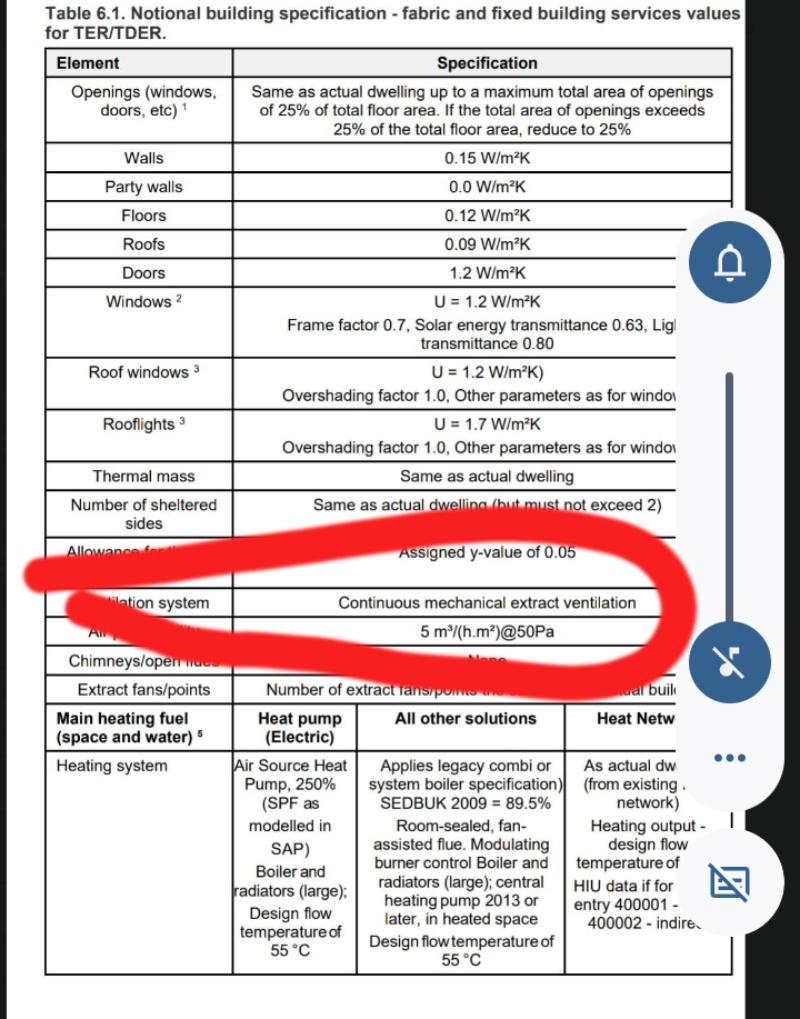
 They have changed the ventilation as well.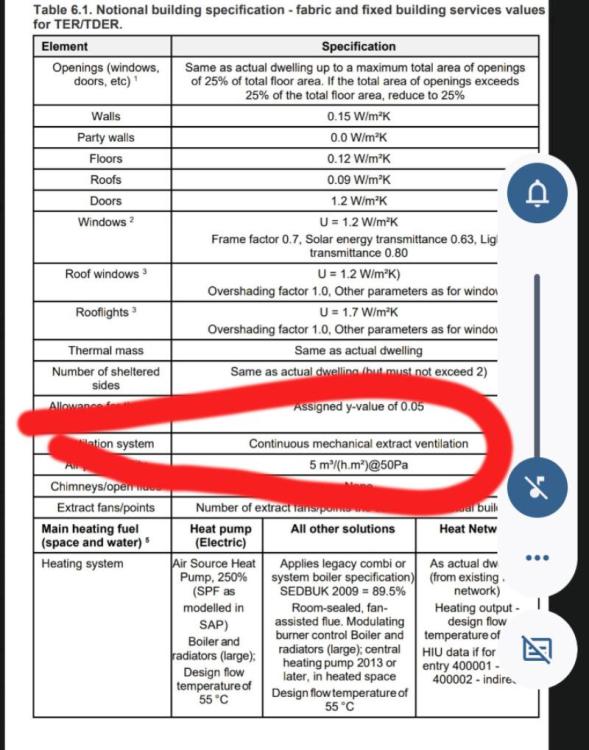
-
@Kelvin and @Iceverge have, IMHO highlighted the glaring omission. Just using the heat loss calculation spreadsheet easily shows the importance of airtightness. Once you plug in the required U value, even slight improvements in airtightness have real positive impacts on heating requirements. Even to a point where lesser levels of insulation can still achieve lower running costs with better airtightness. I think the changes should have focused more on heat loss giving the designer more flexibility to balance u values and airtightness to achieve an efficient solution. The cynic in me would suggest a bit of lobbying from the expensive insulation manufacturers added more weight to the argument. For my build Airtightness was, in material costs, relatively inexpensive to achieve, but labour and attention to detail expensive. And "no body" would be lobbying for that.
-
Glitchy for me. I have 300mbs download speed. Everything else is fine
-
I did a large extension job that needed piling, there was a known sewer 6M deep running across the plot, United Utilities would not take the liability for plotting its location. So the customer organised a camera inspection and location, this was marked out, pile layout was designed around the pipe location........ Build over agreement in place. The piling contractor (thankfully working for the client and not me) piled as per the plan and caught the edge or the 600mm dia pipe @6M deep, thankfully not crushing the pipe but putting a lovely core into the edge of it. When every man and his dog from United utilities turned up, the area supervisor said "that pipe follows this line" - pointing down the road, "see that tree 5 houses down, there's an inspection chamber next to it". absolutely nowhere near the marked location. i.e. about 5M out of line. Camera company said "not our fault, there is a tolerance of error." Anyway, the above is a warning to not bet your shirt on this service.
-
Scenario 3 Cost est ex profit £1000,000 Actual cost. £1150,000 only 15% Builders profit £ 115,000 Saving v est. £0,00 Builders share £0.00 Builders profit £115,000 Your costs £1275,000 Scenario 3 Builder ends up with the same as Scenario 2 you spend £260k more🫣
-
I'd be scared to death of this from the client side, and in my old role as main contractor happy as a pig in a dodoo. As @nod says, the benefits here seem to be for the builder Scenario 2 won't happen, as there's no need for the builder to cut costs. Reading your other post, you are employing architect, SE, QS? If so you should be able to nail down the works required and have accurate BOM's and cost accordingly. Any unforeseen rise in material costs can be handled by negotiation. Site manager? This is the role of the main contractor surely, if not it's another level of mis information/ mis communication and you will pick up the costs of that. This is a house build. Lots of component parts but straightforward. Too many chiefs not enough Indians me thinks.
-
Self Build in Northumberland - odds stacked against us!
Jenki replied to charlieroper's topic in Introduce Yourself
I'm quite happy to offer my insights, as I'm now sat in a warm, low cost house thanks to a lot of research, reading and input from Build hub. My initial build materials changed considerably after my research on here, and fortunately as I drew everything cost me only time. -
Self Build in Northumberland - odds stacked against us!
Jenki replied to charlieroper's topic in Introduce Yourself
These values would not pass Scotland new build target. Max wall is 0.15 - I think you need to push for better levels of insulation, this will reduce your heating requirements further making GSHP illogical. IMHO You need to advise your experts, that you want to achieve push for passive house levels of insulation and Airtightness, without the associated costs of Passive house. I was on a tight budget, but planned to better max U values, and achieve 1 or less ACH. You only get one chance to get this bit correct. I managed my goals and budget with tweaking the design and flexibility with material selection. -
Which (if any) fixings hold PIR and Plasterboard to blockwork?
Jenki replied to Tony K's topic in Garages & Workshops
Normally you would put a service void between plasterboard and PIR for cables, sockets / plumbing etc. so screw through battens & PIR into blockwork. 7mm dia concrete screws are fairly inexpensive in longer lengths and you only need to drill a hole as they are self tapping. -
no WBS for me, but I do need to re-focus on back up generator. we were lucky s far this winter, 3 power cuts only lasting a few hours and 2 water bursts in the area again fixed within hours.
-
the cynic in me would suggest ££
-
The caveat that makes the change in policy useless....
-
Self Build in Northumberland - odds stacked against us!
Jenki replied to charlieroper's topic in Introduce Yourself
GSHP is expensive, you could look into ASHP and possibly save ££. If a GSHP will work so will ASHP, if it wont then you need to look at Airtightness and Insulation, this is in essence a new build, and passive levels should be your priority. Good luck. -
I had a cheap Chinese on off timer for a while, on 5 mins off 7 mins, but although it kept working became unreliable with the timer. Still looking for a better option ideally din rail mounted. I think the blower is 160w so a 60% ish reduction would be worthwhile.
-
Self build affordability in a higher interest rate world.
Jenki replied to gavztheouch's topic in Costing & Estimating
I managed to get 40 sheets of EPS 150 for £800. so that set my plan. I've just had a look at one supplier and PIR would be cheaper at the moment. Crazy pricing, I think they just make it up. -
This type of work is what I used to do. I used an SE that was happy to work from sketches, or he would pop around to confirm things like roof structure etc. Flush walls without the nib can usually be accommodated, but it depends on what other structural parts of the building will take the loads, this is where the SE makes his money. You seem to be able to draw a sketch of what is required? put some more dimensions on this. For a simple job like this my SE would have just coped this and annotated the details. Then I would have submitted the Budling notice for the customer. The key points you seem to have covered or have been mentioned. my process would be - Get SE to confirm you can do what you want. Take the dimensions (and details of where the stop tap is, current layout, height of window sills etc. to Wickes, B&Q, Howdens and get the details of the new kitchen sorted. (this then allows you to understand what services need moving / installing etc. Get quotes for the work - there can be no mis-understanding then - and no "oh I didn't price all this electrical work etc etc..."
-
Self build affordability in a higher interest rate world.
Jenki replied to gavztheouch's topic in Costing & Estimating
100% this - alternative ways to skin the cat are out there, but need planning. 1 example is 300mm EPS vs 150mm PIR for a slab = massive saving similar result. Same for slab build up, many a time read on here quoted "Hardcore and blinding, 100mm Concrete, Insulation, UFH in pumped screed.." most on here are building towards passive standards so why the need for a screed that is reactive? "Hardcore and blinding, Insulation, UFH in Concrete slab" is relatively cheap, although you may end up with some levelling compound, localised grinding to iron out the imperfections (🙈hard earned experience). -
I was just reading this thinking the same thing but as far as I can remember the 3 caravans are given as a form of PD, and have dates associated X month to September for Touring caravans. I think a full time hut would stretch the PD.😔
-
you need a tundish, this has to have an air gap, and to summarise G3 need to be in a visible position or the outlet to the drain need to be prominent and visible. so a waterless trap is ok, but you need a tundish before this. then as @ProDave mentions you need a straight length of pipe after the tundish & before any bend. looks very tricky to achieve with your install, which would make me question the plumber, this is the basics. G3 is common sense and discharge pipes are straight forward, but they need planning / calculating before you install.
-
Summary 4.87 Permitted development rights allow for the carrying out of works within the rear curtilage of a dwellinghouse not covered by other classes. It is intended to apply to garden works, free-standing solar panels, flag poles, swimming pools and oil tanks. In summary, the effect of limitations is that: the development is generally located in the rear the height of the resulting structure is not higher than 3 metres at least half the curtilage remains undeveloped 4.88 This permitted development rights do not apply in conservation areas or within the curtilage of a listed building. 4.89 A building warrant from the local authority may be required for these types of developments, as explained in Section 2. I Couldn't find reference to 9M2.. Class 3B seems to cover PD in the rear curtilage. as below Legislation Class 3B.- (1) The carrying out of any building, engineering, installation or other operation within the curtilage of a dwellinghouse for any purpose incidental to the enjoyment of that dwellinghouse. Development is not permitted by this class if- (a) any part of the development would be forward of a wall forming part of the principal elevation or side elevation where that elevation fronts a road; (b) any resulting structure would exceed 3 metres in height; (c) as a result of the development the area of ground covered by development within the front or rear curtilage of the dwellinghouse (excluding the original dwellinghouse and any hard surface or deck) would exceed 50% of the area of the front or rear curtilage respectively (excluding the ground area of the original dwellinghouse and any hard surface or deck); (d) it would be within a conservation area or within the curtilage of a listed building; or (e) it would be development described in class 3A(1), 3C(1), 3D(1), 3E(1), 6D, 6E, 6G(1), 6H(1) or 8.
-
You could try 150mm hollow blocks with rebar from the footing and concrete filled, but only an SE could prove the design, taking into account location, elevation and roof span and structure, the same goes for 100mm block and piers.
-
Some of these specific products are hideously expensive. Just use PIR, the slight difference on thermal performance can easily be taken care of with 10mm or 25mm more insulation. I achieved 0.094 with 300mm EPS and concrete. Simple and cheap.
-
This would not pass Scottish requirements. Is this correct? I prefer to put the UFH into a big concrete slab, so would go for maximum insulation PIR or EPS, we used 300mm of EPS, nit 150PIR would be equivalent, and UFH in concrete slab. Then allow for a thin layer of latex self leveling. It will be cheaper than concrete and screed and IMHO gives better results. "People" use liquid screeds for speed of heat up, your building an insulated / Airtight house(I hope), so slow and steady will win the race.