saveasteading
-
Posts
10893 -
Joined
-
Last visited
-
Days Won
93
Everything posted by saveasteading
-
How does your garden grow?
saveasteading replied to recoveringbuilder's topic in Landscaping, Decking & Patios
I've just been reading about this. I'm not disagreeing with the article as such, but putting a different slant. Woodland lives on very low nutrient levels provided by fungi breaking down leaves and fallen timber. Adding any extra nutrient encourages alien plants and kills the woodland very quickly, then it takes 300 years to recover. Taking leaf mould away from woodland is a bad thing. Meanwhile, leaves similarly provide negligible nutrient to a garden, as the trees have already sucked back the sugars etc. The fibre isn't that useful either but is better than throwing the leaves away, or burning them. Leaves in woodland...leave them alone. Leaves in garden: I have given up on leaf mould, and just add them to the compost, and they will be broken down by the spring. -
New series of Grand Designs 31st August 2022
saveasteading replied to Thorfun's topic in Property TV Programmes
A building somewhere in Surrey has a slight defect, in appearance only, that couldn't be resolved. The client had no issues. Some years later in passing I went to look at it and immediately saw the imperfection. The experienced site manager with me couldn't see it even when pointed out. -
New series of Grand Designs 31st August 2022
saveasteading replied to Thorfun's topic in Property TV Programmes
Some would as they understand numbers and construction. Some wouldn't as they design shapes and sculptures, and the construction (and cost) is left to others.. -
A very light spray of bleach will kill the mould but be barely wet, and so just dry off within minutes. The difficulty is finding a household spray with bleach , but they exist. You have to look at the small print. Dire warnings on the back are the easy clue.
-
Show us yer shuttering...
saveasteading replied to Mulberry View's topic in General Self Build & DIY Discussion
Prepare for the worst, assume he is not good, and the weather is foul. There is often a reluctance to tell a tradesperson 'how to do their job'. tell him you are nervous about the shuttering (ie your skills not his) and ask if there is a way of protecting it and he will possibly be patronising, but all will be well. -
We revamped an en-suite and installed an electric blanket on a very thin sheet of insulation. Tiles above. It works very efficiently with timer and temperature control and stays warm long after it has gone off. It is a luxury though, for the sake of warm feet on a tiled floor. Why? It is nice and my wife loves it. Why not? Expensive. An electric booster to the towel rail is another welcome addition. Push the button and it dries the towels then switches off, and so saves the boiler running.
-
Show us yer shuttering...
saveasteading replied to Mulberry View's topic in General Self Build & DIY Discussion
In theory that can work, but beware the ready-mix driver just pouring it fast and hard, as the force from fast moving concrete is huge. That apples especially where the fixing pin is near the trench edge. Safer to have it poured into the trenches away from the shutter then shifting it along, with similar pressures both sides. Prepare for the worst and it should be an anti-climax, which is what we want. -
Show us yer shuttering...
saveasteading replied to Mulberry View's topic in General Self Build & DIY Discussion
600mm is a lot of wet concrete to support and the shuttering would have to be very secure. -
I have seen that timber too. For ease of construction I think. Behind the brick will be 2 flues, and they do not seem ho be bonded together. Perhaps one was used a lot and the other not. As Mark c. Says...do you still have chimney breasts in the roomz below? A lot were taken out.
-
Cable size to outbuilding with water pump.
saveasteading replied to saveasteading's topic in Power Circuits
Thanks both. From further discussion, there will be no heavy load tools in this outbuilding. Yes I'm expecting another cu to be used and an earth. Not sure how good an earth spike will be in the hard but free draining sand here. In fact it is difficult to get a pinch bar into the ground...almost rock but then turns to soft sand when disturbed... maybe a long drill. But does dry sand conduct well enough for the earth? 4 to 5m each end noted. I would have underdone that, thinking just come up the wall 2m. So wall to wall route plus 10m. Looped up 5m each end ready for the electrician. -
Looking to seize an opportunity to put a cable from the plant room to an outbuilding. What size cable? There will be a domestic water pump that will feed the large house. Plus workshop and who knows what else. I'm thinking the pump may be about 2kW but perhaps there is more to it. No worse than a kettle? The cable length will be 30m. Pump will lift the water 4m max. There will be advice taken from electrician and plumber but they are not fully engaged yet.
-
Cladco won't provide angled fillers for hips and valleys. I'm shocked. What do people use? Expanding foam or nothing? Anyway with great effort but not too much expense we have them coming. If I can find them so could cladco. Not good customer service or consideration of the final product. Ask if you want the detail for getting them.
-
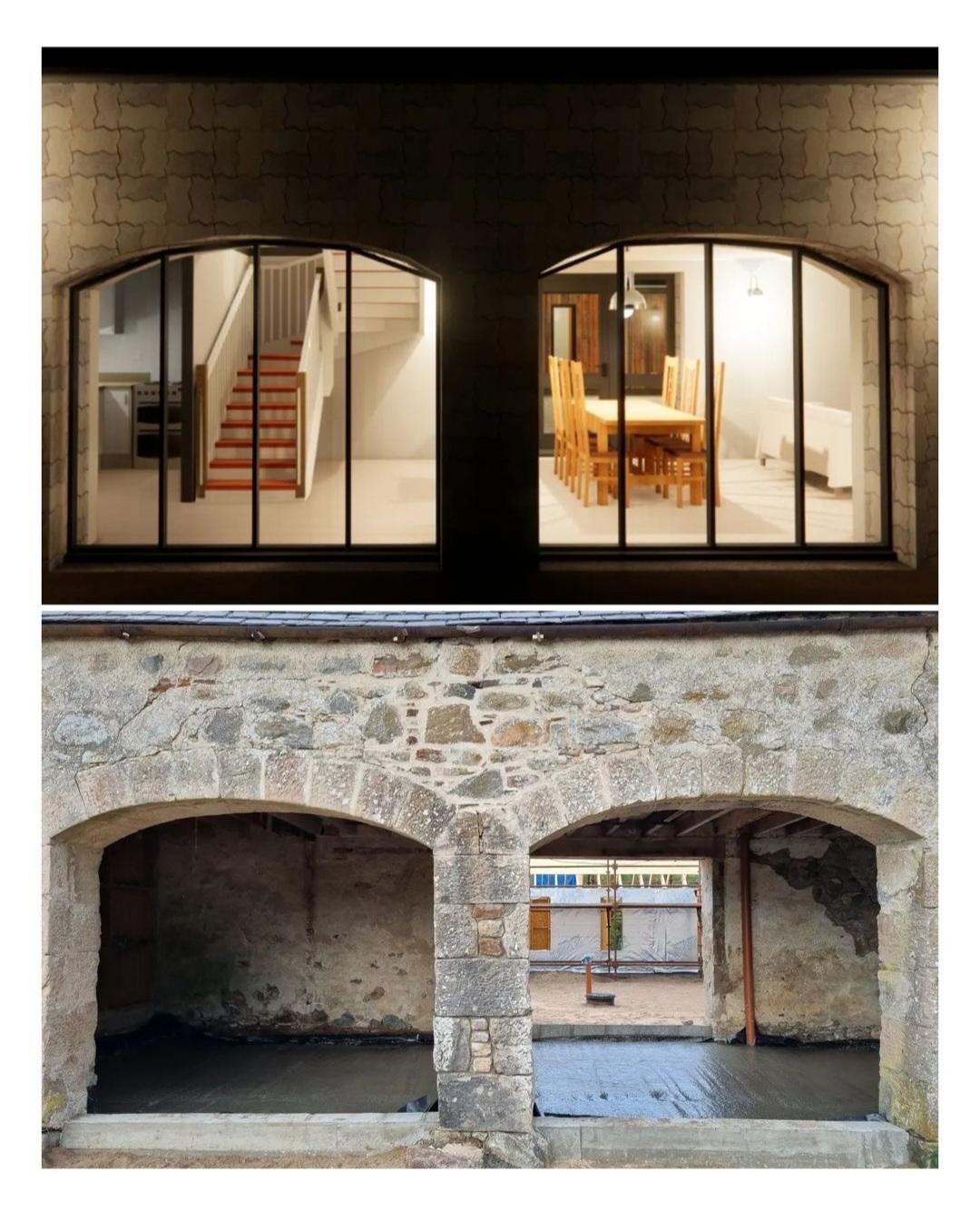
A vision of the final result
saveasteading replied to saveasteading's topic in Surveyors & Architects
Well spotted. The design suite doesn't have granite and sandstone. Or these interesting cracks and asymmetries. The inside spaces are all 'rendered' too which is great especially for those not so familiar with imagining spaces. -
It is very helpful and inspiring to get this level of design. Current and future.
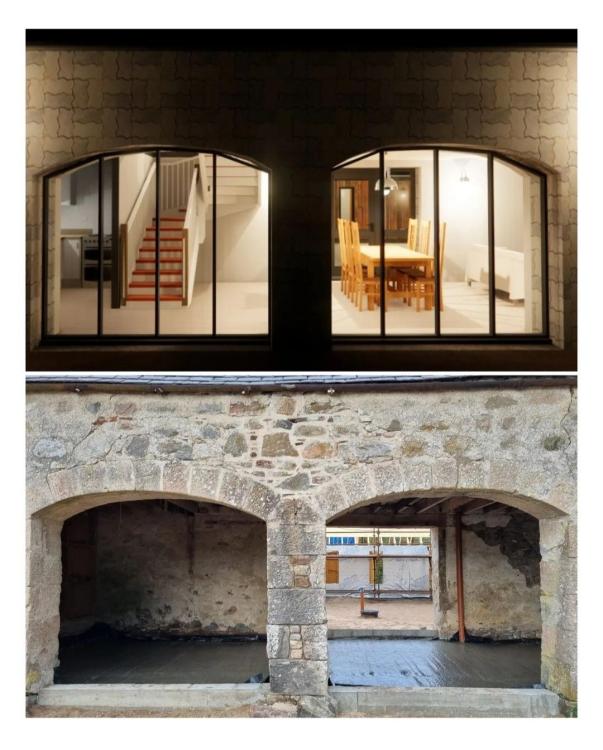
-
ICF and Foundation design
saveasteading replied to Renegade105's topic in Insulated Concrete Formwork (ICF)
That is very deep, and suggests very thick peat or silt. What is the ground, and maybe you can get more soecific advice? I wouldn't count on that. I'm pretty sure there is legal precedent for the investigation company taking no blame. I had a project where the client provided a comprehensive report for tender, from a ground investigation company. Tarmac on stone on clay supposedly. Contract won on that basis. As soon as we started digging we hit a reinforced concrete slab, which 6 boreholes had failed to identify. We minimised the extra cost by redesigning, but the client paid and the G I co and PM got away with it. Either the supervisor was not paying attention x 6.. or they didn't do boreholes and guessed. -
I found a jumper, balaclava and jemmy in a shared council attic.
-
Welcome both. An insurance company manager i built a office for, proudly stated how they had the lowest payout rate of any insurer. They spent money on fighting claims rather than paying. You would know the name. You are right not to be specific on this forum. Everything here is in the public domain.
-
How does your garden grow?
saveasteading replied to recoveringbuilder's topic in Landscaping, Decking & Patios
I am a convert to 'no dig'. I would spread masses of manure asap and let the worms do the work. This will be esp important if droughts become the norm. Also catch all rainwater, even diverting it over the garden if that works for you. Plant nothing that is expensive. The nursery has had a difficult time growing it, and it will surely die. Gardening is a hobby. Why pay someone else to have the fun? -
New build design & cost estimation opinions
saveasteading replied to morgan_22's topic in Costing & Estimating
It was my training and job. Study the site: on the ground , the geology and surroundings. Dig holes. Look at trees and watercourses. Look at nearby projects. Design the building to suit the conditions. Other Engineers are available. -
New series of Grand Designs 31st August 2022
saveasteading replied to Thorfun's topic in Property TV Programmes
It is normal to exclude the fees to the professionals. It shouldn't be, but that is part of the scam. I have many times asked Architect and Client each to state what the budget is, and whether that includes fees and contingencies. It can be an awkward moment for both....one trying to hide the real price (or bluffing) and the other realising it for the first time. Do we know in this case? -
Where is the kWh price heading in 2022?
saveasteading replied to epsilonGreedy's topic in General Self Build & DIY Discussion
Even Which magazine thinks that some kettles cost much more to boil. A reader questioned them on it, and they didn't seem to understand the question, perhaps confusing with overfilling. Energy in = energy out. How many mp's know even the basics of science (or their advisors by the sounds of it). -
New build design & cost estimation opinions
saveasteading replied to morgan_22's topic in Costing & Estimating
But I would have known, and so should your SE or architect. And your SE trumps the BCO. I will modify my statement if you like to 'predictable to those whose subject it is'. But then that applies to every element: I don't know much about electrics. A nasty extra cost for you whether justified or not. Many bco's have a default of asking to dig deeper, because they can and the groundworker does it and the client gets the cost. These aren't usually best pleased when told "no," or asked to prove the need. If there had been a deciduous tree nearby then he was probably right, to some extent at least. The biggest unpredictable aspect of groundwork is the weather....I admit to that bringing surprises. -
Have you seen the price of boreholes?
-
New build design & cost estimation opinions
saveasteading replied to morgan_22's topic in Costing & Estimating
Everything is predictable. Groundworks often has potential for clever designs to minimise muck away. Simply avoiding overdigging (wrong sized bucket) can be worth a great deal. -
Underfloor Heating pipes touching, how big an issue?
saveasteading replied to saveasteading's topic in Underfloor Heating
I was thinking that myself. However, assuming the heating water enters at 30C, and then soon departs again a few degrees lower, it will soon start to part with more heat at the cooler areas of screed, and it will even out. The heat leaving the screed into the room will be the same either way, but there will be some temperature difference on the surface for a while. Contrast that with the spiral arrangement which will alternate warm, cooler as you walk across it. Late news: I am not on the site, and was nervous about the plumbers' skills/knowledge, having seen this (one of many progress pictures) . It turns out that this rough looking loop shape was caused by a late change of design at a partition wall position (we have a step in the slab level and are putting in a stop end). Now adjusted with gaps between.