
ProDave
-
Posts
30857 -
Joined
-
Last visited
-
Days Won
427
Everything posted by ProDave
-
A serious question re drilling joists. That roof truss has an intermediate support. Do you treat the joist as a whole when working out the safe areas to drill, or do you treat the now two halves of the joist individually when working out the drilling zones? that sort of information never appears anywhere in any guidance notes. It is quite likely the house has the same joist throughout and some may have an intermediate support wall and others may span the whole gap in one go. I am watching that truss thread with interest. The outome could worry a lot of electricians.
-
Out of intertest, how much are those back boxes? I've seen it all now, plumbers using sparky bits. Looks like a cooker connection plate with the terminal blocks removed and just the front cover.
-
 The same diagram is in the building regs that you can download for free. I could point you to the Scottish version, but probably best if you look it up on your local council website (It is almost certainly the same diagram)
 -
The regulations are with respect to flue pipe terminations, and building regs set out the distances to windows, doors and air intakes..
-
I'm not questioning your ability, or doubting that what you left is stronger than the original. But the point is neither you or I are actually qualified to make that assesment. That is structural engineer teritory. I'm just saying this in light of the holes in the truss thread. IF it turns out someone says the trusses have to be replaced, then someone is going to need a very good PL insurance policy to pay for it, or they will end up bankrupt.
-
In light of the other thread about drilling roof trusses, did you get a structural engineer or the joist manufacturer to approve you cutting out a section and replacing it? How much PL insurance do you have?
-
This thread was originally posted in the other place, and is a team effort to collect together as many acronyms and abbreviations used in the building trade as we could. If you know of any abbreviations missing, or think there should be a correction to the list, then post them as a reply to this topic and one of the moderators can edit the original list to keep it all up together. AAV = Air Admittance Valve. (Sometimes referred to as a Durgo Valve.) AAV (alternative) = Automatic Air Vent. ACH = Air Change [per] Hour AIUI = "As I understand It". AONB = Area [of] Outstanding Natural Beauty Article 4 Direction = Removes Permitted Development (PD) rights. (See: http://www.brighton-...cle-4-direction ) ASHP = Air Source Heat Pump (And see also: http://www.planningp...ects/heatpumps/ ) BC / BCO / BI = Building Control / Building Control Officer / Building Inspector (Often prefixed with LA = Local Authority, as in LABCO.) BR = Building Regulations (Regs) CIL = Community Infrastructure Levy (= a charge levied by a LA based on the sq.m of a property. Note: self-builds are exempt.) CO = Conservation Officer. (Now often designated: Heritage Officers. Specialized - although often not particularly qualified - planning officers working in a local authority Conservation/Heritage department. Have the power to over-rule BC where the Regs are concerned if a proposal is considered likely to impact on the "historic character" of a building, whether Listed or not, or in a Conservation Area.) {Listed Building, see: http://www.planningp...ing_consent.pdf } {Conservation Area, see: http://www.planningp...ns/conservation } CU = Consumer Unit CCU = Cooker Connection Unit CWS = Cold Water Storage [tank]. (Large plastic tank often in attic.) CYL Stat = hot water cylinder thermostat for control of DHW temperature. DeltaT = ΔT (Greek symbol Δ =delta in Greek alphabet) Temperature difference. (In the building context usually referring to the difference in temperature across a wall when discussing the effectiveness of insulation.) DG = Double Glazing (Sometimes referred to in shorthand as 2g = double glazed; 3g = triple glazed. Also expressed as 'd/g') DCW = Domestic Cold Water DHW = Domestic Hot Water DNO = Distribution Network Operator (electricity supply) DPC = Damp Proof Course DPM = Damp Proof Membrane EA = Environment Agency EDPM = Roofing membrane. (EPDM rubber (ethylene propylene diene monomer (M-class) rubber), a type of synthetic rubber,) EPC = Energy Performance Certificate (See: https://www.gov.uk/b...ce-certificates ) EPS = Expanded Polystyrene Insulation EV - Expansion Vessel EWI = External Wall Insulation F&E = Feed and Expansion tank. (Small plastic tank often found in attic alongside CWS.) FCU = Fused Connection Unit FWIW = "for what its worth". (As in: "That's my opinion FWIW.") FYI = For Your Information. (Now often seen in formal letters since they took the form of emails, and especially in the header of an email forwarded to keep someone "in the loop".) GCN = Great Crested Newt GSHP - Ground Source Heat Pump HC or VHC = heat capacity/volumetric heat capacity ICF= Insulated Concrete Formwork IGU = Insulated Glazed Unit (industry term for double or triple glazing) IMHO = "in my honest opinion." (Alternative: "in my humble opinion.") IIRC = "If I remember correctly." IWI = Internal Wall Insulation KISS = Keep It Simple Stupid. (Usually expressed as: "Stick to the KISS principle.") LA = Local Authority LBC = Listed Building Consent. (Needed to carry out work on any Listed building, whether domestic or commercial, privately or publicly owned, which is protected by law because of its historic significance, whether by age or architectural importance attested to by English Heritage.) (See also: Listed Building, above.) LPA = Local Planning Authority LPG = Liquefied Petroleum Gas M&E = Mechanical and Electrical MCB = Miniature Circuit Breaker MDPE = Medium-density polyethylene also referred to as Alkathene. Pipe used to carry mains water and gas, usually buried underground. MI = Manufacturers Instructions MVHR = Mechanical Ventilation [with] Heat Recovery. NPPF = National Planning Policy Framework OEM = Original Equipment Manufacturer OLIVE = Compressible copper ring accompanying threaded plumbing fittings that compresses around the pipe when the fitting is tightened to form a watertight seal. Often reinforced with PTFE tape [see below]. OSB = Orientated strand board Party wall = An internal wall common to two properties. (Not always a contentious issue, but see: http://www.planningp...on/partywallact ) PDR = Permitted Development Rights. (Sometimes just 'PD'. See: http://www.planningp...ssion/permitted ) PGM room stat = Programmable room thermostat: selects both operating times and temperatures. PI = Professional Indemnity (Insurance) PINS = Planning Inspectorate PME = Protective multiple earthing PIR = Rigid Polyisocyanurate Insulation PoE (or POE) = Power over Ethernet. Enables power to be provided to the device (phone or a network camera) using the same cable as that used for network connection. PRV = Pressure Relief Valve PRedV - Pressure Reducing Valve PHE - Plate Heat Exchanger PTFE (tape) = (polytetrafluoroethylene) Tape used to seal threads and joints (e.g. around olives in compressions fittings) in plumbing. Also known as Teflon tape outside the UK PUR = Rigid Polyurethane Insulation PV = Photovoltaics e.g. Roof Solar panels R-value = Thermal resistance [insulation] (the higher the better) RCD = Residual Current Device RCBO = Residual Current circuit Breaker with Overcurrent protection RDF = Refuse Derived Fuel RTFM = Read The Flipping Manual. (The polite version; the less inhibited version is usually expressed with the 'F' meaning what you think it means.) SAP = Standard Assessment Procedure (See: https://www.gov.uk/s...sment-procedure ) (See also: https://www.bre.co.u...P-2012_9-92.pdf ) ( https://www.gov.uk/g...t_file_2012.pdf ) SAPV - SunAmpPV SE = Structural Engineer SEPA = Scottish Environmental Protection Agency SFCU = Switched Fused Connection Unit SHC = Specific Heat Capacity (heat is another word for energy, don't confuse with temperature) SIPs = Structural Insulated Panels SSSI = Site of Special Scientific Interest Stat = Thermostat. (Room stat = wall mounted thermostat/central heating control.) SUDs = SUSTAINABLE URBAN DRAINAGE [system] SVP = soil vent pipe. SWA = Steel Wire Armoured (cable) SWMBO = She Who Must Be Obeyed (Attributed to "Rumpole of The [Old] Bailey", who used the phrase when referring to his wife, but actually from Rider Haggard's "She": https://www.youtube....h?v=bS5YmETSVCI ) TAF = Temporary Amphibian Fence TBH = "to be honest" (As in: "TBH I don't know.") TBF= "to be fair" (As in: "TBF to the builder, he hadn't a clue.) T&E = Twin and Earth (cable) TF = Timber Frame (form of house construction) T&G = Tongue and groove. (Often given in lower-case: t&g.) T&PV = Temperature & Pressure [relief] Valve TS = Thermal Store UFH = Under Floor Heating. (Also expressed as 'Underfloor Heating' but usually still given as UFH.) U-value = Rate of transfer of heat [insulation] (get it as low as possible, below 0.15 if you can) UVC = Unvented Cylinder VCL = Vapour Control Layer WUFI = "Wärme und Feuchte instationär" - Heat and Moisture transfer analysis XPS = Extruded Polystyrene Insulation ZV = Zone valve, motorised or other. (Directs heating medium to wherever needed according to programmed requirements.) UNITS OF MEASUREMENT L x W x H = Length times width times height. (But note that when giving dimensions for windows and doors ALWAYS follow the convention of width first, following by the height.) J = joule (not Joule) W = watt h = hour s= second k = kilo (thousand) kW = kilowatt kWh = kilowatt hour kWp = kilowatt peak (Solar installations - literally peak output.) m = metre (not meter) m2 = square metre (not metre squared) t = time T = temperature °C = Celsius or Centigrade K = kelvin (not °K or degrees Kelvin) k or k often means conductivity R = resistivity U = 1/R g = gram kg = kilogram (the odd SI unit, use it) J/(kg.K) = J/(kg.K) = J.kg-1.K-1 W/(m2.K) = W/m2.K = W.m-2.K-1 f(x) = function of x. (Common usage in thermal and stress calculations as well as statistics.) e = Exponent (1+1/1!+1/2!+1/3!+1/4!...) how things heat up and cool down, how fast things grow, π = pi ratio of a circles diameter to its circumference
- 55 replies
-
- 4
-

-

-
- acronym
- abbreviation
- (and 4 more)
-
Fixed Speed vs Inverter controlled ASHP
ProDave replied to Stones's topic in Air Source Heat Pumps (ASHP)
I will throw self generated solar PV into the discussion. A modulating unit running at low power will more likely be using up available self generated power and not importing much. A constant but low power load is much better suited to solar PV. A non modulating unit when it's running at full chat for its bursts, will much more likely be using some imported power, followed by periods of not using any self generated power. So the modulating unit is by far the best if you have solar PV. Can I also buck the trend re oil boilers. I have been running an oil boiler directly feeding UFH (and DHW) for 13 years. I don't see this short cycling that people keep mentioning. Unlike a gas boiler, oil boilers (or at least the one I have) tend to be quite large capacity big steel tanks with a burner down the middle, so in themselves have quite a hig heat store. What I find is when running with just a low UFH demand, the boiler will fire up for a couple of minutes every 20 minutes or so. I don't see that sort of short cycling as a problem, certainly not one that needs to be "solved" by fitting a buffer tank. -
It would be the noise of a fixed speed one that bothers me. I would rather have an inverter driven one ticking over near silently for a long time, rather than a fixed speed one running at full chat for bursts.
-
How on earth did you get that in there? the only way I can see is slot it in when only half the roof trusses were on?
-
I would really be surprised if the trusses are that tightly designed that these holes have compromosed them too much and they need replacing. Lets hope they either agree it's okay, or agree an insitu repair like a strengthening plate.
-
That really cheap one was just after the savage cut in FIT so probably just someone dumping stock. I have not seen anything so cheap since.
-
thermocouple or something like that
ProDave replied to Tennentslager's topic in Kitchen & Household Appliances
I would say the thermostat is brown bread. The mains is probably only there for ignition. You can probably get a spare but knowing caravan stuff it will be hard to find and expensive. (second only in obscurity and cost to marine stuff) -
The first question is has building conrtrol signed this off yet? If not then if they haven't done so already, they will usually want to witness a drain pressure test. the answer to that question has a big bearing on what you do next. It looks like they were running out of depth. Obviously the "end" point of the drain run is fixed at what it is, and drains have to be laid to a minimum fall. So the furthest end is breaking out of the ground. Not in itself a problem if you still have the landscaping to do and will be covering it. Just raising the ground level up to the grid of the hopper should be enough.
-
I can see a great deal of potential there. AND a great deal of hard work if doing it manually yourself. I would start with the raised deck area built of timber. At least that quickly gives you somewhere nice to sit and survey the carnage. There is no easy way to landscaping the "lawn" if you want to retain the soil you have, it's a case of pick out the rubble and rubbish then level the soil. Having the deck and then steps down should allow you to get a more level lawn. What to do with all that rubble? Well on the basis you may one day need it when you do the drive etc, put it under the raised deck. And yes that is a serious suggestion, it costs nothing, it's out of the way and accessible should you want it. Obviously fit a side panel to the deck to hide it, but one that can be removed. Other stuff that's clearly rubbish and no good for hardcore even then get a skip or take it to the tip. MOT1 is good stuff for driveways, plenty of people here put that down then never do anything more. To restore a decent lawn, spray the whole lot with something like Gallup 360 (I borrowed a backpack sprayer) which will kill everything without poisoning the ground, then level it and re seed.
-
While you are in communication with your truss maker, I would also enquire is it okay to drill holes in line with the correct guidance given above or is that a no no. Make sure the electricians and the plumber know the results of their findings.
-
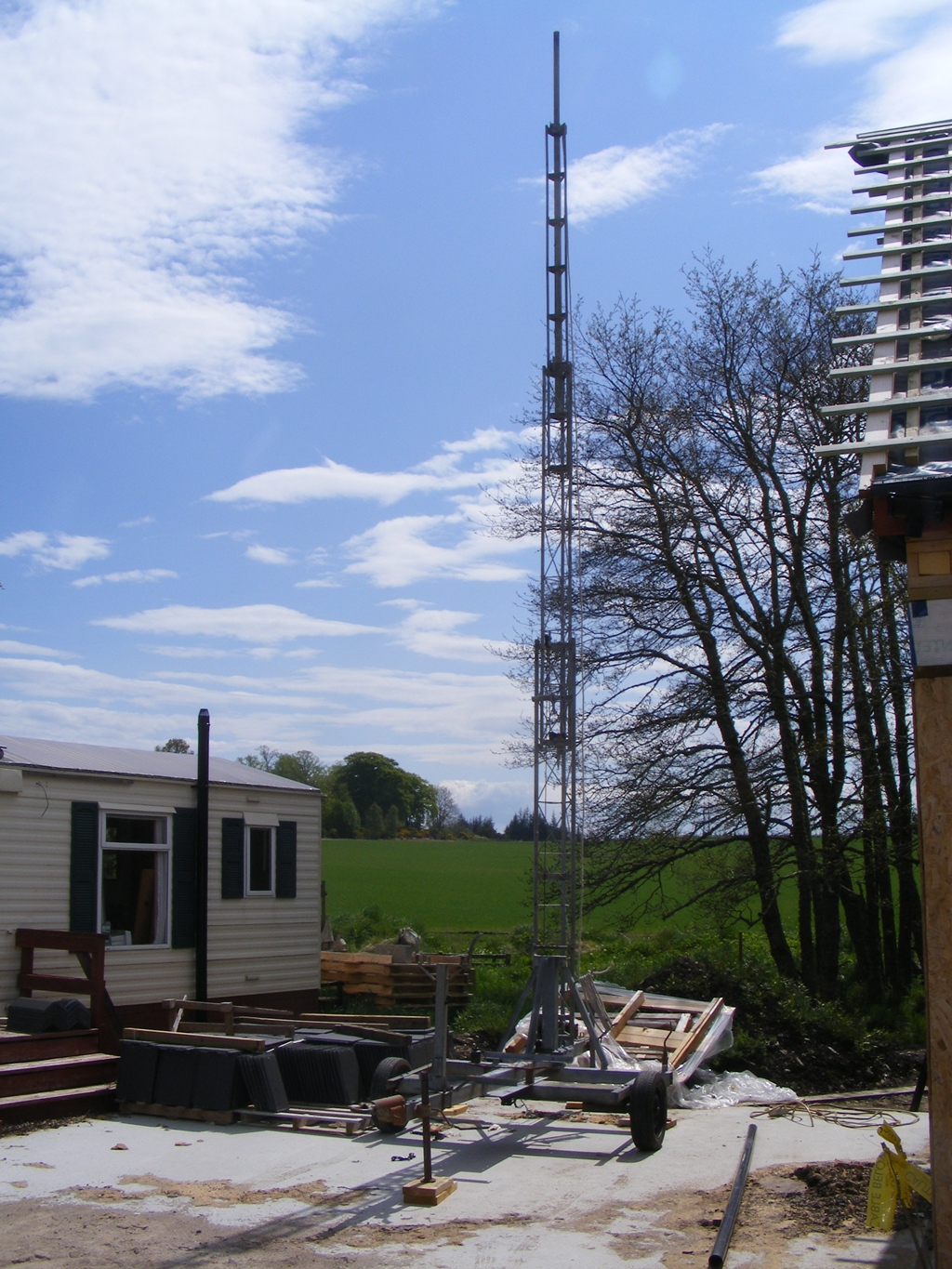
Yes I admit, not what everyone wants. One of my hobbies is ham radio. always in the past I have had my ham radio aerials attached to the house in some form. But now I am building a wooden house clad in wood fibre with no real means of fixing great sturdy T & K brackets for an aerial pole. So time for something completely different, something I have wanted for a long time, but never managed to find one cheap enough. A trailer mounted wind up telescopic lattice mast: Yes it's only a baby one. Three 10ft sections which when fully extended as in the picture, will give an aerial height of at least 30ft, more if I choose to have less of the top mast section inside the top tower section. It came from a good friend of mine just up the road. It was originally a lighting tower and had a generator bolted on the A frame. My friend bought a job lot of 3 of them, he only wanted the generators so he then sold the bare towers. This was the last one of the 3. It's not in bad condition. The steel ropes that wind the mast up need replacing as they are well rusty, and a few bits, mainly the jack legs need cleaning and re painting, but the rest of it is in pretty good condition, even the galvanising is good in most places, not bad since it was made in 1989. It's going to get parked somewhere behind the static caravan eventually and the rear bedroom of the 'van will probably become my "radio shack" I had some fun and games to get it here. The tyres were completely rotten. It took a well fitting spanner, a lot of WD40 and a long pole to get them undone. 2 replacement tyres from freecycle, old but legal tread, and my friendly garage mechanic swapped them over free of charge. At some point someone changed it over to a pin hitch and in doing so didn't re connect the trailer brakes, and the mudguards have gone AWOL but that doesn't bother me as I don't intend towing it on the road again.
-
Adding a single panel and micro inverter on the QT?
ProDave replied to Jeremy Harris's topic in Photovoltaics (PV)
I would do it personally but of course that is not official advice. -
I think the original link got corrupted. I just copied and pasted the item number. Try this link http://www.ebay.co.uk/itm/Delonghi-AWR-MTD-0011-Heat-Pump-/272209537849?hash=item3f60f3eb39:g:ESIAAOSwbwlXDP1I
-
That would suit me fine I am sure, but it's too early in my project. So do I buy it now, or take the gamble that in a year or whatever when I really need it that I will be able to find another at that price?
-
What's missing from that drawing above is that an attic truss will also be in tension to stop the roof spreading apart, perhaps that's why they are more critical? I think the only solution is to get a structural engioneer to either sign it off as acceptable, or if he feels it has compromosed the joists he will recommend remedial action like sistering another joist alongside them. Best also discuss with him what the plumbers can and cannot do befiore they start. They will need bigger holes and more likely notches in the joists rather than holes through them. If they need large holes e.g. for waste pipes they will need a properly engineered solution which may involve a steel plate. It might be advisable to stop the work until you have a definitive answer.
-
Well the water flow from the boiler to the tank and UFH manifold will have to be pumped, so put the pump(s) in the boilerhouse. We certainly don't hear any noise from the boiler at the tank or UFH manifolds, but remember each manifold will have its own pump. I very nearly put one of the UFH manifolds in a bedroom wardrobe (as it was nice and central) until I realised it had its own pump, then I said no way, it's going in the airing cupboard in the bathroom (less central but I don't care about pump noise there)
-
The NHBC guidelines for drilling joists say a hole shal be on the centreline of the joist, in a zone between 0.25 and 0.4 of it's span, and maximum diameter of each hole 0.25 times the joist depth. I suspect those are too close to then end of the span (i.e les than 0.25 span from the end) but otherwise I would not get worried personally about those small holes. Where else did you expect them to run the cables? You wait until the plumber arrives next.
-
Why are attic trusses any different to any other floor joist? For normal floor joists there are set guidelines where you can drill them and where you can notch them and what size holes or notches. I recall BC inspecting our last house and commenting now neat the notches in the joists were for the run of pipes to the boiler.
-
My boat (fibrglass) has a "flange" joint where the hull moulding joins the deck moulding. A U shaped rubber fender strip goes over this to create a rubbing strake. It's fitted by a combination of just stretching it over all round the boat and adhesive to hold it there. The boat used to live in a tidal harbour tied up to the harbour wall and what happened was the continual movement between the boat and wall (even with fenders) causes the rubber strip to unstick and then one stormy night pull off exposing the raw fibreglass edge, which was not kind to fenders. Re fixing it with Stixall and it's not come off again.