
ProDave
-
Posts
30679 -
Joined
-
Last visited
-
Days Won
424
Everything posted by ProDave
-

Short term fix needed. Any suggestions?
ProDave replied to TheMitchells's topic in Electrics - Other
First (no criticism meant) for a fault like this call an ELECTRICIAN not your energy supplier. Let him diagnose exactly what is wrong. Calling the supplier assumes you think the problem is with the dual tariff metering system. It might be, it might not be. As you have found, the "solution" by the suppliers seems to be replace the old dual rate meter with a smart meter. But frankly I hear so many issues with getting off peak supplies to work with smart meters, I doubt the competence of many of the supply companies to set them up properly. At this time of year you should not need heating, so hot water is the immediate concern. In all but the most basic designs of off peak hot water heating there is a means to turn on a daytime immersion heater to heat the hot water even if the off peak supply is not coming on. We need to know more about what was "reset" during these visits. Hot water heating up first night of off peak then not heating up the next night, is often a failed immersion heater thermostat. Again nothing for your supplier but something an electrician can test and repair. You should NOT be needing to change the heating system to "work with the smart meter" Get on the blower to an electrician, let him test and work out what has gone wrong with what you have. -
Explain this bit please, I am clearly having a senior moment? I see 2 + 5 =7 but how does that get to a 150 x 50 joist?
-
Has it actually failed? Or just fallen foul of a new rules that says he must be able to inspect it's entire length, previously a boxed in section did not need to be inspected? Obviously difficult if it passes through an area you don't have access to. Change for all electric will be cost effective your you but will raise tenants bills. If it is not making money, sell it.
-
Central heating system and Asbestos
ProDave replied to TheMitchells's topic in Other Heating Systems
That looks like an Electricaire centralised storage heater. They used to be in most of the council housed here when built. I can pretty much guarantee as well as the unit itself containing asbestos, the cupboard it is in, will be lined with Asbestos cement panels not plasterboard, so if you have other plans for that after removal of the heater, be prepared for that. And likely the inside of the door is also lined with it. -
Replacing first floor joists
ProDave replied to Jawbkk's topic in Party Wall & Property Legal Issues
If you are only talking of an 8' section of these jousts having a lot of notches I am surprised you think there is a a problem. sistering new sections of joist onto the worst sections would be a lot easier. -
It would have been clear to building control that we had a laundry set up inside the house shell, lots of stuff in storage,and a temporary office space. They were not in the least concerned. In Scotland you can a temporary habitation certificate to legally occupy a not finished house as long as some basic points are complete.
-
I am guilty of the cooker hood too high. If I had fitted it at the manufacturers recommended height, I would bang my head on it whenever I lean over to stir something in a pan. and I am not exactly tall. If you are worried about smells from cooking around the house, spare a thought for a previous house I owned where every Sunday I could smell next doors cabbage cooking!!!!
-
I am one of many on here, building a low energy well insulated and air tight house that chose NOT to put any heating in the bedrooms. I did put cables in for electric panel heater points in the bedrooms, but they have never been needed. We get enough heat from downstairs to keep the bedrooms comfortable without any extra heating in them.
-
Try lifting the door from the bottom. If it is anything like mine, there is a lot of play in the joint between each segment of the roller, and a couple of spades could probably create a small gap perhaps enough for a slim person to get under and wind it up with the manual handle? This does not help your situation, but is the reason why I would NOT have an electric roller door as the only means to get into the garage.
-
Post individual questions in the relevant sub forums. A lot of us here regard building regs as the minimum standard and aim to exceed them.
-
Larger "Spark Gap" means fewer heat pumps
ProDave replied to LnP's topic in Environmental Building Politics
Yes to all of those for me. But the average person in an existing house heated with a gas boiler and radiators, no to most of them. they might not change their minds until the price of gas rockets above the price of electricity. -
Larger "Spark Gap" means fewer heat pumps
ProDave replied to LnP's topic in Environmental Building Politics
Yes it is not rocket science. At the moment, at best, a well installed heat pump working well will just about match the running cost of a gas boiler. That is not much of a selling point is it? Most of us on here do it for other reasons, mine being no mains gas here, and I did not want an oil tank. -
Global sea level rise over the next 100 years is inevitable. What are "they" planning to cope with that. What about all the low lying coastal towns and cities that may be under water? At what point do you stop planning defensive walls and start planning relocation?
-
We built our first self build just over 20 years ago. I knew nothing then of passive houses. But coming from a 1930's semi with solid walls and high heating bills, the "standard" timber frame build of the time was very warm, comfortable and not outrageously expensive to heat. but it had many shortfalls, mainly as I have discussed before, the huge amount of holes in the structure forced by building regs to have extract fans in so many rooms, and other "standard" things like a cat flap, a letter box and a non room sealed WBS. In the time between that and starting our second build I did a spell of work for a local company building "low energy" modular homes. I learned a lot about insulation, air tightness and MVHR from that. So that is the principles we applied to out second self build. My 2 main things, I wanted a heating load low enough to be satisfied by a small ASHP. We have no mains gas, and I did not want an oil tank or bulk gas tank in the garden. And I wanted air tight and mvhr with no unnecessary openings in the building structure. So no cat flap or letterbox, no individual extract fans (that most of the time are just a hole to let heat out and draughts in) and an air tight structure. We achieved that and are pleased with the result. I think the term "Passive House" is confusing to the layman, they expect a house that needs no heating. I don't think that is possible in most of the UK.
-
No sorry I don't. At the time I was scouring all sorts of on line suppliers and merchants and I stumbled upon it, or more likely someone on here pointed me to it. It did the job well but I can't find it again right now.
-
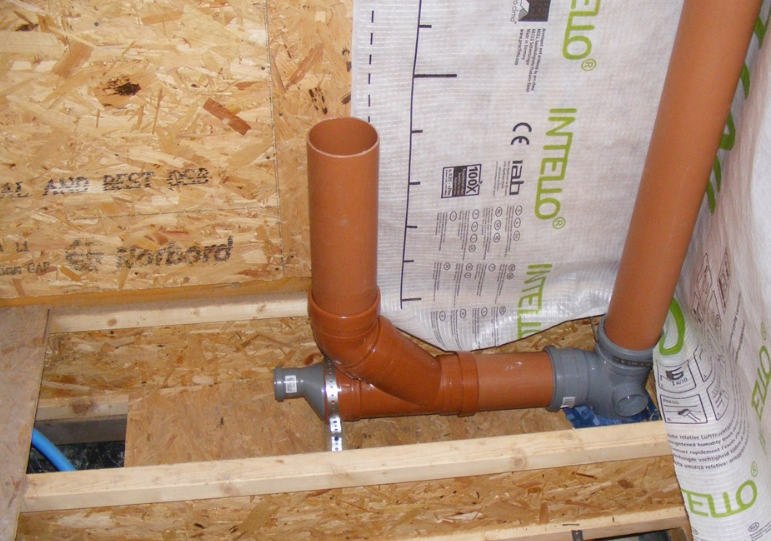
I have this arrangement: To the right is the stack pipe coming down from upstairs then straight down into a rest bend. The 110 sticking up is where the downstairs WC connects. The 50mm branch at the left is washing machine and sink discharge. It has never blocked, probably because unlike @MortarThePoint outside pipe, this has a regular flow of grey water into that 50mm end pipe to keep it flushed free of any solids that are reluctant to move of their own accord.
-
Another thing with posts, you need to dig a nice parallel sided hole. At one previous house a neighbour had a fence installed. The contractors were not very careful, and the first gale, many of the posts simply pivoted out of the cone shaped hole with a cone shape block of concrete still attached.
-
Used crushed / irregular stones, they will lock together and not move much. Do not use rounded "pebbles" it will be like walking on marbles. (a mistake I only made once when ordering 20mm stones from a builders merchant without seeing them or asking any more details)
-
Could you actually see movement at the base where it comes out of the ground? It is surprising just how much concrete posts will bend so movement at the top if solid at the bottom is okay. However it does look to me like they filled the holes not with concrete, but with bricklaying mortar, probably because they had plenty of that on site ready?
-
Cornish Cottage Renovation and Extension
ProDave replied to Aggierockdoc's topic in Introduce Yourself
I looked into GSHP's for here. I soon concluded even if I did all the digging work to lay the slinky myself, the cost of the pipe, fittings, and the brine to fill it was way more than the cost of the GSHP. Then when you see the advice is replace the brine every 10 years, the ongoing costs outweigh the additional efficiency compared to an ASHP. -
+1001 BC are not interested in that. We formed the entrance, got services connected and the static caravan on site before we even started on the building warrant.
-
If it has planning that is locked in because the development is clearly "started" then just go ahead and create the entrance using the details on the plans that are already approved. THEN think about a new planning application, knowing you can still fall back on the existing "started" application if that is refused.
-
That is for a Scottish temporary habitation certificate, I don't think England has such a formal process.
-
I got this written into the planning for ours, that I wanted the static caravan to remain after the build as a "garden building". This overruled the usual clause saying the static caravan must be removed. Instead they inserted an alternative clause "habitational use of the caravan shall cease upon occupation of the house" They are just ensuring you don't end up with the caravan as a second separate dwelling.
-
Internal floor splitting double height entrance
ProDave replied to Phyllis70's topic in Introduce Yourself
In principle you should be able to find the structural points of the wall at first floor height (that will probably be supporting the other floors) and span a floor from those. but to access your new mezanine floor you will need a short staircase up from the half landing but there I see a problem, those stairs will be cutting across a dooorway. Picture from below may help?