
ProDave
-
Posts
30861 -
Joined
-
Last visited
-
Days Won
427
Everything posted by ProDave
-

High speed broadband a legal requirement by 2020
ProDave replied to a topic in General Self Build & DIY Discussion
I suspect the "are able to access" clause will translate to "if you are prepared to pay the high connection fee" Time will tell. -
High speed broadband a legal requirement by 2020
ProDave replied to a topic in General Self Build & DIY Discussion
The existing network is decrepit. When we had our new connection it took them about 2 weeks to actually get a connection from our house to the exchange. they were grubbing around to try and find a spare working pair on each of the several legs of cable between us and the exchange. Speaking to one of the engineers doing it, I got a pretty good idea of the route it took, and from our village it goes down to completely the wrong end of the town, then runs the length of the town to get to the exchange. -
Not related to the breakfast bar. That standpipe in the washing machine or dishwasher space will almost certainly mean the appliance will not go back far enough and will stick out and look awkward. Change that for a washing machine sink trap.
- 4 replies
-
- 1
-

-
- breakfast bar
- little brown bungalow
- (and 1 more)
-
What is the wording of the "timber window" requirement? Rationel do timber windows, indeed all their windows are timber. You can get them as painted timber finish, or aluminium clad timber. Unless your timber window requirement says they must be stained or varnished timber (i.,e timber coloured) I can't see why you can't use rationel. Unfortunately they stopped doing timber coloured windows some time ago. I am sure some f the other quality window suppliers like Nordan do timber coloured.
-
High speed broadband a legal requirement by 2020
ProDave replied to a topic in General Self Build & DIY Discussion
The way it was stated on the news is you can "demand" it. That is not quite the same as them responding to the demand? The Scottish Government did a similar thing to make high speed broadband "available" to all homes by about 2021 (I forget the exact date) My guess is remote properties who currently can only get BB by satellite will be "offered" it but at an astronomical price. The community Council here tried to get a faster rural broadband network installed, but that has stalled because none of the suppliers approached bothered to tender for the job. -
Hello from North Wales (Cottage renovation & extension).
ProDave replied to crave's topic in Introduce Yourself
Those barns need saving, if only as a bloody good covered work / storage space (it rains a bit in Wales) Possible future potential for a conversion? -
I have been phoning around for some prices. For an impey 1200 by 900 tray with tile waste and 5 square metrre tanking kit: Plumbbase £645 William Wilson £560 Plumbstore £453 All including VAT. Still waiting for a price from TP. Jewson and plenty of others can't get them. No reply from the 2 on ebay that I have tried.
-
Hello from North Wales (Cottage renovation & extension).
ProDave replied to crave's topic in Introduce Yourself
Hi and welcome to the forum. I am not sure if your "cottage" is the building on the left or the right? or do you own the whole lot? Looks like an interesting project. -
What do you need to move in? For me personally if it was warm, had a working (not necessarilly finished) kitchen and a working bathroom, I would be in. Even if that meant climbing a ladder to go to bed. We thought about moving in just to sleep but with no kitchen or bathroom operational yet, we would still be using the 'van for those so decided it would be more trouble than it was worth. Some time next year when we can get a bathroom and some form of kitchen we will move in, a long time before it is finished.
-
New Build Warranty ...recommendations? / warnings?
ProDave replied to Ed_MK's topic in New House & Structural Warranties
When we built the last house we paid for the nhbc Solo for Self Build. That has now passed it's 10 years so arguably was as waste of money. This time round we have not bothered, we did get some quotes and the costs had more than doubled. -
From my perspective, usually the "electrical design" was done by the architect in so far as every switch, light and socket is shown and oven and hob positions etc. The reality is I rarely follow that. I spend an hour or so walking round with the client, and a big black marker pen, discussing where to put switches, sockets lights etc. Invariably since the plans were drawn, a door or 2 has reversed it's swing, the kitchen layout has changed and the architect never got the sockets where they were wanted in the first place. If you are going to "pre design" this sort f thing, then you must pre design EVERYTHING that includes the kitchen in detail and all bathrooms in detail, and then not deviate from that detail design. I can see the merit in pre design if you are giving a builder a turn key package to build you a house ready to move into. But most self builders are more hands on and involved and like to tweak things as they go along.
-
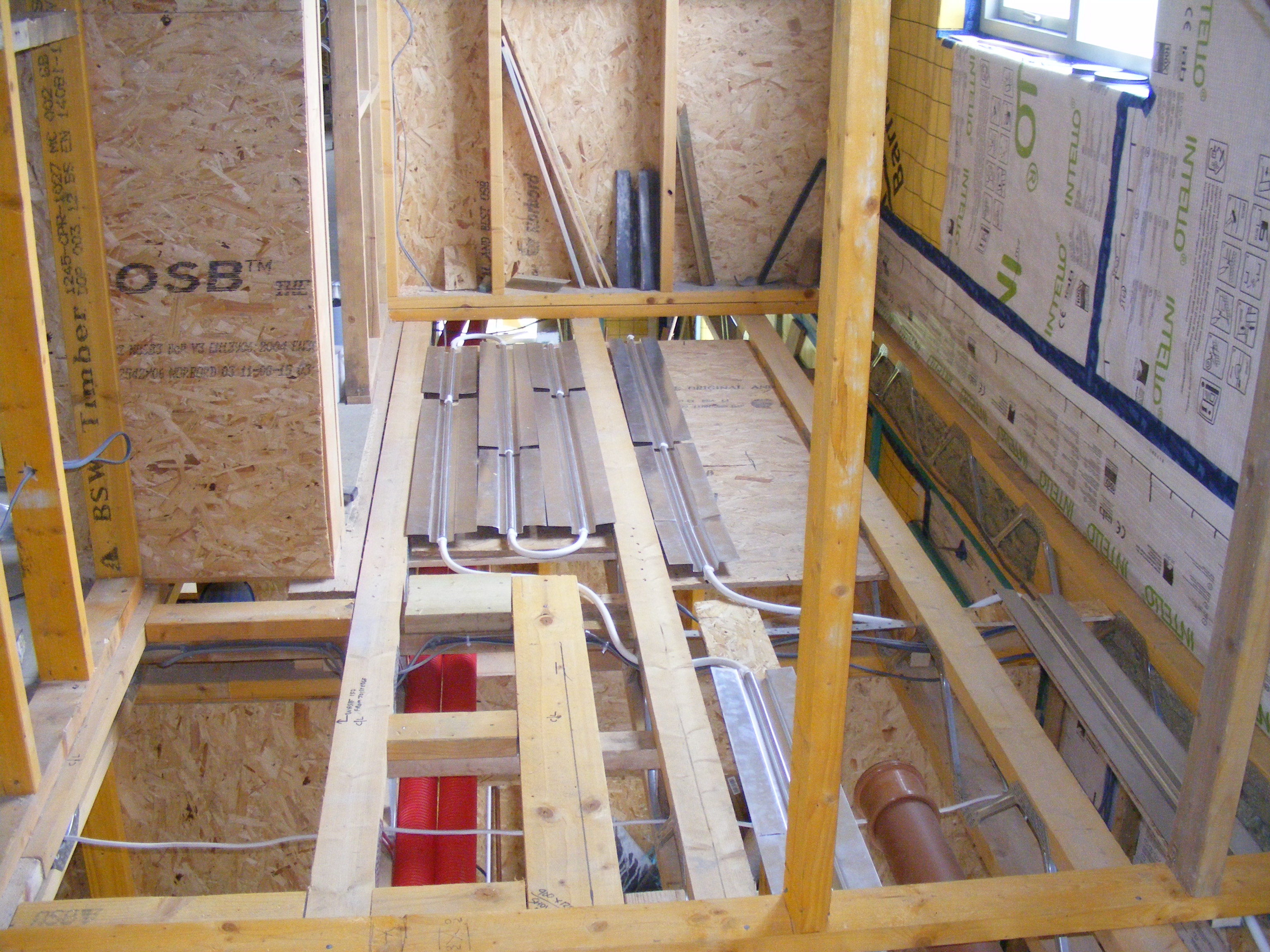
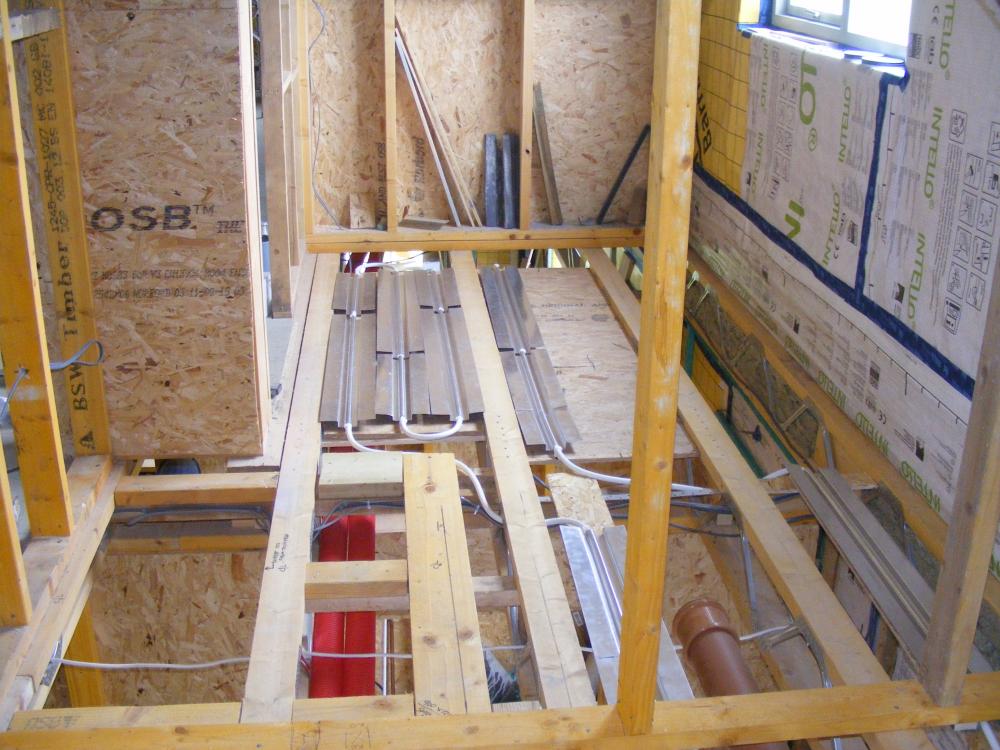
In my case the bathroom UFH IS within the joist space. OSB support "trays" held in place by bearers screwed to the underside of the top member of the posi joists. Whern the floor deck goes down it touches the spreader plates. I put a few dabs of sticks like on each as I laid the floor to stop "creaking plates" The fiddly bit is threading the UFH pipe through the web where it needs o cross a joist. Ok on a small room with a short run but it would be a rel challenge doing this on a large room with a long length of pipe. Now back to my question: cheapest place to but impey trays and tanking kis?
-
Pushes the price of the tray up not to mention the price of the drain. It would work for one of them, but since the drain usually runs along the long side, I would have to cut a big notch in a posi joist which of course is a no.
-
Okay I am bringing up this old thread as I am getting close to buying my two wet room formers and tanking kits. Have settled on the Imprey formers and tanking kit. I need 2 formers each 1200 by 900 and two 5 square metre tanking kits. (One room will be a little over 5 sq m the other a little under) My confusion is what is the difference between the impey easy fit and the impey aqua dek? Are both self supporting (i.e supported on joists alone)? Also where is the cheapest place to get these., I started looking at prices and was quite shocked. Everywhere I have looked there is a huge (> £100 extra) if you select a drain for tiles vs a drain for vinyl. Thar can't be right?
-
I see nothing good here for the self builder. All I foresee is more regulations, more inspections and I fear more items that will require some professional sign off.
-
Yes be careful what gravel you get. You want crushed stones that will be angular and bind together. Don't male the mistake I did once and got a load of "20mm gravel" All lovely roundish stones. It was like driving on marbles, hopeless.
-
It depends if the pitch of your roof is suitable to convert. In my friends case it was not, so entire roof off, and a new, steeper pitched roof on. You would not want to be living in it during that.
-
80w outdoor warm white floodlight - any recomendation?
ProDave replied to Fallingditch's topic in Lighting
I envisage a trap door, and a clever hinge mechanism to lower the light fitting into the door opening for servicing. The beam for the block and tackle would make it look the part. -
The cheapest airtight membrane I could find was Protect Barriair, from Jewsn but not in stock they had to get it to order. Over the normal stud spacing of a TF there is no way you could stretch it tight enough to prevent the socket box pushing it in enough. However you might need to deliberately leave some slack if you need a box very close to the stud. With 11mm plasterboard and a 35mm deep box (I wholeheartedly recommend nothing but Appleby for dry lining boxes) the box will protrude 24mm beyond the back of the PB so with 10mm battens that's just 14mm of give you need. As stated you only have 20mm before it hits the PIR so lets hope you don't hit a thick bit.
-
Hi and welcome to the forum. Yes I would make the insulation follow the roof line all the way. It will be easier to detail and give you a warm eaves storage space as well. I have a friend who did a very similar conversion. Initially he planned to remain in the bungalow during the work, but later decided to move out for the duration, and said that was the single best decision they made.
-
80w outdoor warm white floodlight - any recomendation?
ProDave replied to Fallingditch's topic in Lighting
That house would look right, with a little door in that gable end to give access to the light from the loft space -
80w outdoor warm white floodlight - any recomendation?
ProDave replied to Fallingditch's topic in Lighting
Why did it need to be that high. I would go no higher than you are comfortable with on a 2 section ladder. That 14M would probably need my 3 section ladder and it becomes harder. -
Co-Heating Test
ProDave replied to mike2016's topic in Energy Efficient & Sustainable Design Concepts
In effect I did that on my build. For the whole of November I had a single electric convector heater on 24/7. There are no internal doors fitted yet. Each day I compared internal temperature and external temperature and concluded that the modest 700W of heat was maintaining the house temperature 10 degrees above outside temperature. You do need to tun this test over a long period as the house responds very slowly to changes in outside temperature. I did this test as I was doubting the insulation was as effective as it should be, but the test confirmed the heat loss was exactly as predicted using Jeremy's heat loss spreadsheet. So I know I am on track to have a maximum heat input requirement of 2500W when it's +20 inside and -10 outside. When I complete the new house, I will almost certainly buy an electricity watt hour meter and install that to just measure the power consumed by the ASHP so I will have a real measure of heating power separate from all other electricity usage. I didn't have any doubt about the type or amount of insulation fitted as I fitted it all myself. -
Top one will give more even temperature. Bottom one might give a slight temperature gradient from one end of the room to the other.
-
If this rule applied to on the plot, then I would be in trouble. My water and drainage both run along the front of the house but in separate trenches, but they are only about 1 metre apart.