

ProDave
-
Posts
30676 -
Joined
-
Last visited
-
Days Won
424
Everything posted by ProDave
-
At least it's "one person's" problem you paid for supply and fit, so it does not matter to you whether they were damaged in deliver or in installation. Have you paid the final payment? I hope not as that's your position of power to get it sorted.
-
The longest we were without power was 4 days following a big storm a few years ago. It was the WBS that kept the house habitable for that time. If you are heating water with a stove you need to design the system very carefully so everything flows by gravity including the dump load. So many I see rely on a circulating pump and would be unusable in a prolonged power cut. So WBS heating a thermal store by gravity and over heat dump rad fed by gravity. Work out a valve arangement that does not need electricity to open the flow to the dump rad and you have got it sorted. Such a system can then drive wet UFH when power is available but can safely run with just the stove heating the house in a power cut. Best of both worlds. It's a valve to open the over heat dump without electricity that I have no idea about.
-
That is so true. I did some upgrades in a house recently that had just changed hands, and the new owner was about to rip out the not very old wood pellet boiler and put a gas boiler back in.
-
Did you personally see the windows before they were installed? What happens if the installers say they were like that before they fitted them? Are they the window companies own installers?
-
It would be interesting in this particular case to see a map of where this development would be in relation to other houses. It seems to hinge on whether you consider it's location "isolated" or not. Up here, there is a general presumption against new houses in the countryside unless in an established settlement. Ours got permission because it satisfies at least 2 of the requirements. But I know of one that was refused near here as although close to existing houses the LPA deemed it was "outwith" the area of the existing settlement. I don't know if that ever went to appeal. Some LA's do some ridiculous things. When I was down south I was always looking for a plot (but never found one) but I recall looking at a map in a local plan. This was an existing village. They had outlined the village boundary in red saying there would be no development outside the boundary. But a look at the map showed some ridiculous things like a gap between 2 houses on the edge of the village, where another house would have fitted nicely, was specifically marked as "outside" the village.
-
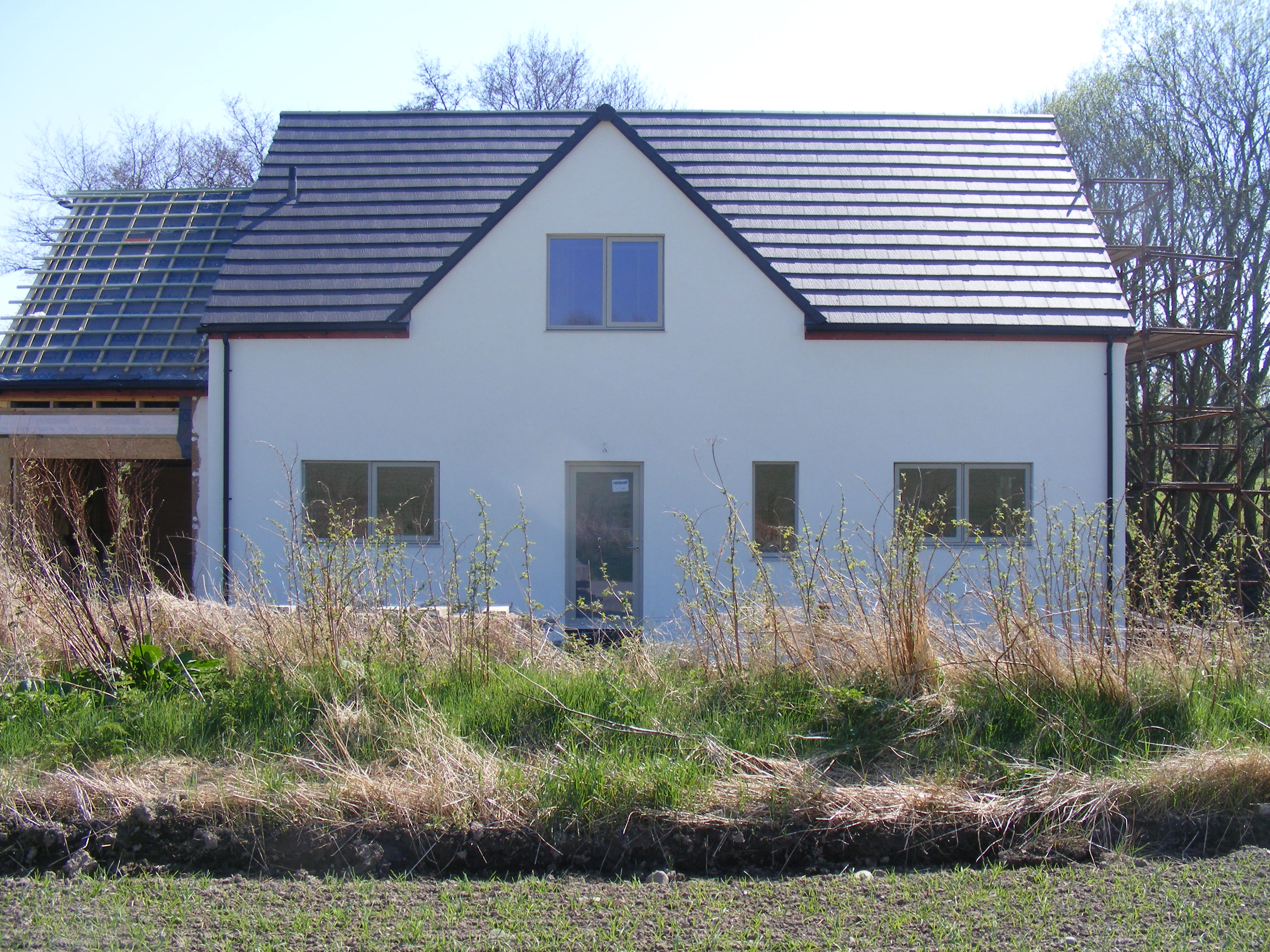
That's starting to look nice now you can see it. To make you feel better I did a rewire on a bungalow last year, that when I first saw it looked way tattier than yours, and had rotten collapsed floors, rotten windows, no kitchen etc. In the space of about 2 months the owner had it all repaired, decorated, new kitchen etc and it is now a cosy home once more.
-
One that worked well in a house I wired a few years back was a stove that put 10KW to water while only putting 2KW into the room. This heated a massive thermal store that provided DHW and UFH. They only needed to light the stove every few days to heat the store. What is it that puts you off wet UFH?
-

Boiler, buffer, thermal store or UVC? UFH with PV
ProDave replied to oranjeboom's topic in General Plumbing
For me UVC because it delivers a near constant temperature water right up to the point it runs out. A thermal store, the DHW temp starts to reduce as you draw water, so to get enough hot water you need a large tank, or store it at a higher temperature. A modulating gas boiler won't need a buffer tank. The expert from Wales will be along shortly to advise more. -
Preparing to lift the roof beam without a crane
ProDave replied to ToughButterCup's topic in Roofing, Tiling & Slating
It's funny how delivery driver vary. When building our last house I had 2 concrete lintels delivered to go above the garage doors. Before I said a word to him and before his feet had touched the ground he said "!'m not lifting them up there" -
Fault on Kingspan Air Source Heat Pump
ProDave replied to philiom's topic in Air Source Heat Pumps (ASHP)
The obvious question is are you sure the flow rate is high enough? if it's only just enough to trip the flow switch it could be unreliable. Faster pump speed? -
Bath Surround / Boxing In, and concealed pipework
ProDave replied to Onoff's topic in Bathrooms, Ensuites & Wetrooms
Just use ptfe tape, as it's going to be hidden, twice as much as you think it will need. -
The rules do seem confusing and do vary a LOT between Scotland and England. At the end of the day, you can only install what your building control officer will agree to, and it does seem he has some flexibility. So in this case I would approach my BC officer with a proposal to site the treatment plant 5M from the house discharging into a soakaway that starts almost immediately the other side of the treatment plant (allowing room for a sample chamber) and see what he says. You still need that percolation test to determine the size of the soakaway and therefore how close you need to go to the boundary to achieve that area. Up here a treatment plant must be 10 metres from a watercourse, yet my neighbour (of our old house) has installed one just 2 metres from the burn. It has not been completed and signed off, so I still don't know if this has been agreed with BC or if he is going to get a nasty disappointment.
-
And deeper pockets than you thought you would need.
- 13 replies
-
- 1
-

-
- specification
- wish-list
- (and 1 more)
-
He certainly did need to do some work before calling the DNO, otherwise they may have refused to reconnect the installation if they thoght it was dangerous.
-
^^ That does indeed take the biscuit. I don't think I have personally seen anything as bad as that. Definitely a candidate for an EDN.
-
How did you secure the back box? It would have had a dwang originally to screw to. It's unlikely to have a dwang at the new height. I would have replaced it with a plasterboard box, and given the amount of cables, a 47mm deep box.
-
From the above link: So the plant must be 7M behind the house but the soakaway must be 15M behind the house. No mention of distance from boundaries, but check the 15M to the adjacent properties, depends how long their back gardens are (hopefully at least 15 metres) If you can go up to your boundaries (check with BC) you will have roughly 15 metres by 5.5 metres, widening a bit towards the house. That's something like 80 square metres available, which I am sure is plenty (our previous 5 bedroom house needed 85 square metres) The crucial thing to look up to confirm that is whether you can indeed install the soakaway right up to your boundary
-
If we are talking about layout, make sure you put your hot water tank right at the centre of where all the hot taps are to minimise pipe lengths to the hot tap. Don't do what my (plumber) friend did, and put the HW tank in the plant room at one end, the complete opposite end of the house to the bathrooms and kitchen.
-
Why are you raising them? Beware of building regs minimum and maximum heights, you don't want to fail on something so simple.
-
Anyone looked up the English Building Regs clearance distances yet? Without that we can't proceed. Another alternative we looked at is the Puraflow system. http://www.symbiotictrading.com/products/puraflo/ This discharges the effluent into containers full of peat and it filters out of the bottom. They are laid on a bed of stones and gravel so what drains out soaks into the ground. They can either be buried or sat on the surface in that case acting like a packaged filter mound. When we looked that solution would fit the very small amount of space we had available, we would have needed 2 crates of peat for our 3 bedroom house and the percolation rate of our soil. But for some unspecified reason building control rejected it, and at that point SEPA granted us a permit to discharge into the burn so we stopped looking at surface discharge. Can you find out who owns the 25ft border between you and the road? and see if you can get permission to put the soakaway under there. This is quite common up here, indeed the soakaway for our old house is under the field behind it.
-
What is an acceptable standard of skimming
ProDave replied to AliG's topic in Plastering & Rendering
Firstly, a properly skimmed wall or ceiling needs no sanding. It is totally different to taping and filling where a soft filler is used and sanding the joint is normal. Sorry to say, you need a different plasterer. It really is a job where you want a personal recommendation. We are pleased with the plaster finish in our house, but I knew the plasterer. I know you contracted the job to a builder so did not employ the plasterer directly, but he would have been off my site by now. -
This could be a long list. LOTS of insulation. Air tight membrane and seal everything to death. MVHR Good triple glazed windows and doors. Efficient heating system probably with under floor heating. Beyond that it gets very much into personal tastes.
-
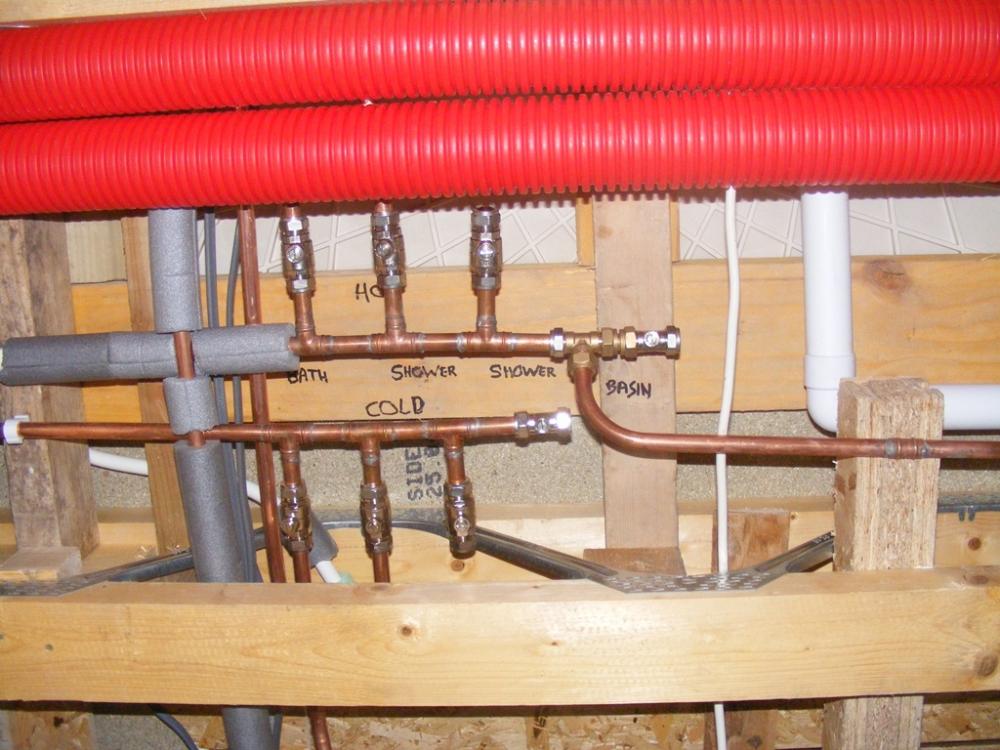
I thought I would post my own take on a manifold hot water distribution system. Requirements: To provide a central distribution and isolation point for hot (and cold) water distribution. To minimise pipe length to hot taps. To minimise pipe usage and be as cheap as possible. The location proved interesting. There is no central cupboard to locate such a thing without making the hot pipe runs longer. So I put it under the floor. It is above the utility room, so when the ceiling is boarded a small "loft hatch" will be made that can be lifted out to gain access to the manifold. This would not have been acceptable had it been any other room. This is what I came up with: All just standard soldered fittings and ball valves. This feeds the bath and shower in the main bathroom. The basin and shower in the en-suite will be added later when that room is done. The basin in the main bathroom is on the wall backing onto the HW tank so gets a more direct feed straight from there with it's isolation points inside the vanity unit. The compression tee is the "I forgot that" hot water feed to the utility room (which will have it's isolator in the unit under it) and I decided it was a little busy there to solder more joints in situ. The kitchen will also have it's own feed from the HW tank as that will run in the opposite direction to all other HW points. Not as pretty as a bought "proper" manifold, but a damned site cheaper.
- 1 reply
-
- 2
-
-
Preparing to lift the roof beam without a crane
ProDave replied to ToughButterCup's topic in Roofing, Tiling & Slating
Have plenty of strong mates, and the beer ready for the topping out ceremony when it's in place. -
Speak to your building control, I honestly don't know the rules under English building regs (anyone else?) Up here it's possible to phone them and speak to the "duty building control officer" to ask a question, or download the whole lot and get reading. There should be pages of information on "infiltration fields" that show you how to do the percolation test an show the distance limits EDIT (following your second post) You can't share a soakaway so say front garden for rainwater soakaway and back garden for foul soakaway. There will also be a minimum distance from buildings etc to the treatment plant. The soakaway can start immediately from the treatment plant unless there are different limits (e.g. here the treatmernt plant only needs to be 5M from the road but the soakaway must be 10M

