

ProDave
-
Posts
30680 -
Joined
-
Last visited
-
Days Won
424
Everything posted by ProDave
-
I have done lots of real time programming in previous employment, and to be honest, something that only has to do a few lines of code once every 10mS did not seem a particularly critical task. I never expected the serial comm's to be an issue and don't recall it being so in the past. I can only assume the systems I worked on before had larger buffers on the serial ports.
-

Advice on insulating underground pipework
ProDave replied to Diablo's topic in Boilers & Hot Water Tanks
If it is a system boiler then it is just flow and return, and with enough antifreeze / inhibitor it will be good to well below freezing anyway, so not such a great problem. My concern would have been if it had been a combi where you would have had potable cold supply and hot out, and there's nothing you can do to protect those other than insulation. -
Thanks @Ed Davies I ran your code at 9600 and deduced my Ardiono Nano has a buffer of 64 bytes. Beyond that I start seeing big delays up to about 20mS So baud rate now up to 250000 (the fastest the serial monitor will run at) and I am down to 1-2 mS for my 100 character message Until you mentioned this I had never considered that writing a few messages to the screen might have messed up my timings.
-
Even with a treatment plant, you are supposed to have separate soakaways for rainwater and waste water. Have you actually explored the possibility of getting permission for a soakaway under one of the adjoining parcels of land? The very first thing you need to do is get a percolation test done. from this you can work out the area of soakaway you will need. Then you can draw that onto the plot (allowing clearance distances to the plot boundary) and see how much it takes up, and how much land is left for the house. Does it have to be 4 bedrooms? 3 bedrooms and a "study" would reduce the area of land you need (lower assumed occupancy)
-
Get him to asses your likely total load. 60A will probably be quite adequate unless you have some seriously big loads.
-
Advice on insulating underground pipework
ProDave replied to Diablo's topic in Boilers & Hot Water Tanks
Combi or system boiler? Why not, as is usually the case, stand the outside boiler so it sits against the wall where the old boiler flue used to exit? Then you have completely eliminated any need for buried cables. -
If your timber frame is wrapped in Tyvek or similar, and is going to be clad with blockwork, then go round and stick down EVERY joint. At our last house we didn't, and there was obviously a loose flap of tyvek, and when the wind blows in a certain direction you can hear this loose end flapping. It sounds like the house is farting.
-
Much less likely to suffer if you have a "plumbing incident"
-
Use P5 chipboard (the green "waterproof" stuff). It happens to be what our BM supplies even when you don't specify it.
-
If I am sending of the order of 100 characters once per second, then by the next send a second later, all 100 will be pretty well guaranteed to have gone unless I go down to 75 baud.
-
Have you got a more detailed sketch of the plot showing where the house is likely to go?
-
We did the same. Set up a "Temporary Bench Mark" which was just a row of nails hammered in to form a line on a fence post at the highest point on the site, from where laser level datums could be measured. All site spot heights were then just referenced to that temporary bench mark.
-
According to the Arduino reference: "As of version 1.0, serial transmission is asynchronous; Serial.print() will return before any characters are transmitted." But I will increase the baud rate anyway.
-
Okay if you are happy to keep the meter in it's box on the outside wall, you do not have to move it, You can keep it there, and your electrician can run a new submain via a switch fuse to the new consumer unit location. My previous comment was made on the assumption the meter was on the wall inside the garage. That new submain will have to be something like steel wire armoured cable to avoid the need for having to rcd protect that run.
-
Is there such a thing as a top entry manifold?
ProDave replied to Triassic's topic in Underfloor Heating
I only have 2 short UFH loops upstairs. I did consider bringing those down to the downstairs manifold, but the forum talked me out of it for the reasons given in the first reply. Instead there is an upstairs manifold in the conventional manner with the manifold forming the high point to trap any air and bleed it out. -
There are 2 parts to this. Firstly you need an electrician to move the consumer unit, which almost certainly means replace it with a new one in the process. There will usually be a lot of cables to re route so don't underestimate the amount of work and disruption to the building., Then you need to get the DNO to move the supply head to the new location. The cost for that will not be cheap, and again there is the disruption to the building to get the new supply cable in to the new location. A half way house is leave the supply head where it is and feed via a switch fuse to the new consumer unit, but if the object is to get all the stuff out of the garage then that does not really achieve that.
-
Internal wall insulation 600mm masonry wall - condensation risk
ProDave replied to Robbie's topic in Heat Insulation
Whatever you do, the BIG problem most people create with these old houses is the "plasterboard tent" It is normal to line the insides with a timber studwork, some insulation of you are lucky and then plastteboard. The problem people create doing this is they leave this gap open to the loft and hence cold air. As an electrician it is normal in such houses to remove a light switch or socket and be greeted by a howling cold gale. So whatever you do, the effectiveness will be down to the detail. -
I can't remember why I settled on 9600. As it's an emulated uart via USB I guess I could just whack it up a lot higher. I don't think it will upset program operation, but as it's also the basis of timings, it would make my Wh tally a little inaccurate if the program pauses every second.
-
Thanks. I will do some timings to see if it really pauses the program or if it all just gets buffered in hardware.
-
I present here my ideas / design for my home built solar PV dump load controller, based around an Arduino microcontroller. It is not presented as a "design" but rather ideas for you to use or adapt as you see fit. This is my MK 2 design. For background, my Mk1 version was based on a design by Eric Ward in Jan 2011 which used a single current transformer, and sampled the ac waveform a number of times per cycle to determine if the measured current was being imported or exported. This worked okay to an extent but some house loads, like the washing machine really confused it and made it think it was importing when it was exporting and vice versa. I now believe if adopting a single CT solution you should base it upon one of the electricity meter chips which are far more sophisticated to make this measurement accurately. So my MK2 version operates by having two current transformers. One measures the power consumed by the house loads, and the other measures the power generated by the solar PV. I am able to easily make this split as there is a convenient split at my outside meter box where both the current transformers reside. I now take the current measurement from the transformers, rectify it and filter it so I have a DC voltage that is proportional to the measured current, filtered with a time constant of about 1 second to smooth out transient currents. I use this type of current transformer, available from many suppliers, the cheapest being direct from China on ebay These come supplied with a load resistor built in, so as presented they provide a voltage output. But because I am sending the current signal some distance over twisted pair telephone cable, I removed the load resistor and fitted that inside my dump controller, so the twisted pair cable is conveying a current signal, not a voltage signal. Now onto the dump controller itself. In essence it measures house load current and PV generation current. If PV generation current exceeds house load current, it sends power to the immersion heater, switched by a Solid State Relay. Now a bit about switching and metering, Most electricity meters, measure imported or exported power based on an "energy bucket" and I believe they will only meter whole watt hours passing in either direction. So if burst firing a 3KW heater, to match say 1KW of surplus PV, you would have to ensure the duty cycle of the immersion heater burst does not allow more than 1 watt hour of electricity to pass before it turns off, and then lets the surplus PV flowing the other way empty the "bucket" again before it is metered. Based on a typical 3KW immersion heater, that will consume 1 Wh in 1.2 seconds. So you want the immersion heater on/off cycle to be shorter than that. So I have based my immersion heater on a half second period. Within that half second the immersion can be fully on, fully off or on for part of it, depending on how much surplus PV is available. To achieve this, and enable some program timing, you need a reference. The Arduino as standard does not have a real time clock, though you can buy add on boards to add that function. However, as a hangover from my Mk1 design, I have a "phase reference" input, which is basically a raw 50Hz ac input connected to a digital input pin. By sampling the rising and falling edges of that, I can time program operations in 10mS steps for any period that I want. This in effect creates an accurate clock signal for everything. So my Pulse Width Modulation for the immersion heater cycles once every 1/2 second, or a total of 50 10mS program cycles. This means I can divide it's on / off period into 50 such 10mS time slices and it can be on or off for any number. So that sets the resolution of different "power" levels that I have available. Other program functions run much less frequent. The basic sums that calculate the import / export power operate every half a second, and there are some display functions that show values on the screen if hooked up to a PC operate once every second. I also do some data logging that keeps a running total of the immersion heater on time, converted into watt hours. This gets stored to eeprom once an hour and recovered from the eeprom on program startup. The once per hour eeprom write is because they have a finite number of write cycles. Also using the eeprom.put() function, this only writes to the eeporm if the value has actually changed. I estimate this eeprom write regime should be good for 30 years eeprom life. I have a moving coil meter hooked up, and depending on the position of a switch on the unit, it will either display total import / export as a centre zero meter, or it will just display total PV being generated. Lastly a bit about how to calculate how much power to send to the immersion heater. You can't just measure the available power and set the immersion heater to that much, otherwise next time the calculation is done, it will measure no power as being available and turn the heater off. Instead the heater power is incremented if any spare power is available and decremented if used power exceeds generated power. So it ratchets up and down relatively slowly to obtain balance at which point all surplus is being sent to the immersion heater but no more. And now onto the code. Pick it apart but please don't be too critical of my programing style, some of the purists will be ashamed at my use of some global variables to save passing values back and forth between functions for example. Remember this is still under development, if I make significant changes I will update this thread, The code is posted as a .txt file, just paste it into the arduino programing environment. This is written for the little Arduino Nano board, you may need to change some I/O designations if using a different variant. arduino_pv_dump_controller.txt
-
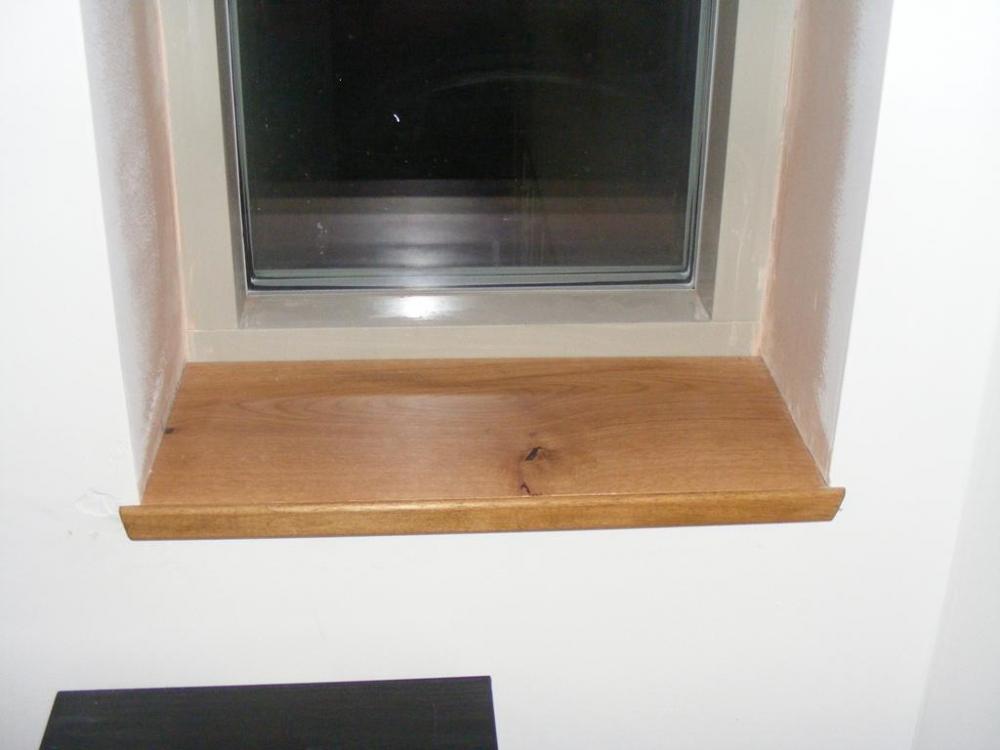
I did similar with left over engineered oak flooring
-
Re track saws. My joiner friend used one to cut my oak kitchen worktop to size. What surprised me is he just laid the tracl on the wood and cut. No attempt at all to clamp the track in position. I can only assume it has some sort of sticky / non slip backing?
-
I just bought a new Lidl multitool for £25 (the last one died after 10 years use) I can confirm that tne present offering DOES have quick change. I was pleasantly surprised.
-
Barn conversion and timber frame
ProDave replied to MattJ's topic in General Self Build & DIY Discussion
Hi and welcome to the forum. I would consider stick built on site, you after all have a dry covered space to work in. I would be concerned that an existing stone barn is unlikely yo be precise and square, and you are unlikely to get a timber frame manufacturer to deliberately make a frame a little bit off square to match the barn. -
If that is the case it is a badly designed valve as it will always reach that equilibrium, and only a swap for a different valve would fix it?



