
ProDave
-
Posts
30862 -
Joined
-
Last visited
-
Days Won
427
Everything posted by ProDave
-

1.8 metre long stair spindles. (and other mezanine topics)
ProDave replied to ProDave's topic in General Joinery
All finished. A total of 12 spindles made and fitted. I was then set another challenge. I needed to trim the gaps between where the spindles attach to the edge of the cantilevered section of the floor. I was just going to cut rectangles of plywood but I was told that's no good, it needed something more solid that would bring that edge out level with the outer edge of the spindles. That set me the challenge to find some planed timber with a finished size of 120mm by 32mm. I didn't hold out much hope of finding anything, but searching first amongst all the offcuts in the garage showed that was exactly the dimensions of the decking timber from the local sawmill. So one more length of decking purchased, sanded and varnished with the "bottom" smooth side showing and the upper ridged side glued to the wall.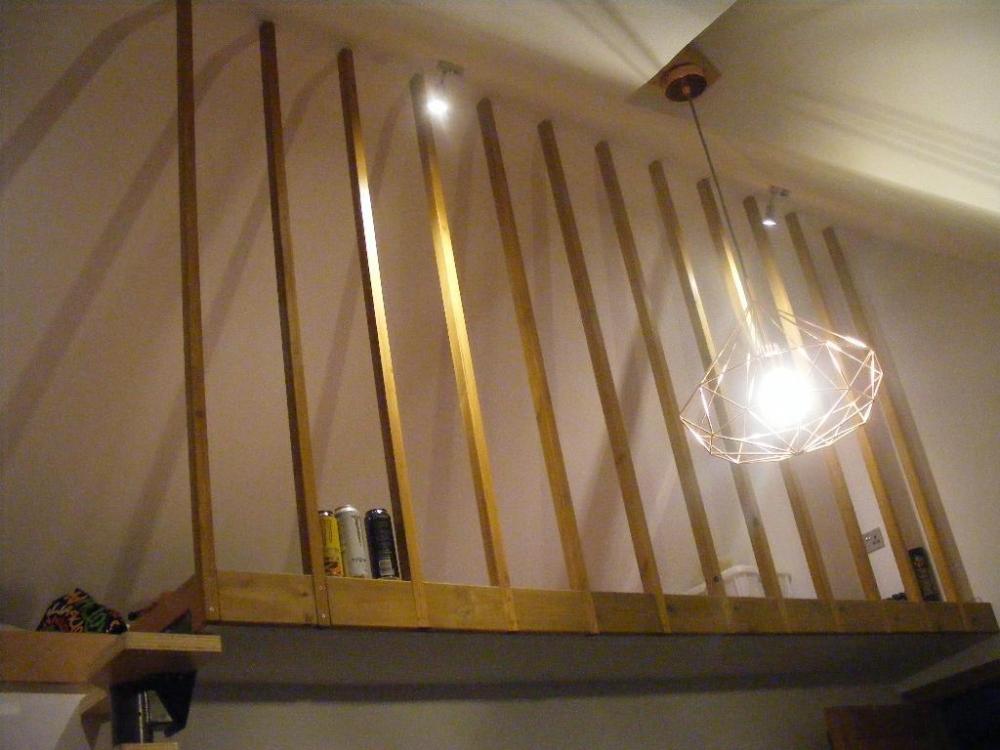
-
I would say it depends where you live. Out here in the sticks in the Highlands, I have no problem with them. But all I know is you are in or near Bristol. If you are in a town or city I would say no, if you are out in the sticks then maybe?
-
Worktop supplier recommendations Scotland
ProDave replied to Barryscotland's topic in Kitchen Units & Worktops
Stone Source Inverness is good but that is probably too far from you? -
Wire through wall for weather-compensation sensor
ProDave replied to Dreadnaught's topic in Air Source Heat Pumps (ASHP)
If you set up what you are proposing, you are doing what is generally known as dead reckoning. Even if your system as you suggest is perfectly balanced and heat input = heat losses, how id it going to cope when you have a party and have 20 people in the house and do a lot of cooking? it will overheat. and how will it cope when someone does not shut a door properly and nobody notices for half an hour? it will cool down. I can't see the opposition to simple thermostats and a basic number of zones, it copes with most eventualities like that. -
One thing from the above post. DO NOT try and run heating and hot water at the same time with an ASHP. Most have different flow temperatures for each and most let you set whether hot water or heating has priority (i.e. which one operates if both are demanded at the same time)
-
Wire through wall for weather-compensation sensor
ProDave replied to Dreadnaught's topic in Air Source Heat Pumps (ASHP)
People keep saying in a well insulated house, individual room thermostats are a waste. I find that not to be true. We only have 3 zones downstairs, the living room, kitchen / diner and utility room. I find the living room heats up quickest and is the first to switch off, next is the kitchen diner, and lagging behind taking much longer us the utility room. If I did not have the individual thermostats, it is likely the living room would overheat if forced to keep running as long as the others. I am not trying to heat them to different temperatures. This really is a simple fit and forget solution. Anything else and you are relying on a lot of dead reckoning, and you will spend a lot of time tweaking things to get it to work properly. -
Wire through wall for weather-compensation sensor
ProDave replied to Dreadnaught's topic in Air Source Heat Pumps (ASHP)
The alternative is simple room thermostats. Yes that's really high tech. Just a few simple room thermostats turn off the heating in each room when it reaches the set temperature. The house holds it's heat for a long time, and the other side of that is it only needs a gentle amount of low level heat. So when the heating is on it heats up slowly. This slow heating and slow cooling means it does not overshoot when it reaches the set temperature. So that is how we control the right amount of heat into the house in all weather throughout the season. What weather compensation will add to that, would be to run the UFH at an even lower temperature when it is mild. That would improve the COP of the ASHP in the shoulder seasons. At the moment it runs at a fixed temperature which is dictated by the heat needed in the coldest weather. I maintain you need to run the heating a whole season without weather compensation so in the coldest period you can experiment and find the minimum UFH temperature needed at the coldest time. Then, and only then when you know that, you have one point on the weather compensation graph. You then have to experiment to find the other end of that graph. That is not going to be a quick process. And in the real world, with a well insulated low energy house, how much will it really save with the small improvement in COP achieved in the shoulder seasons? Edit to add. @TerryE heats his house overnight using the cheap Economy 7 rate, so he as derived a system that calculates the heating needed for the next day and times the heat input during the overnight cheap period. S slightly different situation. -
I used to live in Oxfordshire, and one thing that has always stayed with me was the memory of it raining for days on end non stop and the relief after a few days when it stopped. That never happens here. 24 hours of rain in one go is a lot. It is much more likely that we just get showers. So it might rain on more days here, but we don't get the depressing days on end of rain that we did down south. (of course West coast Scotland is altogether different)
-
My father was a gas plumber and over 30 years ago now he did the LPG install at my first house, and that was all compression fittings, he said then something about solder not being allowed on LPG. I think that might have been the case previously, but later we had a new kitchen and a different gas plumber came to connect the new hob and did a lot of sucking through his teeth when he saw the compression fittings, but after drop testing it was okay to sign it off. New house has one soldered joint at the hob and one compression joint at the changeover regulator.
-
Wire through wall for weather-compensation sensor
ProDave replied to Dreadnaught's topic in Air Source Heat Pumps (ASHP)
I would drill a small hole in the back of the box and place it directly over the cable exit so there is no visible loop. A squirt of your favourite sealant to seal the hole. And a blank in the bottom in place of the stuffing gland. -
A neighbour here had to pay the DNO to extend and re route the supply cable as they would not allow them to build over it when adding a conservatory.
-
I take it the builder arrived on a horse wearing a pair of spurs? Even allowing for the outside gaps, that is no reason for that leak to transfer cold air to the inside so that is two completely separate faults that are allowing cold air in. As above that is always going to be difficult to detail properly building that close, hence no render on most of the wall, but that is no excuse for not getting the inside detail correct.
-
But you may have "wasted" some money by choosing an MCS installer (needed for RHI) compared to just the local plumber and electrician.
-
I have an enthalpy MVHR as well and it does not lead to condensation on the windows (other than my rogue one already mentioned)
-
A lot of waffle that actually says just about nothing.
-
Picture? Are you sure he didn't put a small bend in the pipe?
-
We have 1 pane that gets some condensation. All the ones supplied fitted by Rationel have no condensation issues, but this one pane the glass unit was supplied by the local window company, and I am building up evidence to "reject" it. When it is very cold outside (sub zero) it gets condensation near the bottom, there is also under certain circumstances evidence of marks on the inside of one of the pains. My trouble is I have not been able to convincingly photograph the issues. So i am hoping when the weather gets properly cold the condensation at least should show a lot more often, often enough to get their sales rep to visit and witness it.
-
No 1 it is very unlikely the ASHP will use the cylinder thermostat to set the temperature. That will usually be by a temperature probe inserted into a pocket on the tank. A conventional cylinder thermostat should also be connected and set to a higher temperature as a fail safe to close the motorised valve if the water gets too hot. You have to decide what your hot water requirements are. Do you always shower at the same time of day so only need hot water then and are prepared to accept possibly tepid water at other times? I work on the principle that anyone might shower at any time of day so hot water must always be available. I have the HW set to come on at 11AM and go off at 10PM. The 11AM start is to ensure good self usage of solar PV power, it should be generating well by then. the 10PM is based on nobody normally showers that late so there should be enough hot water left in the tank overnight for a morning shower.
-
If energy eficciency really mattered, then house buyers would be very interested in the EPC rating, would pay more for band A and B houses, and pay a lot less for band F and G to reflect the amount of work they need to bruing them to an acceptable standard. I don't see much evidence of that happening other than perhaps landlords avoiding the worst ones that are too poor to be legally let and not willing to do the work to upgrade them.
-
It looks like that was built as a vaulted roof hung from that ridge beam but that does not really work with a hipped roof without steels to support it at the end. The solution is simple, a horizontal timber say 4 by 2 across the roof at wall plate height strapping each rafter to it's neighbour the other side, securely bolted at the junctions. this will stop the spread. You might want to set up something like a Spanish Winch to pull the sides back into place at each rafter before bolting the cross members. The purists will say roof off, re lay the cracked courses and rebuild the roof.
-
I offer a contrary view to the above. Do NOT kill the sale of the bungalow, let the sale proceed and move into the caravan. A 5th wheel van is the top end of the touring caravan market and should be comfortable. The only issue becomes pay for a site or pitch it on your own plot. I offer that as honest advice in a market that nobody understands. There are plenty of things in the pipeline that could kill the housing market, and trust me, as someone that gave up trying to sell after 3 years on the market in a dead market, you do NOT want to be holding a spare house with all the financial implications of that, wishing you had sold it when you had the chance. We actually found that moving from the caravan into the very unfinished house was way more comfortable. But at the very least you can store all your furniture in the dry and set up a laundry etc in the unfinished house quite easily. If you still haven't got electricity by completion day, negotiate with the buyers of the bungalow to power essential items like the caravan and laundry from an extension lead from the bungalow.
-
Can you Feng shui my study please?
ProDave replied to Adsibob's topic in New House & Self Build Design
I started with my desk facing the wall under the window. Unworkable, in the afternoon when the sun comes round You have the glaring sun behind your PC monitor. I now have the desk on the next wall round so facing a blank wall with the window to the side. Very late in the day the sun can shine right on the monitor, so not as bad but still unworkable late in the day. Most offices I have worked in the desks are a long way from windows. In my workshop I have a bench under a roof light and that seems to work well. So putting your desk under the roof light might be better for lighting and the room is still small enough to look out and daydream if you want to. -
One of the "disappointments" of our build was the inability to get PV registered on the FIT scheme without an EPC and the inability to get an EPC until the house is complete. And further in spite of trying the inability to get anyone to write an exemption letter to claim the FIT with an exemption. Had FIT been possible the ground mount PV would have been installed as soon as the site had a supply and the static caravan was sited. I then watched the FIT rates fall, and then the FIT end before I could meet the criteria to sign up, which was a major frustration, and for some time i pondered whether to go ahead or not and I am glad I did but also glad it was very cheap to do.
-
Re the scientific explanation. It makes me cringe when someone tries to explain heat pumps by talking about compressing gasses and evaporation etc. While he is technically correct, as in the joke thread above, most people will simply not understand. Why can't they just say something like "it extracts some heat from the air by cooling the air a bit, and puts that heat into your house" Most people would understand that.
-
Even if they don't have a pressure gauge built in, the changeover regulator usually incorporates a test nipple onto which the gas engineer plugs his manometer with a hose to do the drop test.