
ProDave
-
Posts
30688 -
Joined
-
Last visited
-
Days Won
424
Everything posted by ProDave
-
Which ASHP? To be honest i have not encountered one with full PID control. PID is something normally used in machine control or on furnaces etc where you are after both accurate and fast response. That does not normally apply to an ASHP heating a house.
-

Air Source Heat Pump - need heating advice
ProDave replied to MartynP's topic in Other Heating Systems
The idea of weather compensation is to reduce the temperature of the delivered water when less heat is required to improve the COP. Personally i maintain that to set that up you need to know some data about the performance. So what you first need to find out, is on the very coldest days in winter, what flow temperature do you need to get the house up to the required temperature. Only then when you know that can you begin to play with the weather compensation curve, experimenting with the other end of the curve to see how much you can reduce the temperature by in mild weather. So for this season at least stay with compensation off. If you are really running at 50 degree flow temperature, those COP figures look good. How are you calculating the COP? or what is measuring the "delivered" power? The big question to start with, is with a constant flow temperature is the house getting hot enough? -
Discount Offers of the Week
ProDave replied to Ferdinand's topic in General Self Build & DIY Discussion
Try https://www.bpcventilation.com/ A well known company offering mvhr systems etc and frequently recommended on the forum. -
Well you would need a buffer tank feeding whichever you are pre heating, with an immersion heater in it, and a solar PV diverter to send excess power to the immersion. You would also have to determine of the shower or combi will be happy with a warm, or possibly very hot feed into them.
-
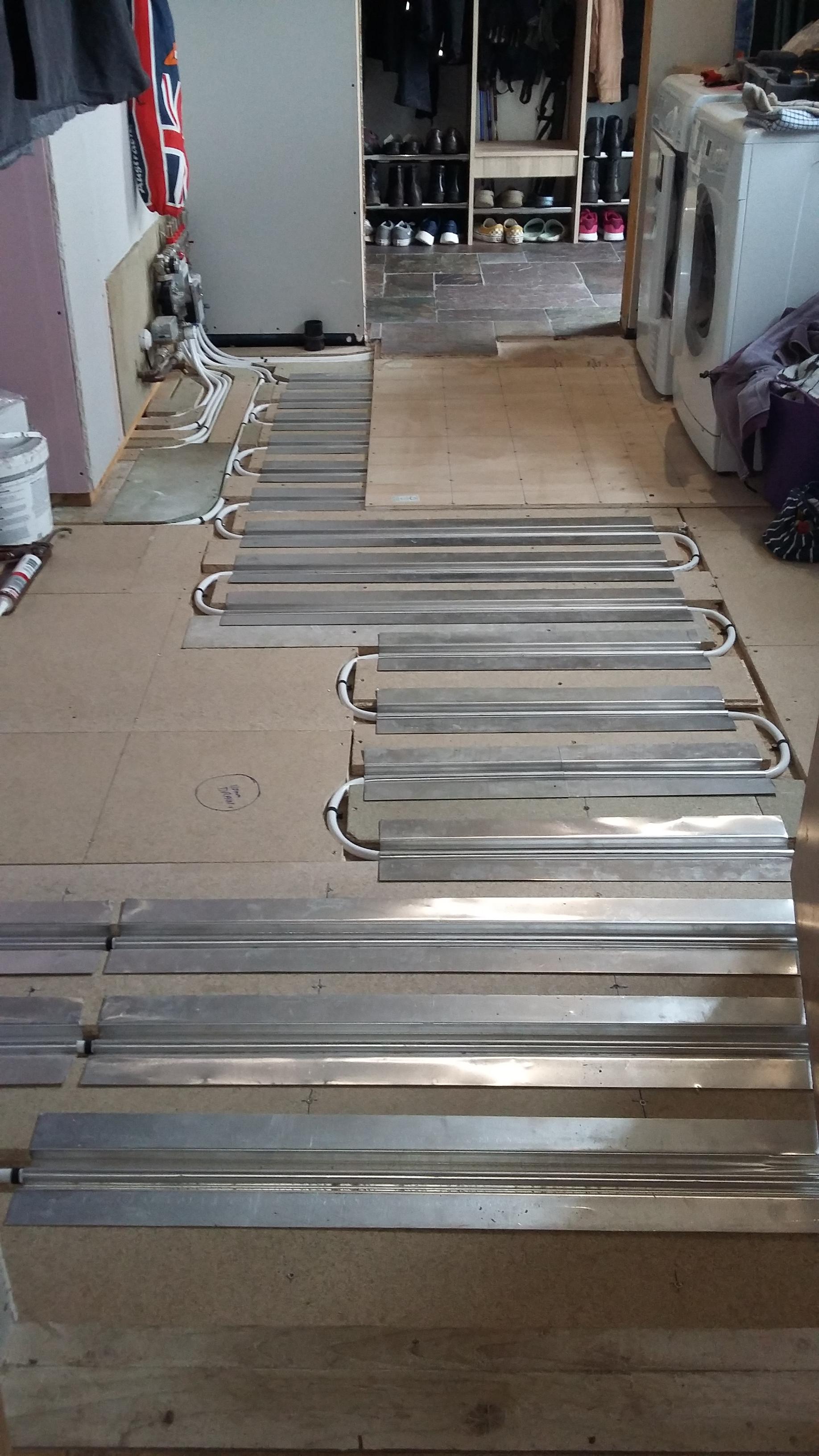
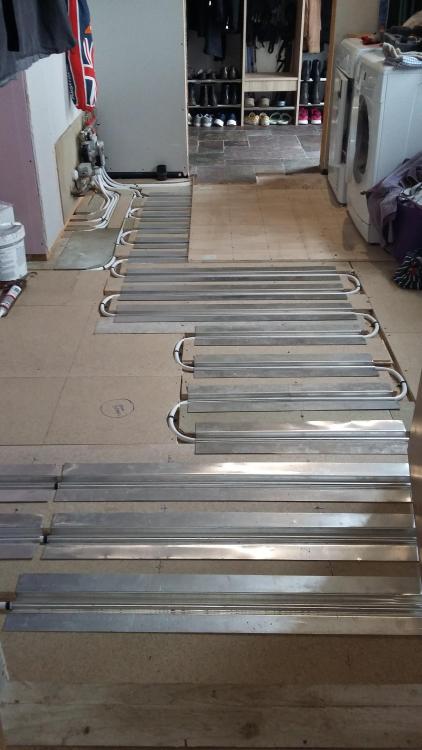
Here is a picture of it in progress. You see the UFH pipes with the spreader plates suspended on the strips of chipboard flooring, then on top was 18mm ply, glued and screwed to hell then the tiles. The bits with UFH missed out, on the right is where the row of units will go, and on the left, there is an area left out where there is provision for one day fitting a shower (and then dividing the room in two) so no UFH where the shower might one day be installed.
-
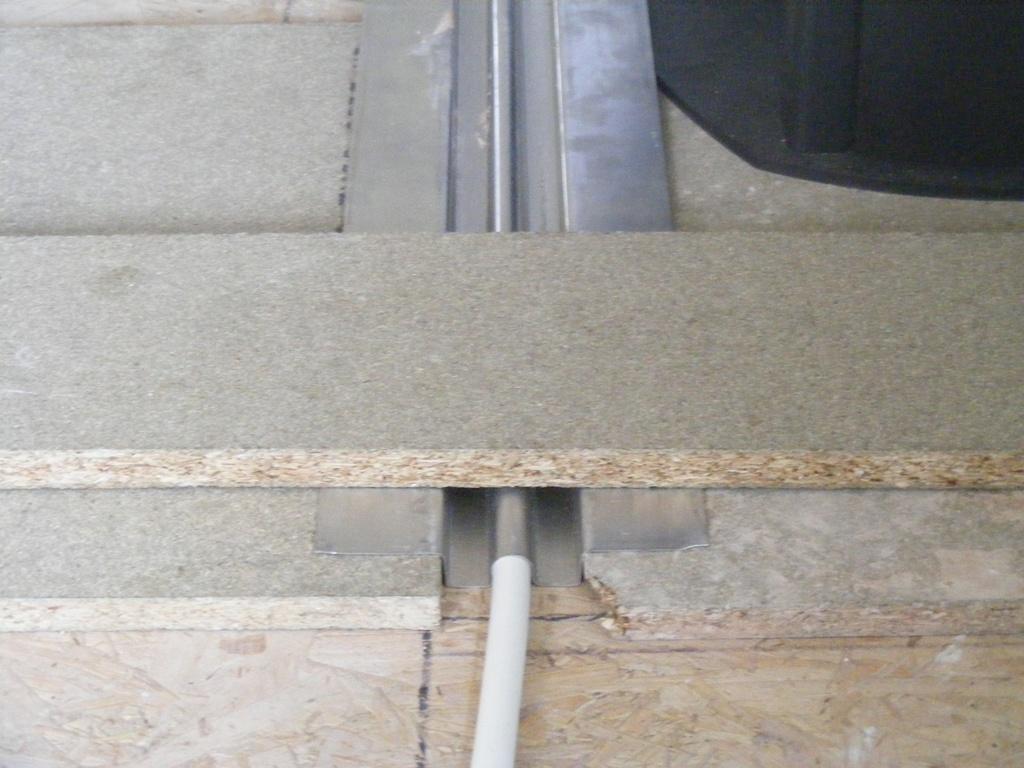
Do something similar to what i did in our utility room. This is just a mock up when i was working out the detail, I can't immediately find a picture of the actual thing. so you have a chipboard floor down screwed and glued. Cut strips of chipboard to match your pipe spacing and lay them across the floor so they are spanning joist to joist (on top of the chipboard. Under floor heating pipes with aluminium spreader plates laid on top. Final floor covering laid over that, shown in this mockup with a strip of chipboard, this will be your engineered floor boards.

-
New build or retro fit? What insulation is under the floor?
-
To get a floor temp of 27 degrees you would need to put very hot water through the pipes. There will be a temperature gradient from the pipe temperature to the floor surface temperature, and that is hard to predict, but my own heating the UFH temperature is about 35 degrees and the measured floor surface temperature is about 22 degrees. It will be hotter in places e.g. underneath a rug. Try it and see, starting low and gradually increasing it, and get a cheap IR thermometer to measure it with.
-
The good standard bit I take exception to. What the small guys can do is is listen to what the customer wants and do exactly that. You won't get that level of detail on a mass build. I do agree not all tradesmen are equal in quality though, I know about 4 or 5 joiners, but only one of those is good enough to work on my own home for finishing joinery.
-
Worth digging more than 200mm under floor joists?
ProDave replied to House man's topic in Introduce Yourself
Corrected that for you. -
My experience is no you won't. Well at least up here all the trades I know only do small jobs, by that I mean nothing bigger than a single house and very often even smaller like an extension or alterations. I don't know of any of these "small trades" that also work on the big building sites and I never meet tradesmen from the big sites. So as far as I see to separate markets served by separate companies.
-
Excellent news @oxo That's the best Christmas present you could wish for.
-
Worth digging more than 200mm under floor joists?
ProDave replied to House man's topic in Introduce Yourself
There is no reason why a suspended timber floor cannot be insulated properly, ours is. A solid slab is not the only way to get a well insulated floor. The original question seemed to be about access and crawl space to access services. Our previous house had nearly 2ft crawl space with access gaps through the sleeper walls so you could crawl around under the entire house, and we had 2 trap doors to get down under the floor. That house has some pipework under the floor and some cables, think building a house the "old way" Our new house has a similar void under the floor but no trap doors to get down there because we wanted a better level of air tightness. But this time there are no services down there. Obviously mains water electricity etc come up and into the building, but straight up in ducting. There is just one short run of drain pipe not under but within the depth of the floor beams to serve the utility room. That should not need access ever. There are no water pipes or cables under the floor, those are all in the service void around the walls or in the inter floor space between ground and first floor. -
If you have not looked already, take a look at the website of the guy that lives off grid at the north end or Raasay which includes a lot about his electricity system. https://lifeattheendoftheroad.wordpress.com/
-
The price of Kerosense Vs mains electricity is making a diesel generator look attractive, particularly if you can use the heat it produces as well. That would do the winter, with some batteries so it does not have to run all the time and the PV would do most of the summer. Given your elevation, a wind turbine of a decent size is probably also viable.
-
Simple light switch in series with the L feed to the PIR sensor
-
It's definitely that orange wire, that's why I suggested physically following it through the trunking, you might even find where it is pinched or damaged doing that. My suggestion was to eliminate the "external" wiring to the lamp as the cause. Yes I am thinking green light. If the compressor is running and it's working it can't be that. If the light is on the outside of the case, UV damage could have cracked the plastic and water got in? just a guess.
-
I think, according to the circuit diagram, R1 (the one we thought was the problem) and R5 share the connector "D" can you confirm that one is the one you unplugged? Looking again at the diagram, R1 is energised when the compressor is OFF presumably to keep a bit of background heat in it. We need to find what is connected to the normally open contact of KA6/1. The diagram does not help us as it does not make any distinction between KA6/1 and KA6/2 So looking for NO contacts on "KA6" one feeds the compressor, and one feeds a light that is connected via terminals 8 and 9. Can you clearly identify any of the terminal blocks as being labelled as 8 and 9? If so try removing the cables from one side of each and try again with KA6/2 plugged in? EDIT the terminals 8 an 9 I am looking for are on the "Installer terminal block" not any internal terminal block.
-
And NEVER accept their first price.
-
Yep, seen many e.g load bearing walls taken out and steels inserted, stairs moved, lofts "converted" all with no building control involvement, There is a guy near here who started building a house at about the same time as us. But his is even slower and not yet finished. He was telling me how awful it was that BC wrote saying he needs to extend the building warrant. He didn't. They followed that up with letters saying he would not be able to legally occupy the house and would not have to meet the current versions of building regs to finish it. Of course he has just ignored that as well. It will be interesting to see what happens when he does finish it.
-
Are you saying it tripped when you put the relay back WITH that plug disconnected? If so, we have not solved this yet and this is where, due to the ambiguity on the circuit diagram, to start physically following the wired from the relay through the trunking to see where they actually go to.
-
Sloppy journalist alert. EXCLUSIVE: Retired businessman, 73, faces £100,000 bill after outraging neighbours by extending his house into church cemetery NO HE DID NOT . He took down the existing boundary wall and built up to what he believed was the boundary, Not INTO the cemetery. He still should not have built it without PP but I just hate seeing sloppy journalism like that.
-
You can probably go into your local Howdens and get them to design it while you sit there and guide them. Our local Howdens are happy to meet the end customer like that, as long as the actual order is placed through an account. I have had no problem using my Howdens account at a different branch when I have been working closer to another branch.
-
Yes if it does not trip with the relay back and the heater removed that should prove beyond doubt you have found the fault. Then we can concentrate on finding a new heater or fixing the one you have.
-
A multimeter won't do the insulation test. It will do a resistance check to determine the heater power. Follow the two black wires from the heater, they will end up at some of the terminal blocks a bit like the compressor motor cable you have already identified. Put the meter on the 200K ohm range and measure the resistance between the 2 black wires you have just followed to the terminal blocks. There is little doubt the heater is what is tripping the rcd so I would just be looking to replace it. But if you want to try rejuvenating it, I would be looking to undo the big jubilee clip, and remove the heater completely and take it into the house and put it somewhere warm for several days to thoroughly dry it out.