
ProDave
-
Posts
30680 -
Joined
-
Last visited
-
Days Won
424
Everything posted by ProDave
-
Look up Biopure, Vortex, Conder ASP as probably the most common used by forum members. They work with an air blower agitating the contents so no moving parts down in the smelly stuff and usually the worst that can go wrong is the air pump will eventually fail so you just replace it or repair it.
-
I would have contested that planning condition and instead asked them to specify "private treatment plant" The Biodisk would be my last choice, moving mechanical parts that WILL one day break is not a good idea. Have you bought it yet? If not I would hold fire on ordering and let us recommend something better (one of the air blower treatment plants)
-
Best we continue this discussion on the thread in the waste & sewage section.
-
Yes, to feed ONE double socket. If that is all that is at the far end of the SWA than fine. However I suspect there might be more connected there.....
-
Can you post a plan of what pipes you have and where in relation to that the new pipe has to finish? Only with that can I tell if there is a better way. e.g going into the top of the soil pipe where you are suggesting means you can't then run your new pipe through the joists. That may or may not be a problem.
-
That is a spur from a ring final and not good for anything other than one 13A socket at the far end. Not a way I would advise anyone to do it.
-
 So, lets say we find lots of "gold hydrogen" and mine it, and burn it to make some form of power or power vehicles. it "green" right, because it does not produce CO2. However burning it, WILL consume oxygen from the atmosphere, and it WILL emit water vapour. So there will be a little less O2 in the atmosphere and a bit more water vapour in the atmosphere. Has anyone modelled what that will do to the environment? My bet is people assume it's insignificant, and perhaps it is, but before we start mining and burning golh hydrogen it would be good to know it is not just going to create a different problem. How would the atmosphere behave with a little less O2? And where do you think all the water vapour emitted will end up and with what effect?
 -
Is that temporary? Are you later going to fit a proper balcony that you can sit out on? (I highly recommend that)
-
You re think the entry route. You could do a potted waterproof connection, but it would be to some other cable of the correct size. Your challenge is to find a more flexible cable that is suitable for outside use. Try and get the SWA inside the house somewhere, through a wall not window frame, inside a cupboard or under the floor, then a junction to a more flexible cable is very much easier.
-
So no doubt about it, SWA glanded into consumer units at each end, and final circuits wired from garden room CU as normal. No need to bodge direct connections from SWA to flat.
-
Unlike Scotland, England has Part P of the building regs that requires a qualified electrician signed up with a competent persons scheme like NICEIC etc to sign it off. In theory in England you can pay BC to do the test and certification, in practice it is almost impossible to get them to actually do that.
-
More information needed. Best way is SWA glanded into a mini consumer unit and final circuit(s) from there with appropriate rcd / mcb protection. But you don't give us any idea what you are trying to do. Is the SWA already protected by a 32A MCB and you are trying to make a lollipop circuit?
-
I rate Octopus because their customer service is less bad than many others, and you are actually in control, you can set your DD amount or as others have said just pay actual bills, if you end up too much in credit you can ask for some back etc. So many other suppliers just choose their own random amount, make silly estimates, won't let you change anything and hold onto a large credit, and won't even discuss it. In other words Octopus allow the things you expect and would hope are normal, but so many people with other suppliers have plenty of horror stories.
-
My built in bin has a standard door with the usual adjustments. You can attach the door to the appliance, then adjust the feet to raise / lower the appliance to get the door right before you screw the appliance in place.
-
Choose the cable method between CU and outbuilding to not require an RCD you can connect it from a non RCD protected MCB in the CU. It will require a high integrity CU.
-
Built in appliance doors have almost zero adjustment. Fit that first and then adjust the other doors to line up with it. The fun starts if you have 2 built in appliances.
-
Let me start by saying an electric boiler is the most useless invention man has ever made. IF you are going to use direct electric resistance heating you are better off just with panel heaters and an immersion heater. Putting a big heater in a box on the wall and using water to move the heat around that will never make it more efficient. However it has given you wet under floor heating so that might be useful. No 1, separate out your space heating and hot water heating, before you can go anywhere you need to know what is using what. If it were me I would be fitting an electricity meter on the feed to the boiler, setting heating and hot water times differently NEVER on at the same time and taking lots of readings to see how much the HW and heating are using separately. How good are you at DIY? With help from this forum would you consider DIY fitting an ASHP? I have no idea what the regs are on Jersey but the parts are likely to cost no more than £5K and DIY might make it viable. You might be better off just with a good plumber and electrician that you can trust, and who are capable of reading an instruction manual, rather than a "specialist" heat pump company which is what I suspect you have been talking to? Do you know anything about the building construction, what levels of insulation for example, particularly under the floor? And what temperature is your UFH running at the moment?
-
Dry/Non screed install of wet UFH on suspended timber floor
ProDave replied to Norbert's topic in Underfloor Heating
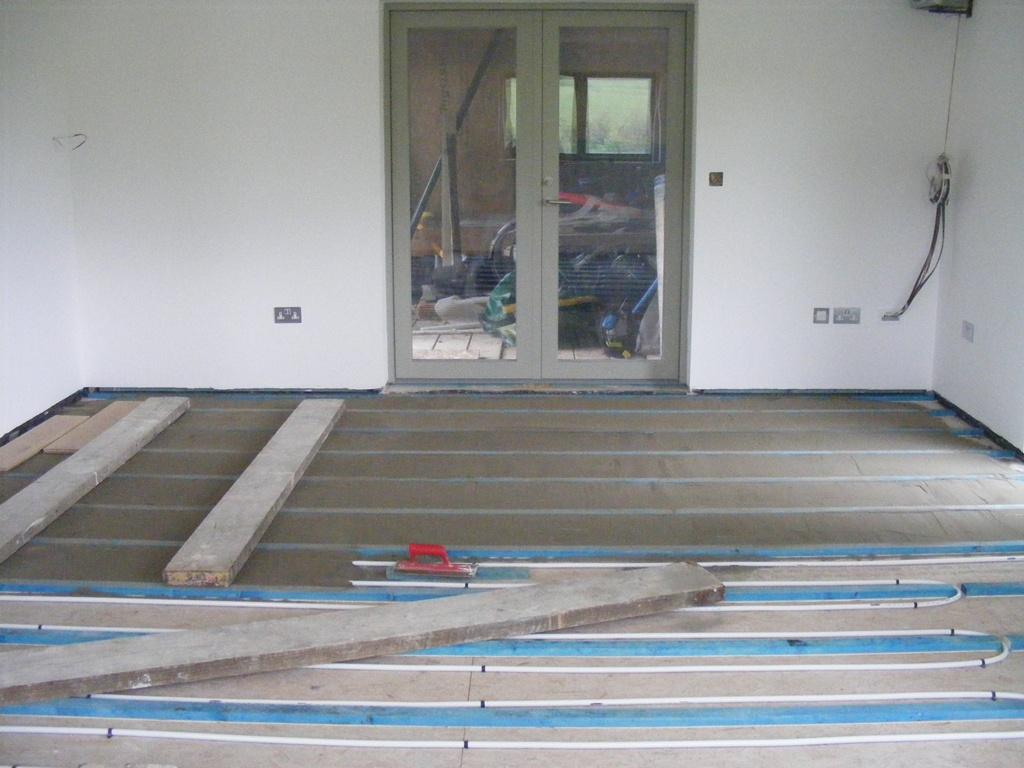
I used dry screed often called pug mix. On top of joists lay OSB or ply, 25mm battens following joists, lay UFH pipes then dry screed, final floor (engineered Oak) on top. Very easy to DIY. Don't forget to include extra dead load when calculating joist sizes.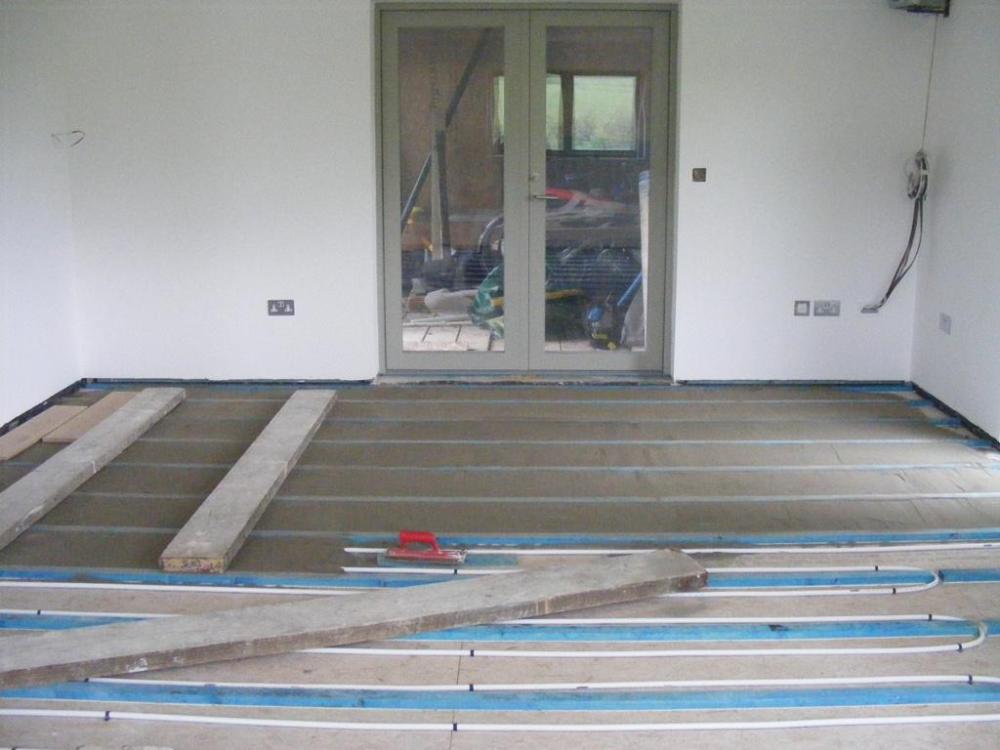
-
You used to be able to download the SAP program and input all the details yourself. You could never produce an officially recognised EPC doing that but it is a good way to while away a lot of time. For a good EPC you need good levels of insulation, good probably triple glazed windows, good air tightness that probably means a proper air tight membrane everywhere with well taped joints and good detail at every penetration, An efficient heating system, probably ASHP and UFH, MVHR and possibly some solar PV. and an official air tightness test. When I sent all the final as built figures to my assessor, my instructions to him were that if it failed to get an EPC A, to not lodge the EPC instead come back and discuss what would be needed to achieve an A. It came back with an A94 which I was happy with.
-
One issue I see is there might be a "warm up time"? If the heater is only a few kW then first time you turn it on, the shower temperature will be low as the waste temperature is low. Once warm waste water starts to reach the unit the flow temperature will warm up, but would there be an issue with a tiled shower where the waste water would initially be cooled by the cold tiles and may be a slow warm up time? Happy to hear how it works in practice. It sounds a good idea but only of interest to new builds or a serious bathroom refit. The biggest market would just be to replace existing electric showers, but the piping for the waste means that is not possible. How do you deal with access for servicing the unit? It seems like it needs to be under a floor with an access hatch to reach it. That might work with a carpeted landing next to a bathroom where you could fold back the carpet to get to a hatch?
-
In what way is your heater more efficient than others, how does it heat the water?
-
No problem at all, standard practice when wiring industrial cabinets.
-
I am electric only and remained on the variable tariff. The only fix they have offered me for a couple of years would have only been a tiny saving and as we keep hearing the price cap will fall over the summer, it was unlikely the fix would save money.
-
Voltage drop is going to be your issue. Voltage drop for 10mm is 4.7mV / Amp / Metre So at 16A and 60 metres that's 4.5V drop. That is per core, so total volt drop = 9V That mainifests itself as voltage rise when the inverter is generating. Most inverters will shut down or power limit at 253 volts. So with that much volt rise, if your house voltage exceeds 244V your inverter is likely to either shut down or reduce power. I would first measure your typical mains voltage and see how close you are . With long runs it is better to do a large part of the run in DC cables with the inverter close to the house. Volt drop on the dc side does not usually cause any issues.
-
How to measure the remaining HW in an unvented cylinder
ProDave replied to Adsibob's topic in Boilers & Hot Water Tanks
What does this "4 pipe" system do to improve efficiency? My ASHP is only 2 pipe (as I think they all are) and it only ever does DHW or Heating (with priority DHW) and runs both at different temperatures. It can be plumbed with a 3 port 2 position valve (not mid position) or as I have, with individual 2 port valves. The only disadvantage of the 2 pipe I can see is when it switched from DHW to heating, there can be a slug of water in the pipe at DHW temperature sent to the UFH (but the mixing valve on the manifold stops that being a problem) I fail to see what magic improvement a 4 pipe system can bring and why a heat only 2 pipe boiler cannot be set up to only do DHW or heating with priority DHW. That is more how you wire the controls than how you plumb it (as long as you avoid using a 3 port mid position valve)