SuperPav
-
Posts
224 -
Joined
-
Last visited
Everything posted by SuperPav
-
I have to question why, but then again most things I do someone would quite reasonably question why If this is "just because I want to prove we can build this thing without concrete", then that's fair enough and crack on with it. However, if you want to reduce the carbon footprint etc. it's not as clear cut as just cutting out concrete completely. So if you want to proceed without concrete, just look at how houses were built 300 years ago, and repeat? Dig down strip trenches until you hit hard ground, then use bricks or (if you're made of money) large stone over a wide footing, build up to ground level with lime mortar, then have a suspended timber floor. This can be easily insulated from below, and you can overlay a UFH system in either boards, or if you want a bit of thermal inertia, you can simply fit the pipes between joists in a layer of sand. Alternatively if you're okay with lime, then do the same for the footings, but instead of suspended timber floor, whack down some glapor (or equivalent), membrane, then UFH in limecrete.
- 16 replies
-
- 1
-

-
- ground screws
- timberframe
- (and 1 more)
-
Cold bridging at cavity reveals and floor slab detail
SuperPav replied to ruggers's topic in Brick & Block
I don't like the cavity closers as they're difficult to fix to. Also, in the past I've had just as much success of cutting and wedging a piece of 50mm Celotex between the leaves and foaming it to create a much more sealed cavity closer. You still can't fix to it so need to take the fixings back to the inner skin via straps. I've also found you need to use insulated plasterboard on the reveals, as it's more rigid (and you can only fix to the inner leaf really). Below is what we did on the current build (essentially built a plywood box BEHIND the outer leaf with a 10mm gap). Unfortunately this only works easily if you aren't tied to matching course heights between the outer and inner leaf (in our case the outer is cropped stone, inner is blockwork). Our cavity is fully foam filled, but I don't see why this sort of setup wouldn't work with other insulation.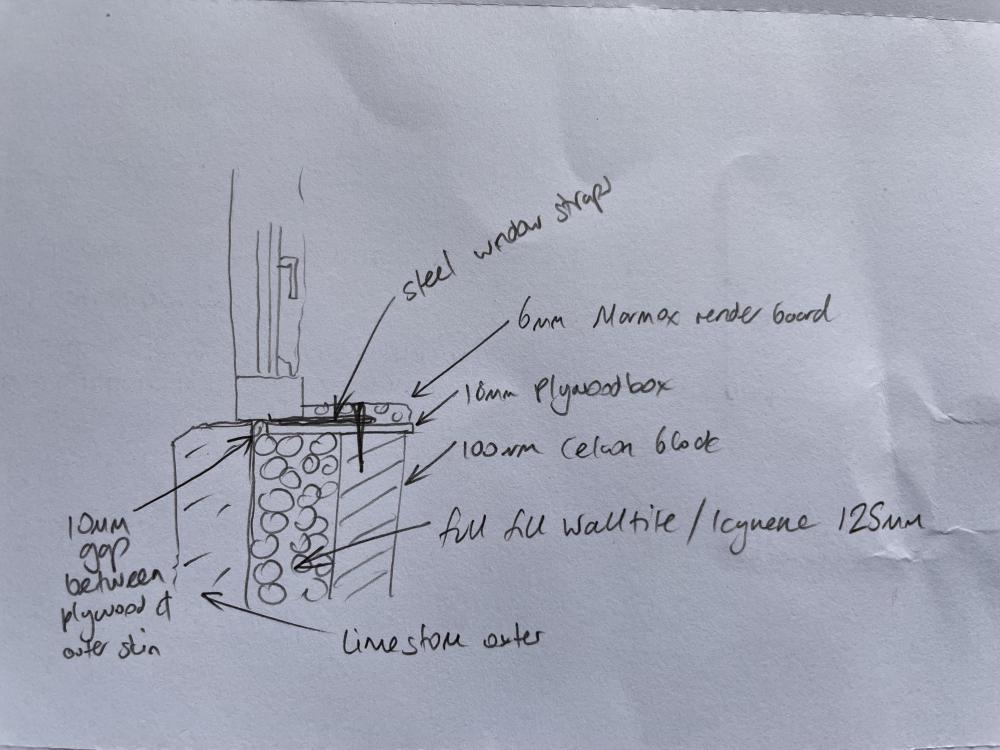
-
What am I missing here (something clearly)... For application in a pitched roof between rafters (200mm full fill) Knauf loft roll (from Wickes) works out to £4/sqm at 200mm Omnifit roll works out to someting like £11/sqm at 200mm Recycled PET at £15/sqm Sheeps wool at £35/sqm Now, I understand why the recycled PET and sheeps wool would be a lot more, but what is the difference between the "loft roll" and the frame/omni roll products? The thermal performance doesn't look massively different to warrant going from £4/sqm to £11-12/sqm? Or is it that the loft roll stuff isn't suitable for use between pitched rafters for whatever reason?
-
Do extractor fans always need to be near ceiling?
SuperPav replied to WWilts's topic in Electrics - Kitchen & Bathroom
An extract below a window would be really ineffective at doing what you want from it. What's the room and ceiling layout? There's usually a way to find a solution. The extract needs to be as high as possible, and ideally far away from the door (if not immediately above or adjacent to the shower). -
Paying tips to delivery drivers
SuperPav replied to Omnibuswoman's topic in General Self Build & DIY Discussion
Never tipped a delivery driver, but probably should do something to recognise our local Amazon and Hermes drivers. For all the shit we read in the news, there's about 3-4 regulars, and over the years they've always gone out of their way to leave the packages, even when it involves them entering a building site, clambering over some rubble and putting it safely in a box somewhere. It's a thankless task, with ridiculous time pressure and having to drive through difficult towns and villages trying to find houses with no number or name. -
Seems like only when installed! Although this is tipping the balance now towards me just using my relatively inactive Ltd company to branch out into energy-saving material installation. If I VAT register through election (currently only turn over a little bit so below the threshold in planning consultancy/design), I can then install all of our insulation (~15k's worth) and even with me paying my Ltd company a nominal labour rate for the installation, if it's all zero rated, it will save a decent amount. Otherwise I'm either paying 20% on anything I DIY install (as it's a renovation not a new build), or I get 0% on installed materials but paying someone the labour will wipe out any savings. Although I am pleased that we were delayed in getting the cavity wall foam insulation - that should give a modest £400 saving by losing the 5%. All this of course assumes that the firms won't just up their prices by 5% to offset the VAT...
-
Never worked with that, but I've found either a 14-15tpi plastic handsaw or a serrated knife the best for most types of insulation. The plastic saw is much more fine toothed than a wood saw and so catches much less. Don't know how much of an issue this is with the honeycomb stuff though. https://amzn.to/3igUBDr https://www.screwfix.com/p/bahco-15tpi-wood-toolbox-saw-14-355mm-/44210?tc=AL4&ds_kid=92700055262507126&ds_rl=1244066&gclid=CjwKCAjw_tWRBhAwEiwALxFPocvzzJ3MAdsY88RVriAsTbjBFGhYmHCliJla_RE1mj2IjSCc7YP-BBoCMJEQAvD_BwE&gclsrc=aw.ds
-
I'm not sure I understand the section detail here of 2x133 beams under the 350mm wall. The indiviual leaves should really be centred over the web of each beam. Which would mean an akward 15mm protrusion of the chords either side of the wall. In any case, I'd fill the inside web (facing the room) with 60mm PIR, and then cover over the beam on the interior side with whatever thickness of insulated render board (marmox/wedi) that brings you flush with the plasterboard. Board the underside of the beams with the same insulated board, and then pump the cavity full of beads which will also fill the space between the two beams. Also I'm not a structural engineer but I've yet to be convinced that bolting two beams at 600mm centres achieves anything when used in a cavity wall installation. (We have independent beams in our build for the two leaves).
-
Just a thought, when I was using insulated tiling boards on a brick wall in the last property, the manufacturer said these should be installed using a full bed (10-20mm notched trowel) adhesive rather than Dot and Dab. Can normal PB not be installed the same way with a 20mm trowel and a solid bed, to avoid any of the issues of airtightness? Or is it just that it is so costly that it's not worth doing and a parge coat is a simpler way of getting to the same result?
-
What about something like this, depending on your internal layout and duct routing options? An integrated cylinder with heat pump. https://www.heatershop.co.uk/dimplex-edl200uk?gclid=CjwKCAjwlcaRBhBYEiwAK341jdz8DNVbnJrzxbk1ovEi_RGvJ_EbNp7dLREhL5O8TUwt0wVa5byJAhoCbJ8QAvD_BwE Although I have never used one so don't know how efficient they are.
-
Sorry if this is a silly question but... we have 254mm posijoists between floors. If I put a 50 or 100mm layer of acoustic wool in the cavity, does it go up against the underside of the upstairs floorboards, and then run services below it, or do I run all services and then the acoustic wool sits below, just above the downstairs ceiling? The first way would be more practical for me, does it make any difference?
-
What's the size of the bathroom? Adding ply to the top won't really help with deflection if the joists are undersized at 600 c/c. Regarding the last point, if you're planning on using any form of heavy tiles, then skimming ANYTHING is not a good idea. I'd use cement board or (I personally prefer) Wedi or Marmox boards every time from now on, regardless of the wall substrate. Super easy to work with and excellent to tile onto + easy to tank.
-
Just to resurrect this, as this seems the way to go for our internal flooring at ~100mm. I just wanted to check if something like Topflow or Agila is suitable for use in footings and/or a ground slab, as we've got some foundations for the garage and a couple of bay windows to do, wondering if it's worth filling them all at the same time?
-
We may still use 75mm in some areas, but it's a pitched roof down to a relatively low eaves upstairs, and don't want it to be below 2000mm internal height at the eaves so we're limited. I think we've now decided to discount wool due to price, and will probably be going with recycled PET. The Mrs did suggest to go for cheap rockwool (as it'll be me installing it!!) and she'll buy me a gallon tub of barrier cream to help with the itchiness. I'm not sold on this proposal.
-
You'll definitely need planning for the dormers if you're in Cotswold AONB. If you're in the curtilage of a listed cottage, this might be a ballache regardless of which route you go to. However even in a AONB you have some options under permitted development assuming there's no Article 4 restriction or condition of the original planning. Even if you use the smallest 4x2 rafters with dwarf walls or purlins and tie them at the floor, that's not enough depth for insulation to meet building regs. Quite simply within the current set up you won't get a usable room up there. How much headroom do you have in the room below? If you could lose 200mm off that, and add 200mm to the ridge, you might be able to get something to work even without adding height at the eaves. In either case, the whole roof needs to come off, so stop thinking about working with what's there and just start thinking as to what options you've got that you'd get planning for that would still give you the increase in space you want. You may be able to reuse the tiles, but that's probably it. This is also why an extension may be a better choice. And currently living through the nightmare of having the whole roof removed off a house, I can't emphasise just how much more disruptive that is than an extension. All this also assumes you're in a location where throwing a large sum of money at an extra room is a worthwhile pursuit. Remember also that you're also most likely losing a fair chunk of space from the floor below where the stairs are going to go (unless you have a very un/fortunate layout at the moment).
-
You'll struggle to get usable headroom if it's 2.25mm from joists to felt at the moment. The rafters will need to be sistered with 6x2's at a minimum + insulation so you're probably at the depth of a 8x2 as a minimum. Then from the bottom you'll most likely need to sister the ceiling joists with at least 8x2's for the floor, again losing space. Unless there's a very good reason not to, building the walls up even by 500mm either side will make a massive difference and give you a usable space. Alternatively is there anything stopping you from doing an extension as it may be easier than messing about with the loft? As it seems your in my part of the world, if you need any help in terms of planning, let me know.
-
Just about to order our rolls of insulation for the pitched roof (vaulted ceilings) - approx 120sqm of roof surface to insulate at 200mm between rafters. There will also be 50mm PIR under rafters. The plan originally was to use the ionic treated sheepwool. Main reasons are it's a natural material so (irrationally) we like the idea of it, and also the fact that it appears much better than rockwool or plastic at controlling moisture. As these will all be bed and bathrooms, and we have OSB sheathing over the top which has a somewhat unproven vapour transmission, the moisture control element seems like a good idea. I've just run the £/sqm costings though and bloody hell have prices doubled since last year?! I didn't think sheep had any microchips in them?! Sheepwool @200mm - £44/sqm Thermafleece recycled PET @ 200mm - £15/sqm Knauf earthwool 44 @200mm - £6/sqm !!! At 100-120sqm that is a big difference! As we'll be installing ourselves, I have already ruled out rockwool as done that enough times and simply cannot be dealing with the itchy mess, but can anybody hit me with some pros/cons of the options to make the decision.
-
The problem is that while all the 3 methods you mention can work, 2 and 3 require a lot of attention to detail to avoid a lot of air movement behind the plasterboard. If you're going to do it or oversee that it gets done properly, i.e. really picky, then that's fine. Otherwise, wet plaster is the "easiest" way while just employing a plasterer.
-
Learning to live with mistakes. 5 Amp circuits
SuperPav replied to ToughButterCup's topic in Power Circuits
Feed to switched/unswitched FCU with 5 amp fuse in it, then run whatever socket(s) you want from it (ideally label 5amp on it) -
So after the dilemma of whether to stick with (rerouted) gas or bite the bullet and move to ASHP, I think we'll be sticking with the BH consensus of gas for now. However, we'd like to future proof for ASHP, so with that in mind can somebody recommend a pre-plumbed UVC (~300 litre) which can be used with a gas boiler in the interim and could then work with an ASHP if required (but doesn't need to work with both/solar simultaneously). Wet UFH groundfloor Radiators upstairs (oversized for lower delta T) 300 litres based on 1 bath + 2 showers, and the fact where it's going we've got space.
-
I never understood cavity closers - surely you just whack a strip of PIR in there with squirty foam round the edges, then it's completely sealed and you don't need to worry about whether the window installers will do a good job or not. But that probably says more about me than about the cavity closers!
-
Yes, I had a induction (electrolux/IKEA) 90cm hob in a 12mm solid surface worktop over pan drawers. There was no way it would work with cutlery drawer, so I think you may need to lose that (we have a small induction hob in a flat that's in 30mm worktop with a cutlery drawer under it and I wouldn't want any less clearance than that has due to heat buildup). One thing that I found very annoying is that the 12mm solid surface does sag a bit over wider spans, and if you have a wide pan drawer unit (we had 1000 I think from memory), it actually sags a bit in the middle at the front edge as there's not much of a support, which results in a small but annoying ~1mm gap to the glass surface of the cooker. Silicone will soon enough cover it but it's still not ideal. Shouldn't be an issue on a 60cm cooker though.
-
Just finalising the order for veluxes (upstairs is room in roof, eaves height 2.1m ridge ~3.6m). All would be too high up to reach without a pole for manual opening... but the dilemma is whether we'll ever need to open them. The main velux in the hall above the stairs void will be opening, so just need to decide whether solar or electric is best/easiest? Price difference is virtually insignificant. We'd want this to be openable for summer stack ventilation if it's very hot in the house so this one is definitely NOT manual. The other two rooms are the main bathroom, and an en-suite. These are the ones we're not sure whether to bother getting manual or electric/solar? We will have MVHR, so I don't anticipate us opening them up much, and given that they are in two ends of the house as bathrooms, not sure that the additional ventilation is particularly important for cooling? The 3 windows in the bathrooms would be ~£600 saving if we went for manual, which could really help at the moment, but can anybody see any reason to want opening ones? I suppose the solar kits can always be used to retrofit? Thanks!
-
I will most likely be installing a UVC with buffer tank, running off a gas boiler in the short term, but with the intention of at some point in the future switching over to ASHP. I'm going to pre-run the pipes to the cylinder from the location where the ASHP eventually would go, in 28mm Hep2o.
-
Feel free to consult a SE as I am not one, but I don't think that needs any support whatsoever. The weight on the rafter across its length means any sagging will be in the middle of the roof, so if anything it will be pulling the end of your overhang UPWARDS with that ratio of cantilever... If you want a column for aesthetics, just whack one on there but I don't think you need any structural support or beam/lintel across the ends (might just want to put a fascia board/timber on to finish the ends off).