


SuperPav
-
Posts
224 -
Joined
-
Last visited
Everything posted by SuperPav
-
Do you "really" need to skim Plasterboard?
SuperPav replied to idontknowwhatiamdoing's topic in Decorating
As an alternative, if you have the time/inclination, why not have a go at skimming it yourself? (FYI I can't plaster or skim to save my life so only wish I could do that!) £300 on a local college evening/weekend course for a couple of weeks, and then do a small room/cupboard/area you can hide If you take your time to get the boards straight and flat, it'll make life much easier whether you skim or tape and joint. While I prefer skim (and if I'm paying someone will always spec it), I've been in lots of houses (esp in USA) which are tape and fill and can't say it bothered me. Maybe they were just done very well? -
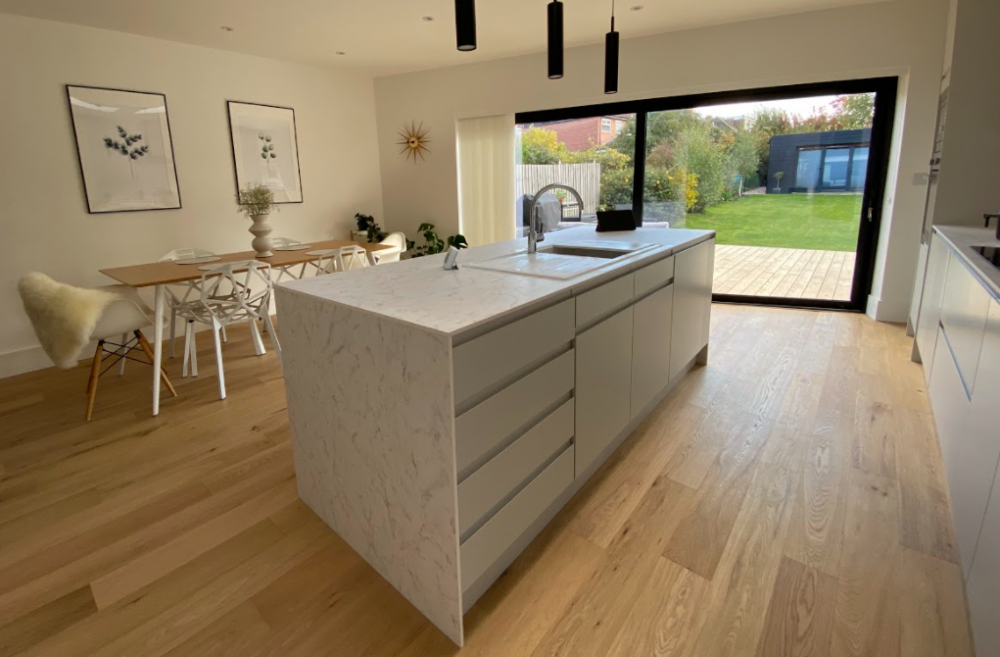
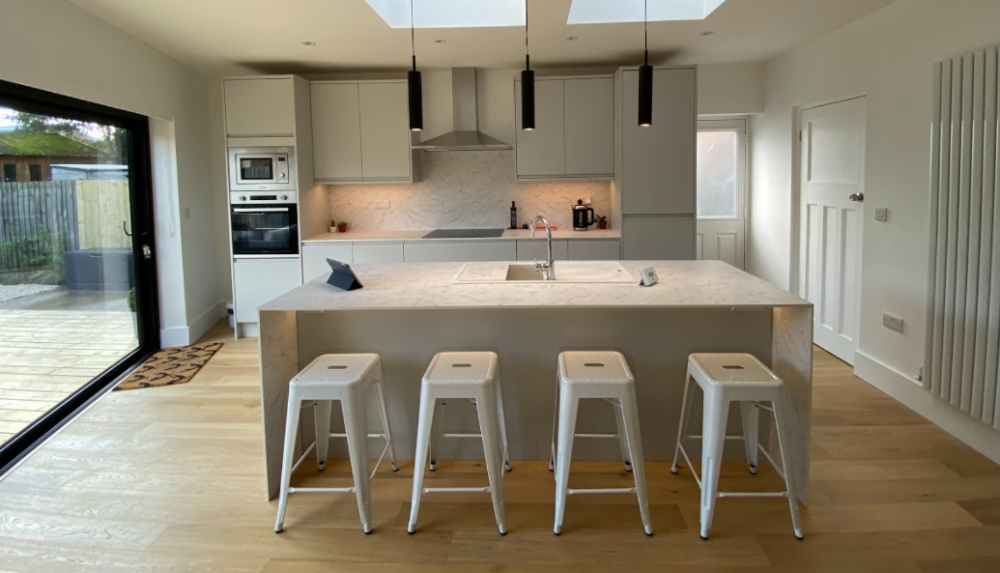
I used Better Kitchens on a previous build, with matt handleless fronts and oak print carcasses. (It was between them and DIYkitchens and came down to availability of colour.) In our current build we're getting bespoke solid timber units but otherwise I'd happily use them again for a conventional install, especially if you just want a simple kitchen and know the layout and exactly what you want. I've also used Jewsons (Symphony Kitchens) before and they were basically the same quality, but I found it more of a ballache to go through the branch than just pick online what units I wanted. I wouldn't use IKEA/B&Q flatpack again for a DIY install unless in a place with difficult access. Getting fully assembled, ready units delivered is *so* much easier and quicker. Plus it means you can spend the time actually fitting them properly, which in my opinion makes WAY more difference to how expensive/premium the kitchen looks at the end than the quality of the underlying units.
-
Concrete block foundation - how many should I use?
SuperPav replied to Danv's topic in General Self Build & DIY Discussion
Use paving slabs instead of concrete blocks - usually can pick these up for free locally, and the larger footprint means they're unlikely to sink unless your ground is REALLY soft. I'd go for the 32 you have in Option 1. -
I mean that logic does sort of make sense... except you're not substituting 215mm of thermalite for 65mm of marmox, you're substituting 65mm of the thermalite course for 65mm of marmox (which is much better) and then still getting the benefit of the remaining 150mm of thermalite below it... Whether it's worth it or not really depends on the rest of the house, and how much perimeter you have to cover with it. Marmox thermoblock is very satisfying to lay though! (or maybe that's just a placebo side effect of its expense...)
-
Reawakening this topic as we're trying to line up a contractor for Icynene (or similar) to fully fill the cavity on our build (stone outer, block inner). Icynene have come back and said only their closed cell (PU) foam is suitable for a masonry cavity application, I mistakenly was planning on open-cell waterblown stuff until this point. More worryingly, they've quoted just a shade under £10k for a 110sqm at 125mm fill, which seems insane? Still waiting for a survey and quote from another installer, but this cost would be a big problem (we budgeted around half that, based on blown EPS being quoted at ~£3.5k). The ties and cavity tray/dpm and airtightness detailing is pretty poor in the house, so we don't really have any alternative to foam insulation at this stage with out a lot of other remedial/additional works to correct the detailing. Has anybody used Icynene or other spray/injection foam insulation recently, and could recommend a contractor? The build is in Gloucestershire...
-
Timber frame vs ICF vs Traditional masonry for a new build
SuperPav replied to Indy's topic in General Construction Issues
Don't get me wrong, I'm not saying there aren't any reasons or upsides to masonry construction (we had the same debate before committing), all I'm saying is that having gone through the reality of a build with masonry, I would not repeat or recommend it for most high performance houses due to the realities of trades using this type of construction. If you've got a builder who is shit hot on details, thermal bridges and the like, and who can guarantee that all of his subbies and labourers will operate at the same level, OR you/a project manager micromanages the detailing full-time on site, you will NOT get real-world performance from a masonry house that you think you'll get in theory. I appreciate that is a bit cynical and I'm sure people will have examples of good experiences of masonry build, but I've yet to come across mainstream trades who will go around and fix every tiny little nick in a membrane, or take care not to make a hole or leave a small gap, or think about how they need to change the construction to avoid vapour build up or thermal bridging on a particularly detailed part of a house. Even if you give them detailed architect's drawings, they will follow them 90%, not 100%. As always, that is just my *opinion* based on our experience. As Tony suggests, there are plenty of upsides to masonry construction, and the balance of which is more important or carries more risk is down to you and your house, not to a bunch of grumpy selfbuilders on a forum -
Timber frame vs ICF vs Traditional masonry for a new build
SuperPav replied to Indy's topic in General Construction Issues
We're in the middle of building with thin joint masonry (so as quick and airtight as masonry can be), facing stone outer. While it *can* be neater, quicker, etc. it still relies on messy trades, and frankly their attention to detail is just not good enough for a high performance house, so unless you're there all day everyday on the details or doing it yourself, I think you'll be disappointed. I would 100% not do it again, and would go for timber frame all day long, whether clad, rendered or even with stone/brick outer. I would probably get a package company for a foundations + frame/shell build such as MBC. We got them to quote and looked into it in detail, but (unfortunately) stuck with masonry. I have no views on ICF as have no experience of it, but suspect the insurance/mortgageability is still trickier than timber frame. -
Here's what I'd do... (and I'm not saying this conforms with all the regs, but in my head it should be a good deal similar or better in real world performance to some of the "compliant" installations what have had no care or attention to detail). Cut fireboard strips to fill the web of the RSJ Install 6mm cement board (hardibacker or similar) in the gap to the stairs where the stairs are. 12mm Fireboard on the wall below/above that
-
This is why a single-OEM system "V2L" connection is more easily executable. The car only needs to know it is supplying to (or drawing from) e.g a Powerwall of its own manufacturer. The Powerwall can then have the necessary algorithm to work out whether it is dumping direct to loads in the house, topping itself up, or exporting to the grid. This is for the primary benefit of the homeowner. Connecting a car directly to the grid is much harder, and therefore having an intermediate buffer/control like this makes the whole thing easier from an integration point of view. Equally it makes it almost impossible to have a system that is agnostic to the brand/type of car, which is where a universal EV charger with V2G capability (and the necessary interface/approvals directly with the grid) comes into play. Once that protocol and standard is defined, and adopted by the DNO's and OEM's, it will provide direct V2G capability in the same way that Chademo has been rolled out in Japan. This is for the primary benefit of wider "society" i.e. it could be used to load balance an office or apartment block, or a grid.
-
Sure, that's a consideration. But what if we you were paid for it? Or at least offset the cost of charging your car? As an OEM, I can guarantee you that there would be no allowance of any V2G without strict parameters on the vehicle side (as mentioned in my previous post), so the battery abuse is a non-topic. An OEM would simply not allow V2G in situations/conditions which would degrade the battery, as it's the OEM ultimately that would be dealing with warranty claims. Any approved V2G interface would be one where the user doesn't need to worry about the degradation.
-
Given EV's are my day job, I can comment on some aspects here... 1) The degradation thing, as SteamyTea suggests, is a non issue if you manage it to small amounts of SoC, and within certain windows. E.g. it will only ever charge-discharge by +/- 10-15% and always within a prescribed window (e.g. 40-75% total state of charge). The degradation at these levels is virtually non existent. 2) The biggest difficulty with it all is creating these parameters within which the OEM will allow its car's use as a battery bank, and the integration of that with the grid and different brands' equipment. Relatively simple if all are coming from the same manufacturer, virtually impossible to do it as a universal plug-n-play without a lot of work on protocols and standards. This is why something like a Tesla PW concept is the "best", in that it's an OEM-created storage solution, with all of the sign-off and interfacing with the grid. Adding a (in this example) Tesla charger, and a Tesla EV as an extended buffer is relatively straightforward. 3) Some additional electrical safety regulation work is still required for the V2G side of things to be compliant, but to be fair this part isn't insurmountable. 4) With the price of used battery packs dropping at a rapid rate as EV adoption increases, I suspect it'll be much easier, cheaper, and "greener" to just integrate complete used modules into a permanent home storage installation with swappable module banks. Even a 50% degraded EV battery is still way more capacity than is required for any normal domestic power storage. However, there are some cases where V2G is really suitable and I suspect it will mature/develop further. Japan are a fair few years ahead on this as the Chademo protocol actually incorporates V2G within its standards.
-
Thermal bridging at gable coping upstand?
SuperPav replied to SuperPav's topic in General Construction Issues
That was my first thought, the problem is Marmox is 65mm thick, which itself isn't enough for the upstand. Sticking a diagonal course of masonry on top of the marmox on a 42-43 deg slip plane doesn't seem right, so would I just keep the marmox block down with timber and just screw all the way through it to the masonry below. In which case I might as well use the PIR as much cheaper than a marmox board, given there is hardly any loading on this. I'm also now interested where the hell originally the idea of coping gables came from historically? Surely running the roof tiles to the end would have been more robust, cheaper and easier for all involved. It's not like this saves on any materials (e.g. lead etc.) that would've been hard to come by in the past. Was it purely a design thing?? -
Thermal bridging at gable coping upstand?
SuperPav replied to SuperPav's topic in General Construction Issues
Thanks both, sorry for not clarifying. It's a room in roof, build up as follows> Plasterboard, 25mm PIR under rafters, 200mm wool insulation between rafters, OSB TG4 over rafers, counter battens, battens, reconstituted stone slate tiles. The cavity closer can go across the whole thing, can be anything really I suppose? cement board/6mm marmox, as long as the edge of it can be hidden by a 10-15mm mortar join on the stone wall. I'm just really struggling to find a detail for this, as the only ones I can come across are solid stone walls, where it seems these things just get plonked on top and nobody cares about any water infiltration through the mortar joints, and certainly nobody cares about any thermal bridging... -
Thermal bridging at gable coping upstand?
SuperPav replied to SuperPav's topic in General Construction Issues
So this is really bothering me now and I can't seem to find any decent details/sections of how housebuilders do coping on cavity wall construction without resulting in a cold bridge via the inner leaf! Instead of building all the way up to the coping in blockwork, would something like this work? i.e. block only up to the sheathing, then put a thermal break PIR strip sandwiched by 2 or 3 bits of 4x2 to get the required upstand, and then just sit the copings onto the stone and timber? Could even screw retainer brackets into the 4x2s... (just dumping brain ideas/thoughts onto here for my own sanity...) Gable wall detail.pdf -
What's the inner block wall made of? If it's aircrete or similar, then you can just use helical ties (as would be used on a thin-joint construction), to whatever course heights you want. If it's solid concrete block, then I'd advise against...
-
How many, what type, how sensitive/picky are you? We've hit a lot of similar supply issues, inevitably always found a way out one way or another by looking further afield...
-
How much am I overthinking this? Cavity wall, 100mm aerated block inner, 125mm stone outer, 125mm average cavity, full fill with icynene. Roof is a room-in-roof with vaulted ceiling, 200mm rafters hung off glulam ridge beam. At the gable ends, there will be stone coping (450mm wide). This needs to rest on both leaves, thus bridging the cavity, but also the upstand where the leaf flashing goes on the inner leaf is exposed to cold air anyway, so either way, the top of the inner leaf gets cold. This obviously just transfers down along the wall. 1) How much of a problem is this in reality (the house is far from passive house standards, this is a second storey add-on onto an existing old bungalow)? 2) Do I need to run a single pitched or stepped course of Marmox thermoblock to somehow decouple the upstand from the inner leaf below? I'm not as fussed about the actual amount of heat loss as much as I am about potential interstital condensation on the inner blockwork at the top of the gables alongside the pitched rafters which are insulated.... Same with the kneeler blocks at the bottom of the gable, which would normally bridge the cavity, something I'm trying to avoid. I'm ready to pay £500 in thermoblocks for the 3 gables if it would help and I can figure out how to actually get it laid, but don't want to do it if it's marginal as the budget is quite tight anyway....
-
Personally I'd probably just wire it up (assuming RCD etc. protections in place) until the place gets demolished, but if your electrician will connect it (after you've routed the cables) for £50, then i'd pay that as an insignificant enough amount. However, we have also previously survived a couple of months using a builders bucket with a battery powered camping shower hooked up to hot water in a sink (or other bucket), with a hoola-hoop suspended from the ceiling to hold a shower curtain when re-doing our bathroom if you want something a bit more creative!
-
Victorian Terrace - 45 Degree rule queries
SuperPav replied to Brett's topic in House Extensions & Conservatories
There are ways to do it and I've previously secured planning in conservation areas for things that may not fall 100% within the "standard" guidelines, but it becomes quite specific to the site and any constraints, as well as which local planning authority you're in, so more details required. I'm happy to have a quick (free!) look if you PM me and don't want to post all the last details publicly, although the more info you give us the more we can help you as a community. The good news is that there will always be SOME solution to any problem you identify, and the community here has as much a breadth and depth of knowledge as you could hope for!:) The other thing to bear in mind is the usual love it or list it (or both) decision here - how much value can you add to your terrace and how much will it cost? -
So around £550 + VAT? These days around here that gets you 2 days' labour of a semi competent tradesperson. Does it look like a 2 day job? The coving that was installed in our house when we moved in had such badly fitting joints, so if you get nice plaster coving with perfectly seamless transitions all smoothed out, I wouldn't be as scared by the total amount. Even though I reckon he'll do it in a day...
-
Roof ceiling joist strengthening.
SuperPav replied to alexbr's topic in Lofts, Dormers & Loft Conversions
Firstly I am not a structural engineer so in the absence of any insurance/survey etc. always go with the engineer's recommendations.... However... what I would do if all I wanted was a level ceiling would be as mentioned above, just attach straight 4x2's to the existing ceiling joists. Don't worry too much about their attachment to the wall or the rafter, you're still ultimately relying on the tensile strength of the original joists for the roof, all you're doing with the 4x2's is creating a level platform for the plasterboard. Personally what I would then do is add struts from the existing roof rafters to a single point above the spine wall/rsj in the middle rather than where they currently go midspan in a room! You will lose flat walking space in the loft, but it will channel any additional roof loads into a part of the ceiling/wall which can't sag, so will stop the ceiling sagging in the same place in the future. Do NOT notch, cut or in any other way reduce the strength of the existing joists - they are quite possibly just about fine as they are (other than sagging) but are woefully undersized by modern standards so don't tempt fate. -
North Cotswolds (Gloucestershire, just about)
-
Any good news re building?
SuperPav replied to CalvinHobbes's topic in General Self Build & DIY Discussion
This is good news as having purchased 10k worth of timber materials in a rush last year at the absolute peak of the prices, only for it to still not be used by our builders. No, not bitter at all! At least we haven't yet ordered our OSB3 TG4, so hopefully that's come down in price a bit as need 200sqm of it! -
Thanks Peter, It sounds like the right sort of product, as we've got the depth to play with but I'm going to show my ignorance here. What exactly is flowing concrete and how widespread is its use in residential - I've had a quick google, but am worried at the lack of local results, and at the number of results that use it interchangeably with "flowing screed"! Presumably it is a cement based screed with lots of plasticisers/additives added to flow better and not shrink too much when curing, as opposed to flowing screed which is gypsum based? Would it normally be left finished "ready to tile" or does it need finishing operations?
-
Planning oopsie. Retro fit drain channel?
SuperPav replied to Build2022's topic in Party Wall & Property Legal Issues
"No new hardstanding has been installed in my ownership, only maintenance and upkeep of the existing path/garden" if they ask anything else say "not as far as I know". if they ask whether you will do anything about it say "sorry, no" And leave it at that. Been there/done that with various issues. I would do the above unless you're REALLY struggling to shift your house and this is the only buyer willing to consider it (I doubt it in the current climate?)



