SimonD
-
Posts
2215 -
Joined
-
Last visited
-
Days Won
13
Everything posted by SimonD
-
Warm v's Ventilated Roof - Which Way to go ?
SimonD replied to bob the builder 2's topic in Roofing, Tiling & Slating
As per my earlier question, what has already been finalised and what is still open for re-evaluation and re-design? Presumably the windows were ordered when the timber frame was signed off for production, which means that's essentially fixed... Thanks, I really needed educating on that one 😉 Unfortunately a 1:100 scale drawing isn't much help when doing the details as even a bold line can hide a multitude of sins equal to as much a 100mm. But I don't think your problem is with the eaves, it's probably with the detailing around your qausi dormer window. Do you know the actual dimensions or do you have a detail drawing for that dormer to roof area? Assuming that your tf is not open to any change, then your options, if you want to go for a natural insulation, are to build up the total thickness of your roof either to the outside or to the inside of the timber frame. Each of those options comes with its own compromises. To the inside you'll lose ceiling height, which wouldn't be great at the lowest point as it's already fairly low. To the outside, it is probably easiest but you have the detailing around the window and possibly the eaves (the eaves are probably not a great deal in the grand scheme of things). To the outside you're probably looking at a minimum of 100mm extra. Also, if you did go this way, you'd probably also then be looking at modifying the wall buildup to replace your pir in there with woodfibre as there doesn't seem much point only doing it on the roof, IMHO. This means implications across all the build. HTH -
Warm v's Ventilated Roof - Which Way to go ?
SimonD replied to bob the builder 2's topic in Roofing, Tiling & Slating
Ah, okay, we've hit a sore spot - very common on here 🙂 😉, we all have them at several points of the build. Sorry to say this, but there's a few things that don't sit right with me here. If I've understood correctly, your roof is currently being designed by Roe, but the window to go into the timber frame has already been specified, ordered and made? Has the timber frame also been ordered and made? Because if that's the case the whole conversation re a change in buildup is moot and you're then limited to what you have. In that case you're limited in what you can add internally to the roof as you'll lose height where you've only got 2179mm height already, which I think is where you patio doors are going with the steel. If that's the case, given the buildup, you can't full fill the rafters with woodfibre because you need the ventilation behind the metal roof and only putting in 170mm isn't really going to cut it for what you want to achieve. If you're not completely stuck however, just for reference, when I refer to the pitch of the roof, I'm suggesting the change in pitch only to accomodate an alternative buildup using woodfibre with sarking boards. That would mean something less than about 2 degrees change if that. The finished roof level at the top where you'll install the standing seam would stay where it is. Depending on the size of your window, it might actually be possible to hide the difference in pitch, so nobody would be the wiser. In terms of measurement and to give you a better feel, this would mean that the height indicated on your sectiom B-B where the rafter meets the vertical wall reduces from 3586mm to about 3400mm, so really very little. What has actually been finalised here, ordered and made and what is open for re-evaluation and re-design? -
Kitchen: Wife's whims vs static design requirements
SimonD replied to MortarThePoint's topic in Kitchen Units & Worktops
Has she been watching youtubes? It could be a good thing. I've recently found some helpful stuff on there for kitchen design which has changed my design. What I also found really helped for my wife was to buy in a few of the bits like fridge/freezer, sink, dishwasher, place them out where they're going to be and then mark out the floor where the cupboards etc, are going to go. This helped her to visualise it all enough for us to finalise the design. Phew, and I didn't have to get the digger out to prep that new patio -
Warm v's Ventilated Roof - Which Way to go ?
SimonD replied to bob the builder 2's topic in Roofing, Tiling & Slating
I like cellulose too. Having used cellulose, sheepswool and woodfibre, I like them all. Just the experience of working with them makes it a whole load more comfortable and pleasant. I've used one small sheet of PIR in my built at a point where I needed to reduce coldbridging near some steel and I hated it. I've got some papers somewhere re the natural insulation - I have to admit, my management of references has been useless while I've been building so it's a bit haphazardous - I'll have a look to see if I can find something. It might take a few days or so. Yes, agree in good airtightness - totally essential - I just left those parts out as I assumed it was covered already and not the point in question. I'll be more thorough next time 😊 -
Warm v's Ventilated Roof - Which Way to go ?
SimonD replied to bob the builder 2's topic in Roofing, Tiling & Slating
I get it. It's one of those full of compromise. However, I assume the problem of height is just to do with section B-B? Can you confirm which flashing you're refering to here? Is it the flashing between roof and vertical wall, or something else? Assuming it's the one at the roof to wall junction, a standing seam roof requires a minimun upstand of 100mm for a roof of 13 degrees. Is there something not visible on the section drawing, like windows, causing the height issue? Not knowing your design history, the other possibility is reducing the pitch? You've got a 13 degree pitch right now and standing seam can safely go down to 5 degrees even with penetrations for velux windows. I don't think a lot of adjustment is required to give you that extra space at your roof to wall junction. I wonder whether it's worth a quick call to your designers to have a chat about your requirements as a client and how you'd like to revisit this design, in light of your updated needs? Or are you looking for something more definitive to go back with? -
Warm v's Ventilated Roof - Which Way to go ?
SimonD replied to bob the builder 2's topic in Roofing, Tiling & Slating
If you're intent on using the flex woodfibre between your rafters then I'd suggest it would be really useful to consider if you can increase the height of your roof buildup over the rafters. This is because if you're looking to maximise heat decrement delay then using the woodfibre sarking boards on top of the rafters is a better solution and is the typical detail for woodfibre roof buildups. Because the sarking board is denser and it sits outside the rafters it is more beneficial for reducing cold bridging as well as improving decrement delay than having insulation to the inside of your rafters within your service void. In this sense, I'd recommend you seriously consider this buildup from the outside: 1, standing seam 2, iso-mat membrane 3, plywood (I'm not suggesting sarking board but if you prefer them, for a standing seam roof they should be between 18 -25mm thickness and fitted with a gap of between 3-5mm between) 4, battens to create ventilation space minimum 50mm 5, woodfibre sarking - you can opt for anything between 25 - 60mm, but if you full fill your rafters then about 40mm would be fine 6, rafters full fill with insulation 7, internals and you can then decide if you want a service void or additional woodfibre sheathing boards and then your plasterboard etc. etc. With this buildup, you'll be around the 0.16 ish on your u-value with about 260 depth in. The important thing to consider with woodfribre is that natural insulation materials often perform much better in the real world than theoretical calcs and certain woodfibre builts benefit from improved reduction of thermal bridging and can therefore be designed slightly thinner than a basic u-value calculation might indicate. This buildup is likely to give you a comfortable indoor environment and if you make sure you use all breathable paints etc. it'll be even better. -
I have no idea what current pricing is like but Russell Timbertech is very worth a look. They were recommended to me after I'd ordered my windows. http://www.russelltimbertech.co.uk/windows-doors-ranges/conservation-windows-doors
-
I would take a few steps back here to ask about the design process. I may have read this entirely wrong but from your questions something doesn't quite sit right with me. It doesn't seem like you've received a design service as that would normally entail the architect asking you what you like/don't like design wise and then going through an interative design process with you. This would involve discussions about exterior finish, as well as light and sound proofing, particularly if it's to reduce solar gain/over heating problems and your requirements as a client.. First I would dispense with the immediate technical discussion, go through a mutual design process which would naturally proceed to the technical details such as thermal performance, heating system and ventilation design etc. Just read this. Doesn't sound good from a design or relationship perspective going forwards as you may well need to call on the architect a lot during the project, especially if there are issues with planning wanting amendments etc. I'd be talking to some alternative architects right now...
-
Where is the kWh price heading in 2022?
SimonD replied to epsilonGreedy's topic in General Self Build & DIY Discussion
The Norwegian state owns 67% of Equinor which used to be Statoil. The state derives its revenue from the oil industry in part through taxation, in part through the state's direct financial interest arrangements and of course dividend. The organisational design is evidently not your typical plc and actually confirms that the company is essentially owned by the state. Yup, the oil and gas companies are definitely coining it in but SSE's Q3 trading statement was hardly gloomy. In fact they're so positive about trading that adjusted earnings per share is now up to at least 90p from 83p. It looks like they're going to be fairly generous with dividend payments too at 81p plus RPI. Not too shabby given the current market. In September reported Earnings per share were up 65% mainly as a result of market volatility. More interestingly the SSE interim results of 30 September 2021 state that while renewable profits were down, this: I also don't think it was intended to malign SSE as such, it was simply that the data used for calculation was from published SSE figures which are broadly representiative of the market. If that is indeed the case, then having it under national public control and ownership makes more financial sense. If margins and returns are indeed tight then investment typically suffers (as we know) and value is extracted for the benefit of shareholders, and surprisingly, a huge buildup of corporate debt. Just look at the debt held by SSE, yet still paying generous dividends. SSE debt in 2021 was over £9.5billion pounds and if I've got it right the servicing of this debt costs about £200 million, operating profit of £376m And that is the pattern what we have seen develop over the last 10-20 years in many large companies, so it does make a difference. It's a pattern of corporate behaviour that doesn't belong anywhere near energy generation as it's unsustainable. -
Where is the kWh price heading in 2022?
SimonD replied to epsilonGreedy's topic in General Self Build & DIY Discussion
As I've mentioned before. I beg to differ. It depends on the model used to run the service. Take 2 examples of current activities I'd argue are fairly successful: Norway: Source: https://www.norskpetroleum.no/en/economy/governments-revenues/ Sweden source https://www.scc.org.uk/about/patrons/vattenfall/: -
Where is the kWh price heading in 2022?
SimonD replied to epsilonGreedy's topic in General Self Build & DIY Discussion
It's interesting how you've read that as I didn't find myself getting hung up about the rough numbers. The basis of his calculations are actually rather more clear in that they're based on representative figures published by one of the large energy companies themselves and he does, on several occasions, make note of that they're simplistic, roughly representative figures For me the more important, and accurate points, are to do with political economy rather than an argument about the specifics of the accounting. E.g.: I think he makes a pretty strong point and actually pretty robust argument re what's really going on that many people aren't even the slightest bit aware of. E.g why has my proper , not traded, green tariff electricity price risen by just over 50% when it has nothing to do with gas prices, unless my tariff is being used to subsidise the gas or something else. That's where the real accounting and political failure lies, not with the back of a fag packet calculation of fixed and variable costs of energy providers. But the only way we're going to find out who's got their figures right is wait for end of year profit statements from the oil and gas companies. I know where my bets are. -
Where is the kWh price heading in 2022?
SimonD replied to epsilonGreedy's topic in General Self Build & DIY Discussion
I'm guessing you probably haven't looked at his background and what he's been up to for the last 20 odd years, and the influence he's had in a number of areas of social importance, including tax justice, fairer tax, plus lots of work related to tax and environmental issues. Hardly brainwashed students IMHO, rather more enlightened than many in the field.. -
Variable temperature boiling water tap
SimonD replied to SimonD's topic in Kitchen & Household Appliances
We had a water softener setup in our last place and I hated it with a vengeance. I seemed to be spending my entire life either arranging salt delivery or going to collect and then filling the bloody thing up all the time. That and the cost of the unit with installation and storage space for the salt. I certainly wasn't convinced it provided the promised value in savings or comfort. Not again. -
Variable temperature boiling water tap
SimonD replied to SimonD's topic in Kitchen & Household Appliances
Which introduces a rather important question about the longevity of these things. Reading some of the posts here on BH there have been some shorter than expected lifespans. Also what are peoples' experiences re ongoing maintenance costs - e.g. filter every 6 months, plus what else servicing wise? I expect the Quooker being essentially a boiling UVC needs some regulary servicing and check ups? We're in a hard water area and given the current designs of some heating elements for dishwashers, we've blown through about 4 in 6 years, even with the dishwasher set correctly - most of these have been under warranty but I did just have to pay for one as it was just out of warranty since the last one was changed. -
Where is the kWh price heading in 2022?
SimonD replied to epsilonGreedy's topic in General Self Build & DIY Discussion
I think it's even worse than that. The current government are relying almost entirely on 'the private market' to put in the investment, and we all know how this market likes to behave. It doesn't want to take the risks, but wants all the rewards. It certainly does need to take some control and make some serious investment both in terms of effort and finance, but the current lot aren't even close to being capable, nor do I see anyone who is right now. -
Where is the kWh price heading in 2022?
SimonD replied to epsilonGreedy's topic in General Self Build & DIY Discussion
Not entirely sure what's implied here, but I can surmise. Resources being part of the commons is totally different from how the services are run. There are many models available to provide good services yet retain public ownership and common benefit, it's the short sightedness and limited ideology of closed minded policy makers that stops it from being put into effect - and this isn't aimed at a particular side of politics as both the conservatives and labour are over the years just as guilty, just look at public private partnerhsip introduced by Blair to see what was in effect a massive fleecing of the NHS in the interest of an accountancy slight of hand to make it look like less national government borrowing, and basically benefited large, rich corporations and their shareholders. The idea that privatisation is more efficient is also a perpetual myth. -
Where is the kWh price heading in 2022?
SimonD replied to epsilonGreedy's topic in General Self Build & DIY Discussion
I agree, certain fundamental resources should be part of the commons where everyone benefits. -
Where is the kWh price heading in 2022?
SimonD replied to epsilonGreedy's topic in General Self Build & DIY Discussion
You are absolutely right, I find myself bemused on a daily basis what the powers at be are getting away with. Just wanted to avoid another one of those political slanging matches that goes around in circles and decided to keep strictly to the topic at hand 😉 -
Where is the kWh price heading in 2022?
SimonD replied to epsilonGreedy's topic in General Self Build & DIY Discussion
Interesting thread here by Richard Murphy about how we're being taken for a ride with energy prices: https://threadreaderapp.com/thread/1502671563530948610.html -
Variable temperature boiling water tap
SimonD replied to SimonD's topic in Kitchen & Household Appliances
Thanks, yes I have one of those Bosch kettles that's been doing great service for a few years now. It's a good bit of kit. -
Variable temperature boiling water tap
SimonD replied to SimonD's topic in Kitchen & Household Appliances
Thanks, for moment when I looked at it I'd hoped the combi could've done it but alas. -
Variable temperature boiling water tap
SimonD replied to SimonD's topic in Kitchen & Household Appliances
You know I hadn't considered that one at all 😉😁 nor had I thought about letting the water cool for a while in the pot 😉. I had singularly, and maybe unreasonably for £1.5 - £3k or more for a Quooker, wondered whether there wasn't some bright spark of an engineer that might have considered that when it's possible to provide an all in one tap that gives you hot/cold water, boiling water, chilled sparkling filtered and normal filtered - something that's sold as doing it all - it isn't also a decent idea to design one that also provides a thermostatic control for the boiling water coming out of the tap. 😉 I can't be the only one that would like water between 70 - 100 degrees when spending that kind of money. 🙄 It's not just green tea, even good coffee needs to be brewed at less than boiling temp. Maybe I shall just have to stick with my low tech variable temperature kettle as I reckon there's a design oversight here 🤔😉 -
I've been looking around at the boiling water taps, specifically looking for one where I can adjust the outlet temperature of the water between 70-100 degrees. I've found some where I can do this on the tank but none that have controls at the tap. I mostly drink green tea which needs 70-80 degrees and everyone else normal teas and coffee at full temp so tank adjustment of temp is impractical. Anyone know of a solution available here?
-
Yup, I've now got twice the number of alerts from both google photos and microsoft one drive photos. I think they're both mocking me. I look at the photos and often wonder what I've done in the last year yet it feels like I haven't stopped! I'm currently at double the anticipated time, probably, and still have no idea when it'll be finished. Yeah, meet a few of them that consider this self-build. It's such a relief when chatting to a couple of friends who have been through the process and understand the challenges beyond, one asking me the other day whether I wasn't overcome with decision fatigue, the other saying frustrating it is when apparently small jobs end up taking days! I've seen a few near us where they've finished and gone. There's one project I drive past regularly however, that still puts me at ease because the developers started building works before we even got planning and it's still going on (and it's only one large georgian style town house new build and one existing cottage renovation). I'm hoping I might just beat them to it 😁 Like you, I've felt like I've been in a miserable hole with the building work for at least the last year and now the sun has come out as I start to make the kitchen and have a functioning bathroom in the house. It's starting to feel real... well almost. Doing it all myself with not a lot of prior experience, the one thing that I did not anticipate was the amount of time I'd have to spend doing research and learning new things. In all honesty, I think this has been the biggest delay factor beyond the supply problems due to covid. Put this together with a tendency to go round in circles a bit and overthink decisions and it's a recipe for slowing progress. I'm also a bit of a perfectionist - so much so the others on a plumbing course I took a while ago were taking the piss out of me for it. However, people I know are now starting to call me for advice and it's so nice to be able to answer the questions knowledgeably off the top of my head, or like the other day help someone out sorting a problem and fixing it with ease - at least someone can benefit from the learning! 😊
-
Standing Seam Roof
SimonD commented on Patrick's blog entry in Timber Portal Frame - but stick built
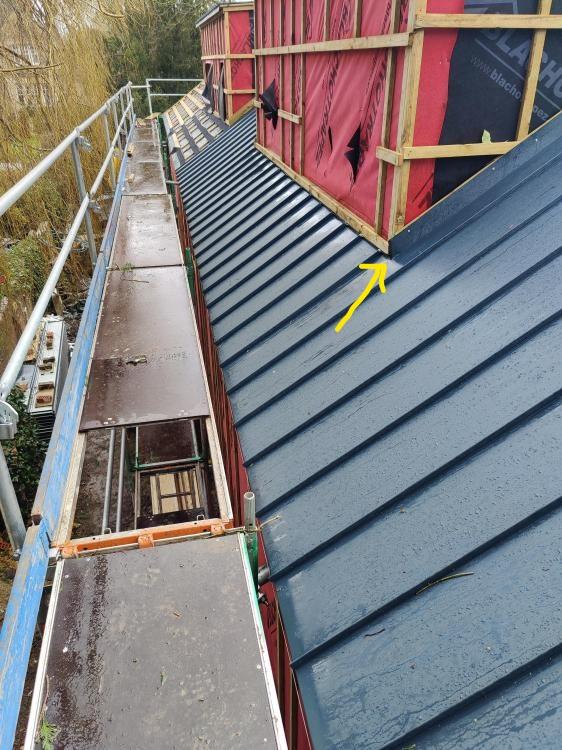
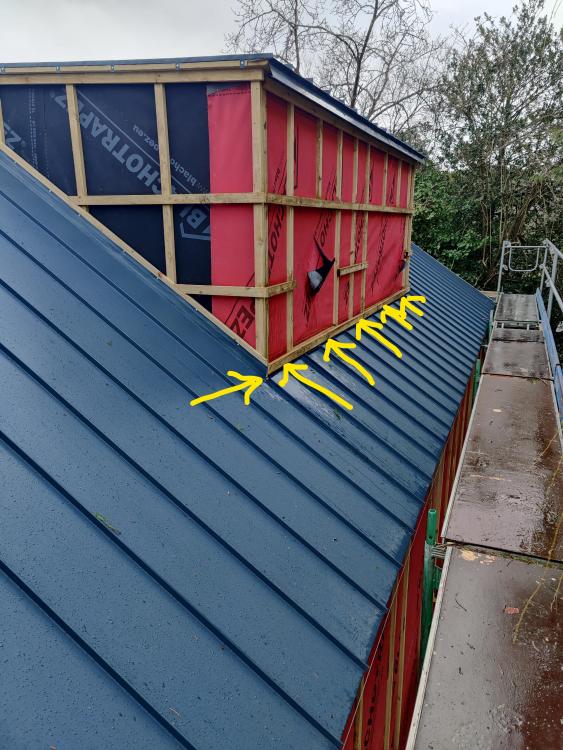
These are the areas I was referring to, especially the external corner, but the upstands at the junction between the roof and the bottom of the dormer are too low .