


SimonD
-
Posts
2215 -
Joined
-
Last visited
-
Days Won
13
Everything posted by SimonD
-
Just to add to this thread that it isn't just the rise + going and angle of the stairs but also the rise + going relationship that matters. This relationship is defined as 2R + G (R = Rise, G = Going) which needs to be between 550 - 700. Edit: @jack kind of just got in there first I've noticed! If you're making the stairs yourself, I'd recommend getting a book on it. This one is pretty good - Simply Stairs: https://www.hive.co.uk/Product/Mark-Milner/Simply-Stairs--The-Definitive-Handbook-for-Stair-Builders/16592144. It has a very helpful chart, plus it's a pretty straightforward task to make up a basic spreadsheet like the attached that I made up to help me build stairs. (it's not annotated so you need to familiarise yourself with the terminology and formulas to make sense of it to know what matters!). Staircase calcs.ods
-
I just took a peak at the details of the UK Ltd company and its filings with Companies House. On that basis alone I wouldn't touch with a barge pole.
-
Just checked, it's up to 4.65m working height
-
I have an extension as some of my ceilings are 3.6m. IIRC it does 4.2meters. I will check.
-
Great idea. BTW I'm an hour away from you and have a board lifter. How soon is soon?
-
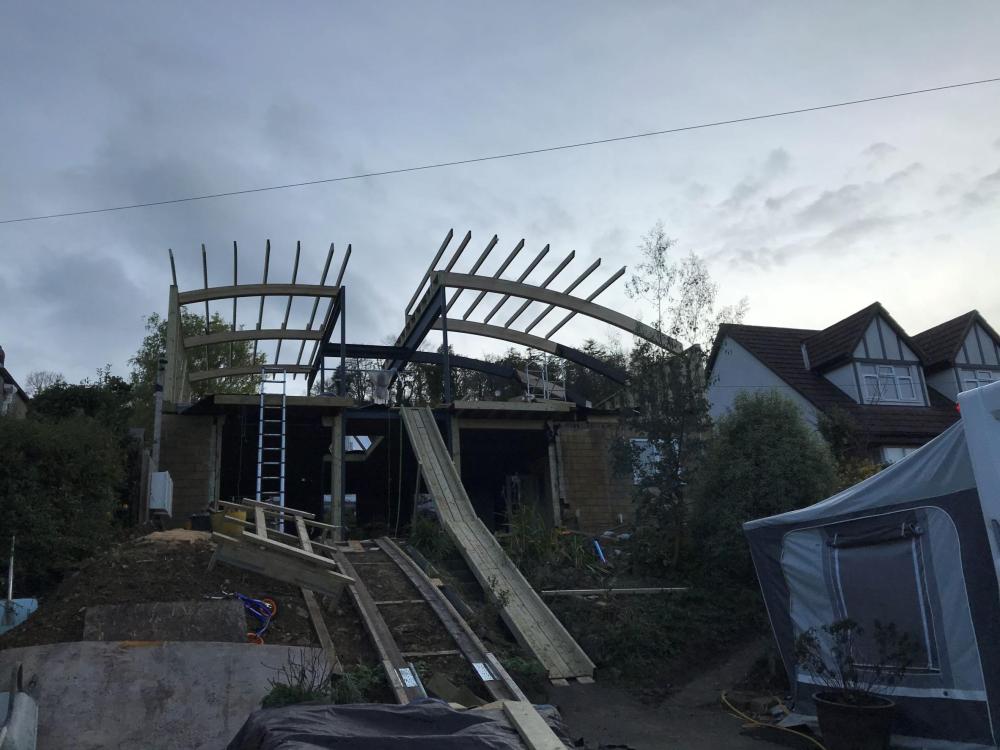
I reckon a ramp and pulley/hoist are your best ideas. It's surprising how only a small angle ramp reduces the effective weight of the material being lifted. Also gives you more control. You could also get some castor wheels and create a dolly for the EPDM roll, or as already suggested load it onto some plywood or OSB to slide along the ground. All my materials went up that way including the glulam beams either on my own or with one person helping. I bought a hoist that had enough cable to reach to the bottom of the driveway so could pull materials up from the roadside. It looks a bit weird and unconventional, but it worked and saved a shed load compared to hiring in lifting machinery.
-
Yes it does. However, there are now several lime products to go on woodfibre IWI, for example, that are very easy to apply, so much so that a typical plasterer will find it easy, possibly easier, to work with than gypsum - nicely workable and long set time. An example is Lime Green Solo as part of the IWI system - https://www.lime-green.co.uk/warmshell/warmshell-interior. Baumit also sell products well regarded in this area. This piece does highlight that local climate is very important, and that driving rain can have a significant effect on the performance of the wall. You're going to find variations in suggested buildups. I would personally like to see an update of this as it's from 2010. The Bristolians guide to insulation suggest 0.60. https://sdfoundation.org.uk/wp-content/uploads/2018/01/2015_bristolsolidwallinsulationguidance.pdf. There are lots of other links in some recent posts that go into a lot more detail about approaches to IWI.
-
You've got to be a bit careful with reading these documents as the reference note in paragraph 48 points to this: You really need someone who can run it through a proper analysis like with WUFI before arriving at a buildup for yourself. You still have the challenge of how to create and maintain a fully sealed and effective vapour control layer throughout the building if using PIR. The detailing thus being imperative. I personally don't understand the popularity of PIR in these circumstances because of the detailing and added risks, particularly when you have a preferred option of moisture open solutions available to you. The alternatives will not only reduce your risks but also tend to provide a nicer indoor air environment because of their breathability. This can in turn reduce the demands on additional ventilation requirements.
-
How does your builder propose to deal with the thermal bridging at those partition walls? I would want everything inside the thermal envelope, especially with ufh.
-
It'll depend on your budget really. Expect to pay about £500 for an entry level airless sprayer, but the ones the trades use are typically a lot more then that. The typical brands are Graco and Wagner. I have a more budget air sprayer by Wagner, which is the W690 Flexio and that has been fine. It takes a few minutes to get the settings right for the paint being used. After that it'll do a typical bedroom in 20 minutes odd plus refills. Cleaning is a doddle, takes a few minutes, is easier and quicker than cleaning up paint brushes & rollers. You can use a paint filter/strainer to filter paints if they're likely to have flakes/lumps, but if using a fresh tin, just mix properly with a paddle and maybe a little watering down - the sprayer comes with a measuring stick to water down by specific percentages. I'm very happy with it so far, the worst bit being the taping up and covering everything before pulling the trigger. The masking tape with plastic sheeting attached is a blessing here.
-
Best practise guidance now recommends against using moisture closed insulation systems on retrofit iwi. Where it is used, a ventilated cavity is recommended. If you're going to below u-value of 0.30 then you have to have a good look at cold bridging, not just interstitial condensation and moisture. If you were to go with a moisture open insulation you can fix this directly to the wall, not worry about your vcl, just air barrier. Government guidance here: https://assets.publishing.service.gov.uk/government/uploads/system/uploads/attachment_data/file/1019707/iwi-guidance.pdf
-
Best model acoustic insulation for studs and joists?
SimonD replied to ashthekid's topic in Sound Insulation
I've dug out the report @ADLIan refers to above. The link https://www.jhbrandt.net/wp-content/uploads/2014/11/ir761.pdf I'll leave you to nerd out and make your own minds up about the various components as you may see it is not all entirely intuitive. -
Best model acoustic insulation for studs and joists?
SimonD replied to ashthekid's topic in Sound Insulation
I posted these up a little while ago giving absorption coefficients for Rockwool and Knauf acoustic insulations: https://forum.buildhub.org.uk/applications/core/interface/file/attachment.php?id=53703&key=6933e2a133c40aea7af458dc3a9054d0 https://forum.buildhub.org.uk/applications/core/interface/file/attachment.php?id=53702&key=0a4d463e77ddae0b111dc91878cb0bbe As you'll see, 50mm isn't great, better to go for 75 or 100mm in your stud wall. Having a small airgap in there is a good idea. And also as per @ADLIan the insulation only plays part of the role, it's the whole buildup that makes it work. -
Are any energy companies taking on new customers?
SimonD replied to jayc89's topic in General Self Build & DIY Discussion
Unless you're on an exempt green tariff which is not capped. We're on such a tariff which is now become incredibly painful abnd way above the capped rate. I've looked at alternative suppliers and it seems to be a case of phoning around and speaking to the companies as they won't quote online. -
FWIW I've used 18mm osb on my non-loadbearing stud walls to line my utility room as I'm going to be hanging lots of stuff on the walls. Upstairs I've used a load of 11mm osb to line the stud wall in the study/guestroom again to help with fixing and hanging things. I had it all left over from building the roof and tf so though I may as well use it and it does reinforce the plasterboard nicely for fixing.
-
Only yesterday was I reading an article in the Guardian about the cost of house renovation and extension and how you can maximise your return on investment. Sadly, there was absolutely no mention of energy performance but singled the biggest benefit being to do the bathrooms and kitchens. I wonder how long it's going to take for the priorities to change in light of this huge bump in prices? I have to say though, I abhor the focus on economic payback associated with energy performance upgrades when they actually add so much value to day to day comfort and pleasure which makes the house a much nicer place to live. I'd much prefer a basic plain kitchen and bathroom and a warm and cosy house. When will the penny drop not just for the population but the government too, I wonder?
-
Where is the kWh price heading in 2022?
SimonD replied to epsilonGreedy's topic in General Self Build & DIY Discussion
Was it one of those place that had to be escaped in youth? -
Farrow and Ball paint: is it that much better?
SimonD replied to ToughButterCup's topic in Decorating
Interesting your experience here. We did our last place up with F & B in its entirety and can't say we were bowled over by the quality or finish. We used what was Ecos paints (I think now Lakeland paints?) for the next redecoration and one of the colours caused us a mega headache due to inconsistent pigmentation - it was so bad that when mixing the different pots, it went a completely different colour which looked really weird. Then when we had our two boys I used the trade Dulux diamond hardwearing whatever stuff that put up no resistance at all to the boys' tendencies to drive their hotwheels along the walls, especially when going up the stairs. This time I'm trying Auro clay paint, the white tester of which I've had on a wall and occasionally rubbed my dirty building hands over it, left it for a while and then wiped off. I've been surprisingly re-assured with this so far I'm going to let the boys loose on a test wall. Pigments are realy nice in these paints too. -
The good old history of the building. I found a mixture of newspaper from 1927, the 1960s and the 1980s when pulling our place down. I wondered whether the builders had found the earlier stuff and thought that's how it's done and just copied it down the line.
-
Where is the kWh price heading in 2022?
SimonD replied to epsilonGreedy's topic in General Self Build & DIY Discussion
Gorgeous location, nice place to be! 🙂 -
Are kitchen extractor designs all rubbish?
SimonD replied to SimonD's topic in Kitchen & Household Appliances
That's really helpful, thanks for that. -
Are kitchen extractor designs all rubbish?
SimonD replied to SimonD's topic in Kitchen & Household Appliances
That looks great @Mr Punter. Neat profile on the hood and simple which is what I'm looking for. Did you have any issues with the internals when you removed the motor, like losing the spigot or other necessary ducting that needed to be fixed? -
Are kitchen extractor designs all rubbish?
SimonD replied to SimonD's topic in Kitchen & Household Appliances
Good to know. Thanks for the heads up on the TD Silent. I have a Vent Axia unit going spare I thought I'd used so I'll check to compare extract data. -
Are kitchen extractor designs all rubbish?
SimonD replied to SimonD's topic in Kitchen & Household Appliances
That's excellent, thanks -
Are kitchen extractor designs all rubbish?
SimonD replied to SimonD's topic in Kitchen & Household Appliances
Yes, it's 29mm deep. I've also found some that's 308mm wide https://www.nationalventilation.co.uk/wp-content/uploads/2020/11/Monsoon-Rectangular-Ducting-308mm-x-29mm-Duct-Accessories.pdf Okay so I haven't completely lost it. That sounds very similar where I'd planned on using the corner in the kitchen base units to house the fan as I've ditched the idea of a corner cabinet to have some services in there instead.



