


Carrerahill
-
Posts
2122 -
Joined
-
Last visited
-
Days Won
10
Everything posted by Carrerahill
-
Plenty of options given to you above, my input: If fitting a new joist is not possible - i.e. ceiling attached beneath etc. then you need to make do and improve what is there. I make up OSB or plywood laminate joists in these situations. Glue some 18mm ply in 2400mm strips along the joist, then sister it up with another one, glue it all, drill and coachbolt it all together. Solid as a rock and stronger than timber only. I have also used flitch beams. I get steel laser or water jet cut from a local place and they are not expensive. Even a 3mm mild steel plate sandwiched in between two timbers and coach bolted is seriously strong - 5mm is best, however it really depends on dead-load and expected live loads.
-
Perhaps... but in all honesty it is not something really worth doing as I click on an icon, up comes a list by code or by standard name, click on that then I am in.
-
Yeah, we used to have that, I think my 17th edition PDF is watermarked with my name. I can't remember the reason but the IT guy thought this was better as we got access to some thing we can use on our phones/tablets etc. but none of us use it. When it comes to renewal I will actually bother to sit down with him and see our options are later this year.
-
Does someone know how to do calcs? My local merchant stocks Quinn Therm - I'd like to see what I need to use of their products to get the same value.
-
No, there is no min value spec'ed just the makeup. I shall have a look at this now then - thanks.
-
I have just tonight managed to get hold of a datasheet for the old FR5000 range, the FR5150 (I think was the code for 150mm stuff) was: 0.024 W/mK 1.10 m^2 K/W 0.14 W/m^2K
-
We don't get a digital copy, it's all via a portal thing - it's fairly seamless but you must be connected to the internet for it to work. Once in you can view the full doc from a sort of digital menu - you cannot select or copy text from it - which is a pig when you want to quote reg's directly into reports or specs. We ahem, did think, yes just think, about trying to make offline digital copies so that we could have the most commonly used stuff at our fingertips but you need to basically screenshot each page, save as a PDF then use a character recognition program to convert to usable text document you can copy and paste from. It took IT about 3 hours to make us up a 10 page PDF with some electrical and fire reg stuff which we use a lot! We decided our attempts were futile. The thing is, it is quite clear in our subscription that we may publish excerpts not exceeding something like 2 full consecutive sections and a max of 4 in a single report, document or set of documents constituting a package of information for the uses of reference, specification, arbitration etc. So I am within my subscription contract rights to for example copy the whole of section 411 (protection against shock) into a report on the suitability of a structure's grounding or something equally relevant. If I need to reference anything I just work from a paper copy about 98% of the time, I keep a paper copy of BS7176 and BS5839 in my laptop bag.
-
Anyone used online 3D printing services
Carrerahill replied to Gone West's topic in Tools & Equipment
I like it! -
Well... Not for the regs no, it is totally ridiculous that British regulatory material isn't free - if they want to write regs and have people adhere to them they ought to be available to all F.O.C. on a government website. I spend £1000's a year on subscriptions to places such as BSOL/BSI for access to British Sandards docs etc. and have paper copies in our office. I don't know the source of the version I pasted above because I had it saved into a text file from a post from DIYnot when someone asked for details on cable routes. It's very handy to have those sections at the ready for the very situation that arose above. Interestingly, British Law is available to all on a government site.
-
1 or 2 extract points in kitchen?
Carrerahill replied to j_s's topic in Mechanical Ventilation with Heat Recovery (MVHR)
Anyone who is willing to show me! So yes, you if you could! I want a fairly simple system just to improve the air quality in our house and let us ventilate year round without needing windows open. -
Anyone used online 3D printing services
Carrerahill replied to Gone West's topic in Tools & Equipment
I'd mill that in aluminium. Not difficult, a small independent machine shop or a hobbiest with a mill would do that for a few beer tokens and the price of the ali. It would look good anodised but painted would work. -
1 or 2 extract points in kitchen?
Carrerahill replied to j_s's topic in Mechanical Ventilation with Heat Recovery (MVHR)
I'd like to see what you have bought and are installing - I want to put a system into our extension (which will have the kitchen) and connect in some of the downstairs rooms. -
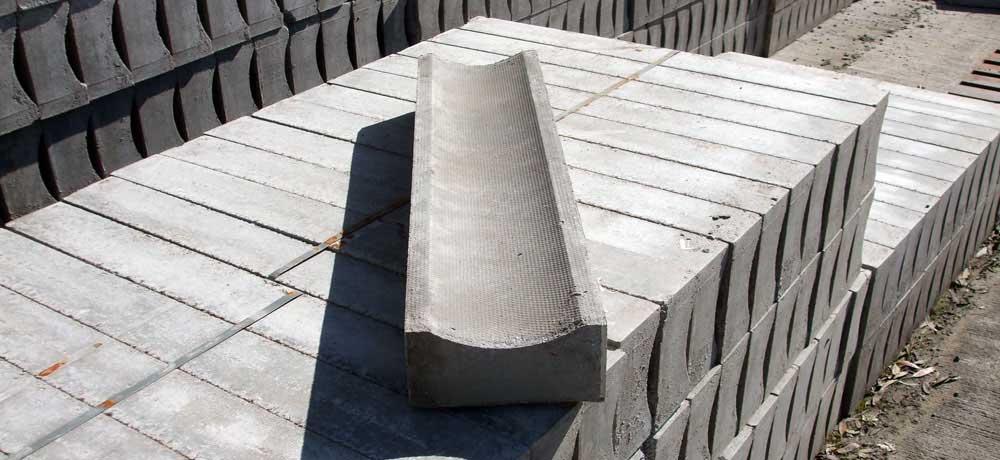
Something like this, but you could pour it in concrete and form it yourself. It is a simple channel drain - at the end of it if it won't naturally continue to run away then fit a gully and pipe it to where it needs to go. I was going to lay channel drains and all sorts for my garage but I thought about it and decided that it will likely fill with stones from the drive and end up full of sawdust and rust from my projects I do in the garage. I also liked the idea of being able to roll the car tyre (rolling chassis of project cars) into it and it would stay put. I am going to pour mine as I like making concrete, any excuse to get the mixer out and make a batch of concrete and I am there!
-
I'd probably lift the channel, cut around a 400mm strip along the whole front and put in 100mm concrete, then form a gully into it (I use a piece of gutter and slide it along) you then have a surface water run off that can be easily swept and cleaned over and a few stones won't block it. Alternatively lift the channel and fit a proper big commercial channel and run it to a proper drain - the drain it eventually runs into, is that public highway or in someone elses property? What sort of sewage system are you on? Septic or mains? If mains you could tie into that if there was a drain line handy - I would make sure to put in at the very least a trap but better a sump as it looks like that road will be prone to muck and gravel and what no wanting to block your drains.
-
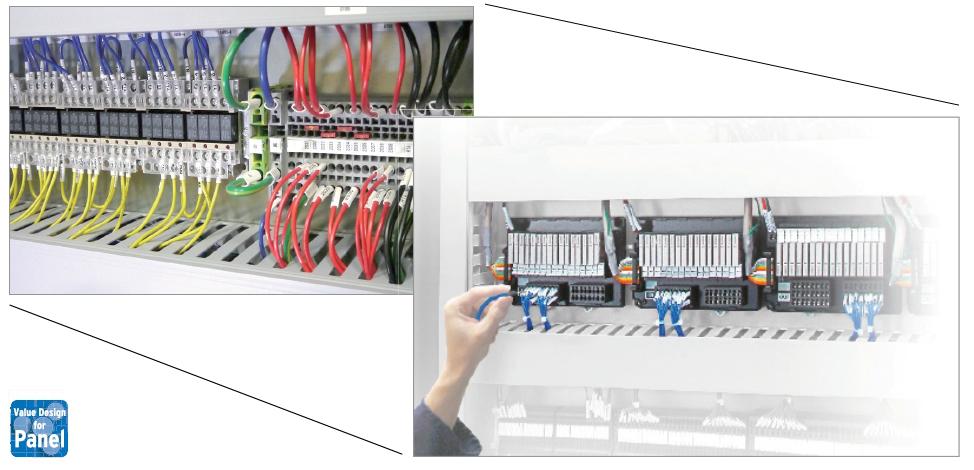
If you were going to that qty I would spec up an enclosure with DIN rail(s) and use Din rail mount terminals to make a really neat and easily inspected and tested panel. https://uk.rs-online.com/web/p/non-fused-din-rail-terminals/5076535/
-
Firestop! where does it go in a timber framed house?
Carrerahill replied to Triassic's topic in Building Regulations
From building guide: "Firestops to be installed in cavity around all apertures, at wall head, corners and at centres not exceeding 10m in runs of wall" -
Basically, you need to record shed loads of footage ideally from the exact same location with same zoom and focus so when all joined up it doesn't jump about too much. Either have a camera stationed permanently with a feed out to a remote storage location so you can save up the Tb's of data without needing to swap cards all the time, the other option is to have a solid post mounted (4x4 fence post concreted in would work with the mount on the top) then have some marks to line it all up each day.
-
It does not satisfy BS7671 (the wiring regs) but it is not illegal - the police will not be making arrests, there are very very few things that do not comply with regs that would be considered illegal. You have many options here - this is just a summer house feed - I assume not part of building works or anything, in which case you just want to make it safe. Undo it, route it through conduit, clip conduit to fence, re-connect. Replace with SWA Dig a trench and bury SWA. Here are the sections which pertain to your situation: 512.2 External influences 512.2.1 Equipment shall be of a design appropriate to the situation in which it is to be used or its mode of installation shall take account of the conditions likely to be encountered. 512.2.2 If the equipment does not, by its construction, have the characteristics relevant to the external influences of its location, it may nevertheless be used on condition that it is provided with appropriate additional protection in the erection of the installation. Such protection shall not adversely affect the operation of the equipment thus protected. 512.2.3 Where different external influences occur simultaneously, they may have independent or mutual effects and the degree of protection shall be provided accordingly. 512.2.4 The selection of equipment according to external influences is necessary not only for proper functioning, but also for the reliability of the measures of protection for safety complying with these Regulations generally. Measures of protection afforded by the construction of equipment are valid only for the given conditions of external influence if the corresponding equipment specification tests are made in these conditions of external influence. 522 SELECTION AND ERECTION OF WIRING SYSTEMS IN RELATION TO EXTERNAL INFLUENCES The installation method selected shall be such that protection against the expected external influences is provided in all appropriate parts of the wiring system. Particular care shall be taken at changes in direction and where wiring enters into equipment. NOTE: The external influences categorised in Appendix 5 which are of significance to wiring systems are included in this section. 522.1 Ambient temperature (AA) 522.1.1 A wiring system shall be selected and erected so as to be suitable for the highest and lowest local ambient temperatures and so that the limiting temperature in normal operation (see Table 52.1) and the limiting temperature in case of a fault (see Table 43.1) will not be exceeded. 522.1.2 Wiring system components, including cables and wiring accessories, shall only be installed or handled at temperatures within the limits stated in the relevant product specification or as given by the manufacturer. 522.2 External heat sources 522.2.1 In order to avoid the effects of heat from external sources, one or more of the following methods or an equally effective method shall be used to protect a wiring system: (i) Shielding (ii) Placing sufficiently far from the source of heat (iii) Selecting a system with due regard for the additional temperature rise which may occur (iv) Local reinforcement or substitution of insulating material. NOTE: Heat from external sources may be radiated, conducted or convected, e.g.: - from hot water systems - from plant, appliances and luminaires - from a manufacturing process - through heat conducting materials - from solar gain of the wiring system or its surrounding medium. 522.2.201 Parts of a cable within an accessory, appliance or luminaire shall be suitable for the temperatures likely to be encountered, as determined in accordance with Regulation 522.1.1, or shall be provided with additional insulation suitable for those temperatures. 522.3 Presence of water (AD) or high humidity (AB) 522.3.1 A wiring system shall be selected and erected so that no damage is caused by condensation or ingress of water during installation, use and maintenance. The completed wiring system shall comply with the IP degree of protection (see BS EN 60529) relevant to the particular location. NOTE: Special considerations apply to wiring systems liable to frequent splashing, immersion or submersion. 522.3.2 Where water may collect or condensation may form in a wiring system, provision shall be made for its escape. 522.3.3 Where a wiring system may be subjected to waves (AD6), protection against mechanical damage shall be afforded by one or more of the methods of Regulations 522.6 to 8. 139 522.4 Presence of solid foreign bodies (AE) 522.4.1 A wiring system shall be selected and erected so as to minimise the danger arising from the ingress of solid foreign bodies. The completed wiring system shall comply with the IP degree of protection (see BS EN 60529) relevant to the particular location. 522.4.2 In a location where dust in significant quantity is present (AE4), additional precautions shall be taken to prevent the accumulation of dust or other substances in quantities which could adversely affect heat dissipation from the wiring system. NOTE: A wiring system which facilitates the removal of dust may be necessary (see Section 529). 522.5 Presence of corrosive or polluting substances (AF) 522.5.1 Where the presence of corrosive or polluting substances, including water, is likely to give rise to corrosion or deterioration, parts of the wiring system likely to be affected shall be suitably protected or manufactured from a material resistant to such substances. NOTE: Suitable protection for application during erection may include protective tapes, paints or grease. 522.5.2 Dissimilar metals liable to initiate electrolytic action shall not be placed in contact with each other, unless special arrangements are made to avoid the consequences of such contact. 522.5.3 Materials liable to cause mutual or individual deterioration or hazardous degradation shall not be placed in contact with each other. 522.6 Impact (AG) 522.6.1 Wiring systems shall be selected and erected so as to minimise the damage arising from mechanical stress, e.g. by impact, abrasion, penetration, tension or compression during installation, use or maintenance. 522.6.2 In a fixed installation where impacts of medium severity (AG2) or high severity (AG3) can occur protection shall be afforded by: (i) the mechanical characteristics of the wiring system, or (ii) the location selected, or (iii) the provision of additional local or general protection against mechanical damage, or (iv) any combination of the above. NOTE: Examples are areas where the floor is likely to be penetrated and areas used by forklift trucks. 522.6.3 Not used 522.6.4 The degree of protection of electrical equipment shall be maintained after installation of the cables and conductors. 522.6.201 A cable installed under a floor or above a ceiling shall be run in such a position that it is not liable to be damaged by contact with the floor or ceiling or their fixings. A cable passing through a joist within a floor or ceiling construction or through a ceiling support (e.g. under floorboards), shall: (i) be installed at least 50 mm measured vertically from the top, or bottom as appropriate, of the joist or batten, or (ii) comply with Regulation 522.6.204. 522.6.202 A cable installed in a wall or partition at a depth of less than 50 mm from a surface of the wall or partition shall: (i) be installed in a zone within 150 mm from the top of the wall or partition or within 150 mm of an angle formed by two adjoining walls or partitions. Where the cable is connected to a point, accessory or switchgear on any surface of the wall or partition, the cable may be installed in a zone either horizontally or vertically, to the point, accessory or switchgear. Where the location of the accessory, point or switchgear can be determined from the reverse side, a zone formed on one side of a wall of 100 mm thickness or less or partition of 100 mm thickness or less extends to the reverse side, or (ii) comply with Regulation 522.6.204. Where indent (i) but not indent (ii) applies, the cable shall be provided with additional protection by means of an RCD having the characteristics specified in Regulation 415.1.1. 140 522.6.203 Irrespective of its buried depth, a cable concealed in a wall or partition, the internal construction of which includes metallic parts, other than metallic fixings such as nails, screws and the like, shall: (i) be provided with additional protection by means of an RCD having the characteristics specified in Regulation 415.1.1, or (ii) comply with Regulation 522.6.204. For a cable installed at a depth of less than 50 mm from the surface of a wall or partition the requirements of Regulation 522.6.202(i) shall also apply. 522.6.204 For the purposes of Regulation 522.6.201(ii), Regulation 522.6.202(ii) and Regulation 522.6.203(ii), a cable shall: (i) incorporate an earthed metallic covering which complies with the requirements of these Regulations for a protective conductor of the circuit concerned, the cable complying with BS 5467, BS 6724, BS 7846, BS 8436 or BS EN 60702-1, or (ii) be installed in earthed conduit complying with BS EN 61386-21 and satisfying the requirements of these Regulations for a protective conductor, or (iii) be enclosed in earthed trunking or ducting complying with BS EN 50085-2-1 and satisfying the requirements of these Regulations for a protective conductor, or (iv) be provided with mechanical protection against damage sufficient to prevent penetration of the cable by nails, screws and the like, or (v) form part of a SELV or PELV circuit meeting the requirements of Regulation 414.4. 522.7 Vibration (AH) 522.7.1 A wiring system supported by or fixed to a structure or equipment subject to vibration of medium severity (AH2) or high severity (AH3) shall be suitable for such conditions, particularly where cables and cable connections are concerned. 522.7.2 For the fixed installation of suspended current-using equipment, e.g. luminaries, connection shall be made by cable with flexible cores. Where no vibration or movement can be expected, cable with non-flexible cores may be used. 522.8 Other mechanical stresses (AJ) 522.8.1 A wiring system shall be selected and erected to avoid during installation, use or maintenance, damage to the sheath or insulation of cables and their terminations. The use of any lubricants that can have a detrimental effect on the cable or wiring system are not permitted. 522.8.2 Where buried in the structure, a conduit system or cable ducting system, other than a pre-wired conduit assembly specifically designed for the installation, shall be completely erected between access points before any cable is drawn in. 522.8.3 The radius of every bend in a wiring system shall be such that conductors or cables do not suffer damage and terminations are not stressed. 522.8.4 Where conductors or cables are not supported continuously due to the method of installation, they shall be supported by suitable means at appropriate intervals in such a manner that the conductors or cables do not suffer damage by their own weight. 522.8.5 Every cable or conductor shall be supported in such a way that it is not exposed to undue mechanical strain and so that there is no appreciable mechanical strain on the terminations of the conductors, account being taken of mechanical strain imposed by the supported weight of the cable or conductor itself. NOTE: Consumer unit meter tails are included in the requirements of this regulation. 522.8.6 A wiring system intended for the drawing in or out of conductors or cables shall have adequate means of access to allow this operation. 522.8.7 A wiring system buried in a floor shall be sufficiently protected to prevent damage caused by the intended use of the floor. 522.8.8 Not used 522.8.9 Not used 141 522.8.10 Except where installed in a conduit or duct which provides equivalent protection against mechanical damage, a cable buried in the ground shall incorporate an earthed armour or metal sheath or both, suitable for use as a protective conductor. The location of buried cables shall be marked by cable covers or a suitable marker tape. Buried conduits and ducts shall be suitably identified. Buried cables, conduits and ducts shall be at a sufficient depth to avoid being damaged by any reasonably foreseeable disturbance of the ground. NOTE: BS EN 61386-24 is the standard for underground conduits. 522.8.11 Cable supports and enclosures shall not have sharp edges liable to damage the wiring system. 522.8.12 A cable or conductors shall not be damaged by the means of fixing. 522.8.13 Cables, bus-bars and other electrical conductors which pass across expansion joints shall be so selected or erected that anticipated movement does not cause damage to the electrical equipment. 522.8.14 No wiring system shall penetrate an element of building construction which is intended to be load bearing unless the integrity of the load-bearing element can be assured after such penetration. 522.9Presenceofforaand/ormouldgrowth(AK) 522.9.1 Where the conditions experienced or expected constitute a hazard (AK2), the wiring system shall be selected accordingly or special protective measures shall be adopted. NOTE 1: An installation method which facilitates the removal of such growths may be necessary (see Section 529). NOTE 2: Possible preventive measures are closed types of installation (conduit or channel), maintaining distances to plants and regular cleaning of the relevant wiring system. 522.10 Presence of fauna (AL) 522.10.1 Where conditions experienced or expected constitute a hazard (AL2), the wiring system shall be selected accordingly or special protective measures shall be adopted, for example, by: (i) the mechanical characteristics of the wiring system, or (ii) the location selected, or (iii) the provision of additional local or general protection against mechanical damage, or (iv) any combination of the above. 522.11 Solar radiation (AN) and ultraviolet radiation 522.11.1 Where significant solar radiation (AN2) or ultraviolet radiation is experienced or expected, a wiring system suitable for the conditions shall be selected and erected or adequate shielding shall be provided. Special precautions may need to be taken for equipment subject to ionising radiation. NOTE: See also Regulation 522.2.1 dealing with temperature rise. 522.12 Seismic effects (AP) 522.12.1 The wiring system shall be selected and erected with due regard to the seismic hazards of the location of the installation. 522.12.2 Where the seismic hazards experienced are low severity (AP2) or higher, particular attention shall be paid to the following: (i) The fixing of wiring systems to the building structure (ii) The connections between the fixed wiring and all items of essential equipment, e.g. safety services, shall be selected for their flexible quality. 522.13 Movement of air (AR) 522.13.1 See Regulation 522.7, Vibration (AH), and Regulation 522.8, Other mechanical stresses (AJ). 522.14 Nature of processed or stored materials (BE) 522.14.1 See Section 527, Selection and erection of wiring systems to minimise the spread of fre and Section 422, Precautions where particular risks of fre exist. 522.15 Building design (CB) 522.15.1 Where risks due to structural movement exist (CB3), the cable support and protection system employed shall be capable of permitting relative movement so that conductors and cables are not subjected to excessive mechanical stress. 142 522.15.2 For a flexible structure or a structure intended to move (CB4), a flexible wiring system shall be used.
-
Can you hit a nail on the head?
-
Looks like you are in London... everything is overpriced in that quaint little tourist trap! The OP is in Aberdeen, I gave him a price local to him and for the scenario he describes - he is going to be attracting local firms who do this type of work - this isn't a main contractor on a commercial build. I have personally never paid more than £1 a block laid (less for brick) and had 10,000's of blocks laid; in our consultancy practice our QS library uses that as the accepted rate from North of England up for private dwelling builds and other small projects. So they can and do go jump when they ask for £2 a brick. The labour shortage down south has simply driven prices up. Everyone will get paid more in London and the surrounding area - I suppose you need to pay people more to keep them there!
-
I don't know, the package only contained the drawing and that was it! I'll see what Celotex say.
-
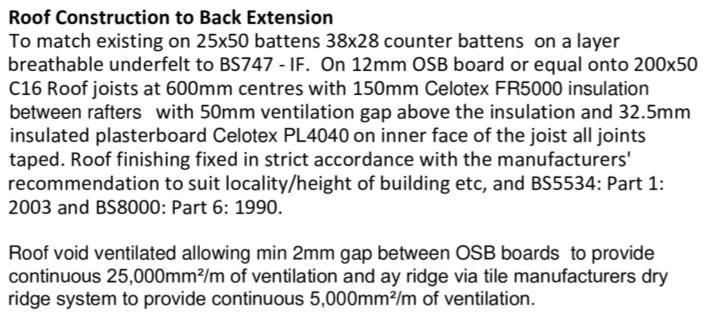
This is what by approved BC drawing says (it's a bad copy and paste by my original architect!) Issues with this are: 1.You cannot get FR5000 anymore or an equivalent; if the 3-4 places I have called today are correct and one girl in particular knew her onions so I don't disbelieve this. 2. PL4040 is 52.5mm as the 40 means it's 40mm PIR then a 12.5mm PB - so I could play this to my advantage and go with a PL4025 and still come out thicker than 32.5mm. (more on this later). So the first issue is that I cannot get the FR5000 so I need an alternative, now FR5000 had slightly better R value than a standard same thickness counterpart, so it may be that it was spec'ed not because of the fire rating but because it gave a better R value for a given thickness than a standard counterpart. So it was possible in my case to use 150mm to achieve what was needed and leave the 50mm ventilation void - had he spec'ed another product maybe it would have needed to have been 175mm for example. So my thinking is, I get some GA4000 or TP10 or something 150mm thick and put it in between the rafters, then I need a further 20mm of insulation to allow for the 32.5mm insulated plasterboard, so my thinking was a sheet of 25mm Quinn Therm on the underside of the rafters, tape it to act as my vapour barrier then use GTEC fireboard. However, as said above PL4040 is a 52.5mm product, I don't know if he meant PL4040 as in 52.5mm version or he meant 32.5mm and incorrectly spec'ed PL4040 as a product forgetting the second 40 = the thickness of the insulation on the PB. Because that drawing was approved I reckon I could make it fly if I used only 32.5mm and claim I thought PL4040 was just a product a bit like GA4000 is yet you can get it in 25, 50, 100mm etc. This would give me a ceiling construction with better fire properties, mitigates the fact I am not using FR5000 and takes care of the insulation thicknesses - as to the R values here well I am not sure, they may be slightly lower, but as no calc was done, just a written spec of the makeup I wonder if I can make that fly. I have also just discovered my BC officer has left so I need to work out who will look after my case. I am holding off contacting them until I have a new proposal. I have also submitted to Celotex the original spec and asked them to come up with a comparable one using standard products and taking care of the fire rating with fireboard. Just keen to hear what you guys have done on new builds and extensions, I guess as long as the new spec is better than the original BC cannot say anything, but I want to work out the best minimum spec first. I just want to take care here as insulation is an expensive business (single most expensive material in the whole build not including the kitchen!) and I don't want to spend money on materials I end up not being able to use or having to sister up with another product to get to where I need.
-
Sorry, I mis-read your post, I was sure you said 145mm and took it you were using 6*2's. Can you not beef these up a bit? 4x2's are only good for non-supporting stud walls and even at that they are a bit flimsy. With a proper makeup of flooring you are going to struggle to get a good solid tiled floor. What is the distance from your solum to your finished floor height? I think I would be adding some hardcore, sand blinding, DPC, concrete!
-
Stage 1 Is Very Nearly Complete :)
Carrerahill replied to Construction Channel's topic in General Self Build & DIY Discussion
Congratulations! It's going to be brilliant and don't listen to everyone who makes everything sound like it's all just difficult and near impossible - it really isn't - life will brilliant! -
Well indeed, we know now it is a retaining wall - Garden wall! Pfft!

